



No products in the cart.
- Blog
- Grades & specs
- Performance Grade (PG) Bitumen Explained: Matching Binder to Site Climate and Traffic
Performance Grade (PG) Bitumen Explained: Matching Binder to Site Climate and Traffic
Grades & specs

Saniya MirzaBlack Rock Bitumen · Dubai, UAE
4 min read

Table of contents
For highway engineers, road contractors and procurement teams specifying bitumen for major infrastructure projects, performance grading bridges the gap between laboratory testing and real-world field distresses: rutting, fatigue cracking and thermal cracking.
Why Traditional Grading Falls Short
Traditional grading systems, such as Penetration Grading (ASTM D5) and Viscosity Grading (IS 73), rely on tests conducted at fixed temperatures (25°C and 60°C) regardless of where the material will ultimately be laid.
In contrast, the Performance Grade (PG) system, developed under the Strategic Highway Research Program (SHRP) as part of the Superpave (Superior Performing Asphalt Pavements) protocol, grades binders according to actual climatic conditions and expected extreme pavement temperatures at the project site.
Decoding the PG Rating Nomenclature
Performance Grade binders are designated using a two-number rating format: PG H-L, where:
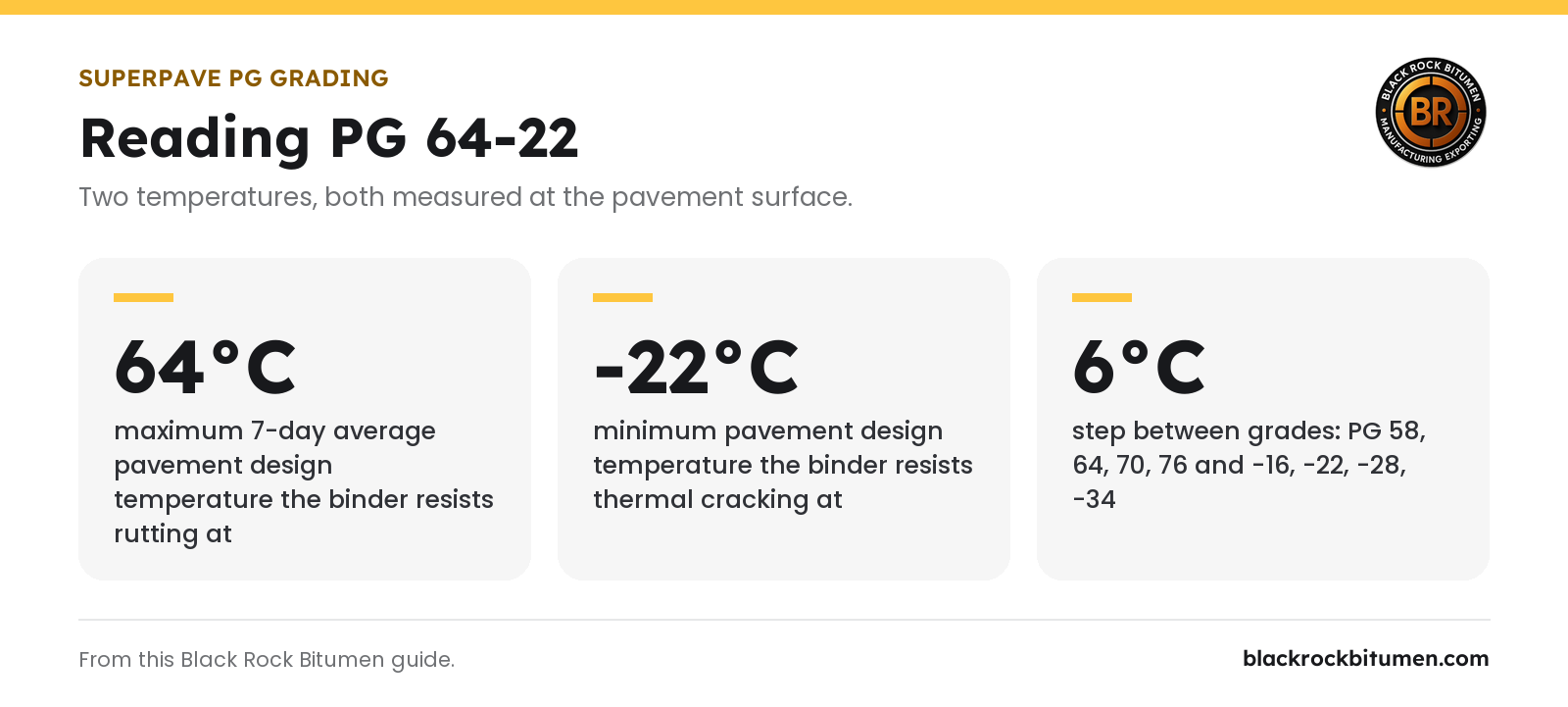
- H (high-temperature rating): the maximum 7-day average pavement design temperature (°C) at which the binder maintains adequate rutting resistance.
- L (low-temperature rating): the minimum expected pavement design temperature (°C) at which the binder resists thermal contraction cracking.
For example, a binder graded as PG 64-22 is engineered to perform reliably on pavements where peak 7-day average surface temperatures reach up to 64°C and minimum winter surface temperatures drop no lower than -22°C.
Both ratings change in increments of 6°C (for example, PG 58, 64, 70 and 76 for high temperatures; -16, -22, -28 and -34 for low temperatures).
The Three Stages of Binder Aging Tested in Superpave
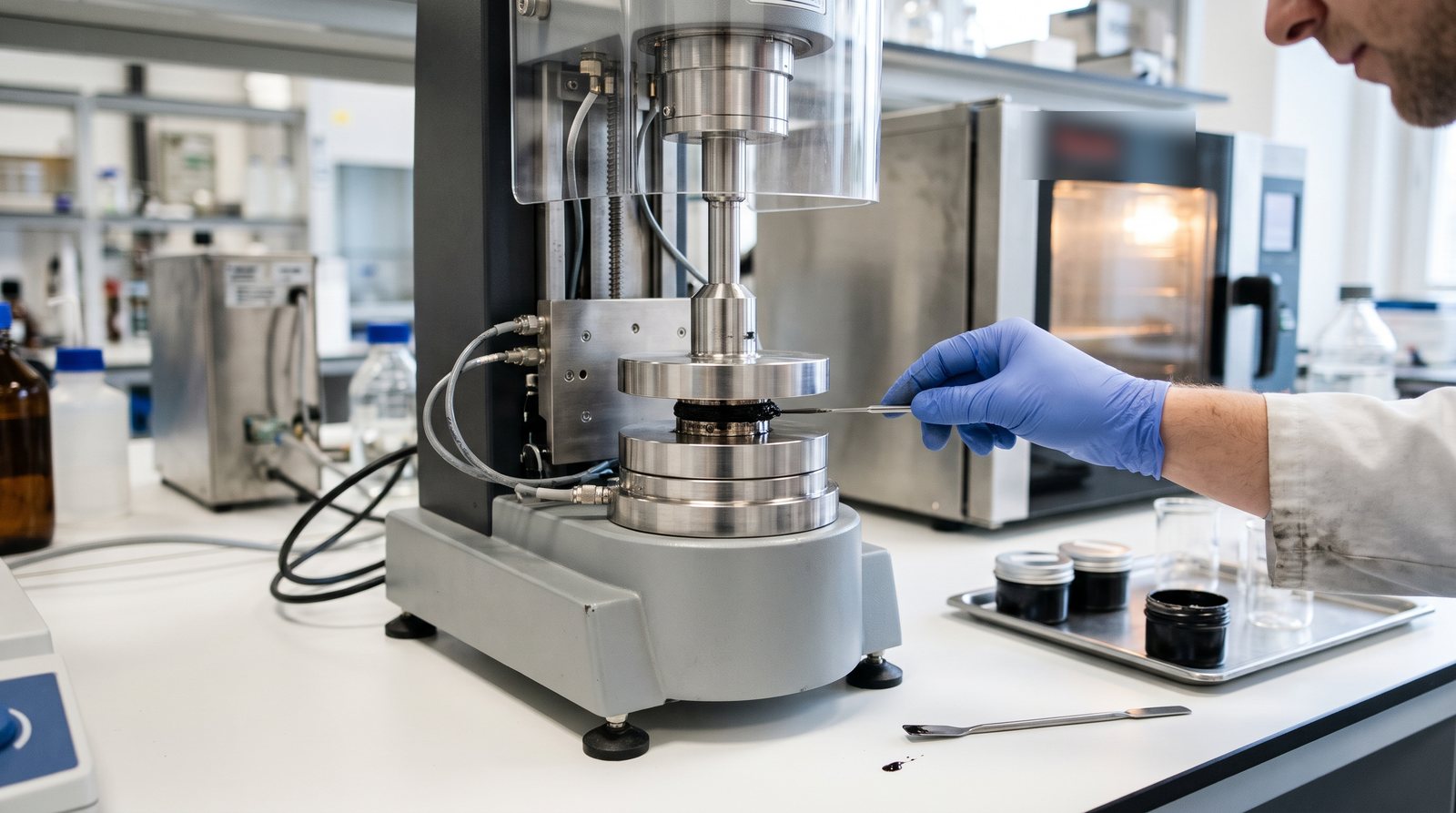
Unlike empirical tests that only evaluate unaged bitumen fresh from the refinery, Superpave testing characterizes physical properties across three distinct lifecycle phases using rheological instruments.
| Lifecycle Phase | Simulation Test Method | Simulates Physical State |
| Original Binder | Fresh sample testing | Tank storage, pumping and initial handling prior to plant mixing |
| Short-Term Aged | Rolling Thin Film Oven (RTFO), AASHTO T 240 | Volatilization and oxidation during plant mixing, transport and laydown |
| Long-Term Aged | Pressure Aging Vessel (PAV), AASHTO R 28 | In-service oxidative aging over 7 to 10 years of pavement life |
The Dynamic Shear Rheometer (DSR) and Bending Beam Rheometer (BBR) then measure physical rheological parameters rather than simple depth penetration or liquid flow times to quantify viscoelastic behavior.
How Superpave Tests Binder Performance
Rutting Resistance at High Temperatures (DSR Testing)
High-temperature performance is evaluated using a Dynamic Shear Rheometer (DSR) on both original and RTFO-aged binders (AASHTO T 315). The DSR measures the complex shear modulus (G*, the total resistance to deformation) and the phase angle (δ, the ratio of viscous to elastic response).
To resist permanent deformation (rutting), the binder must remain stiff and elastic. The rutting parameter is G/sin δ*:
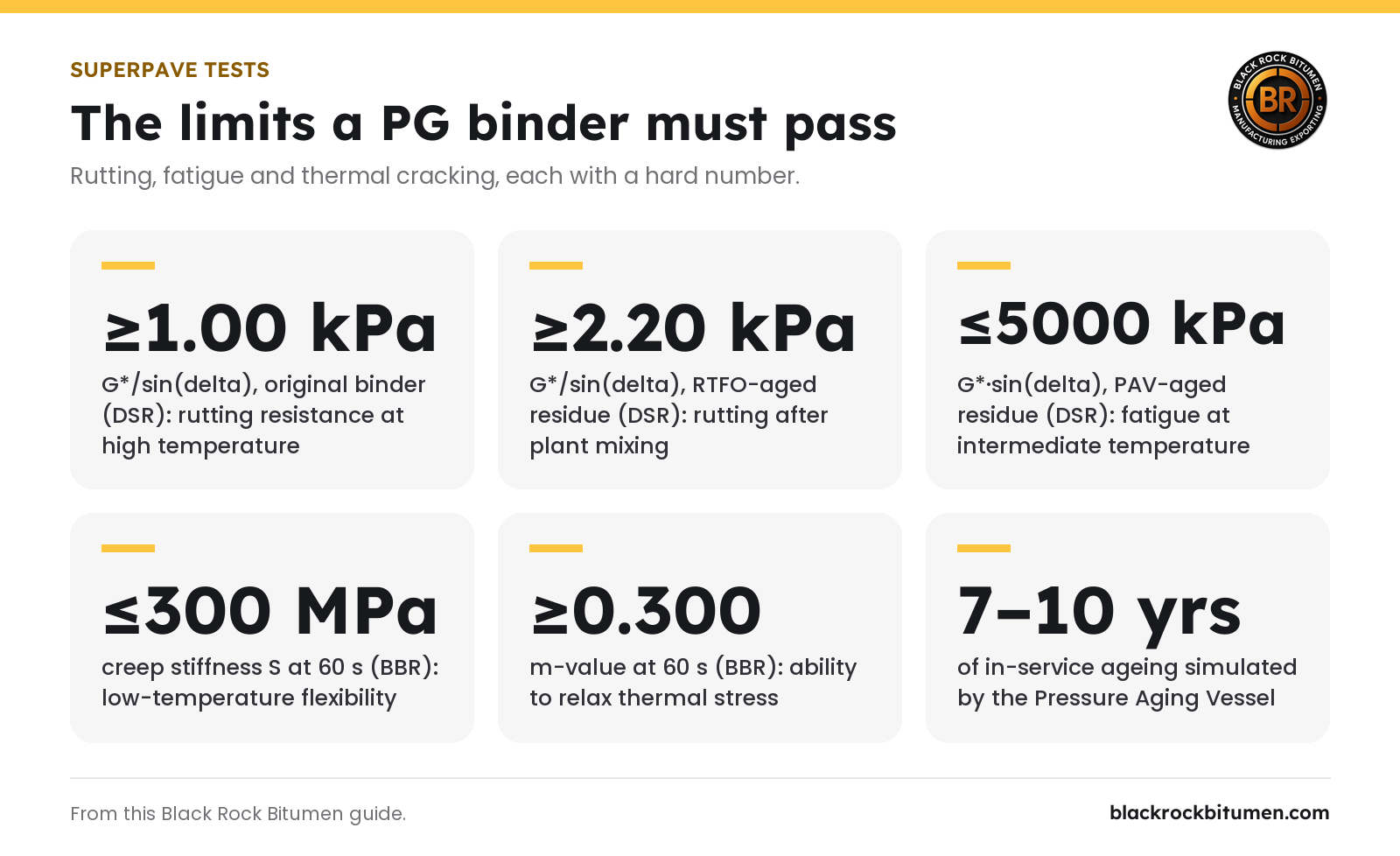
- Original binder: G*/sin δ ≥ 1.00 kPa at the target high design temperature.
- RTFO-aged residue: G*/sin δ ≥ 2.20 kPa at the target high design temperature.
Fatigue Cracking Resistance at Intermediate Temperatures (DSR Testing)
Fatigue cracking occurs after repeated wheel load applications at intermediate pavement temperatures (typically 15°C to 30°C). DSR testing is conducted on PAV-aged samples to measure energy dissipation per cycle.
The fatigue parameter is G · sin δ*. For PAV-aged residue, the requirement is G* · sin δ ≤ 5000 kPa at the intermediate design temperature. Lower values indicate a softer, more flexible binder capable of absorbing cyclic strain without cracking.
Thermal Cracking Resistance at Low Temperatures (BBR and DTT Testing)
In sub-zero conditions, asphalt contracts. If the tensile stress exceeds binder strength, transverse thermal cracking occurs.
Bending Beam Rheometer (BBR), AASHTO T 313 measures low-temperature creep stiffness (S) and the slope of the stiffness curve (m-value) on PAV-aged beam specimens loaded at low temperatures:
- Flexibility requirement: S ≤ 300 MPa at 60 seconds.
- Stress relaxation requirement: m-value ≥ 0.300 at 60 seconds.
Direct Tension Tester (DTT), AASHTO T 314 is used when creep stiffness S falls between 300 and 600 MPa, to measure failure strain (≥ 1.0%).
Traffic Speed and Loading Adjustments (“Grade Bumping”)
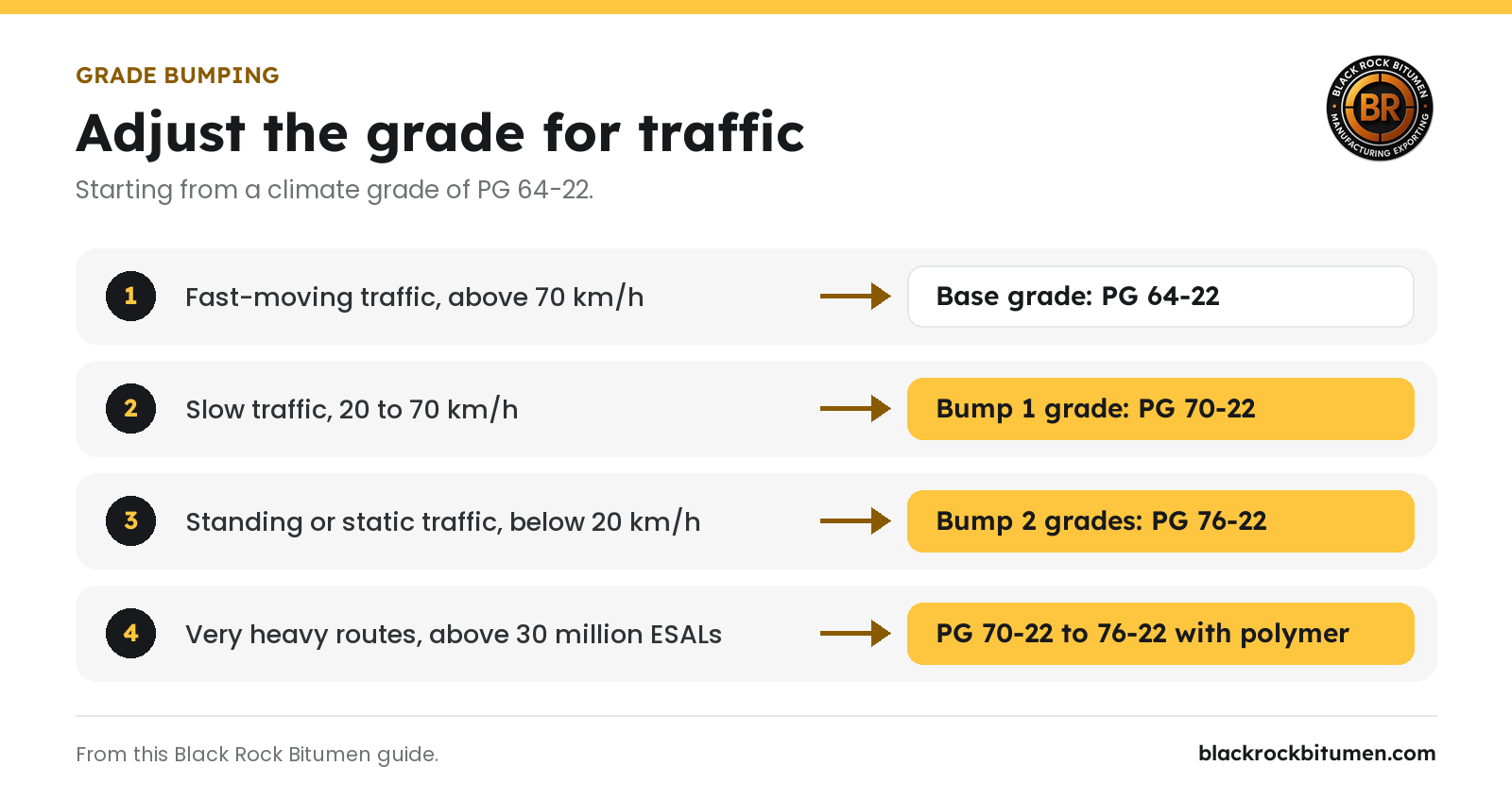
When a project site experiences heavy, slow-moving or static loads, standard climatic grade selection must be modified. Because bitumen is viscoelastic, longer loading times produce more viscous flow.
| Traffic Condition | High-Temperature Adjustment | Example |
| Standard traffic (fast-moving, above 70 km/h) | Base PG grade | PG 64-22 |
| Slow traffic (20 to 70 km/h) | Bump 1 high-temperature grade | PG 70-22 |
| Standing or static traffic (below 20 km/h) | Bump 2 high-temperature grades | PG 76-22 |
| Extremely heavy load routes (above 30 million ESALs) | Bump 1 to 2 grades plus polymer modification | PG 70-22 to PG 76-22 with polymer |
If an urban arterial road in a warm climate requires a base climate rating of PG 64-22 but features a bus rapid transit (BRT) lane or a heavy toll plaza approach, engineers bump the high-temperature grade by one or two levels to PG 70-22 or PG 76-22 (often requiring SBS polymer modification) to handle severe static shear stresses.
PG vs Penetration and Viscosity Grading: Comparison
| Feature | Penetration Grading (ASTM D5) | Viscosity Grading (IS 73) | Performance Grading (AASHTO M 320) |
| Primary basis | Empirical hardness at 25°C | Fundamental viscosity at 60°C | Viscoelastic properties across actual site temperatures |
| Climatic customization | None | Limited | Direct (uses 7-day high and 1-day low surface temperatures) |
| Aging characterization | Unaged binder only | RTFOT residue viscosity | Fresh, short-term (RTFO) and long-term (PAV) |
| Failure modes addressed | None directly | Rutting focus | Rutting, fatigue cracking and thermal cracking |
| Modified binders (PMB) | Poor applicability | Limited suitability | Fully accommodates polymer-modified and rubberized binders |
Procurement Takeaway
The Performance Grade (PG) system shifts binder procurement from empirical guessing to precise environmental engineering. By matching the PG rating to the site, such as PG 76-10 for high-heat, heavy-axle desert routes or PG 58-28 for freeze-thaw mountain corridors, contractors and project owners reduce temperature-induced binder failures and maximize long-term pavement design life.
About the author:
Saniya Mirza
Content Writer, Black Rock Bitumen
Saniya Mirza writes the Black Rock Bitumen guides on bitumen grades, testing, storage, shipping and supply, in plain language for buyers, contractors and engineers.