Here is a number that should focus your attention immediately.
Incorrect or incomplete documentation can result in shipment delays, financial penalties, disputes between parties, or even rejected cargo — translating directly into financial losses and damaged business relationships (Gulf Petro, April 2025).
In a practical bitumen import transaction, the stakes are concrete:
- A discrepant document in an LC (Letter of Credit) can freeze payment until corrected — and banks have only 5 banking days under UCP 600 to examine documents.
- An incorrect HS code can trigger duty reclassification — fines of 10–50% of cargo value and 7–30 day delays (FreightAmigo, 2025).
- A missing MSDS at destination can cause customs to hold petroleum products pending hazardous goods assessment.
- Temperature during transport must stay 150–180°C for bulk bitumen — customs delays that extend port waiting time directly degrade product quality.
The UAE’s digital customs infrastructure adds another layer: from January 2025, the UAE mandates the 12-digit GCC Integrated Customs Tariff for all import and export declarations, replacing older 6 or 8-digit codes (Kayroux & Associates, January 2026). Getting this right upfront costs nothing. Getting it wrong costs demurrage fees that can run $1,000–$5,000 per day for a bulk cargo vessel.
20
Total documents you may need across the full import cycle.
Source: This Guide
5 Days
Max time banks have to check LC documents under UCP 600.
Source: ICC UCP 600
12-Digit
HS Code now mandatory in UAE from January 2025.
Source: Kayroux, 2026
1–2 Days
Standard UAE customs clearance when docs are clean.
Source: C4 Customs, 2025
2. The 3 Document Categories: Commercial, Technical, and Regulatory
Every document you will ever need in a bitumen import from the UAE falls into one of three categories:
| Category | Documents | Purpose | Who Provides |
|---|---|---|---|
| A — Core Commercial | Commercial Invoice, Packing List, Bill of Lading, Proforma Invoice, Certificate of Origin, Insurance Certificate | Transaction proof, title of goods, customs valuation | Exporter (supplier) |
| B — Technical & Quality | Certificate of Analysis, Third-Party Inspection Certificate, Technical Data Sheet, MSDS/SDS | Grade verification, safety compliance, quality assurance | Supplier + Independent Inspector |
| C — Regulatory & Compliance | Customs Declaration, HS Code Filing, Import Permit, Trade Licence, LC Document Set, Delivery Order | Legal clearance, duty payment, banking compliance | Buyer + Customs Broker + Bank |
The Golden Rule: Every document in Category A must be internally consistent — the names, quantities, values, and HS codes must match exactly across every document. A mismatch between the Commercial Invoice and the Bill of Lading, for example, is the single most common reason LCs are rejected and customs clearance is delayed.
3. Category A — Core Commercial Documents
These are the non-negotiables. You cannot receive, pay for, or clear a bitumen shipment from the UAE without all of these in order.
Document 1 — Commercial Invoice
The master financial and legal document of the transaction
The Commercial Invoice is the contract of sale. It is the document customs authorities worldwide use to assess duties, and the document banks examine first when processing an LC. A properly formatted Commercial Invoice for bitumen export must include: complete buyer and seller information including tax identification numbers, detailed product description including HS code (typically 2713.20 for petroleum bitumen), quantity in metric tons, unit price, total value, currency, payment terms, Incoterms, port of loading and destination (Gulf Petro).
Critical Detail: The description on the Commercial Invoice must match the description in the LC exactly — word for word. Banks will reject an LC presentation if the invoice says ‘Bitumen Grade 60/70’ but the LC specifies ‘Penetration Bitumen 60/70 to ASTM D946’. The LC wording governs.
Document 2 — Packing List
The physical inventory of the shipment
The Packing List itemises the contents of every container or drum in the shipment — quantity, type, weight per unit, total gross and net weight, drum/container numbers, and marks. It is used by the shipping line to determine weights and by destination customs to verify cargo contents.
For drummed bitumen: the packing list should specify number of drums, drum capacity (typically 180 kg), net weight per drum, gross weight per drum, number of containers, and container numbers. For bulk bitumen: specify vessel name, quantity loaded in MT, and loading port.
Document 3 — Bill of Lading (B/L)
The title document and proof of shipment
The Bill of Lading is a contract between the seller and the carrier evidencing delivery of goods into the care and custody of the carrier. When authenticated, it becomes a document of title — meaning whoever holds the original B/L has legal title to the goods (CreditGuru / UCP 600).
For LC transactions, you almost always require a 3/3 set of original on-board Bills of Lading (3 originals, 3 copies). The B/L must show:
- Shipper name (must match LC beneficiary)
- Consignee (typically ‘to the order of’ issuing bank for LC transactions)
- Notify party (the buyer or their customs agent)
- Port of loading and port of discharge
- Description of goods (must match Commercial Invoice and LC exactly)
- ‘Clean on Board’ notation — meaning cargo loaded in apparent good condition
- Freight payment status: ‘Freight Prepaid’ (CIF/CFR) or ‘Freight Collect’ (FOB)
Document 4 — Proforma Invoice
The pre-transaction price agreement document
The Proforma Invoice is issued by the UAE supplier before the sale is confirmed. It contains the agreed product specification, quantity, price, payment terms, and delivery conditions. Buyers use it to open the LC with their bank, apply for import permits, and confirm internal budget approvals. It is not a legally binding invoice but it is the document that initiates the LC process. Every field in the Proforma Invoice should be identical to what will appear on the final Commercial Invoice — because the LC is opened against the Proforma Invoice terms (Dataverse Export Documentation).
Document 5 — Certificate of Origin (CoO)
Proof of where the bitumen was produced
The Certificate of Origin is particularly important in bitumen trade due to: preferential duty rates that may apply based on country of origin, trade agreements that might exempt or reduce tariffs, and import restrictions that some countries place on petroleum products from certain origins (Gulf Petro).
For UAE-origin bitumen, the CoO is issued and authenticated by the UAE Chamber of Commerce or the relevant Free Zone Authority. It must state the country of manufacture/origin, the HS code, product description, quantity, and the names of exporter and importer.
India-UAE CEPA Note: If importing into India, the India-UAE Comprehensive Economic Partnership Agreement (in force since May 2022) provides preferential tariff treatment. To claim CEPA benefits, you need a specific Certificate of Origin Form certifying UAE origin — not a generic non-preferential CoO. Confirm with your customs broker at destination which form is required.
Document 6 — Insurance Certificate
Cargo protection during transit
An Insurance Certificate is required when the trade terms are CIF (Cost, Insurance and Freight) or CIP. As per UCP 600 Article 28, the insurance document must cover at minimum 110% of the CIF invoice value. It must be issued or countersigned by an insurance company or underwriter (CreditGuru / UCP 600).
For FOB or CFR transactions, the buyer arranges their own insurance — the seller does not provide this document. For bitumen specifically, ensure the insurance policy covers: temperature-related damage, drum/packaging damage, contamination, and total loss.
4. Category B — Technical & Quality Documents (Bitumen-Specific)
This is where bitumen differs from most other commodities. Because it is a petroleum-derived product with performance-critical specifications, the technical document set carries equal weight to the commercial documents — especially in government infrastructure tenders.
Document 7 — Certificate of Analysis (CoA)
The grade specification compliance document
The Certificate of Analysis is the most bitumen-specific document in the entire set. It is issued by the supplier’s or an accredited laboratory and certifies that the batch being shipped meets the declared specification — e.g., Bitumen 60/70 to ASTM D946 or EN 12591. A complete CoA for penetration grade bitumen should report:
- Penetration at 25°C (100g, 5s) — target range for 60/70: 60–70 x 0.1mm
- Softening Point (Ring and Ball) — typically 49–56°C for 60/70
- Ductility at 25°C — minimum 100cm
- Flash Point (Cleveland Open Cup) — minimum 232°C
- Solubility in trichloroethylene — minimum 99%
- Specific Gravity at 25°C — typically 1.00–1.05
- Loss on Heating (TFOT) — max 0.2% by weight
- Test standard reference (ASTM / EN / IS 73 / AASHTO)
- Refinery batch number and production date
Non-Negotiable: Request a batch-specific CoA, not a template. A CoA that shows generic values without a batch number or production date is a documentation red flag. Legitimate suppliers provide test data generated from the actual batch being shipped.
Document 8 — Third-Party Pre-Shipment Inspection Certificate
Independent quality and quantity verification
This is the document that protects you most directly against grade substitution and short-shipping. Issued by SGS, Bureau Veritas, or Intertek after physical inspection and sampling of the loaded cargo, it independently confirms that the goods shipped match the specification and quantity declared (Trade.gov — Special Documents).
From a trade finance perspective, inspection certificates are often linked to LC payment terms. Clear inspection documentation supports smoother customs clearance, reduces demurrage risk, and ensures alignment between supplier and importer under Incoterms (RTS Family, December 2025).
The inspection certificate must reference: the batch/lot number, the quantity inspected, the test results, the inspector’s name and agency, the date and location of inspection, and the seal or container numbers.
Approved agencies:
- SGS — world’s largest testing and certification company
- Bureau Veritas — widely accepted for government infrastructure tenders
- Intertek — strong in ASTM and AASHTO testing protocols
Document 9 — Technical Data Sheet (TDS)
Product performance specification reference
The TDS is the supplier’s published specification sheet for the grade being supplied. It details the nominal properties, applicable test standards, and performance parameters. It is referenced by on-site engineers to verify the product matches the project design specification. UAE buyers require TDS, MSDS, and CoA as a standard compliance documentation set (Chemtradeasia UAE).
Document 10 — Material Safety Data Sheet (MSDS) / Safety Data Sheet (SDS)
Hazardous goods safety documentation
Bitumen is classified as a petroleum product. Its HS codes 2713.20 (petroleum bitumen) and 2714 (natural bitumen) both require accompanying safety documentation for transport and customs clearance in most jurisdictions (Tiger Bitumen MSDS).
The MSDS must include: product identification, hazard identification, composition and ingredients, first-aid measures, fire-fighting measures (bitumen has a minimum flash point of 232°C), handling and storage requirements, and disposal guidance.
Under the GHS (Globally Harmonized System) and REACH regulations in the EU, the modern term is Safety Data Sheet (SDS). The MSDS/SDS must follow the 16-section format prescribed by OSHA’s Hazard Communication Standard.
5. Category C — Regulatory & Compliance Documents
Document 11 — HS Code Classification (2713.20)
The tariff classification that determines duty and permit requirements
The primary HS code for petroleum bitumen is 2713.20 under Chapter 27 of the Harmonized System. This is the 6-digit international standard code. For UAE customs from January 2025, you must use the 12-digit GCC Integrated Customs Tariff extension. Misclassifying or using the old 6-digit code alone risks penalties of 10–50% of cargo value and 7–30 day delays (FreightAmigo HS Code Guide, 2025).
| Product | HS Code | Notes |
|---|---|---|
| Petroleum Bitumen (standard) | 2713.20 | Covers 60/70, 80/100, 40/50, PG grades |
| Natural Bitumen/Asphalt | 2714.90 | Lake asphalt, gilsonite, natural deposits |
| Bitumen Mixtures / Asphalt | 2715.00 | Pre-mixed asphalt concrete — different from bitumen |
| Carbon Black Oil / Residue | 2713.90 | Other refinery residues — NOT bitumen |
Document 12 — Customs Declaration (Mirsal 2 — UAE Side)
Electronic submission to Dubai/UAE Customs
All imports and exports through UAE ports and airports must be declared through Mirsal 2 — the UAE’s official electronic customs declaration platform operated by Dubai Customs. In 2025, the updated Mirsal declaration form includes a QR code for verification and displays HS code line-item data at the 12-digit level (EY Tax Alert — Dubai Customs Notice).
To submit a Mirsal 2 declaration, the UAE exporter (or their licensed customs broker) must have: a valid UAE Trade Licence, a Customs Client Code (Mirsal Business Code) obtained via the Dubai Trade Portal, and a digital certificate (AED 100–200/year) for secure authentication (Kayroux & Associates).
Document 13 — UAE Trade Licence (Exporter-Side)
Legal authorisation for the UAE supplier to export
To export goods from the UAE, the supplier must hold a valid UAE Trade Licence from the Department of Economy and Tourism (for mainland companies) or from the relevant Free Zone Authority (for JAFZA, HAMRIYAH, SHARJAH, etc.) (C4 Customs, 2025).
The licence must include export activities within its permitted scope. As a buyer, you should verify: the supplier’s trade licence number, its validity date, and that export of petroleum products is explicitly listed in the permitted activities. Request a copy of the trade licence as part of your supplier due diligence.
Document 14 — Delivery Order (D/O)
The port release authorisation document
After the vessel arrives at the destination port, the shipping agent issues a Delivery Order to the consignee (buyer or their agent). This document authorises the port/terminal to release the cargo. The D/O is required alongside the original Bill of Lading for cargo pickup (UAE Import Procedures — C4 Customs).
Without the D/O, cargo cannot be moved from the terminal regardless of who holds the B/L. Obtain it from the shipping line’s local agent at the destination port, usually 24–48 hours before expected arrival.
Document 15 — Import Permit (Country-Specific)
Country-specific permission to import petroleum products
Many countries require a specific import permit or licence for petroleum-derived products, including bitumen. This is separate from a general business import licence. Requirements vary significantly by destination:
- India: Petroleum and Natural Gas Regulatory Board (PNGRB) may have requirements; check with customs broker for specific state and project type.
- East Africa (Kenya, Tanzania): Kenya Revenue Authority and Energy & Petroleum Regulatory Authority (EPRA) may require import approvals for petroleum products.
- West Africa (Nigeria, Ghana): NMDPRA (Nigeria) and Energy Commission of Ghana may require sector-specific import approvals.
- Southeast Asia: Indonesia (SNI compliance), Vietnam (TCVN standards), and Philippines (BPS) each have product standards compliance requirements.
Action Required Before You Start: Verify import permit requirements with a licensed customs broker in your destination country at least 30 days before expected shipment. An import permit application can take 1–4 weeks. Starting this process after the goods are loaded will cost you demurrage.
6. UAE-Side Export Documentation: What Your Supplier Provides
When you buy bitumen from the UAE, your supplier is responsible for generating and providing a specific set of export documents. Understanding which documents come from the supplier versus which you must arrange yourself prevents last-minute documentation gaps.
| Document | Provided By | Your Action |
|---|---|---|
| Commercial Invoice | UAE Supplier | Review for accuracy; must match LC terms exactly |
| Packing List | UAE Supplier | Verify quantities and container numbers |
| Bill of Lading (3 originals) | Shipping Line (via Supplier on FOB/CFR/CIF) | Present to bank for LC payment release |
| Certificate of Origin | UAE Chamber of Commerce (via Supplier) | Verify authentication stamp; check preferential vs non-preferential |
| Certificate of Analysis | Supplier Laboratory / Accredited Lab | Compare against your specification; retain original |
| Third-Party Inspection Cert | SGS / BV / Intertek (your nomination) | You nominate the agency; supplier facilitates access |
| Technical Data Sheet | UAE Supplier | File with project documentation for engineer sign-off |
| MSDS / SDS | UAE Supplier / Refinery | Required for customs at destination; keep on site |
| Export Customs Declaration (UAE) | Supplier via Mirsal 2 | Obtain customs exit certificate copy for your records |
| Fumigation Certificate (if drums) | Supplier (if required) | Check if destination country requires this for wooden pallets |
Key Point for LC Transactions: Under a Letter of Credit, the document presented to the bank must be exactly as specified in the LC — down to the name of the inspection company. If your LC says ‘SGS Inspection Certificate’ but the supplier used Bureau Veritas, the bank will reject the presentation. Specify every required document in your LC instructions before the LC is opened — not after the goods are loaded.
7. Destination Country Requirements: Key Markets
The destination country determines which additional documents are needed beyond the core set. Here are the specific requirements for the most important bitumen-importing markets.
India
| Requirement | Details | Authority |
|---|---|---|
| HS Code | 27132000 (Petroleum Bitumen) | Indian Customs / DGFT |
| Bill of Entry | Filed electronically via ICEGATE portal | Indian Customs |
| Certificate of Origin | Form I (CEPA) for preferential tariff under India-UAE CEPA | UAE Chamber of Commerce |
| BIS Certification | Required if bitumen is for IS 73-specified government road projects | Bureau of Indian Standards |
| Import-Export Code (IEC) | Mandatory for all importers in India | Directorate General of Foreign Trade |
| GST Registration | 5% IGST on bitumen imports | Government of India |
Kenya & East Africa
| Requirement | Details | Authority |
|---|---|---|
| Customs Declaration | Requires full commercial set + MSDS | Kenya Revenue Authority (KRA) |
| KEBS Pre-Export Verification | Kenya Bureau of Standards PVoC scheme applies to petroleum products | KEBS / Approved PVoC Agent |
| Import Declaration Form (IDF) | Filed online before goods arrive | Kenya Trade Net |
| Certificate of Conformity | Issued by KEBS-approved inspection agency (SGS/BV/Intertek) | Kenya Bureau of Standards |
Nigeria & West Africa
| Requirement | Details | Authority |
|---|---|---|
| NAFDAC / DPR Approval | Check whether specific permit needed for petroleum imports | NMDPRA / DPR Nigeria |
| Form M | Import documentation form mandatory for all commercial imports | Central Bank of Nigeria |
| Combined Certificate of Value & Origin | Required in addition to standard CoO | Nigerian Customs Service |
| Pre-Shipment Inspection | SON / NAFDAC recognised agencies | Standards Organisation of Nigeria |
Southeast Asia (Indonesia, Vietnam, Philippines)
| Requirement | Details | Authority |
|---|---|---|
| SNI Compliance (Indonesia) | Standar Nasional Indonesia compliance certification required | Badan Standardisasi Nasional (BSN) |
| TCVN Standards (Vietnam) | Bitumen must meet TCVN standards for paving grade | Vietnam Ministry of Science & Technology |
| BPS Standards (Philippines) | Bureau of Product Standards compliance | Department of Trade & Industry |
| Phytosanitary (if wood packing) | Required if wooden pallets or crating used | Destination country agriculture ministry |
8. The LC Document Set: What Banks Check
Letters of Credit facilitated over 40% of the UAE’s import-export transactions in 2024 (UAE Central Bank data). If your payment mechanism is an LC, your document set must be perfect — because banks examine documents against the LC terms, not against the physical reality of the cargo.
Under UCP 600 (the ICC’s Uniform Customs and Practice for Documentary Credits), banks have a maximum of 5 banking days to examine documents (ICC UCP 600 / CreditGuru). A discrepancy on any document — an incorrect date, a name that doesn’t match, a quantity discrepancy — can delay the entire payment.
Minimum LC Document Set for UAE Bitumen Imports (Documents 16–20 complete your LC presentation set):
- Full set of clean on-board Bills of Lading (3 originals + 3 copies), made out ‘to the order of’ the issuing bank
- Commercial Invoice in triplicate — signed, on supplier letterhead, matching LC description exactly
- Packing List in duplicate
- Certificate of Origin authenticated by UAE Chamber of Commerce
- Certificate of Analysis (from accredited lab, batch-specific)
- Third-Party Pre-Shipment Inspection Certificate from nominated agency (SGS/BV/Intertek)
- Insurance Certificate or Policy for CIF/CIP terms — minimum 110% of invoice value (UCP 600 Art. 28)
- MSDS / Safety Data Sheet
- Draft/Bill of Exchange if required by the LC
- Any additional country-specific certificates required in the LC terms
9. Common Documentation Mistakes (and How to Avoid Them)
These are the exact mistakes that cause delays, demurrage charges, and rejected LCs. Every one of them is avoidable.
Mistake 1 — Name and Address Inconsistency
The buyer’s name appears as ‘ABC Trading Company’ on the Commercial Invoice, ‘ABC Trading Co. Ltd’ on the Packing List, and ‘ABC Trading’ on the CoO. Under strict LC rules, these are three different names — and banks will flag the discrepancy. Use the exact legal name as registered, consistently, across every document.
Mistake 2 — Generic or Templated Certificate of Analysis
A CoA that shows typical values without a batch number, production date, or reference to the actual loaded quantity is worthless for customs purposes — and signals to experienced buyers that quality may not have been verified. Always insist on a batch-specific CoA that references the container or drum serial numbers in the shipment.
Mistake 3 — Wrong or Outdated HS Code
Using the old 6-digit code 271320 instead of the now-mandatory 12-digit GCC code for UAE declarations, or confusing HS 2713.20 (petroleum bitumen) with 2714.90 (natural bitumen) or 2715.00 (bitumen mixtures), can trigger reclassification with fines of 10–50% of cargo value (FreightAmigo, 2025). From January 2025, 12-digit is mandatory.
Mistake 4 — Insurance Certificate Below 110% of Invoice Value
Under UCP 600 Article 28, the insurance must cover at minimum 110% of the CIF invoice value. Policies issued at exactly 100% or 105% will be rejected by the bank. Build in the 110% requirement when requesting the policy and verify the coverage amount before presenting to the bank.
Mistake 5 — Missing Destination Country Import Permit
The import permit for petroleum products in Kenya, Nigeria, and several Southeast Asian markets must be obtained BEFORE the goods are shipped. Arriving at the destination port without a valid permit can result in the cargo being held, additional storage charges accruing, and in worst cases, the cargo being returned to origin at the buyer’s cost. Start permit applications 30 days before shipment.
Mistake 6 — Bill of Lading Description Mismatch
The description on the B/L reads ‘Bitumen 60/70’ but the LC specifies ‘Penetration Grade Bitumen 60/70 to ASTM D946.’ The bank considers these different goods and will reject the presentation. The exact product description in the B/L must match the LC description character for character.
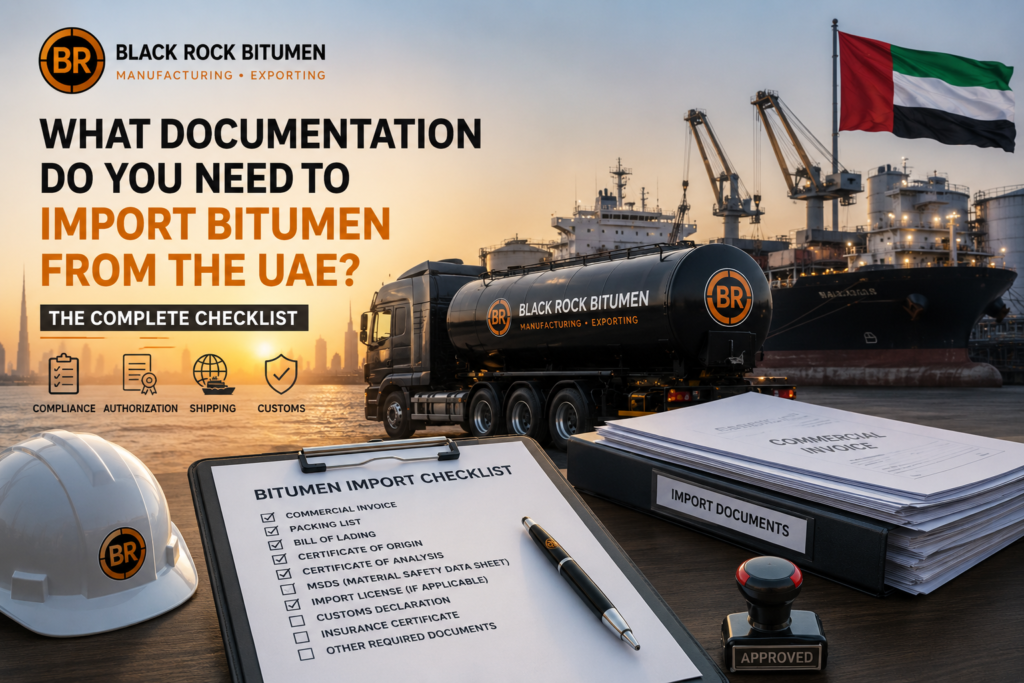
10. Master Checklist: All 20 Documents at a Glance
Use this table for every bitumen import from the UAE. Mark each document as Received / Pending / Not Applicable before presenting to your bank or customs broker.
| # | Document | Category | Required For | Source |
|---|---|---|---|---|
| 1 | Commercial Invoice | A — Commercial | All transactions | UAE Supplier |
| 2 | Packing List | A — Commercial | All transactions | UAE Supplier |
| 3 | Bill of Lading (3/3 originals) | A — Commercial | All sea shipments | Shipping Line |
| 4 | Proforma Invoice | A — Commercial | LC opening / import permit | UAE Supplier |
| 5 | Certificate of Origin (CoO) | A — Commercial | Duty assessment / CEPA benefits | UAE Chamber of Commerce |
| 6 | Insurance Certificate | A — Commercial | CIF/CIP Incoterms; LC requirement | Insurance Company |
| 7 | Certificate of Analysis (CoA) | B — Technical | All transactions; project compliance | Supplier / Accredited Lab |
| 8 | Third-Party Inspection Cert | B — Technical | LC transactions; quality assurance | SGS / BV / Intertek |
| 9 | Technical Data Sheet (TDS) | B — Technical | Project engineer sign-off | UAE Supplier |
| 10 | MSDS / Safety Data Sheet | B — Technical | All petroleum product imports | Supplier / Refinery |
| 11 | HS Code 2713.20 (12-digit) | C — Regulatory | All UAE customs declarations | Customs Broker |
| 12 | Mirsal 2 Declaration (UAE) | C — Regulatory | UAE port export clearance | Supplier / Customs Broker (UAE) |
| 13 | UAE Trade Licence (Supplier) | C — Regulatory | Supplier due diligence | UAE Supplier |
| 14 | Delivery Order (D/O) | C — Regulatory | Cargo release at destination port | Shipping Line Agent |
| 15 | Import Permit (Destination) | C — Regulatory | Petroleum products in applicable countries | Buyer (at destination) |
| 16 | Customs Declaration (Destination) | C — Regulatory | All imports | Buyer’s Customs Broker |
| 17 | Draft / Bill of Exchange | C — Regulatory | LC transactions with deferred payment | Buyer / Bank |
| 18 | LC (Letter of Credit) MT700 | C — Regulatory | LC payment transactions | Buyer’s Bank |
| 19 | Country-Specific Cert (BIS/KEBS/SNI) | C — Regulatory | Specific destination markets | Nominated Inspection Agency |
| 20 | Fumigation Certificate | C — Regulatory | If wooden pallets used | Supplier (pest control company) |
11. Verified Sources
- Gulf Petro — Key Documents for Bitumen Supply
- Trade.gov — UAE Import Requirements and Documentation
- Trade.gov — UAE Customs Regulations
- Trade.gov — Special Export Documents (Pre-Shipment Inspection)
- C4 Customs — Import & Export Clearance Dubai & UAE 2025 Full Checklist
- Kayroux & Associates — Dubai Customs Clearance Guide: Duties, HS Codes, Mirsal 2
- EY Tax Alert — Dubai Customs Updated Declaration Form (Notice 05/2024)
- FreightAmigo — HS Code for Petroleum Bitumen (2713.20), 2025 Guide
- CreditGuru — Documents Requested in a Letter of Credit (UCP 600)
- RTS Family — Bitumen Quality Testing Procedures for UAE Projects
- RTS Family — Bulk Bitumen Transportation Tips for UAE Suppliers
- Chemtradeasia UAE — Why 60/70 Bitumen Is Critical for UAE Road Projects
- Tiger Bitumen — MSDS Penetration Grade Bitumen (All Grades)
- Dubai Customs — Customer Guide (Mirsal 2, FZ, Re-Export)
- Dubai Trade — Mirsal 2 FAQs
- UAE Expert Hub — How to Start Import-Export Business in UAE 2025
- Complete 2025 Buyer’s Guide
- OSHA — Hazard Communication Standard: Safety Data Sheets
- Gulf Fast Cargo Services — UAE Import Procedures
- BlackRock Bitumen — Top Bitumen Suppliers in UAE, 2026
Disclaimer: Documentation requirements are subject to change based on regulatory updates in the UAE and destination countries. Always verify current requirements with a licensed customs broker in both the UAE and your destination country before shipping. This guide is for informational purposes only.
Frequently Asked Questions
What happens if a document has a discrepancy under an LC?
No. The Commercial Invoice, Packing List, and CoO typically cover the entire shipment across all containers. The Bill of Lading covers all containers under one or more B/L numbers. The CoA covers the batch. Container numbers are listed on the Packing List and referenced in the B/L.
How does the India-UAE CEPA affect my documentation requirements?
These are completely different documents that serve different purposes. The Certificate of Origin (CoO) certifies where the bitumen was produced (country of manufacture) — used for customs duty assessment and trade agreement benefits. The Certificate of Analysis (CoA) certifies the technical quality of the product — the test results showing the bitumen meets the declared grade specification. You need both.
Can I use a photocopied Bill of Lading for customs clearance?
No. Original Bills of Lading are required for cargo release at destination. For LC transactions, original B/Ls are presented to the bank. Copies may be sent ahead electronically to the destination agent to prepare the Delivery Order, but you need originals for actual cargo release. With telex release (surrender B/L), originals can be surrendered at origin for the shipping line to issue a telex release — confirm this option with your supplier and shipping line before shipment.
What is the difference between Certificate of Origin and Certificate of Analysis?
The India-UAE Comprehensive Economic Partnership Agreement, in force since May 2022, may provide preferential import duty treatment for UAE-origin bitumen into India. To claim CEPA benefits, you need a specific Form I Certificate of Origin certifying UAE origin — issued by the UAE Ministry of Economy or authorised issuing bodies. Standard non-preferential CoOs do not qualify. Confirm current applicability with your Indian customs broker, as specific HS codes and product rules of origin apply.
How long does UAE export documentation take to prepare?
Under UCP 600, the bank will issue a notice of discrepancy within 5 banking days. You then have options: (1) request the supplier to correct and re-present, (2) request the bank to seek a waiver from the applicant (buyer), or (3) present under reserve/guarantee. Discrepancy fees apply (typically USD 50–150 per discrepancy). The safest approach is to build a document review checklist and have your freight forwarder pre-check all documents before presentation (CreditGuru / UCP 600).

Content Writer, Global Bitumen Supply & Market Insights, Black Rock Bitumen
Farheen Fatima is an infrastructure materials writer specializing in bitumen supply, asphalt technology, and global road construction. He shares practical insights on bitumen grades, supplier evaluation, and international standards to help contractors and project teams make informed procurement decisions.