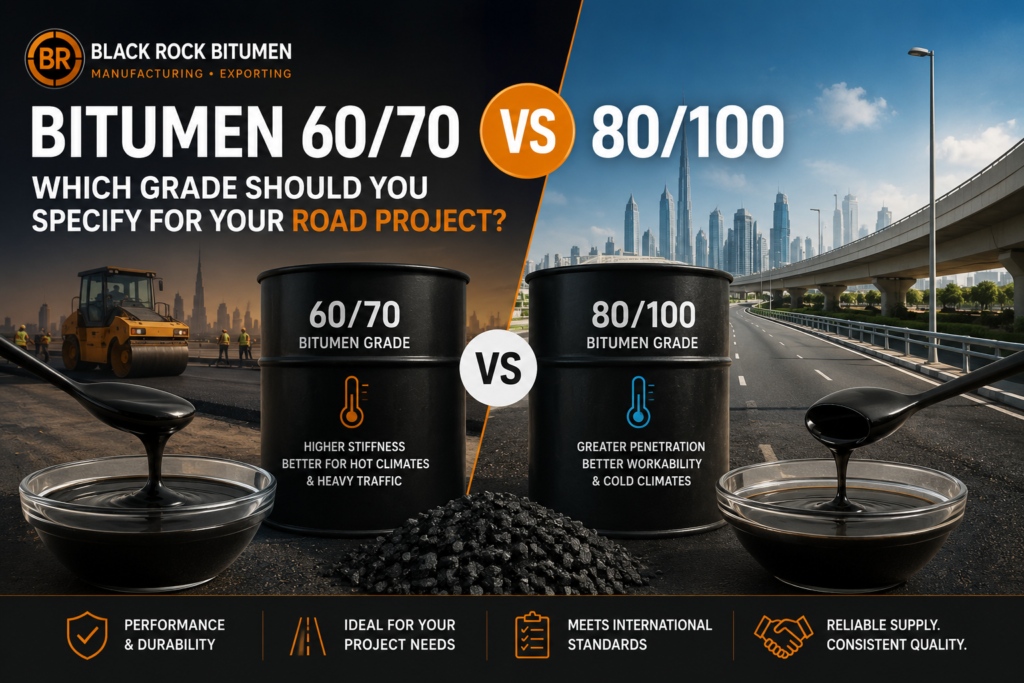
Bitumen binder typically represents 5 to 15 percent of total road project cost. You can work extremely hard to save 10 percent on your bitumen unit price. That effort — realistically — saves you 0.5 to 1.5 percent of total project budget.
Specifying the wrong penetration grade costs you the road.
Here’s what that means in practice. In 2023, global bitumen demand surpassed 120 million metric tonnes, with over 85 percent directed toward road paving (Market Growth Reports, January 2026). The 60/70 and 80/100 grades together account for the vast majority of that volume. Engineers and procurement managers on thousands of projects specify between these two grades every single month. When the specification is wrong, the pavement fails.
Pavement failure is not theoretical. It is concrete:
- Wrong grade in hot climate (80/100 in a tropical country): The binder softens above its softening point of 43–47°C at road surface temperatures that commonly reach 55–70°C. Permanent wheel-path rutting forms within 12–18 months. Bleeding — where binder migrates to the surface — creates a slick, safety-critical road surface. Roads designed for 12-year service life fail at 3 to 5 years.
- Wrong grade in cold climate (60/70 in northern Europe or Canada): The binder reaches its Fraass breaking point at around −12°C. In locations with -20°C winter minima, the pavement cannot accommodate thermal contraction stress. Transverse cracking forms, water infiltrates, freeze-thaw cycles attack the pavement base, and the road deteriorates structurally years ahead of schedule.
- Correct grade: The pavement performs through its full 12–20 year design life with normal maintenance. Every dollar spent on correct grade specification avoids USD 4–7 in future reconstruction costs — a ratio cited by pavement management programmes worldwide (Mordor Intelligence, 2025).
Global road construction expenditure is projected to reach USD 1.8 trillion by 2025 (International Road Federation, via GMI Insights). This guide exists to help engineers, procurement managers, and project owners make the grade specification decision correctly, every time.
120M MT
Global bitumen demand in 2023
Source: Market Growth Reports, 2026
85%+
Directed toward road paving applications
Source: Market Growth Reports, 2026
$1.8T
Projected global road construction spend 2025
Source: IRF via GMI Insights
$4–7
Return per dollar of correct grade specification
Source: Mordor Intelligence
2. Understanding the Penetration Number: What 60/70 and 80/100 Actually Measure
Most engineers know intuitively what the penetration number means. But when you are specifying for a project, the details matter — and a surprising number of specification errors come from misunderstanding what the test actually measures and how it predicts field performance.
The penetration test (ASTM D5 / EN 1426) works like this: a standard 100-gram needle is placed on a bitumen sample at exactly 25°C and allowed to penetrate for 5 seconds. The depth is measured in dmm (decimillimetres — units of 0.1mm). The grade designation is the acceptable range for this depth.
Bitumen 60/70: the needle penetrates 6.0 to 7.0mm. Bitumen 80/100: the needle penetrates 8.0 to 10.0mm. This means 80/100 is 14 to 43 percent softer at 25°C test conditions than 60/70 — a substantial material difference that translates directly into performance at field temperatures (Pssoil — ASTM D5 / EN 1426).
The Physical Meaning: The penetration number is a proxy for stiffness at service temperatures. A harder bitumen (low penetration = 60/70) resists deformation under load at high temperatures. A softer bitumen (high penetration = 80/100) remains flexible at low temperatures and does not crack under thermal contraction stress. The relationship is thermoplastic: bitumen softens when heated and hardens when cooled (Pro-Road Global). The grade you choose determines the temperature range over which the binder performs adequately. Get the range wrong and you have either a rutting or a cracking problem — both expensive, both avoidable.
The Penetration Test vs Real Road Performance
It is important to understand that the penetration test is conducted at 25°C — a moderate temperature. Road surfaces in tropical countries reach 55–70°C in summer. Road surfaces in northern climates reach −20°C in winter. The penetration number at 25°C predicts performance across the full service temperature range through the Penetration Index (PI) — a derived value in EN 12591 that measures temperature susceptibility. A higher PI means the bitumen is less sensitive to temperature change; a lower (more negative) PI means greater sensitivity. Both grades have negative PI values, meaning their consistency changes significantly with temperature — which is exactly why climate matching is essential.
The penetration grade system is governed by four major international standards: ASTM D946 (USA), EN 12591 (Europe), IS 73:2013 (India), and AASHTO M20 (USA highways). All four establish the minimum and maximum penetration values, softening points, ductility, flash point, and other parameters that define each grade (Pssoil — Standards Reference). Your project specification should reference one of these standards explicitly — and your supplier’s Certificate of Analysis should cite test results against the same standard.
3. Side-by-Side Technical Specification Tables (ASTM D946, EN 12591, IS 73)
The following values are taken from published technical data sheets and the referenced international standards. Use these when writing project specifications or evaluating supplier Certificates of Analysis.
| Property | Test Standard | Bitumen 60/70 | Unit | Bitumen 80/100 |
|---|---|---|---|---|
| Penetration @ 25°C, 100g, 5s | ASTM D5 / EN 1426 | 60–70 dmm | dmm | 80–100 dmm |
| Softening Point (Ring & Ball) | ASTM D36 / EN 1427 | 49–56°C | °C | 43–47°C |
| Ductility @ 25°C (min) | ASTM D113 / EN 13398 | 100 cm | cm | 100 cm |
| Flash Point (Cleveland Open Cup) | ASTM D92 | Min 232°C | °C | Min 230°C |
| Loss on Heating (TFOT, max) | ASTM D1754 / D6 | 0.5% | % | 0.8% |
| Solubility in TCE (min) | ASTM D2042 | 99.0% | % | 99.0% |
| Specific Gravity @ 25°C | ASTM D70 / EN 15326 | 1.01–1.06 | g/cm³ | 1.01–1.05 |
| Kinematic Viscosity @ 135°C | ASTM D2170 | ~300 cSt | cSt | ~200 cSt |
| Fraass Breaking Point (max) | EN 12593 | ~−12°C | °C | ~−15 to −18°C |
| Penetration Index (PI) | EN 12591 Annex B | −1.0 to +1.0 | — | −1.5 to +0.7 |
Sources: Gold Bitumen TDS 80/100 | Tohid Trade Oil — 60/70 Spec | Petro Naft — 80/100 | Pssoil — ASTM/EN/IS
How to Read These Numbers in Practice
The softening point is your most important number. For 60/70 at 49–56°C: this grade maintains structural stability up to road surface temperatures that are routinely seen in tropical and Middle Eastern climates. For 80/100 at 43–47°C: this is dangerously close to road surface temperatures in hot climates where ambient air temperature is already 40°C. A dark asphalt surface in that environment can reach 60–65°C — well above 80/100’s softening point, meaning the binder is in a plastic flow state under traffic. This is how rutting begins.
The Fraass breaking point tells you the low-temperature story. For 60/70 at approximately -12°C: in any country where winter temperatures drop regularly below -10°C, 60/70 is at or near its brittleness threshold. For 80/100 at approximately -15 to -18°C: it maintains flexibility several degrees lower, which is critical for frost-affected pavements. Countries like Norway, Sweden, Canada, and northern Russia deal with winter temperatures of -25 to -40°C and use even softer grades — 100/120 or 160/220 — for wearing courses in the most extreme zones.
4. Deep Dive: Bitumen 60/70 — Properties, Strengths, and Ideal Applications
Bitumen 60/70 is the global workhorse for road paving. It is popular in India, South East Africa, and other tropical markets because its quality is acceptable and its price is competitive (Infinity Galaxy). It accounts for the majority of paving-grade bitumen consumption in the world’s largest infrastructure markets.
What Makes 60/70 Perform in Hot Climates
1. Higher softening point (49–56°C). Road surfaces in countries like India, the UAE, Nigeria, and Thailand regularly reach 55–65°C in summer. A binder must remain in a semi-solid, load-bearing state at these temperatures. Bitumen 60/70’s softening point gives it a thermal buffer that 80/100 lacks.
2. Higher kinematic viscosity at 135°C (~300 cSt vs ~200 cSt for 80/100). Viscosity at application temperature determines how well the binder coats and bonds aggregates in the asphalt plant. A higher viscosity at 135°C means 60/70 provides more durable aggregate binding, which improves structural stability of the finished pavement.
3. Lower penetration index sensitivity. 60/70’s somewhat higher PI means its consistency changes less dramatically per degree of temperature change than 80/100. In hot climates with intense daily temperature swings from morning to peak afternoon, this translates into more consistent pavement performance throughout the day.
4. Superior aging resistance. Bitumen undergoes oxidative aging over time, increasing in hardness and brittleness. Bitumen 60/70 starts harder; it therefore has more headroom before aging makes it unacceptably stiff. In long-service-life pavements, this aging resistance extends functional pavement life significantly (Petro Naft — 60/70 vs 80/100).
Primary Applications for 60/70
Bitumen 60/70 should be specified for:
- Highways and expressways in tropical, subtropical, and warm temperate climates — including all National Highway Authority projects in India, GCC highway networks, and highway networks across Sub-Saharan Africa (IS 73 / EN 12591 / ASTM D946)
- Wearing course and binder course in high-traffic urban roads in any country with mean maximum summer temperatures above 30°C — which includes most of the developing world where road infrastructure investment is growing fastest (Tohid Trade Oil)
- Heavily loaded roads regardless of moderate climate — where traffic-generated heat and load-induced deformation risks outweigh ambient temperature considerations. Motorways carrying heavy goods vehicles (HGV) with AADT above 5,000 should default to 60/70 in any climate above temperate.
- Airport taxiways (as a secondary option) where 40/50 or PMB is not specified — though for runways and aprons, harder grades are strongly preferred (Tohid Trade Oil)
5. Deep Dive: Bitumen 80/100 — Properties, Strengths, and Ideal Applications
Bitumen 80/100 is often underrated by engineers who think of it as simply a ‘softer 60/70’. It is not. It is a grade with genuine performance advantages in specific conditions — and in those conditions, specifying 60/70 instead creates unnecessary cost and shortened road life.
What Makes 80/100 Perform in Cold and Moderate Climates
1. Greater flexibility at low temperatures (Fraass breaking point −15 to −18°C vs −12°C for 60/70). Thermal cracking begins when pavement stiffness prevents accommodation of thermal contraction. Bitumen 80/100 maintains flexibility at several degrees lower temperature than 60/70, giving it a 3–6°C advantage in the critical winter brittleness zone. In locations where winter temperatures regularly reach -15°C or below, this difference can be the margin between cracking and not cracking.
2. Better compaction workability. 80/100’s softer consistency allows it to be mixed and compacted at slightly lower temperatures than 60/70 (mixing at 140–155°C vs 150–165°C). In cool weather when maintaining mix temperature is challenging, 80/100 provides a longer and more forgiving compaction window. Poor compaction is one of the primary causes of premature pavement failure — 80/100 reduces this risk in cool-weather construction.
3. Superior fatigue resistance in moderate climates. 80/100’s higher ductility and flexibility mean it can absorb more repeated-load deformation cycles before fatigue cracking initiates. In moderate-climate urban roads with medium traffic and significant temperature variation, this fatigue performance advantage over 60/70 extends pavement life by 20–40% on lightly-loaded roads (Carbokim, February 2026).
4. Superior waterproofing and adhesion properties. For non-road applications — roofing membranes, foundation waterproofing, bridge deck membranes, and infrastructure waterproofing — 80/100 is the preferred grade. Its higher flexibility means the waterproofing membrane can accommodate structural movement (thermal expansion/contraction, minor settlement) without cracking and losing its seal (Gulf Petro — 80/100 Applications).
Primary Applications for 80/100
Bitumen 80/100 should be specified for:
- All road construction in cold climates where winter minimum temperatures regularly fall below -10°C — Scandinavia, Northern Europe, Canada, Russia, northern China, and high-altitude projects worldwide
- Rural and secondary roads in moderate climates where AADT is below 5,000 and truck percentage is low — 80/100 provides adequate durability with better fatigue resistance at lower cost (Grand Petroleum)
- Roofing felt and bitumen membrane production — 80/100 bonds effectively with reinforcing materials like fibreglass or polyester mat, creating durable and flexible waterproofing systems (Petro Naft — Bitumen 80/100)
- Foundation, basement, and tunnel waterproofing — where continuous waterproof coverage with flexibility against structural movement is critical
- Bridge deck waterproofing layers — bridge structures require waterproofing that accommodates thermal movement and dynamic load effects (Gulf Petro)
- Production of bitumen emulsions and cutback bitumen — 80/100 is a versatile base grade for producing secondary bitumen products used in surface dressing, prime coats, and tack coats
6. Head-to-Head Performance Comparison: 8 Key Criteria
This is the definitive comparison matrix. For each performance criterion, one grade wins clearly. Understanding why each wins builds the engineering intuition for correct specification.
| Performance Criterion | 60/70 Rating | 80/100 Rating | Winner & Why |
|---|---|---|---|
| Rut Resistance (Hot Climate) | Excellent | Poor–Fair | 60/70 — Higher softening point prevents viscous flow at road temperatures above 50°C |
| Thermal Crack Resistance (Cold) | Fair | Excellent | 80/100 — Fraass point 3–6°C lower; maintains flexibility in winter freeze conditions |
| Fatigue Life (Repeated Loading) | Good (hot roads) | Excellent (cold/moderate) | Context-dependent — 80/100 better under moderate temps; 60/70 better in hot conditions |
| Compaction Workability | Good | Very Good | 80/100 — Softer grade has longer compaction window at lower temperatures |
| Aging & Oxidation Resistance | Very Good | Good | 60/70 — Higher initial hardness means more headroom before aging-induced brittleness |
| Waterproofing Adhesion | Good | Excellent | 80/100 — Higher ductility ensures waterproof membranes flex without cracking |
| Aggregate Binding Strength | Excellent | Good | 60/70 — Higher viscosity at mixing temperatures provides stronger aggregate-binder bond |
| Surface Dressing / Chip Seal | Fair | Excellent | 80/100 — Softer grade embeds aggregate better and maintains flexible chip retention |
7. The Master Verdict Table: 15 Applications Rated for Both Grades
Every major road construction, infrastructure, and waterproofing application rated for both grades. This is the table to reference when writing specifications or defending your grade choice to a client or tender board.
| Application & Conditions | 60/70 | 80/100 | Engineering Rationale |
|---|---|---|---|
| Motorway / Expressway — Hot Climate (>40°C max air) | PREFERRED ✔ | Not Recommended ✘ | High surface temp + heavy trucks = rutting risk; 80/100 softening point 43–47°C dangerously close to road temp |
| Motorway / Expressway — Cold Climate (<5°C min air) | Use with caution | PREFERRED ✔ | 60/70 becomes brittle at Fraass point ~−12°C; 80/100 stays flexible to −15 to −18°C |
| National Highway — Tropical or Subtropical | PREFERRED ✔ | Second choice | Climate & heavy AADT both favour harder grade in hot zones |
| Urban Arterial Road — Hot/Tropical Region | PREFERRED ✔ | Not Recommended ✘ | Stop-start traffic generates sustained surface heat; bleeding risk with 80/100 |
| Urban Arterial Road — Temperate / Cold Region | Acceptable | PREFERRED ✔ | Winter temps demand flexibility; 80/100 prevents low-temp cracking |
| Rural / Secondary Road (All climates) | Acceptable in hot zones | PREFERRED ✔ | Light traffic; flexibility prevents fatigue cracking; cost advantage |
| Wearing Course — High Traffic, Hot Climate | PREFERRED ✔ | Second choice | Surface layer bears most thermal and load stress; must resist rutting |
| Binder Course & Base Course | PREFERRED ✔ | Acceptable in cold | Structural layers need stiffness for load distribution under wheel loads |
| Road Maintenance, Overlay & Patching | Acceptable in tropics | PREFERRED ✔ | Better compaction workability; improved bonding to existing pavement |
| Surface Dressing / Chip Seal | Acceptable | PREFERRED ✔ | Softer grade bonds better with aggregate in surface treatment applications |
| Airport Taxiways — Pavement Areas | 40/50 or PMB | 40/50 or PMB | Both grades insufficient for aircraft static loads; go harder |
| Industrial Pavements, Port Yards | 40/50 or PMB | 40/50 or PMB | Sustained concentrated loads from cranes/forklifts require extra stiffness |
| Roofing Membranes & Felt | Second choice | PREFERRED ✔ | Flexibility and waterproofing adhesion suit roofing better than 60/70 |
| Waterproofing — Foundations & Basements | Second choice | PREFERRED ✔ | Higher ductility ensures waterproof membrane moves without cracking |
| Bridge Deck Waterproofing | Second choice | PREFERRED ✔ | Dynamic loads and thermal movement on bridges need flexible binder |
Sources: Basekim — 60/70 vs 80/100 | Gulf Petro — 80/100 Applications | Tohid Trade Oil — 60/70 Applications | Pssoil — IRC:37:2018
8. Which Countries Specify Which Grade — and Why
Grade selection patterns around the world are not arbitrary. They reflect decades of pavement engineering experience, codified in national standards. Understanding these patterns confirms the climate-traffic logic and helps procurement teams validate that the grade they’re specifying aligns with established practice in comparable environments.
| Region / Country | Primary Grade | Climate Drivers | Applicable Standard |
|---|---|---|---|
| India (all climate zones) | 60/70 dominant | Mean max 35–48°C; high humidity; heavy Bharatmala NH traffic | IS 73:2013, IRC:37:2018 |
| UAE, Saudi Arabia, Kuwait | 60/70 | Road surface temps exceed 60°C in summer; desert highways | EN 12591, ASTM D946 |
| Sub-Saharan Africa (East/West) | 60/70 | Equatorial/tropical; surfaces 55–65°C; ADB/World Bank funded roads | EN 12591, ASTM D946 |
| Southeast Asia (Thailand, Vietnam) | 60/70 | Year-round tropical heat; monsoon-stressed road surfaces | ASTM D946, national specifications |
| Indonesia | 60/70 | Hot, humid; heavy commercial vehicle loadings; SNI compliance | SNI / ASTM D946 |
| Northern Europe (Scandinavia) | 70/100 or 80/100 | Winter −15 to −25°C; freeze-thaw; mandatory EN standards | EN 12591 (PEN 70/100) |
| UK, Germany, France | 70/100 or 80/100 | Temperate; moderate summer; cold winters; strict EN compliance | EN 12591 |
| Canada / Northern USA | 80/100 or softer | Extreme cold −30 to −40°C; frost heave; AASHTO compliance | AASHTO M20, CSA |
| Australia (northern/central) | 60/70 | Hot, dry outback; Darwin, Queensland; Austroads AGPT02 | Austroads AGPT02B |
| Australia (southern states) | 80/100 acceptable | Melbourne/Sydney — cooler winters; dual-season design | Austroads AGPT02B |
| Turkey (north) | 80/100 | Black Sea coast; cold winters; moderate traffic | TS EN 12591 |
| Turkey (south/central) | 60/70 | Mediterranean/continental; hot summers; heavy roads | TS EN 12591 |
| Brazil (Amazon/Northeast) | 60/70 | Tropical heat; DNIT paving standards | DNIT / ABNT NBR |
| China (central/southern) | 60/70 | Hot summers; rapid highway expansion; Belt & Road projects | JTG F40, GB/T |
| China (northeast/northwest) | 70/100 or 80/100 | Extreme cold winters in Heilongjiang/Xinjiang | JTG F40 |
India deserves special mention. It is the world’s second-largest infrastructure market and consumes bitumen at a scale that few other countries match. Bitumen 60/70 is dominant across India’s entire national highway network under IS 73:2013 and IRC:37:2018. India’s Bharatmala Pariyojana programme — the largest highway construction initiative in history — runs almost exclusively on 60/70 for wearing and binder courses (Infinity Galaxy).
9. How Grade Affects Asphalt Mix Design and Construction Practice
Grade selection does not end at procurement. It has direct implications for asphalt plant operations, mix design, and on-site construction practice. Specifying engineers and construction managers need to understand these downstream effects.
Mixing and Compaction Temperatures
Bitumen 60/70 requires higher mixing and compaction temperatures than 80/100 due to its higher viscosity. Typical mixing temperature for 60/70 is 150–165°C; for 80/100, 140–155°C. Compaction must occur before the mix temperature drops below the point where the bitumen becomes too viscous to achieve adequate density. For 60/70, this window is narrower than for 80/100. In cool-weather construction conditions (ambient below 15°C), 80/100 is therefore more forgiving and less likely to result in poorly-compacted pavement (Petro Naft — Optimal Mixing Temperature 60/70).
This temperature difference has practical budget implications: higher mixing temperatures mean higher fuel consumption at the asphalt plant. A project using 60/70 instead of 80/100 may incur marginally higher plant energy costs. In large-volume projects, this can be a legitimate economic consideration — though it should never override the performance-driven grade selection.
Aggregate Coating and Bond Strength
60/70’s higher viscosity at mixing temperatures produces a thicker, more tenacious binder film around each aggregate particle. This improves the binder-aggregate bond, which is the fundamental mechanism of asphalt pavement structural strength. Better aggregate bonding means better resistance to stripping (where water infiltrates and separates binder from aggregate) and better load distribution across the pavement structure (Carbokim — Bitumen Grade Selection).
Marshall Mix Design Implications
The Marshall mix design method — widely used in Asia, Africa, and the Middle East — determines the optimum bitumen content (OBC) for a given aggregate grading and bitumen grade. The OBC is typically slightly lower for 60/70 than for 80/100 in equivalent mixes, because the higher viscosity of 60/70 provides adequate film thickness at lower dosage. This can provide a marginal cost saving on binder content per tonne of asphalt produced — typically 0.1 to 0.3 percent of mix weight.
Research published in NCBI / PMC (2024) confirms that 60/70 grade bitumen is the standard benchmark for flexible pavement research in hot climates and that traditional asphalt mixtures using 60/70 can still lack rutting resistance under very heavy loading — the scenario that justifies moving to 40/50 or PMB for the most demanding applications.
10. Cost Analysis: Price Difference, Lifecycle Economics, and ROI
Spot Market Price Differential
In normal market conditions, Bitumen 80/100 trades at a discount of approximately USD 5–15 per metric tonne versus Bitumen 60/70 FOB Middle East — reflecting slightly lower refinery complexity for producing the softer grade. Both grades typically sit within a 5–10 percent price range of each other.
RAHA Bitumen’s live price data (April 2026) shows Bitumen 60/70 drum FOB at $565±5 per MT (RAHA Bitumen). On a 1,000 MT order, the price differential between 60/70 and 80/100 is therefore approximately USD 5,000–15,000. On a road project consuming 500 MT of bitumen at an installed asphalt cost of USD 500,000, this represents 1–3 percent of binder cost, or 0.1–0.4 percent of total project cost. It is not the decision variable.
The Lifecycle Economics Calculation
This is where the real numbers are. Wrong grade selection creates a compounding cost problem:
- Rutting failure (80/100 in hot climate): Surface resurfacing required at year 3–5 instead of design life year 12–15. A road that costs USD 1 million/km to construct requires a USD 200,000–400,000/km resurfacing event 8–10 years early. That’s 20–40% of original project cost as avoidable expenditure.
- Thermal cracking failure (60/70 in cold climate): Annual crack sealing plus pothole patching costs increase by 40–60% over a 10-year period. Water infiltration into the base accelerates structural deterioration, leading to base failure that requires full reconstruction 5–8 years ahead of schedule.
- Correct grade: Standard routine maintenance only until design life (12–20 years). Total lifecycle cost savings of 60–75% versus a failed-pavement scenario. The USD 4–7 return on every dollar of correct specification decision is the most robust ROI available in road project management (Mordor Intelligence, 2025).
The Bottom Line on Cost: Do not let a USD 10–15/tonne price difference between 60/70 and 80/100 influence your grade decision. The cost of specifying the wrong grade to save on binder price is orders of magnitude higher than the saving. Specify the correct grade. Negotiate hard on that grade. Never substitute grade for price.
11. When to Move Beyond Both Grades: PMB, PG, and Harder Options
Polymer-Modified Bitumen (PMB)
PMB delivers superior performance when standard penetration grade bitumen — whether 60/70 or 80/100 — reaches its performance limits. PMB consumption reached 18 million metric tonnes globally in 2023, and over 80 percent of roads in Germany today use PMB blends, reflecting both performance standards and environmental compliance requirements (Coherent Market Insights). PMB reduces maintenance cycles by up to 25 percent versus standard penetration grade (Market Growth Reports). Specify PMB when: motorway AADT exceeds 100,000; airport runways and aprons are involved; pavement temperature range exceeds 60°C from summer maximum to winter minimum; or long-lifecycle requirements (25+ years) justify the premium.
Performance Grade (PG) Bitumen
PG bitumen under AASHTO M 320 is specified by temperature performance range rather than penetration — for example, PG 64-22 performs from -22°C minimum to 64°C maximum pavement temperature. This is the standard for US-funded and World Bank-funded infrastructure projects globally. If your tender documents specify a PG grade, penetration grades are not directly interchangeable without engineering justification and approval (Pssoil — AASHTO M 320). PG 64-22 is broadly comparable to 60/70 in terms of high-temperature performance, but the grading systems are not equivalent and should not be substituted without laboratory confirmation.
Harder Grades (40/50 and 30/40)
Grade 40/50 (penetration 40–50 dmm, softening point typically 52–60°C) is appropriate for airport pavements, heavily loaded intersections, bus lanes, port container yards, and industrial pavements where static loads from aircraft, cranes, or heavy plant create sustained concentrated stress that 60/70 cannot adequately resist. Grade 30/40 and below are specialist grades used in very high-temperature or very heavy-loading environments (Gold Bitumen — Comprehensive Grade Guide).
12. The 5-Step Engineering Decision Framework
Use this framework on every project. It takes approximately 15 minutes and prevents the kind of specification errors that cost millions.
Step 1 — Determine Maximum Pavement Temperature
Find the mean maximum air temperature for the project location over the hottest month from national meteorological data. Add 10–20°C to account for solar gain on a dark asphalt surface.
Decision rule: If estimated road surface temperature exceeds 50°C → 60/70 is your baseline. If it stays below 40°C → 80/100 is your baseline.
Step 2 — Determine Minimum Pavement Temperature
Find the mean minimum air temperature for the coldest month.
Decision rule: If minimum temperature is regularly below −10°C → 80/100 is strongly preferred. If minimum is above −5°C → either grade may work; proceed to traffic assessment. If minimum falls between −10°C and −5°C → 80/100 has a performance advantage in crack resistance.
Step 3 — Assess Traffic Loading Category
Determine AADT (Annual Average Daily Traffic) and percentage heavy vehicles.
Decision rule: AADT >10,000 with >10% trucks → traffic loading strongly favours 60/70 regardless of moderate climate. AADT <5,000 with <5% trucks → 80/100 typically appropriate. Between these → combine with climate assessment.
Step 4 — Check Project Specification, Funding, and Standard
Review the project tender documents: does it call for IS 73, EN 12591, ASTM D946, AASHTO M20, Austroads, or a national equivalent? Does it specify a PG grade? If the funding body (World Bank, ADB, USAID, AfDB) mandates a specific standard, that governs. Your climate/traffic analysis should confirm alignment — not override the standard.
Step 5 — Apply the Verdict and Document It
- Hot climate + heavy traffic → specify 60/70
- Cold climate (below −10°C min) → specify 80/100
- Moderate climate + heavy traffic (AADT >10,000 trucks) → specify 60/70
- Moderate climate + light/medium traffic → specify 80/100
- Extreme conditions (airport, port, very hot climate + very heavy loading) → specify 40/50 or PMB
- Waterproofing, roofing, surface dressing → specify 80/100
Verified Sources
- Market Growth Reports — Global Bitumen Market 2024–2033
- Fortune Business Insights — Global Bitumen Market Size 2025–2032
- GMI Insights — Bitumen Market Size, Share & Growth Analysis
- Petro Naft — Bitumen 60/70 vs Bitumen 80/100 (Comparison Guide)
- Petro Naft — Penetration Bitumen 80/100 (Deep Dive)
- Petro Naft — Optimal Mixing Temperature for Bitumen 60/70
- Basekim — Bitumen 60/70 vs 80/100: Which Grade Performs Better?
- Carbokim — Bitumen 60/70 vs 80/100, 2025 Guide
- Gold Bitumen — Bitumen 60/70 vs 80/100 Complete Guide
- Gold Bitumen — TDS Bitumen 80/100 (Technical Data Sheet)
- Gold Bitumen — Comprehensive Grade Guide 30/40 to 160/220
- Pssoil — Bitumen 60/70 vs 80/100: Climate-Based Grade Selection (ASTM, EN, IS, IRC)
- Gulf Petro — Bitumen 80/100 Applications in Different Fields
- Tohid Trade Oil — Bitumen 60/70 Specification
- Tohid Trade Oil — Use of Bitumen 60/70 for Asphalt
- Pro-Road Global — 60/70 Penetration Grade Bitumen / Asphalt Cement
- Pro-Road Global — 80/100 Penetration Grade Bitumen
- Grand Petroleum — Bitumen 60/70 vs 80/100
- Grand Petroleum — Bitumen 80/100 Guide
- Infinity Galaxy — Bitumen Penetration Grade 60/70
- ATDM — Bitumen 80/100 Manufacturer Specifications
- Coherent Market Insights — Bitumen Market 2025
- Mordor Intelligence — Bitumen Market Industry Analysis 2030
- RAHA Bitumen — Live Bitumen Price (Updated Weekly)
- NCBI / PMC — High-Temperature Performance of Flexible Pavement (60/70 Research)
Disclaimer: Technical specifications in this article are based on published data sheets and international standards as of 2025. Always verify against current supplier documentation and the applicable national standard for your project jurisdiction before finalising a specification.
Frequently Asked Questions
What does 80/100 mean? Is it a ratio, a percentage, or a range?
Neither a ratio nor a percentage. The numbers represent the minimum and maximum acceptable penetration depth in dmm (decimillimetres) under the standard test at 25°C. 80/100 means the penetration value falls between 80 dmm (8.0 mm) and 100 dmm (10.0 mm). A common misconception is that it means ’80 out of 100′ — it does not (ATDM — Grade 80/100).
How do I buy both grades from a UAE supplier for comparison testing?
Both 60/70 and 80/100 are readily available from UAE-based exporters through Jebel Ali Port, typically in 180 kg steel drums with 110 drums per 20-foot container (20 MT per container). For a laboratory comparison, you can order as little as one container of each grade. Payment is via irrevocable LC at sight or 30 percent TT advance plus balance against Bill of Lading. Request a Certificate of Analysis from an SGS or Bureau Veritas-certified laboratory for each batch. For the full procurement process, refer to the companion article: How to Buy Bitumen from the UAE — Step-by-Step Guide.
Which grade is used for surface dressing (chip seal)?
80/100 is generally preferred for surface dressing applications. The softer grade spreads more effectively at spraying temperatures, penetrates aggregate particles more readily, and provides better adhesion retention as the surface dressing cures. Many surface dressing specifications in Europe and Africa specify penetration grade 80/100 or a cationic emulsion derived from 80/100 as the base binder.
Does the grade specification change for each layer of the pavement?
Not typically in standard road projects. The same grade is usually used throughout the flexible pavement structure (wearing course, binder course, base course). However, on high-specification projects such as motorways or airports, different grades or formulations may be specified for different layers: for example, PMB for the wearing course with 60/70 for the binder course in hot climates. Always follow the pavement design document rather than assuming a single grade applies to all layers.
Can I mix 60/70 and 80/100 to create an intermediate grade?
Technically, blending is possible and does occur in some markets. However, it is not standard engineering practice and is not recommended without laboratory testing. Blended grades may not perform predictably because the asphaltene, resin, and oil fractions of two different batches may not mix uniformly. Most national standards require a certified penetration grade from a single source.
Which grade is more commonly used globally?
Bitumen 60/70 accounts for the majority of penetration grade bitumen consumption globally, driven by its dominance in the three largest markets: India, China, and the Middle East/Africa combined. Over 75 million metric tonnes of penetration grade bitumen were consumed globally in 2023 (Market Growth Reports, 2026), with 60/70 and 80/100 the two dominant grades. However, 80/100 dominates in the world’s most affluent road construction markets — Europe and North America — where cold-climate performance requirements drive specification.

Content Writer, Global Bitumen Supply & Market Insights, Black Rock Bitumen
Farheen Fatima is an infrastructure materials writer specializing in bitumen supply, asphalt technology, and global road construction. He shares practical insights on bitumen grades, supplier evaluation, and international standards to help contractors and project teams make informed procurement decisions.