


No products in the cart.
Viscosity Grade Bitumen
Standards & Grades
We reliably supply high-quality bitumen globally for road construction and industrial projects, ensuring competitive pricing and timely delivery.

Dependable binder with consistent flow, ensuring durable, long-lasting, and sustainable roads even under erratic temperature conditions.
We reliably supply high-quality bitumen globally for road construction and industrial projects, ensuring competitive pricing and timely delivery.
For road performance, the AC Standard (e.g., AC-10, AC-20) Bitumen compatible with asphalt concrete, created for steady performance and high power in pliable pavements.
Need a quote? We pave the way for a great deal.
Air-rectified bitumen with improved hardness, excellent thermal stability, and long-lasting durability for heavy traffic roads, ensuring superior performance, enhanced resistance to deformation, and reliable protection in extreme climates and high-load conditions.
Dependable bitumen grade that adheres to Indian specifications, apt for sustainable road constructions through erratic climates.
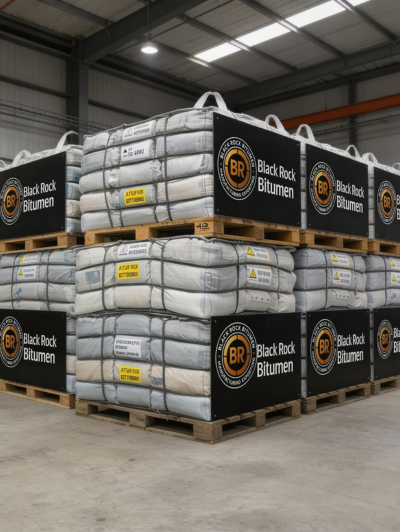
We deliver bitumen in versatile, secure options: economical Jumbo Bags, robust steel Drums, or high-volume Bulk Containers (Bitutainers/Bituboxes).
The buyer pays 30% advance, with the balance against B/L draft (CFR) or customs docs (FOB).
100% irrevocable, non-transferable, confirmed LC at sight, subject to bank approval by Black Rock Bitumen.
strong adhesion, superior load-bearing capacity, resistance to deformation, and long-lasting performance under extreme temperatures.
Viscosity grade bitumen (VG bitumen) is a petroleum binder classified by its absolute viscosity at 60°C rather than by needle penetration, under the IS 73:2013 standard. The grading system — VG10, VG20, VG30, VG40 — predicts how the binder will flow and perform at actual road-surface operating temperatures, making it the dominant grading system in India and increasingly specified across South Asia and parts of Africa.
Penetration grade bitumen is classified by hardness at 25°C (an ambient-temperature test), while viscosity grade bitumen is classified by flow resistance at 60°C and 135°C (operating-temperature tests). Viscosity grading (IS 73) is considered a more reliable predictor of road performance under heavy traffic and high surface temperatures than penetration grading (EN 12591/ASTM D946), which is why it's the required standard on most Indian government infrastructure tenders.
The number after "VG" indicates minimum absolute viscosity at 60°C, measured in poises — VG10 (800 poises) is the softest grade and VG40 (3,200 poises) is the stiffest. Higher VG numbers mean a harder, more heat-resistant binder suited to heavy traffic and hot climates; lower numbers mean a softer, more flexible binder suited to lighter traffic and cooler regions.
VG30 and VG40 are specified for high-temperature regions and heavy axle-load roads, including national highways and expressways across India, the Gulf, and Sub-Saharan Africa, because their higher viscosity resists rutting under sustained heat and load. VG40 in particular is the standard choice for airport runways and industrial pavements exposed to extreme surface temperatures.
VG10 and VG20 are specified for lower-traffic roads, surface dressing, and paver-mix applications where a softer, more workable binder is preferred. VG10 is also commonly used in cold-mix and spray-applied applications where flexibility matters more than heat resistance.
They're closely related but not identical: ASTM AC grades (AC-2.5 through AC-40) and IS 73 viscosity grades (VG10–VG40) both classify bitumen by viscosity at 60°C, but the acceptable value ranges and complementary test requirements differ between the two standards. Buyers should always confirm which standard — IS 73 or ASTM AC — their project specification requires before ordering, as the two aren't automatically interchangeable on paper.
The test measures a bitumen sample's resistance to flow at 60°C (simulating road-surface temperature) and 135°C (simulating mixing temperature) using a vacuum or rotational viscometer, with results expressed in poises. This method, governed by IS 1206 under the IS 73:2013 framework, gives a more direct read on high-temperature road performance than the penetration needle test used for EN/ASTM penetration grades.
Black Rock Bitumen ships viscosity grade bitumen in new steel drums (180kg), jumbo bags, and bulk bitutainers/bituboxes for tanker-free container shipping. Packaging choice depends on destination port infrastructure, order volume, and whether the buyer's site is equipped for bulk unloading — our team advises on the right format per shipment.

No products in the cart.