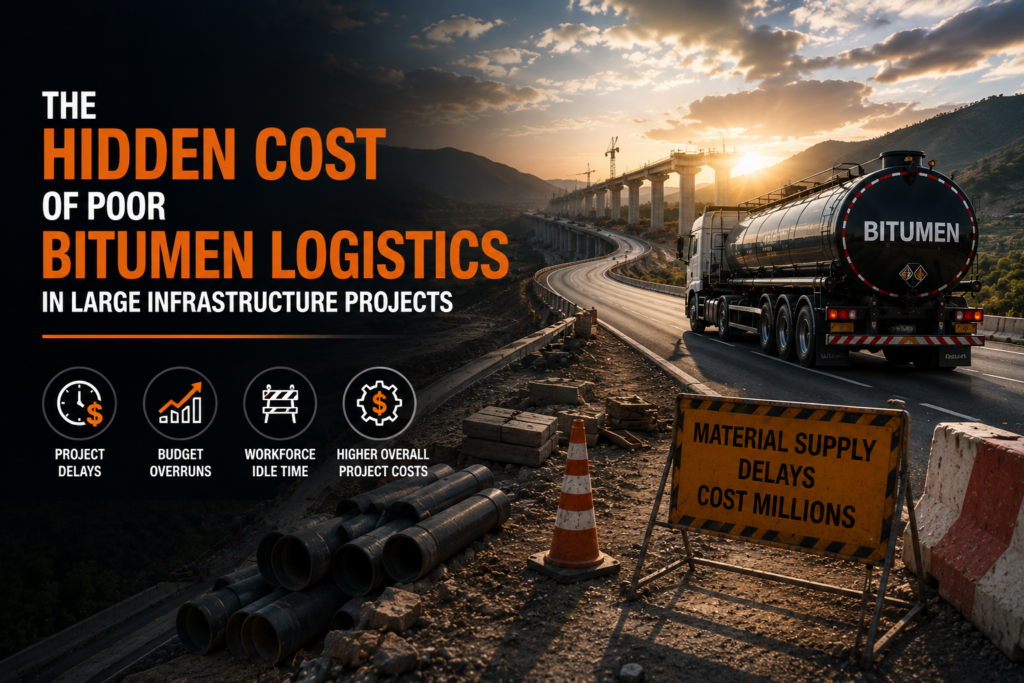
What happens when a $200 million road project gets delayed because bitumen shipments arrive five days late?
The answer is brutal.
Idle machinery. Labour costs piling up. Contract penalties. Asphalt plants shutting down. Entire paving schedules collapsing.
According to industry estimates, logistics inefficiencies can increase infrastructure project costs by 10% to 30% in developing markets. And in road construction — where timing, temperature, and material consistency matter — poor bitumen logistics can quietly destroy project profitability.
Most buyers focus heavily on bitumen price. Very few focus on supply chain reliability. That’s the mistake. Because the cheapest shipment often becomes the most expensive decision.
If you manage procurement for highways, airports, industrial zones, or government infrastructure projects across the UAE, Saudi Arabia, India, or Africa, this article matters. You’ll see exactly how poor logistics impact project costs, timelines, and asphalt quality — and how smart procurement teams avoid those losses before they happen.
Key Takeaways
- Poor bitumen logistics can increase total infrastructure project costs through delays, downtime, and emergency procurement
- Cheap suppliers often create expensive operational disruptions due to weak logistics systems
- Temperature control, storage infrastructure, and delivery coordination directly impact asphalt quality and road lifespan
- Procurement teams that buy bitumen in bulk should evaluate logistics capability as seriously as product pricing
- UAE-based exporters like Black Rock Bitumen offer strategic advantages through strong regional connectivity and export infrastructure
Why Bitumen Logistics Is More Important Than Most Buyers Realize
Bitumen isn’t like cement. It isn’t like steel. You can’t simply stockpile massive quantities indefinitely without considering handling conditions, heating systems, storage infrastructure, temperature stability, and delivery coordination.
Bitumen is highly sensitive to logistics execution. And once projects scale into thousands of tons per month, even small supply chain inefficiencies become expensive very quickly.
Here’s what usually happens when logistics planning fails:
- Asphalt plants stop production waiting for material
- Road paving schedules get pushed back
- Labour teams remain idle
- Heavy equipment rental periods increase
- Material quality degrades during improper transport
- Contractors face liquidated damages and penalties
- Fuel costs increase due to rushed operations
- Emergency procurement drives prices higher
Now multiply those delays across a six-month or two-year infrastructure project. That’s how millions disappear.
A single delayed shipment can affect:
- Site readiness
- Asphalt batching schedules
- Contractor coordination
- Government inspection timelines
- Equipment utilization rates
- Overall project completion dates
The ripple effect is enormous. And yet many procurement teams still choose suppliers based almost entirely on price per ton. The smartest infrastructure developers evaluate logistics capability with the same seriousness as product quality — that’s where experienced suppliers create long-term value.
The Real Financial Damage Caused by Poor Bitumen Logistics
Most infrastructure delays don’t begin on the construction site. They begin in the supply chain. Let’s break down the hidden costs most project owners underestimate.
1. Equipment Downtime Becomes a Silent Profit Killer
Road construction equipment is expensive. A single asphalt paver, milling machine, or batching plant sitting idle can cost thousands of dollars per day.
Consider this scenario: A contractor schedules paving operations for a major highway expansion. The workforce is ready. The equipment is deployed. Traffic diversions are approved. But the bitumen tanker shipment gets delayed at the port. Everything stops.
The contractor still pays for:
- Equipment leasing
- Operator wages
- Fuel standby costs
- Site supervision
- Traffic management teams
- Security and logistics staff
Even a 48-hour delay can create massive financial leakage. A reliable bitumen supplier UAE contractors can trust doesn’t just deliver material — they protect operational continuity.
2. Temperature Loss During Transit Impacts Asphalt Quality
Bitumen performance depends heavily on temperature consistency. Improper transportation methods can affect viscosity, workability, and application efficiency — creating serious paving risks.
Poor temperature control during long-distance transportation may lead to:
- Inconsistent asphalt mixing
- Reduced pavement bonding
- Premature cracking
- Reduced compaction quality
- Surface defects
- Shorter road lifespan
This becomes especially critical in hot climate regions like the UAE, Saudi Arabia, and parts of Africa. When logistics operators lack proper insulated tankers or coordinated delivery systems, material integrity suffers — and once low-quality asphalt gets laid, repair costs become exponentially higher.
3. Port Delays Trigger Chain-Reaction Cost Escalation
Large infrastructure projects depend on timing. Ports don’t. That mismatch creates problems. If customs documentation, vessel coordination, storage planning, or unloading schedules fail, projects can face weeks of disruption.
Common logistics bottlenecks include:
- Port congestion
- Delayed customs clearance
- Documentation errors
- Limited tanker availability
- Improper storage preparation
- Last-mile transportation gaps
Each delay compounds the next. Contractors begin emergency sourcing from alternate suppliers at higher prices — destroying procurement budgets. This is one reason experienced exporters like Black Rock Bitumen invest heavily in coordinated shipping schedules, export documentation management, and supply continuity planning.
4. Poor Inventory Planning Leads to Costly Panic Buying
Global crude fluctuations, refinery shutdowns, geopolitical disruptions, and seasonal demand spikes all affect availability. When procurement teams fail to forecast properly, they end up in emergency buying situations — and emergency procurement is almost always expensive.
Buyers suddenly face:
- Higher spot-market prices
- Limited product availability
- Inferior product alternatives
- Increased freight costs
- Delivery uncertainty
- Lower negotiating power
Strategic inventory planning changes everything. Reliable suppliers help buyers maintain stable supply pipelines instead of reacting to shortages — and predictability protects margins.
Why Cheap Bitumen Often Becomes the Most Expensive Option
Every procurement manager has faced this pressure. One supplier quotes slightly lower. The finance department pushes for cost savings. The cheaper option wins. Then the problems begin.
The issue isn’t always the bitumen itself. The issue is usually the ecosystem behind the product. Low-cost suppliers often cut corners in areas buyers don’t initially see — such as:
- Weak logistics coordination
- Poor tanker infrastructure
- Inconsistent shipment timelines
- Limited export experience
- Inadequate quality monitoring
- Weak communication during transit
- Minimal contingency planning
The visible price looks attractive. The hidden operational costs don’t. A delayed project can erase every “saved” dollar instantly — especially for buyers who purchase bitumen in bulk for long-duration infrastructure developments. The best procurement teams optimize total project cost, not just invoice cost.
The 5 Logistics Factors Smart Infrastructure Buyers Evaluate Before Choosing a Supplier
Most procurement mistakes happen before the first shipment even leaves the refinery. Here’s what experienced project heads and infrastructure developers evaluate before signing large-volume contracts.
1. Export Capability and Regional Supply Experience
Export logistics are complex — especially across the Middle East, India, and African markets. Suppliers must understand regional compliance requirements, port handling procedures, cross-border documentation, vessel coordination, import regulations, and local transportation networks. A supplier with strong export systems can reduce delays dramatically. Regional familiarity reduces operational surprises, and infrastructure projects hate surprises.
2. Storage and Tank Infrastructure
Bitumen storage quality directly impacts delivery consistency. Professional suppliers invest in:
- Heated storage tanks
- Temperature monitoring systems
- Controlled handling procedures
- Bulk loading infrastructure
- Tank maintenance protocols
Without these systems, product quality risks increase — especially for high-volume projects requiring continuous daily dispatch.
3. Fleet Coordination and Delivery Planning
Late deliveries aren’t always caused by product shortages — sometimes transportation coordination is the problem. Strong logistics suppliers plan route optimization, tanker availability, delivery sequencing, backup transportation support, emergency dispatch coordination, and peak-demand scheduling. Reliable transportation planning keeps asphalt plants operational, and operational continuity protects profitability.
4. Communication and Supply Visibility
Buyers don’t just need material — they need visibility. Professional suppliers provide:
- Shipment tracking updates
- Accurate ETAs
- Proactive delay notifications
- Port clearance coordination
- Delivery documentation support
- Dedicated account management
Clear communication reduces operational chaos. Project teams can adjust schedules proactively instead of reacting blindly.
5. Quality Consistency Across Multiple Shipments
Large infrastructure projects involve repeated deliveries over months or years. If viscosity, penetration grade, or performance characteristics vary significantly between shipments, asphalt quality becomes inconsistent — creating pavement durability risks. Professional suppliers maintain strict quality control systems because infrastructure projects require repeatability.
How Poor Bitumen Logistics Impacts Road Lifespan
Most buyers think logistics only affect timelines. That’s not true. Logistics can directly impact pavement performance. If temperature control fails or contamination occurs during transportation, road durability suffers.
Common consequences include:
- Rutting
- Surface bleeding
- Thermal cracking
- Pothole formation
- Reduced skid resistance
- Water penetration damage
According to global infrastructure studies, poor road quality increases maintenance spending significantly within the first five years of operation. For government-funded projects, that creates political pressure. For private developers, it destroys ROI. Long-term pavement performance starts with logistics discipline.
Why UAE-Based Suppliers Hold a Strategic Advantage
The UAE has become one of the most important global hubs for bitumen exports — and that’s not accidental. Its geographic positioning creates major logistical advantages for infrastructure buyers across Asia and Africa.
A strong bitumen supplier UAE exporters rely on can offer:
- Faster shipping access to multiple regions
- Better port infrastructure
- Stronger export ecosystems
- Higher supply flexibility
- Efficient international trade connectivity
- Reliable marine logistics
Suppliers operating from the UAE can often respond faster to demand fluctuations compared to suppliers in less connected export markets. Black Rock Bitumen operates within this strategic export ecosystem, helping contractors and infrastructure developers maintain reliable supply continuity across demanding project environments.
A Real-World Scenario: How One Delayed Shipment Can Derail an Entire Project
A contractor in East Africa secures a government highway resurfacing project requiring 18,000 tons of penetration grade bitumen over eight months. The selected supplier offers lower pricing but lacks coordinated export logistics.
Here’s what happens:
- Two shipments arrive late due to documentation errors
- Asphalt production slows down repeatedly
- Labour teams remain idle for days
- Heavy equipment rental periods extend
- Local authorities pressure the contractor over delays
- Emergency procurement increases costs by 22%
- Final completion misses the contractual deadline
Now compare that to a supplier with coordinated export operations, proper shipment planning, and proactive communication. The original product price may be slightly higher — but the total project cost becomes dramatically lower. Procurement success isn’t about buying cheaper material. It’s about preventing expensive disruptions.
What High-Performance Procurement Teams Do Differently
The best infrastructure procurement managers think beyond purchasing — they think operationally. Instead of asking “How cheap can we buy?”, they ask “How reliably can we execute?”
Long-Term Supplier Partnerships
Transactional sourcing creates instability. Strategic supplier relationships create continuity. Reliable long-term suppliers understand project timelines, consumption patterns, and operational priorities — improving planning efficiency over time.
Forecast-Based Procurement Planning
Instead of reactive buying, strong teams forecast demand months ahead. That reduces emergency sourcing risks and improves pricing stability.
Multi-Layer Logistics Evaluation
Professional buyers evaluate port capabilities, storage infrastructure, fleet reliability, documentation processes, shipment lead times, and backup supply capacity — not just product specifications.
Operational Communication Systems
Suppliers who communicate proactively reduce operational uncertainty significantly — improving scheduling accuracy across the entire construction chain.
Why Black Rock Bitumen Focuses Heavily on Logistics Reliability
Most suppliers talk about product quality. Very few talk deeply about logistics execution. But for large infrastructure projects, logistics reliability is part of product quality.
Black Rock Bitumen serves infrastructure, construction, and road development sectors across the Middle East, Asia, and Africa with a strong emphasis on:
- Consistent supply continuity
- Coordinated export operations
- Bulk shipment planning
- Reliable delivery scheduling
- Quality-focused handling systems
- Responsive communication support
For contractors and developers who buy bitumen in bulk, reliability becomes a competitive advantage — because every uninterrupted paving day protects profitability, and every avoided delay protects project reputation.
The Future of Infrastructure Procurement Will Reward Reliable Supply Chains
Infrastructure demand is growing rapidly across emerging markets. Governments are investing billions into highways, smart cities, airport expansions, industrial corridors, economic zones, and urban mobility projects. That means bitumen demand will continue rising — and demand growth also increases supply chain pressure.
Procurement teams that fail to secure reliable logistics partnerships will face increasing operational volatility. The next decade will reward suppliers and buyers who prioritize supply chain resilience, inventory visibility, regional logistics expertise, consistent product quality, and faster delivery coordination. Infrastructure execution is becoming more complex — and complexity punishes weak logistics.
The Bottom Line
Road projects don’t fail because of one dramatic mistake. They fail because of small operational breakdowns that compound over time — and poor logistics is one of the most expensive breakdowns in infrastructure development.
If you’re managing highways, industrial developments, airport projects, or large-scale paving operations, your supplier choice affects far more than material cost. It affects timelines, cash flow, project reputation, and long-term pavement performance.
That’s why experienced procurement teams prioritize reliability, coordination, and supply continuity when selecting a bitumen partner.
Contact Black Rock Bitumen today to discuss your project requirements, bulk supply needs, and export logistics planning.
Frequqently Asked Questions
1. What is bitumen and why is it critical for road construction?
Bitumen is a viscous, black hydrocarbon material derived from crude oil refining. It acts as the binding agent in asphalt, holding aggregates together to form a durable road surface. Its quality, temperature consistency, and timely supply are all critical to the structural integrity and longevity of paved roads, highways, and runways.
2. How much can poor bitumen logistics increase infrastructure project costs?
Industry estimates suggest that logistics inefficiencies can increase total infrastructure project costs by 10% to 30% in developing markets. In real-world scenarios, emergency procurement alone — triggered by delayed shipments — can increase procurement costs by as much as 22% on a single project.
Bitumen is a viscous, black hydrocarbon material derived from crude oil refining. It acts as the binding agent in asphalt, holding aggregates together to form a durable road surface. Its quality, temperature consistency, and timely supply are all critical to the structural integrity and longevity of paved roads, highways, and runways.
3. Why does temperature control during bitumen transport matter?
Bitumen must be maintained within a specific temperature range to preserve its viscosity and workability. If it cools excessively during transit, it becomes too thick to pump or mix effectively. If overheated, it can oxidize and lose its binding properties. Both scenarios lead to inconsistent asphalt mixes, poor compaction, and premature road failures such as rutting, cracking, or potholes.
4. What grades of bitumen are commonly used in large infrastructure projects?
The most commonly used grades include Penetration Grade Bitumen (60/70 and 80/100) for standard road surfacing, Viscosity Grade (VG-10, VG-30, VG-40) for high-temperature regions like the UAE and India, and PMB (Polymer Modified Bitumen) for high-traffic highways and airports. The right grade depends on climate, traffic load, and pavement design.
5. What should I look for in a reliable bitumen supplier for large projects?
Key factors to evaluate include: export experience in your target region, storage and tanker infrastructure quality, fleet coordination and delivery planning capability, real-time shipment visibility and communication, consistency of product quality across multiple deliveries, and ability to handle bulk volumes on long-term contracts. Price should be considered as part of total project cost, not in isolation.
6. Why is the UAE a strategic location for bitumen exports?
The UAE sits at a geographic crossroads between Asia, Africa, and Europe, giving it direct maritime access to major import markets. Its world-class port infrastructure — including Jebel Ali Port, one of the largest in the world — strong trade frameworks, and established export ecosystems make it one of the most efficient bitumen export hubs globally, reducing lead times and shipping costs for buyers across Asia and Africa.
7. How can procurement teams avoid emergency bitumen buying situations?
The best approach is forecast-based procurement planning — estimating demand months in advance and securing supply agreements with reliable exporters. Building long-term supplier relationships, maintaining buffer inventory, and monitoring global crude and refinery conditions also help procurement teams avoid last-minute spot-market purchases at inflated prices.
8. Does poor logistics only affect project timelines, or does it affect road quality too?
Both. Beyond delays, poor logistics — including inadequate temperature control, improper storage, and contamination during transit — directly degrades bitumen quality before it ever reaches the asphalt plant. This results in inconsistent asphalt mixes, weak pavement bonding, and reduced road lifespan, all of which drive up long-term maintenance costs significantly.
9. What is penetration grade bitumen and where is it used?
Penetration grade bitumen is classified based on how far a standard needle penetrates the material under set conditions. The most common grades — 60/70 and 80/100 — are widely used in road surfacing, highway construction, and industrial paving across the Middle East, Africa, and South Asia.
10. How do I get a bulk bitumen supply quote for my infrastructure project?
You can reach out directly to Black Rock Bitumen via their contact page to discuss your project's volume requirements, delivery timelines, grade specifications, and export destination. Their team works with contractors, developers, and government project teams across the UAE, Middle East, Asia, and Africa.

Content Writer, Global Bitumen Supply & Market Insights, Black Rock Bitumen
Farheen Fatima is an infrastructure materials writer specializing in bitumen supply, asphalt technology, and global road construction. He shares practical insights on bitumen grades, supplier evaluation, and international standards to help contractors and project teams make informed procurement decisions.