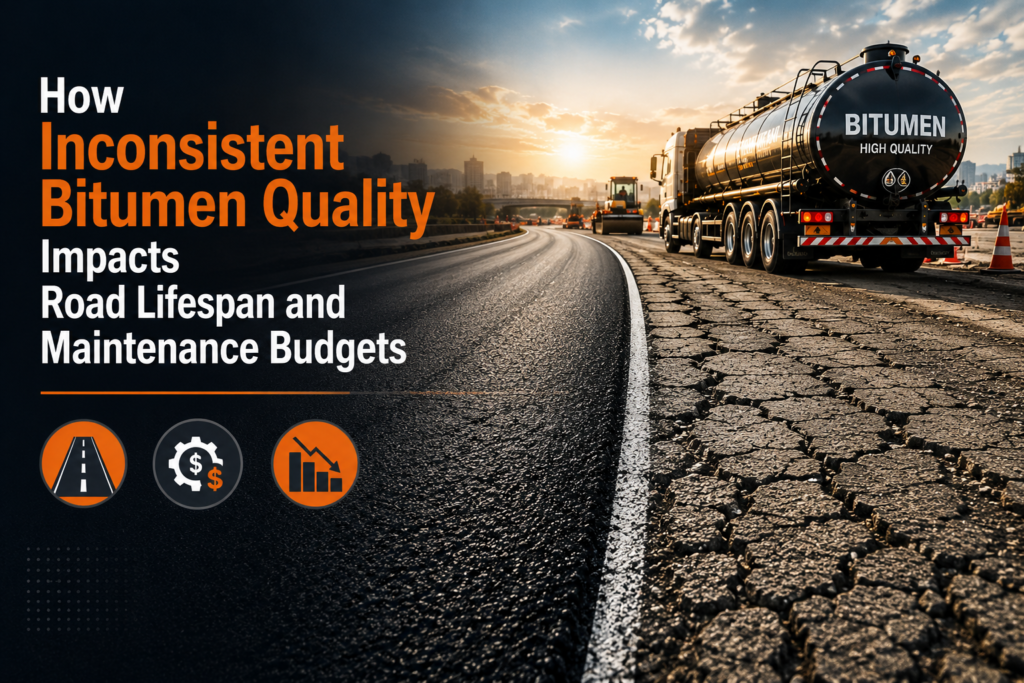
A poorly built road can start failing in less than two years. That’s not a design issue alone. In many cases, the real problem starts much earlier — with inconsistent bitumen quality.
According to multiple transportation studies across developing and high-temperature regions, premature pavement failures can increase road maintenance costs by 25% to 40% over the expected lifecycle of a project. For governments, infrastructure developers, and contractors, that means millions lost in repairs, traffic disruption, labor, and reputational damage.
And here’s the hard truth. Most road failures don’t happen because engineers lack expertise. They happen because procurement teams underestimate how much bitumen consistency actually matters.
If you buy bitumen in bulk from the wrong supplier, even a small variation in penetration value, viscosity, softening point, or aging resistance can shorten pavement life dramatically — especially in regions like the UAE, Saudi Arabia, India, and Africa where roads face:
- Extreme temperatures
- Heavy axle loads
- Long-haul freight traffic
- Sand abrasion
- Oxidation stress
- Seasonal monsoon exposure
That’s why infrastructure buyers are becoming far more selective about who they source from — and why working with a reliable bitumen supplier UAE has become a strategic decision, not just a procurement exercise.
In this guide, you’ll learn exactly how inconsistent bitumen quality affects road performance, project budgets, and long-term maintenance planning — and how to avoid those costly mistakes before they happen.
The Hidden Cost of Inconsistent Bitumen Quality
Most procurement decisions focus heavily on price. When you’re purchasing thousands of metric tons for a highway, airport, industrial zone, or municipal road project, even small cost differences per ton can appear significant. But cheaper bitumen often becomes exponentially more expensive later — because inconsistent quality creates hidden structural weaknesses inside the pavement that surface fast under real traffic conditions.
What Happens When Bitumen Quality Varies?
Road performance depends heavily on consistency. If one shipment differs slightly from another in viscosity, penetration grade, or thermal resistance, the pavement structure begins reacting unevenly under load and climate stress. That leads to:
- Premature cracking
- Rutting under heavy traffic
- Surface bleeding
- Moisture penetration
- Reduced skid resistance
- Oxidation and brittleness
- Pothole formation
Once those issues begin, maintenance costs escalate rapidly. A road designed for 12–15 years may require major rehabilitation within 5–7 years — destroying project economics entirely.
The Financial Impact Is Bigger Than Most Buyers Expect
According to international pavement management studies, reactive maintenance can cost up to 4–5 times more than preventive maintenance over a road’s lifecycle. Combine that with inconsistent bitumen quality and you’re suddenly dealing with:
- Increased resurfacing frequency
- Additional labor expenses
- Traffic diversion costs
- Delayed logistics movement
- Contract penalties
- Reduced contractor credibility
- Public safety concerns
For large highway projects, those overruns can easily reach millions — and the root cause often traces back to procurement decisions made months earlier. That’s why experienced contractors no longer evaluate suppliers based only on price. They evaluate consistency.
The cheapest bitumen shipment is often the most expensive long-term decision.
Why Roads Fail Faster in High-Temperature Markets
If you operate in the Middle East, India, or Africa, this becomes even more critical — because hot climates amplify every weakness in bitumen quality. Road temperatures in Gulf countries can exceed 70°C during peak summer conditions. At those temperatures, low-quality or inconsistent bitumen softens faster, creating permanent deformation under traffic.
Heat Resistance Is Non-Negotiable
A reliable asphalt binder must maintain structural integrity even under extreme thermal stress. If softening points vary across shipments, the pavement behaves inconsistently — some sections remain stable while others fail early. That inconsistency accelerates maintenance cycles and makes quality control significantly harder during mixing and paving operations.
Oxidation Happens Faster in Harsh Climates
Heat also accelerates oxidation. As bitumen oxidizes, it becomes stiffer and more brittle — leading to fatigue cracking and surface deterioration. Inferior-quality binders age faster, and once oxidation begins aggressively, pavement lifespan drops sharply. This is especially problematic in:
- Desert highways
- Industrial corridors
- Port access roads
- Mining transport routes
- Heavy logistics networks
That’s why premium-grade road construction bitumen matters so much in these regions. Harsh climates expose bitumen weaknesses faster than almost anything else.
The Procurement Mistake Most Infrastructure Buyers Make
Many procurement teams focus heavily on technical documentation. But paperwork alone doesn’t guarantee consistency. A supplier may provide compliant test reports while still delivering inconsistent batch quality across large-volume orders — and that’s where problems start.
Consistency Across Shipments Matters More Than Single Tests
One laboratory-approved sample means very little if future shipments vary. Large-scale infrastructure projects require stable material behavior across months of supply — especially when projects involve:
- National highways
- Smart city developments
- Airport expansions
- Industrial parks
- Municipal resurfacing programs
- Cross-border infrastructure corridors
If bitumen properties fluctuate between deliveries, asphalt mix performance becomes unpredictable — creating complications for plant calibration, compaction consistency, density achievement, pavement strength, and binder performance.
Supply Chain Stability Also Impacts Quality
Some suppliers source from multiple inconsistent origins depending on market pricing. That creates variation in chemical composition, aging behavior, viscosity performance, thermal sensitivity, and adhesion characteristics. Over time, those inconsistencies affect pavement durability. Reliable suppliers maintain stricter sourcing controls and quality verification systems — one reason international buyers increasingly prefer established bitumen exporters UAE with strong quality assurance processes.
A consistent supplier creates consistent roads.
The Solution Framework: How to Avoid Costly Bitumen Quality Problems
If you’re responsible for procurement, engineering, or infrastructure planning, here’s how to reduce long-term risk.
1. Prioritize Performance Consistency Over Lowest Price
Many projects still award contracts primarily based on short-term cost savings — and that approach usually backfires. A slightly lower upfront price means nothing if maintenance costs surge later. Instead, evaluate suppliers based on:
- Batch consistency
- Historical performance
- Export experience
- Technical support capability
- Quality documentation
- Supply chain reliability
- Regional climate compatibility
The goal is lifecycle value — not just invoice reduction. A road that lasts 15 years instead of 8 creates enormous savings by reducing maintenance frequency, labor requirements, material replacement, operational disruption, and traffic management costs. That’s why advanced infrastructure authorities increasingly evaluate total lifecycle performance rather than initial procurement cost alone.
2. Verify Penetration Grade Accuracy
Penetration grade directly affects pavement behavior, and incorrect grading can seriously damage road performance. Softer grades may deform excessively under heat. Harder grades may crack prematurely under load stress. Inconsistent penetration values create uneven pavement behavior across the entire structure.
Common grades used across infrastructure markets include:
- Penetration Grade 60/70
- Penetration Grade 80/100
- VG10, VG30, VG40
- Polymer Modified Bitumen (PMB)
- Oxidized bitumen for industrial applications
But selecting the correct grade is only part of the equation. Maintaining consistency within that grade matters even more — and this is where experienced suppliers separate themselves from commodity traders. A correct grade with inconsistent properties still creates road failures.
3. Demand Strong Quality Control and Laboratory Testing
Every serious supplier should have robust, consistent testing systems — not optional testing. You should expect verification for:
- Penetration value
- Softening point
- Ductility
- Flash point
- Viscosity
- Solubility
- Specific gravity
- Aging resistance
For major projects, third-party independent verification provides additional confidence — especially for government tenders and multinational infrastructure developments. Independent testing helps validate shipment consistency, reduce contractual disputes, improve compliance documentation, and protect all project stakeholders. This is particularly important when you buy bitumen in bulk for long-duration infrastructure projects. Testing is not a formality. It’s risk management.
4. Choose Suppliers With Export Infrastructure Experience
Bitumen handling is highly sensitive. Poor logistics can affect product integrity even before it reaches the asphalt plant. Improper heating, contamination, or handling during transport can alter bitumen characteristics, creating quality deviations that are invisible on paper but devastating in practice.
Reliable exporters maintain:
- Controlled storage systems
- Proper heating protocols
- Clean tanker operations
- Temperature monitoring
- Efficient port logistics
- Consistent loading procedures
This is one reason many international buyers work with a trusted bitumen supplier UAE serving large-scale export markets. The UAE’s strategic logistics infrastructure supports faster, more reliable regional distribution. Product quality means little if logistics compromise consistency.
5. Match Bitumen Type to Actual Traffic Conditions
Not all roads experience the same stress, and using the wrong binder for traffic intensity is a common and costly mistake. A rural access road has completely different performance demands compared to freight corridors, container terminal roads, airport pavements, industrial transport zones, or urban commercial highways.
As axle loads increase, pavement stress rises sharply, and inferior binders deform faster under repetitive loading — leading to rutting and structural fatigue. Infrastructure developers should evaluate:
- Average traffic volume
- Heavy vehicle percentages
- Axle load intensity
- Temperature exposure
- Rainfall conditions
- Surface drainage quality
Then select the appropriate binder solution accordingly. The wrong binder under heavy traffic guarantees shorter pavement life.
6. Build Long-Term Supplier Relationships Instead of Spot Buying
Spot purchasing based purely on market price creates instability — especially during periods of global oil volatility. Long-term supplier relationships typically provide:
- Better quality consistency
- Stable availability
- Technical collaboration
- Faster issue resolution
- Improved logistical planning
- Stronger accountability
Top-performing contractors don’t treat bitumen as a commodity. They treat it as a strategic performance material. That mindset shift alone improves long-term project outcomes significantly. Strong supplier partnerships reduce both operational and financial risk.
Why Black Rock Bitumen Stands Out in Competitive Infrastructure Markets
There’s no shortage of suppliers in the global market. But consistency is where true differentiation happens. Black Rock Bitumen focuses heavily on reliability, export quality, and long-term infrastructure performance — because large-scale projects cannot afford material unpredictability.
A Strong Focus on Quality Consistency
One of the biggest concerns buyers face is shipment variation. Black Rock Bitumen addresses that through controlled sourcing, quality verification, and strict handling processes — delivering stable performance across every shipment. That’s especially important for contractors managing multi-phase highway projects, government infrastructure contracts, airport developments, municipal resurfacing programs, and industrial transport networks.
Export Capability Across Key Global Markets
As a growing bitumen exporter serving the Middle East, Asia, and Africa, Black Rock Bitumen understands the logistical demands of international supply — including bulk order coordination, timely shipment planning, consistent documentation, export compliance, and reliable loading operations. For buyers handling large procurement volumes, operational reliability becomes just as important as material quality.
Supporting Infrastructure Growth Across Regions
Road infrastructure investment continues accelerating across Saudi Arabia, UAE, India, East Africa, West Africa, and emerging industrial corridors. As governments push economic expansion through transportation development, demand for reliable road construction materials keeps rising — and that’s where dependable suppliers gain long-term trust.
Infrastructure projects succeed when material consistency and supply reliability work together.
Real-World Scenario: How Inconsistent Bitumen Can Derail a Highway Project
A contractor wins a major highway resurfacing project connecting an industrial port to a logistics corridor. The project involves thousands of tons of asphalt. Traffic loads are extremely heavy. Temperatures regularly exceed 45°C. Procurement chooses a low-cost supplier to reduce upfront expenses — on paper, the technical specifications appear compliant.
But six months later, problems begin emerging. Truck lanes start deforming under heat and axle pressure. Surface cracking appears. Water infiltration follows during seasonal rainfall. Maintenance crews are forced to intervene.
The contractor now faces:
- Emergency repair expenses
- Traffic disruption complaints
- Additional labor deployment
- Asphalt replacement costs
- Reputation damage
- Potential contract penalties
The initial procurement savings disappear completely — and total lifecycle costs become dramatically higher.
Now compare that with a scenario where the contractor sourced from a reliable bitumen supplier UAE focused on consistency and performance verification. The pavement maintains stability longer. Maintenance cycles extend. Operational disruption decreases. And long-term project economics improve substantially.
The real cost of low-quality bitumen appears after the road opens to traffic.
Why Infrastructure Buyers Are Becoming More Quality-Focused
The global infrastructure landscape is changing. Governments and developers are under pressure to build roads that last longer with lower maintenance costs — and procurement standards are evolving to reflect that.
Across major infrastructure sectors, decision-makers increasingly focus on lifecycle performance, asset longevity, reduced rehabilitation costs, sustainability goals, and operational efficiency. This is especially true for smart city projects, industrial expansion corridors, mega transport infrastructure, and public-private partnerships.
Sustainability Is Also Driving Better Material Selection
Frequent road repairs create significant environmental costs too. More maintenance means higher fuel consumption, additional raw material usage, increased emissions, greater construction waste, and repeated traffic congestion. Longer-lasting pavements reduce all of those impacts — making high-quality bitumen selection both an economic and sustainability decision.
Durable roads are becoming both a financial and environmental priority.
The Long-Term Advantage of Choosing the Right Supplier
A dependable supplier does more than deliver material — they help reduce uncertainty. And in infrastructure projects, uncertainty is expensive.
The best suppliers contribute value through:
- Consistent product quality
- Technical guidance
- Stable logistics
- Export expertise
- Documentation support
- Faster response times
- Long-term accountability
Civil engineers can design excellent roads — but pavement performance still depends heavily on material consistency. That’s why procurement and engineering teams increasingly collaborate more closely during supplier selection. The conversation is no longer “Who offers the lowest rate?” It’s “Who can consistently support long-term pavement performance?” That shift is reshaping the global bitumen market.
Reliable suppliers reduce both technical and financial risk.
Key Takeaways
- Inconsistent bitumen quality significantly shortens road lifespan and increases maintenance budgets
- High-temperature regions like the UAE, Saudi Arabia, India, and Africa expose material weaknesses faster
- Batch consistency matters more than isolated laboratory reports
- Choosing the lowest-cost supplier often leads to far higher lifecycle expenses
- Strong quality control, export handling, and supplier reliability directly impact pavement durability
- Long-term supplier partnerships improve operational stability and project outcomes
- Working with an experienced bitumen supplier UAE helps reduce quality and logistical risks
Ready to Source Reliable Bitumen for Your Next Infrastructure Project?
Road performance starts long before asphalt reaches the pavement. It starts with the quality and consistency of the bitumen you choose.
If you’re planning a highway project, municipal resurfacing program, industrial corridor, airport expansion, or large-scale infrastructure development, material reliability cannot be an afterthought. Black Rock Bitumen supplies high-quality bitumen solutions for contractors, infrastructure developers, and government projects across the Middle East, Asia, and Africa.
Whether you need to buy bitumen in bulk, secure long-term supply support, or source dependable export-grade materials, the team focuses on consistency, reliability, and operational efficiency.
The difference between a road that lasts 15 years and one that fails in 5 often comes down to a single decision. Choose the supplier that protects your long-term investment.
Contact Black Rock Bitumen today to discuss your project requirements, request technical specifications, or receive a competitive bulk supply quotation.
Frequently Asked Questions
1. How does inconsistent bitumen quality affect road lifespan?
When bitumen properties such as viscosity, penetration value, or softening point vary between shipments, the pavement structure reacts unevenly under traffic and temperature stress. This leads to premature cracking, rutting, surface bleeding, and moisture penetration — reducing a road's expected lifespan from 12–15 years down to as little as 5–7 years in severe cases.
2. What is the financial impact of using low-quality bitumen on infrastructure projects?
According to international pavement management studies, reactive maintenance can cost 4–5 times more than preventive maintenance over a road's lifecycle. Poor bitumen quality triggers emergency repairs, increased labor costs, traffic diversion expenses, and potential contract penalties — easily erasing any savings made during procurement and pushing total lifecycle costs significantly higher.
3. Which bitumen grades are most suitable for high-temperature regions like the UAE and Saudi Arabia?
For high-temperature environments, Viscosity Grade bitumen (VG-30 and VG-40) is commonly recommended as it offers better resistance to heat-induced deformation. For heavily trafficked roads or highways, Polymer Modified Bitumen (PMB) provides superior rutting resistance and durability. The right grade always depends on specific climate conditions, traffic loads, and pavement design requirements.
4. What laboratory tests should I request when sourcing bitumen for a large infrastructure project?
At minimum, you should request test results for penetration value, softening point, ductility, flash point, viscosity, solubility, specific gravity, and aging resistance. For major government or multinational projects, independent third-party testing across multiple production batches provides the strongest quality assurance and protects all project stakeholders.
5. Why does bitumen quality vary between shipments from the same supplier?
Variation can occur due to sourcing from multiple refineries or crude oil origins, inconsistent storage conditions, temperature fluctuations during transport, contamination during loading or unloading, and inadequate quality monitoring between production batches. Suppliers with strict sourcing controls, controlled storage infrastructure, and consistent testing protocols significantly reduce this risk.
6. What is Polymer Modified Bitumen (PMB) and when should it be used?
PMB is bitumen enhanced with polymer additives — typically SBS (Styrene-Butadiene-Styrene) or EVA — to improve elasticity, rutting resistance, and thermal stability. It is recommended for high-traffic highways, airport runways, heavy freight corridors, and any application where standard penetration grade bitumen would be insufficient under extreme load or temperature conditions.
7. How does climate affect the choice of bitumen grade for road construction?
Climate is one of the most critical factors in binder selection. In hot regions, softer grades can deform and rut under traffic, requiring stiffer or polymer-modified binders. In cooler or wet climates, harder grades can become brittle and crack under thermal stress. Matching the binder to the local climate, combined with traffic load analysis, is essential for achieving the design service life of any pavement.
8. Why is it better to build a long-term relationship with a bitumen supplier rather than spot buying?
Long-term supplier relationships provide better batch-to-batch consistency, stable pricing, priority supply during periods of market shortage, faster technical support, and stronger accountability. Spot purchasing — especially during oil market volatility — often results in sourcing from unfamiliar suppliers with unverified quality records, creating unpredictable material behavior and higher project risk.
9. How can I verify that a bitumen supplier maintains quality across large bulk orders?
Ask for quality test certificates for every production batch — not just one-time approvals. Verify that the supplier sources consistently from the same refinery or origin. Request references from previous large-scale infrastructure projects. Consider engaging independent third-party inspectors for shipment verification, especially for long-duration government or multinational contracts.
10. How do I get a bitumen quality consultation or bulk supply quote from Black Rock Bitumen?
You can reach the team directly through the Black Rock Bitumen contact page to discuss your project specifications, required grades, volume requirements, and delivery timelines. Their team serves contractors, infrastructure developers, and government project teams across the UAE, Middle East, Asia, and Africa.

Content Writer, Global Bitumen Supply & Market Insights, Black Rock Bitumen
Farheen Fatima is an infrastructure materials writer specializing in bitumen supply, asphalt technology, and global road construction. He shares practical insights on bitumen grades, supplier evaluation, and international standards to help contractors and project teams make informed procurement decisions.