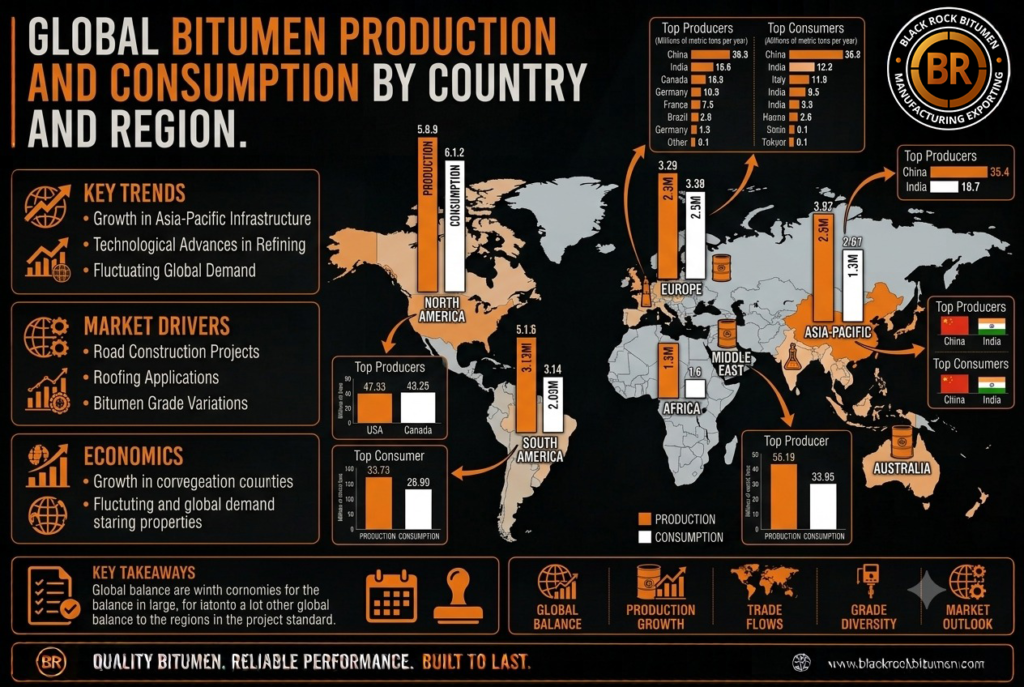
Where is the world’s bitumen actually produced? And which countries consume the most?
Those questions sound straightforward until you look at how the market works. Bitumen is produced as part of petroleum refining, consumed mainly through road construction and maintenance, and traded across borders when domestic supply does not match local demand.
The result is a global market with several different patterns: some countries are major producers, some are large consumers, some rely heavily on imports, and some sit in the middle as important export or transit hubs.
For buyers in Africa, South America and Southeast Asia, understanding these patterns is useful because global production and trade influence availability, freight routes, sourcing options and ultimately delivered cost.
The latest comparable country-level data available for 2024 shows that **China and the United States were the two largest petroleum-bitumen producers**, while China and the United States were also among the largest consumers. Market-research estimates put Asia Pacific ahead of other regions in overall bitumen demand. citeturn0search6turn0search1
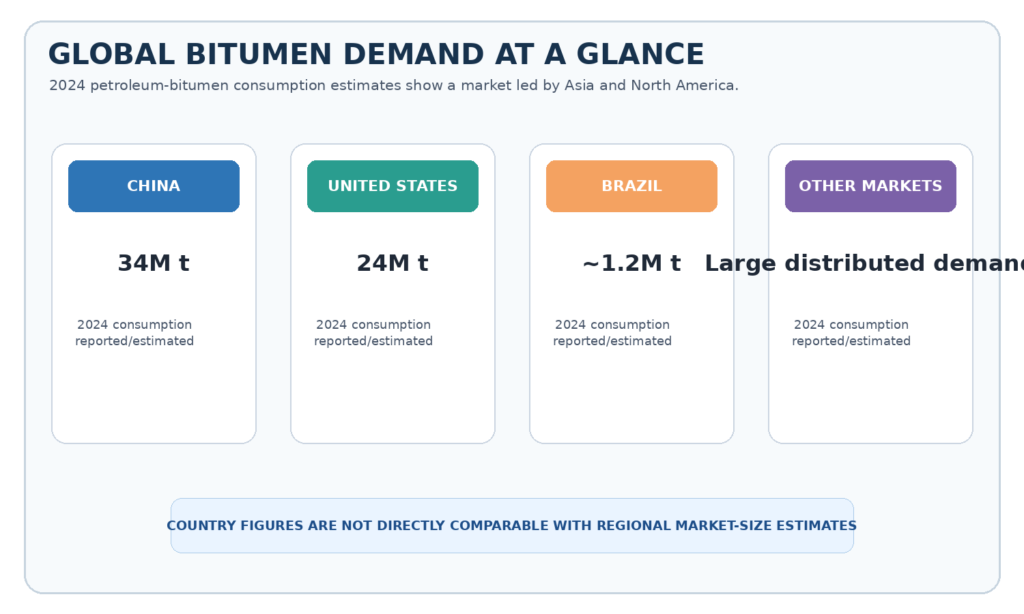
Alt text: Colour infographic showing 2024 petroleum-bitumen consumption leaders, including China at about 34 million tonnes and the United States at about 24 million tonnes, with other major markets shown separately.
How Big Is the Global Bitumen Market?
There is no single global database that gives a perfectly clean production-and-consumption number for every country because definitions and reporting systems differ.
For petroleum bitumen, one 2024 market dataset estimated global consumption at roughly **100 million tonnes**, with China at about 34 million tonnes and the United States at about 24 million tonnes. The same source estimated China, the United States and India at a combined 52% of global consumption; for this article, India is intentionally excluded from the discussion to match Black Rock Bitumen’s target-market focus. citeturn0search6
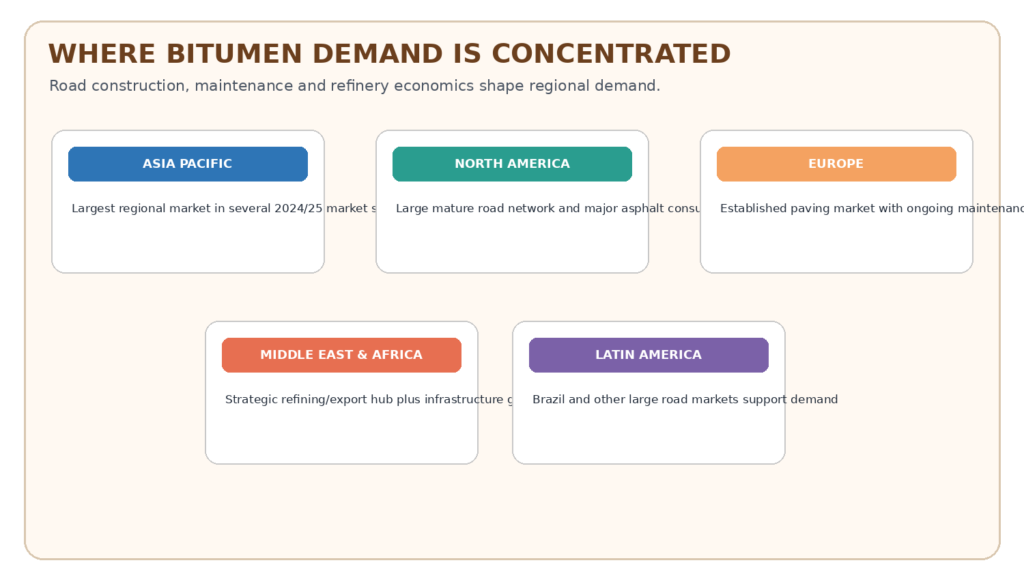
A separate market study uses a narrower definition of “primary bitumen demand” and estimated **132 million tonnes across five major regions in 2025**: 41 million tonnes in Asia Pacific, 31 million tonnes in Europe, 25 million tonnes in North America, 20 million tonnes in the Middle East and Africa, and 15 million tonnes in Latin America. Because the methodologies differ, these figures should be treated as market-study estimates rather than directly combined with the country data above. citeturn0search1
That distinction matters. When comparing bitumen statistics, always check whether the source is measuring petroleum bitumen, asphalt articles, apparent consumption, primary demand, market size or another category.
**Data note — read this before the numbers:** bitumen statistics are unusually easy to misread because different sources measure different things. This article uses **one 2024 petroleum-bitumen dataset for country-level production and consumption** and **World Bank WITS/UN Comtrade data for 2024 petroleum-bitumen trade under HS 271320**. The two datasets are kept separate. They are not added together and they are not treated as interchangeable measures of market size.
That distinction matters because a source may report petroleum bitumen, asphalt/bitumen articles, apparent consumption, primary demand or market value. A trade database records reported cross-border shipments; a market dataset may estimate domestic production and consumption. The figures below are therefore best used for **relative scale, sourcing context and trade patterns**, not as a single perfectly reconciled global balance.
| Country | 2024 petroleum-bitumen production | Position in global market |
| China | ~31 million tonnes | Largest producer in the cited 2024 dataset |
| United States | ~19 million tonnes | Second-largest producer |
| Brazil | Major producer / regional supplier | Important Latin American market |
| Other producing countries | Distributed across Europe, Asia, Middle East and the Americas | Supply regional and export markets |
For buyers in Africa, South America and Southeast Asia, the practical question is not simply who produces the most. It is where reliable supply exists, where imports are entering, which grades are available and how freight and storage affect delivered cost.
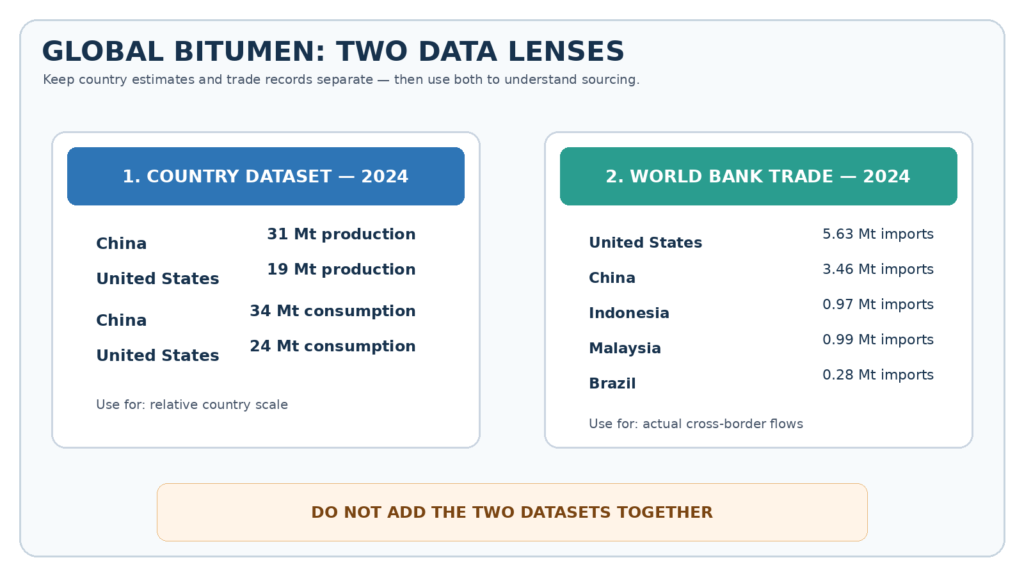
Alt text: Global bitumen data infographic showing two separate 2024 data lenses: country-level production and consumption estimates for China and the United States, and World Bank petroleum-bitumen import quantities for major markets including the United States, China, Indonesia, Malaysia and Brazil.
The 2024 dataset estimated **31 million tonnes of production in China and 19 million tonnes in the United States**, with the two together representing roughly 37% of the production reported in that dataset. citeturn0search6
Production figures should not automatically be interpreted as export capacity. A country can produce large volumes while consuming most of them domestically.
The United States: A Major Producer and Consumer
The United States is one of the world’s largest petroleum-bitumen markets. The 2024 dataset estimated consumption at around **24 million tonnes** and production at around **19 million tonnes**. citeturn0search6
The country also appears prominently in international trade data. World Bank WITS data for 2024 recorded petroleum-bitumen imports of about **5.63 billion kg**, or 5.63 million tonnes, for the United States. citeturn0search7
That illustrates an important point: domestic production and imports can coexist. Regional supply, refinery economics, product grades, project locations and logistics all influence trade flows.
China: The World’s Largest Production and Consumption Market
China sits at the centre of the global petroleum-bitumen market.
There is no single global database that gives a perfectly clean production-and-consumption number for every country. The 2024 country dataset used here estimated global petroleum-bitumen consumption at roughly **100 million tonnes**, with China at about **34 million tonnes** and the United States at about **24 million tonnes**. We do **not** use the earlier 52% three-country calculation because it depended on a country that is outside this article’s target-market discussion and created an arithmetic distraction. The important point is the scale of the two largest markets, not an artificially precise global-share calculation.
As a cross-check on the U.S. figure, a separate 2022 industry estimate cited in recent technical literature put U.S. asphalt-binder consumption at about **27.4 million tons**. That difference illustrates why country estimates should be treated as estimates and why this article uses the cited 2024 dataset consistently rather than mixing years or constructing a false-precision global total. citeturn0search18
For international suppliers, China’s scale demonstrates how road investment and refinery supply can create enormous domestic demand even in a country with significant production of its own.
Brazil and Latin America
Brazil is particularly important for South American bitumen demand.
Country 2024 petroleum-bitumen production
Position in the cited 2024 dataset
China ~31 million tonnes — largest producer
United States ~19 million tonnes — second-largest producer
Brazil — major Latin American producer / regional supplier
Other producing countries — distributed across Europe, Asia, the Middle East and the Americas
The 2024 dataset estimated about **31 million tonnes of production in China and 19 million tonnes in the United States**. Together, those two countries account for roughly 37% of the production reported in that dataset. Production should not automatically be interpreted as export capacity: domestic consumption may absorb most output.
North America: High Consumption with Strong Domestic Supply
North America remains one of the largest bitumen-consuming regions because of its extensive road network and large annual asphalt production.
The United States: A Major Producer and Consumer
The United States is one of the world’s largest petroleum-bitumen markets. The 2024 country dataset used in this article estimated consumption at around **24 million tonnes** and production at around **19 million tonnes**. A separate 2022 industry estimate puts U.S. asphalt-binder consumption at about 27.4 million tons, reinforcing the point that published estimates vary with year and methodology. We therefore use the 2024 dataset consistently for the country comparison and avoid presenting the number with false precision.
World Bank WITS/UN Comtrade data recorded U.S. petroleum-bitumen imports of about **5.63 million tonnes in 2024**. Domestic production and imports can coexist because regional supply, refinery economics, grade availability, project location and logistics all influence trade flows.
The Middle East plays an important role in global bitumen supply because of its refinery base and access to crude. At the same time, infrastructure development across the wider Middle East and Africa region creates substantial demand.
The 2025 regional estimate used in this article put Middle East and Africa primary bitumen demand at around **20 million tonnes**, representing a significant share of the five-region total. citeturn0search1
For Africa, the opportunity is particularly interesting because demand can be disconnected from domestic refinery production. Road expansion, rehabilitation, airports, industrial zones and port infrastructure can require imported paving binders where local supply is limited.
That makes reliable marine logistics and regional distribution important competitive factors for suppliers operating from the Gulf.
China: The World’s Largest Production and Consumption Market
China sits at the centre of the petroleum-bitumen market in the 2024 country dataset, with production of about **31 million tonnes** and consumption of about **34 million tonnes**. World Bank trade data also recorded about **3.46 million tonnes of petroleum-bitumen imports in 2024**. The figures show why a country can be a major producer and still remain an important import market.
Asia Pacific is consistently identified as the largest regional bitumen market in current market studies.
The cited 2024/25 market analysis estimated Asia Pacific at **30.36% of global bitumen market share in 2024**, with the region forecast to grow at about **4.31% CAGR from 2025 to 2032**. A separate 2025 demand estimate placed Asia Pacific primary bitumen demand at about **41 million tonnes**. citeturn0search1
Large road networks, urbanisation, highway construction and recurring pavement maintenance support the region’s scale.
Southeast Asia is particularly relevant for international suppliers because countries such as Indonesia and Malaysia participate in both consumption and regional trade. World Bank data recorded Indonesia importing about **970,461 tonnes of petroleum bitumen in 2024**, while Malaysia imported about **991,349 tonnes**. citeturn0search7
These import volumes illustrate why Southeast Asia is not simply a production story. Regional buyers can rely on imports to supplement domestic refining and supply.
Brazil and Latin America
| Region | 2025 primary bitumen demand estimate | Market position / trend |
| Asia Pacific | 41 million tonnes | Largest regional demand block; strong growth outlook |
| Europe | 31 million tonnes | Large mature market driven heavily by maintenance and infrastructure |
| North America | 25 million tonnes | Large established road network and asphalt market |
| Middle East & Africa | 20 million tonnes | Refining/export importance plus infrastructure growth |
| Latin America | 15 million tonnes | Large regional demand led by major South American markets |
| Total across these five regions | 132 million tonnes | Methodology-specific market estimate |
Brazil is particularly important for South American bitumen demand, but its position should be described carefully. A 2024 regional market analysis estimated Brazil’s petroleum-bitumen consumption at about **2.3 million tonnes**, making it the largest consuming country in Latin America and the Caribbean in that dataset. Mexico followed at about 1.2 million tonnes. citeturn0search12
World Bank WITS data provides a different but complementary view: Brazil imported about **281,403 tonnes of petroleum bitumen in 2024** and exported about **33,856 tonnes**. Those trade figures should not be treated as total domestic consumption; they simply show the role of cross-border supply in the market. citeturn0search3turn0search11
For suppliers targeting South America, Brazil is therefore a meaningful anchor market, while neighbouring markets such as Uruguay, Paraguay and Bolivia also appear in Brazil’s regional export flows. Road rehabilitation, highways, ports and urban infrastructure can create demand beyond the headline national production number.
A country’s production figure tells you how much it makes. Consumption tells you how much its market uses. Imports and exports explain how the gap is filled.
A country producing 5 million tonnes and consuming 3 million tonnes may have export potential. A country producing 5 million tonnes but consuming 7 million tonnes may need imports.
This is why procurement teams should look beyond production rankings when deciding where to source.
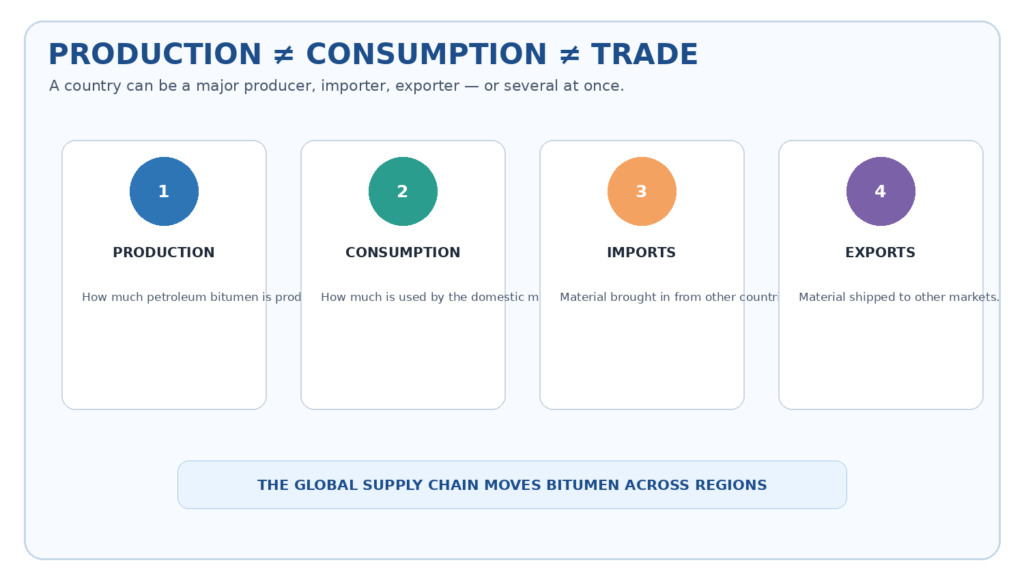
Alt text: Colour infographic explaining the difference between bitumen production, domestic consumption, imports and exports, showing how the four measures describe different parts of the global supply chain.
Regional Demand: Use Trade and Infrastructure Together
Rather than combine a separate 2025 regional-demand study with the 2024 country dataset, this article uses reported 2024 petroleum-bitumen trade to show where imported material is actually entering markets. That is more useful for an international supplier because imports reveal a real cross-border procurement flow.
| 2024 petroleum-bitumen importer | Approx. import quantity | What it indicates |
| United States | 5.63 million tonnes | Large domestic market supplemented by imports |
| China | 3.46 million tonnes | Very large market despite major domestic production |
| Indonesia | 0.97 million tonnes | Significant Southeast Asian import demand |
| Malaysia | 0.99 million tonnes | Significant regional import activity |
| France | 0.91 million tonnes | Large European import market |
| Turkey | 0.98 million tonnes | Significant regional import demand |
For Southeast Asia, World Bank data recorded approximately **970,461 tonnes of petroleum-bitumen imports into Indonesia** and **991,349 tonnes into Malaysia** in 2024. These volumes demonstrate the importance of imported supply alongside domestic production. citeturn0search7
For Africa, the same WITS dataset shows significant import activity in individual markets, including Algeria, Morocco and Nigeria. Country-by-country trade data is more useful than treating the entire Middle East and Africa region as one market because procurement conditions, refining capacity and infrastructure investment vary widely. citeturn0search4
For South America, Brazil’s 2024 petroleum-bitumen imports of about 281,000 tonnes provide a concrete trade indicator, while its exports show regional flows into neighbouring markets. This is a better procurement signal than describing Brazil simply as a global top-three consumer. citeturn0search3turn0search11
What Is Driving Global Bitumen Consumption?
1. Road construction
New highways, urban roads, bypasses and logistics corridors remain major consumers of asphalt binder.
Singapore and Gulf Storage Hubs: Why Trade Routes Matter
Production rankings do not tell the whole supply-chain story. Singapore is a major regional trading and logistics centre for petroleum products, and companies operating there explicitly trade asphalt/bitumen across networks covering Southeast Asia, South Asia, the Middle East, Australia and East Africa. citeturn0search0turn0search8
For buyers in Southeast Asia, Singapore’s location and marine infrastructure can therefore matter even when the material originates elsewhere. The same principle applies to Gulf export hubs: refinery supply, heated storage, terminal access and marine freight can connect Middle Eastern production with East African and other international markets.
For Black Rock Bitumen, this is where Dubai becomes commercially relevant. **Black Rock Bitumen operates from Dubai as an export-oriented supplier**, so Gulf logistics and regional marine distribution are part of the practical sourcing conversation — not just background market statistics. Buyers should compare grade availability, shipment format, destination port, storage requirements and landed cost rather than refinery-gate price alone.
4. Freight and logistics
As freight traffic grows, road networks need rehabilitation and stronger pavement structures, supporting demand for appropriate binders.
5. Refinery economics
Bitumen supply depends partly on refinery configuration and the availability and characteristics of heavy residue. Changes in crude slates and refinery operations can affect regional availability.
Why Regional Demand Does Not Always Follow Population
Bitumen consumption is closely tied to infrastructure intensity, not simply population.
What This Means for Africa, South America and Southeast Asia
These regions have different market structures, but all three can be influenced by international supply. In Africa, imported bitumen can support projects where local refining capacity or grade availability is insufficient. In South America, Brazil is a major national market and regional trade flows connect neighbouring countries. In Southeast Asia, Indonesia and Malaysia show substantial import volumes alongside domestic supply.
For **Black Rock Bitumen**, the commercial opportunity is therefore not simply to sell into the biggest production countries. It is to supply the right grade, in the right packaging, with the right documentation and shipping plan from Dubai to the project destination. That is particularly important when buyers are comparing suppliers across long marine routes.
What the Numbers Mean for International Buyers
For an international buyer, global production and consumption data can help answer three practical questions.
| Question | What to examine |
| Where is demand strongest? | Regional road investment, asphalt production and import volumes |
| Where is supply available? | Refinery output, export volumes and marine logistics |
| Where can sourcing be reliable? | Grade availability, documentation, port access, shipping routes and supplier consistency |
A Note on Bitumen Market Statistics
This article deliberately uses a simpler data structure than many market reports: **one 2024 country-level petroleum-bitumen dataset + 2024 World Bank WITS/UN Comtrade trade data for HS 271320**. That makes the comparisons easier to audit and avoids adding together figures that use different definitions.
The country dataset is used for production and consumption estimates. World Bank WITS is used for reported import and export quantities. Trade quantities should not be interpreted as domestic consumption, and country-level market estimates should not be treated as customs records.
Natural bitumen and asphalt/bitumen articles are also separate categories and should not be mixed with petroleum-derived paving bitumen. When a source uses a broader category, the article identifies that limitation rather than quietly combining it with petroleum-bitumen data.
In Africa, imported bitumen can support projects where local refining capacity or grade availability is insufficient.
In South America, large national road networks create substantial demand, with Brazil standing out as a major regional market.
Frequently Asked Questions
Which country produces the most bitumen? The 2024 petroleum-bitumen dataset used here estimates China as the largest producer at about 31 million tonnes, followed by the United States at about 19 million tonnes.
Which country consumes the most bitumen? The same 2024 dataset estimates China at about 34 million tonnes and the United States at about 24 million tonnes. A separate 2022 U.S. industry estimate is higher, which is why the figures should be treated as estimates rather than exact annual accounts.
How important is Brazil? Brazil is a major Latin American market. A 2024 regional analysis estimated consumption at about 2.3 million tonnes, while World Bank data recorded about 281,000 tonnes of petroleum-bitumen imports and 34,000 tonnes of exports in 2024. citeturn0search12turn0search3turn0search11
Which Southeast Asian markets import significant volumes? World Bank 2024 trade data shows Indonesia at about 970,461 tonnes and Malaysia at about 991,349 tonnes of petroleum-bitumen imports under HS 271320.
Why mention Singapore? Singapore functions as a major petroleum trading and logistics centre, including asphalt/bitumen trading, with regional coverage extending across Southeast Asia and East Africa. citeturn0search0
Does high production mean a country is a good exporter? Not necessarily. Domestic consumption can absorb most production. Export suitability also depends on grade availability, refinery configuration, logistics, storage and trade economics.
Why do different reports give different global bitumen market sizes? They may use different definitions, years, products and methodologies. This article keeps the country estimates and trade statistics separate for that reason.
What should a buyer look at besides production volume? Look at grade availability, batch consistency, specifications, COA documentation, packaging, storage, shipping routes, port infrastructure and supplier reliability.
Which country consumes the most bitumen? The same 2024 dataset estimated China as the largest consumer at about 34 million tonnes, followed by the United States at about 24 million tonnes. citeturn0search6
Which region consumes the most bitumen? Asia Pacific is identified as the largest regional market in several current market studies. One 2025 estimate used here puts primary regional demand at about 41 million tonnes. citeturn0search1
Is Africa a major bitumen market? The Middle East and Africa region is estimated at about 20 million tonnes of primary bitumen demand in the cited 2025 market study, although the source combines the two regions. Individual African markets vary considerably. citeturn0search1
The Bottom Line
The global bitumen market is concentrated around several very large consuming and producing economies, but international trade connects far more markets than production rankings alone suggest. The 2024 country dataset used here identifies China and the United States as the largest production and consumption markets, while World Bank trade data shows significant import activity across Southeast Asia, Africa, Europe and the Americas.
For buyers in Africa, South America and Southeast Asia, the most useful statistic is not simply “who produces the most?” It is the combination of **production, domestic consumption, imports, exports, infrastructure demand and logistics**.
If you are sourcing from Dubai, start with the required Bitumen Grades & Standards for Infrastructure Tenders. Then compare Penetration Grade Bitumen, Performance Grade Bitumen or Polymer Modified Bitumen for the application, and review Bitumen Storage, Handling & Transport Standards and Bulk vs. packaged bitumen shipping considerations so the market data translates into a practical supply plan.
The Bottom Line
**Data maintenance note:** Market figures on this page should be reviewed at least every six months. The visible “Last updated” date should be changed whenever country estimates, trade data or sourcing-route information is refreshed.
China and the United States are the two biggest petroleum-bitumen production and consumption markets in the 2024 dataset used here. Asia Pacific is the largest regional demand centre in current market studies, while Europe and North America remain major mature markets. The Middle East and Africa and Latin America represent important demand pools for infrastructure-driven growth.
For international buyers, the most useful statistic is not simply “who produces the most?” It is the combination of **production, consumption, imports, exports, infrastructure demand and logistics**.
If you are sourcing for a road or infrastructure project, start with the required Bitumen Grades & Standards for Infrastructure Tenders. Then compare the appropriate Penetration Grade Bitumen, Performance Grade Bitumen or Polymer Modified Bitumen for the application. For imported supply, also review Bitumen Storage, Handling & Transport Standards and Bulk vs packaged bitumen shipping considerations so production statistics translate into a practical, reliable supply plan.