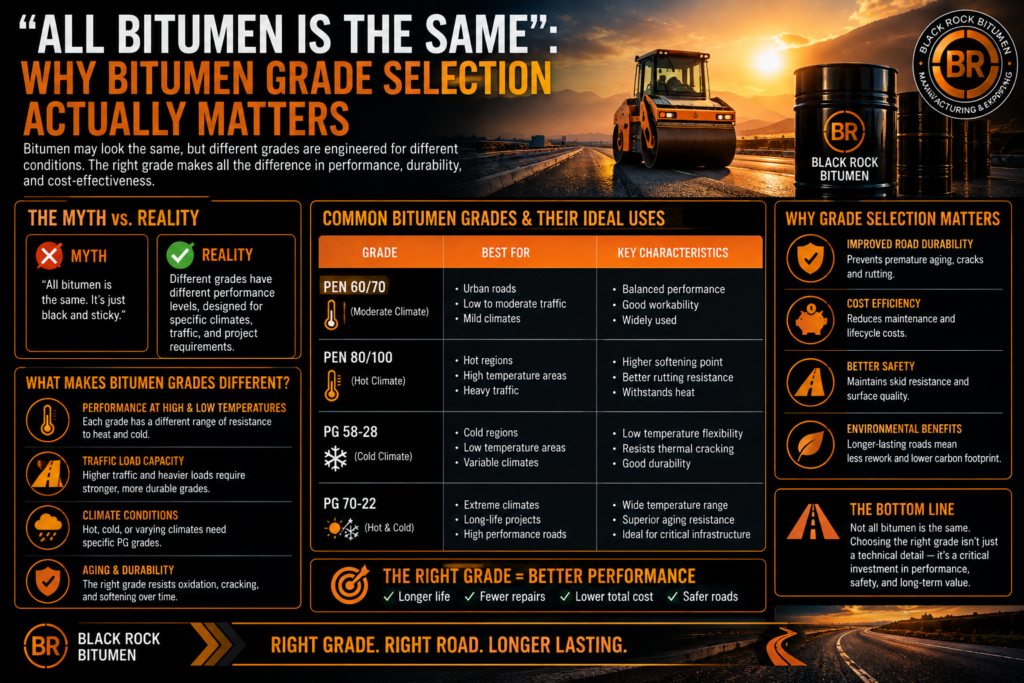
Black Rock Bitumen’s technical team works with penetration, viscosity and performance-grade specifications, helping buyers match what a tender asks for to what a supplier actually ships. To someone looking at a tanker, drum or heated storage tank, most paving bitumen looks almost identical: black, viscous and sticky. That visual similarity creates one of the most common procurement mistakes — assuming one grade can simply replace another.
It cannot.
Bitumen grade selection starts with the grading system, not the number. Penetration grades such as 60/70 are defined by one set of tests; viscosity grades such as VG-30 by another; performance grades such as PG 76-10 by pavement-temperature-based criteria. Polymer-modified binders add another layer of specification on top.
The practical lesson is simple: the right bitumen is not necessarily the hardest, softest or most expensive grade. It is the grade that matches the pavement, climate, traffic and governing specification.
Key takeaway: 60/70, 50/70 and VG-30 come from three different specifications, and 80/100 is not a grade in ASTM D946 at all. Choose the grade the project specification and pavement conditions require, then check the standard, test methods and batch COA behind the label — not just the label.
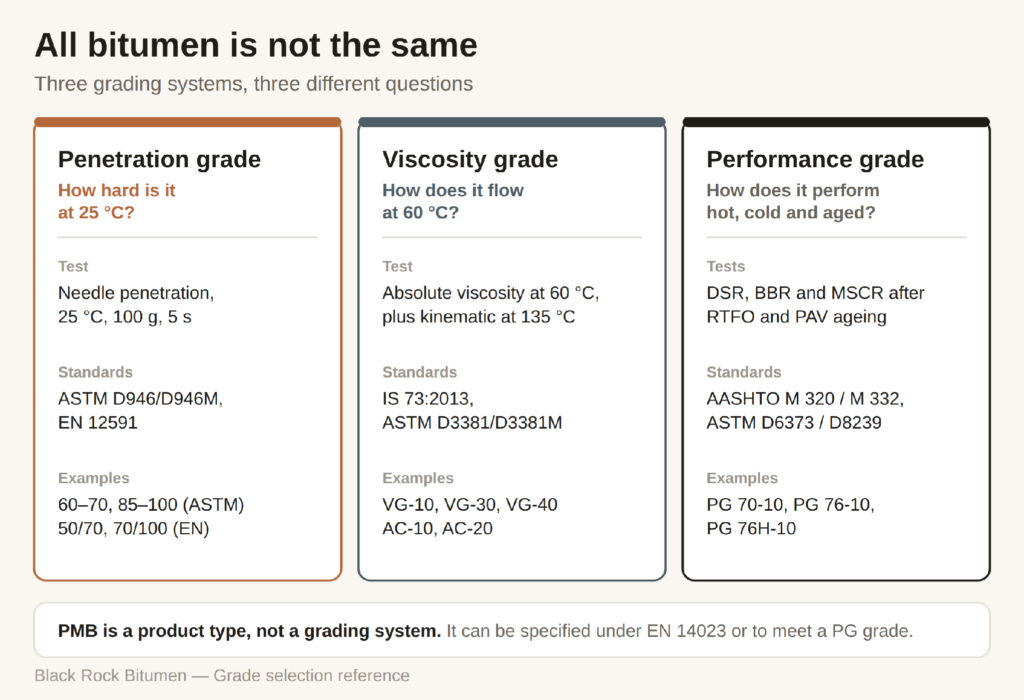
Alt text: Comparison of the three bitumen grading systems: penetration grading measures needle penetration at 25 °C under ASTM D946 or EN 12591; viscosity grading measures absolute viscosity at 60 °C under IS 73 or ASTM D3381; performance grading tests rheology across pavement design temperatures after ageing under AASHTO M 320, M 332, ASTM D6373 or D8239. PMB is a product type, not a grading system.
What Does “Bitumen Grade” Actually Mean?
A bitumen grade is a classification based on measured properties under defined test conditions. The grading system tells engineers and buyers what type of binder they are purchasing, which standard it is tested against, and which limits it has to meet.
| Grading system | Governing specifications | Example grades | Primary basis |
|---|---|---|---|
| Penetration grade | ASTM D946/D946M-25a; EN 12591 | 40–50, 60–70, 85–100 (ASTM); 35/50, 50/70, 70/100 (EN) | Needle penetration at 25 °C, 100 g, 5 s (ASTM D5; EN 1426) |
| Viscosity grade | IS 73:2013; ASTM D3381/D3381M | VG-10, VG-20, VG-30, VG-40; AC-10, AC-20, AC-30 | Absolute viscosity at 60 °C, with kinematic viscosity at 135 °C |
| Performance grade | AASHTO M 320 / ASTM D6373; AASHTO M 332 / ASTM D8239 | PG 70-10, PG 76-10, PG 76H-10 | Rheology across pavement design temperatures, before and after laboratory ageing |
| Polymer-modified bitumen | EN 14023, or a PG specification | PMB 25/55-65; a modified binder meeting PG 76-10 | Modified binder properties under the applicable standard |
ASTM D946/D946M-25a covers penetration-graded asphalt binder in five grades: 40–50, 60–70, 85–100, 120–150 and 200–300. ASTM itself describes these as legacy United States ranges that date back to the 1940s, now used in North America mainly for roofing, and notes that other parts of the world use different penetration ranges for paving. That is exactly why a label on a quotation is not enough on its own. Performance grades are covered separately by ASTM D6373-23.
60/70 vs 80/100 Bitumen: Which Standard Are You Actually Buying Against?
60/70 and 80/100 are two different penetration grades, not two prices for the same material. A 60/70 binder has a needle penetration of 60 to 70 tenths of a millimetre at 25 °C, so it is harder; an 80/100 binder falls between 80 and 100 and is softer. Neither is better in general. Harder grades are generally chosen where rutting resistance in heat matters most, softer grades where flexibility and cracking resistance matter more — and the project specification makes the final call.
There is a second, less obvious problem. 60/70 and 80/100 are penetration designations in common commercial use. Under ASTM D946/D946M the closest equivalents are 60–70 and 85–100; under EN 12591 the closest equivalents are 50/70 and 70/100. These are not interchangeable labels for the same product, and a tender written against one system cannot be filled against another without checking the specification.
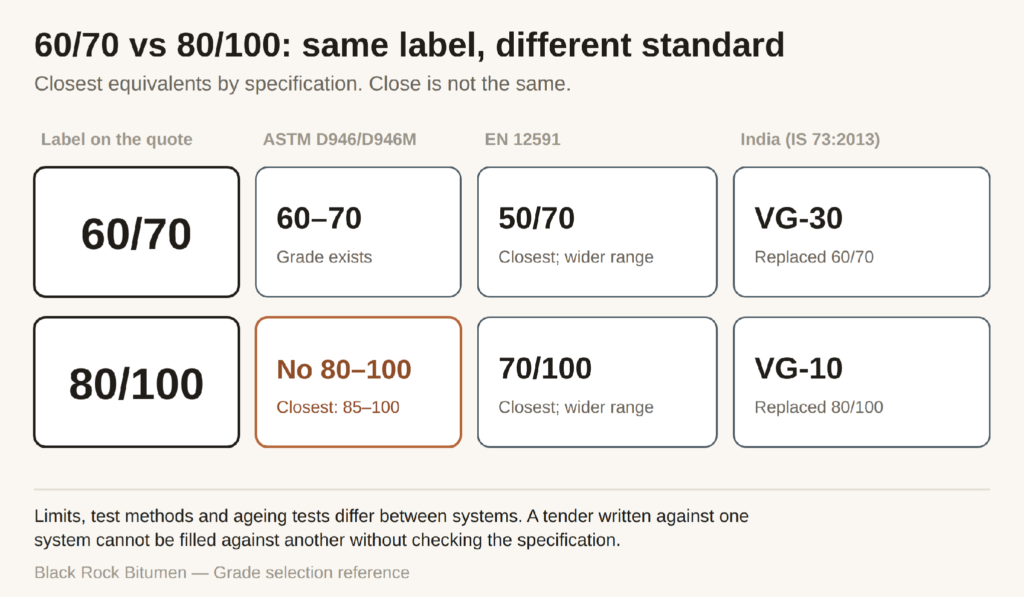
Alt text: Crosswalk showing that commercial penetration labels are not the same as standard grades: 60/70 corresponds to 60–70 under ASTM D946, closest to 50/70 under EN 12591, and was replaced by VG-30 in India; 80/100 has no ASTM D946 grade, the closest being 85–100, is closest to 70/100 under EN 12591, and was replaced by VG-10 in India.
| Label on the quotation | ASTM D946/D946M | EN 12591 | India (IS 73:2013) |
|---|---|---|---|
| 60/70 | 60–70 (grade exists) | 50/70 (closest; wider range) | VG-30, marketed in place of 60/70 |
| 80/100 | No 80–100 grade; closest is 85–100 | 70/100 (closest; wider range) | VG-10, marketed in place of 80/100 |
The systems do not just use different numbers. They check different properties with different methods. EN 12591 sets a softening point range for each grade and ages the binder in the rolling thin-film oven (EN 12607-1), while ASTM D946 relies on ductility and the thin-film oven test. Solubility is measured in toluene under EN 12592 but in trichloroethylene under ASTM D2042. Two certificates can therefore both say “60/70” and still not be comparable.
80/100 still appears widely on supplier data sheets and in tenders across Gulf, African and South Asian markets. A 2026 study of pavements in Ethiopia, for example, found 40/50, 60/70 and 80/100 to be the three most commonly used grades. Some national standards retain an 80–100 range, but it is not a grade in ASTM D946 or EN 12591. If a quotation says “80/100 to ASTM D946”, ask the supplier which grade and which specification they actually mean before comparing prices.
Black Rock Bitumen supplies each of these as a separate product: Bitumen 60/70, Bitumen 80/100 and Bitumen 85/100, alongside EN grades 50/70 and 70/100. For grade-by-grade properties, see our bitumen penetration grade chart and our application guide, Bitumen 60/70 vs 80/100: Which Grade Should You Specify?
What About Viscosity Grades Such as VG-30?
A large share of projects in India and South Asia do not use penetration grades at all. The Bureau of Indian Standards moved IS 73 from penetration grading to viscosity grading in 2006, and IS 73:2013 now defines four grades by absolute viscosity at 60 °C. Indian refiners market VG-30 in place of the old 60/70 penetration grade and VG-10 in place of the old 80/100 (Indian Oil; Bharat Petroleum).
| IS 73 grade | Absolute viscosity at 60 °C (poise) | Typical use |
|---|---|---|
| VG-10 | 800–1200 | Spraying and surface dressing; paving in very cold climates |
| VG-20 | 1600–2400 | Paving in cold climates and high-altitude regions |
| VG-30 | 2400–3600 | Extra heavy-duty pavements carrying substantial traffic loads |
| VG-40 | 3200–4800 | Highly stressed areas such as intersections, toll plazas and truck parking |
Outside India, ASTM D3381/D3381M covers viscosity-graded asphalt binder, also graded by viscosity at 60 °C. It offers several tables of limits — AC grades such as AC-10 and AC-20 based on the original binder, and AR grades based on aged residue (Pavement Interactive) — and the purchaser must state which table applies. East African standards bodies have drawn on it too: the Tanzania Bureau of Standards’ draft viscosity-graded binder standard is based on ASTM D3381/D3381M-18.
The buyer’s point is the same as for penetration grades. VG-30 is not simply 60/70 under another name: it is specified by a different primary property, so a VG-30 data sheet must report absolute viscosity at 60 °C, not just penetration. See our viscosity grade bitumen range and VG-30.
Why Temperature Changes Everything
Bitumen is temperature-sensitive. Its stiffness and flow behaviour change as temperature changes. At high pavement temperatures a binder softens and the asphalt becomes more susceptible to permanent deformation; at low temperatures it stiffens and thermal stresses can cause cracking.
Penetration and viscosity grades each measure the binder at one or two fixed temperatures. The Superpave performance grading system goes further and tests the binder at the pavement’s own design temperatures. FHWA’s LTPPBind tool, for example, selects a performance grade from site temperature data at a chosen level of risk and can adjust the grade for traffic loading and speed. For how to read and specify those grades in detail, see our Superpave PG Grading System guide.
Where Performance Grades and PMB Fit
A performance grade such as PG 76-10 carries two numbers: the high pavement design temperature (76 °C) and the low pavement design temperature (−10 °C). Both are needed, which is why “PG 76” alone is an incomplete purchase requirement. Black Rock Bitumen supplies PG 70, PG 76 and PG 82 families from Dubai; our Superpave PG guide explains how the grade is calculated, tested and verified.
PMB and PG are not the same thing either. PG is a grading framework; polymer-modified bitumen (PMB) is a product type. A PMB can be specified under EN 14023, with a designation such as PMB 25/55-65, or manufactured to meet a PG grade. If a tender asks for both a PG grade and polymer modification, both requirements must be met. See our polymer-modified bitumen range.
Is a Higher Grade Always Better?
No. If a project requires PG 70-10, buying PG 82-10 because 82 is the bigger number does not make the pavement better — and cost is the mildest of the consequences. FHWA Superpave training material warns that using both a higher reliability level and grade bumping to address the same traffic produces an unnecessarily stiff binder that can cause problems during production and laydown. In practice, over-specifying to PG 82 brings three risks:
Higher mixing and compaction temperatures. PG 82 binders are typically polymer-modified and stiffer at plant temperatures. The Asphalt Institute advises using the supplier’s recommended temperatures for modified binders, because standard viscosity methods can give unreasonably high mixing and compaction temperatures. Hotter production means more fuel, more fumes and more binder ageing before the road is even laid.
Tighter plant and storage handling. Modified binders need controlled heating and agitation to stay uniform; left unstirred, the polymer can separate from the base bitumen. That is a handling burden the project did not need to take on. See Common Bitumen Storage and Handling Mistakes.
Cracking risk if the low-temperature side is wrong. Chasing a higher high-temperature number without checking the low-temperature grade can leave the pavement with a binder that is stiffer at low temperature than the site needs, making it more sensitive to thermal cracking.
How Traffic Changes the Requirement
Temperature is only one part of bitumen grade selection. Two roads in the same climate can experience very different loading.
| Road condition | Potential binder demand |
|---|---|
| Normal traffic | Moderate repeated loading |
| Heavy freight traffic | Higher repeated loading |
| Slow-moving heavy vehicles | Longer loading time on each pass |
| Truck queues and intersections | Repeated loading concentrated in the wheel paths |
| Industrial and port access roads | Potentially severe, standing loads |
Slower loading has a similar effect on a binder to higher temperature: the binder has longer to deform under each wheel. That is why copying a grade from another road in the same city can be a poor procurement shortcut.
Performance-grade specifications can capture traffic directly through the Multiple Stress Creep Recovery (MSCR) test, ASTM D7405 / AASHTO T 350. Under AASHTO M 332 and its ASTM equivalent, ASTM D8239-23, a traffic letter — S, H, V or E for standard, heavy, very heavy or extremely heavy loading — sits inside the grade, as in PG 76H-10. The exact traffic category should always come from the governing project specification; our Superpave PG guide explains how the letter works and why it replaces grade bumping.
Every Grading System Tests Ageing — in Different Ways
Bitumen hardens through heat and oxidation during production and throughout service, so every major specification tests the binder after laboratory ageing as well as fresh. The methods differ by system, which is another reason certificates from different standards are not directly comparable.
| Grading system | Ageing test | What is checked afterwards |
|---|---|---|
| ASTM D946 penetration grades | Thin-film oven (ASTM D1754) | Loss on heating, retained penetration and ductility |
| EN 12591 penetration grades | Rolling thin-film oven (EN 12607-1) | Change in mass, retained penetration and increase in softening point |
| IS 73 viscosity grades | Rolling thin-film oven | Viscosity ratio at 60 °C and ductility |
| Performance grades | RTFO (short term), then PAV (long term) | DSR, BBR and, where specified, MSCR |
What Happens If the Wrong Grade Is Selected?
| Potential issue | What may be happening |
|---|---|
| Rutting | Insufficient resistance to permanent deformation under temperature and traffic |
| Thermal cracking | Binder too stiff for the project’s low-temperature conditions |
| Premature deterioration | Binder properties not matched to the ageing and service environment |
| Poor overall performance | Mixture design, structural design or construction may also be inadequate |
It is important not to blame every pavement failure on the binder. Acceptable pavement performance also depends on sound mixture design, structural design and construction quality. The binder grade is one essential input, not the whole answer.
The Same Climate Does Not Mean the Same Grade
Suppose two roads sit in the same broad climate. Road A carries ordinary traffic. Road B is a freight corridor with heavy trucks, slow-moving traffic and repeated loading at intersections. The climate input may be similar, but the traffic demand is very different.
That is why bitumen grade selection should be project-specific rather than based on a country’s name or a supplier’s most commonly sold grade. For international procurement, the same supplier may be shipping 60/70 to ASTM limits, 50/70 to EN 12591 and VG-30 to IS 73 to three different markets in the same month.
What Buyers Should Compare — Not Just Price
| Check | Why it matters |
|---|---|
| Complete grade | Confirms exactly which product is being offered |
| Governing standard and edition | Ensures the offer matches the tender, not just the label |
| Test methods | Confirms results are comparable between suppliers |
| Actual test results | Shows whether the batch meets the specification limits |
| Ageing results | Shows performance after the specified conditioning |
| MSCR, where required | Adds traffic-sensitive information for PG binders |
| Technical Data Sheet (TDS) | Provides typical product information for the grade |
| Batch Certificate of Analysis (COA) | Links measured properties to the actual shipment |
| Traceability | Connects product, testing and shipping documentation |
A quotation that says only “bitumen 60/70” is not enough to establish technical equivalence between two suppliers. The standard, test methods and batch documentation all need to be checked.
The COA Is Where the Difference Becomes Measurable
Two suppliers can offer what appears to be the same grade at different prices. Before deciding the cheaper offer is better, compare the certificates line by line and confirm each result was measured by the method your specification names. For conventional penetration and viscosity grades, these are the methods to look for:
| Property | ASTM method | EN method | Indian Standard method |
|---|---|---|---|
| Penetration | ASTM D5 (25 °C, 100 g, 5 s) | EN 1426 | IS 1203 |
| Softening point | ASTM D36 (ring and ball) | EN 1427 | IS 1205 |
| Ductility | ASTM D113 | Not in EN 12591 | IS 1208 |
| Solubility | ASTM D2042 (trichloroethylene) | EN 12592 (toluene) | IS 1216 |
| Flash point | ASTM D92 (Cleveland open cup) | EN ISO 2592 | IS 1448 (Part 69) |
| Loss on heating / thin-film oven | ASTM D6 / ASTM D1754 | EN 12607-1 (rolling thin-film oven) | Rolling thin-film oven, per IS 73 |
| Absolute viscosity at 60 °C | ASTM D2171 | EN 12596 | IS 1206 (Part 2) |
| Kinematic viscosity at 135 °C | ASTM D2170 | EN 12595 | IS 1206 (Part 3) |
For PG binders, check the rheological, low-temperature and MSCR results and their test temperatures; our Superpave PG guide sets out the acceptance limits. The rule in every case is the same: compare like with like. For a wider pre-shipment checklist, see How to Test Bitumen Quality Before Purchase.
How to Choose the Right Bitumen Grade
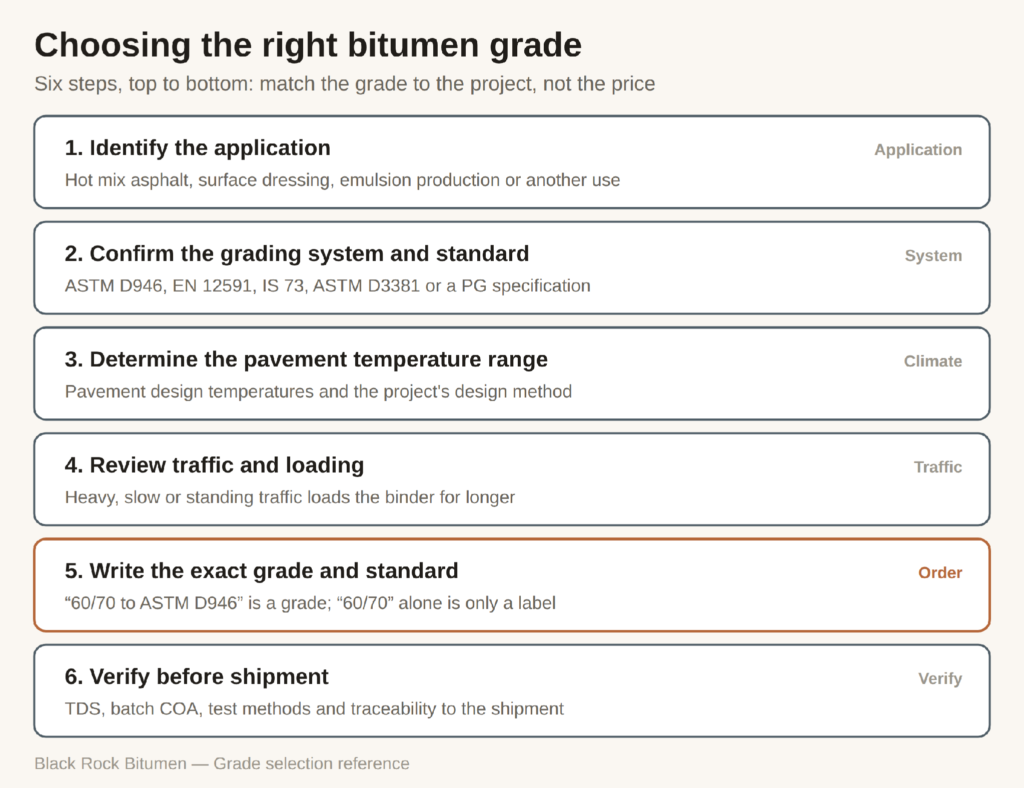
Alt text: Six-step bitumen grade selection process: identify the application, confirm the grading system and standard, determine the pavement temperature range, review traffic and loading, write the exact grade and standard on the purchase order, and verify the TDS, batch COA and traceability before shipment.
- Identify the actual application: hot mix asphalt, surface dressing, emulsion production or another use.
- Confirm which grading system and standard the project uses: ASTM D946, EN 12591, IS 73, ASTM D3381 or a PG specification.
- Determine the relevant pavement temperature range and design method.
- Review traffic, loading and speed conditions.
- Write the exact grade and standard on the purchase order, including the edition.
- Verify the supplier’s TDS, batch COA, test methods and traceability before shipment.
Hot-Climate Projects: Why Grade Selection Matters Even More
Hot climates place additional demands on bitumen because pavement temperatures run well above air temperature in direct sun. But the answer is not automatically “buy the hardest penetration grade” or “buy the highest PG grade available”. The project should still use its specified pavement-temperature calculation, reliability level and traffic requirements to determine the grade — and the standard that grade is tested against.
Black Rock Bitumen supplies penetration, viscosity and performance grades from Dubai for infrastructure projects across Africa, Asia and the Middle East. See our performance-grade range and our guide to choosing the right bitumen grade for your climate.
Why Grade Selection Is Also a Cost Decision
The cheapest material per tonne is not necessarily the cheapest material over the life of the pavement. A poorly matched grade can lead to earlier maintenance and performance problems. On the other hand, an unnecessarily high grade raises more than the purchase price: hotter plant operation, tighter handling of a modified binder, and cracking risk if the low-temperature side is overlooked.
The commercial objective should therefore be: required performance → correct grade → verified specification → competitive landed cost. That approach is more useful than simply asking for the lowest quotation.
Common Buyer Mistakes
Assuming all black, viscous bitumen is interchangeable. Grades from different systems meet different specifications even when they look identical in the drum.
Treating a commercial label as a standard. “60/70” or “80/100” on a quotation does not say whether the product was tested to ASTM D946, EN 12591 or a national standard.
Accepting “80/100 to ASTM D946” at face value. ASTM D946 has no 80–100 grade. Ask whether the supplier means 85–100 or a different specification entirely.
Substituting a closest equivalent without checking. 50/70 for 60/70, or VG-30 for 60/70, may be acceptable on some projects, but limits and test methods differ and the specification has to allow it.
Comparing price before confirming the exact grade and standard. A cheaper offer can simply be a different product.
Treating a higher grade as automatically better. Over-specification brings production, handling and cracking risks, not just extra cost.
Using air temperature instead of pavement design temperature. Pavement surfaces run far hotter than the air above them.
Ignoring traffic loading and speed. Slow and standing heavy traffic loads the binder for longer on every pass.
Accepting a product label without reviewing the batch COA. The COA is the only document that links measured properties to the material being shipped.
Frequently Asked Questions
Is all bitumen the same? No. Paving bitumen is classified under different grading systems — penetration, viscosity and performance grading — and grades within each system have different properties. Two binders that look identical can meet completely different specifications.
What is the difference between 60/70 and 80/100 bitumen? Both are penetration grades. 60/70 has a needle penetration of 60 to 70 tenths of a millimetre at 25 °C, so it is harder; 80/100 falls between 80 and 100 and is softer. Neither is better in general: the right choice depends on climate, traffic and the governing specification.
Is 80/100 an ASTM grade? No. ASTM D946/D946M-25a covers 40–50, 60–70, 85–100, 120–150 and 200–300. The closest ASTM grade to 80/100 is 85–100, and the closest EN 12591 grade is 70/100.
Is 60/70 bitumen the same as 50/70? No. 60/70 matches the ASTM D946 60–70 range, while 50/70 is an EN 12591 grade with a wider penetration range and different test methods and limits. A tender written for one cannot be filled with the other without checking the specification.
What is VG-30 bitumen equivalent to? VG-30 is an IS 73 viscosity grade with an absolute viscosity of 2400 to 3600 poise at 60 °C. Indian refiners market it in place of the old 60/70 penetration grade, but it is specified by viscosity, so it is not simply 60/70 under another name.
Does a higher grade number mean better quality? No. A higher number indicates a different requirement, not superior quality. Specifying PG 82 where PG 70 is needed can raise mixing and compaction temperatures, complicate handling of a modified binder and add cracking risk if the low-temperature side is wrong.
Does PMB mean the binder is a higher grade? No. PMB describes polymer modification, while penetration, viscosity and performance grades describe how a binder is classified. A PMB can be specified under EN 14023 or manufactured to meet a PG grade.
Why does traffic matter in bitumen grade selection? Heavy, slow-moving traffic loads the binder for longer on each pass, which increases rutting risk. MSCR-based specifications, AASHTO M 332 and ASTM D8239, account for this with an S, H, V or E traffic letter in the grade.
What should I ask a bitumen supplier for? The complete grade, the governing standard and its edition, the TDS, a batch-specific COA showing the test methods used, and traceability information linking the COA to the shipment.
The Bottom Line
Bitumen may look like a simple commodity, but its performance is specification-driven.
A 60/70 binder and an 80/100 binder are not interchangeable simply because both are paving bitumen. 60/70 and 50/70 are not interchangeable simply because the numbers overlap, and VG-30 is not 60/70 under a new name. PG 70-10 and PG 76-10 are not interchangeable simply because both are PG binders. And a PMB is not just a more expensive version of conventional bitumen.
The correct product is the one that meets the project’s actual requirements for temperature, traffic, performance and specification. For buyers, the most useful habit is to stop asking only “How much does the bitumen cost?” and start asking “What exactly am I buying, which standard does it meet, and is that the grade my pavement requires?”
For international projects supplied from Dubai, Black Rock Bitumen can support that process with penetration grades, viscosity grades and performance grades, each with technical documentation aligned to the specified standard. To discuss your tender, contact Black Rock Bitumen.