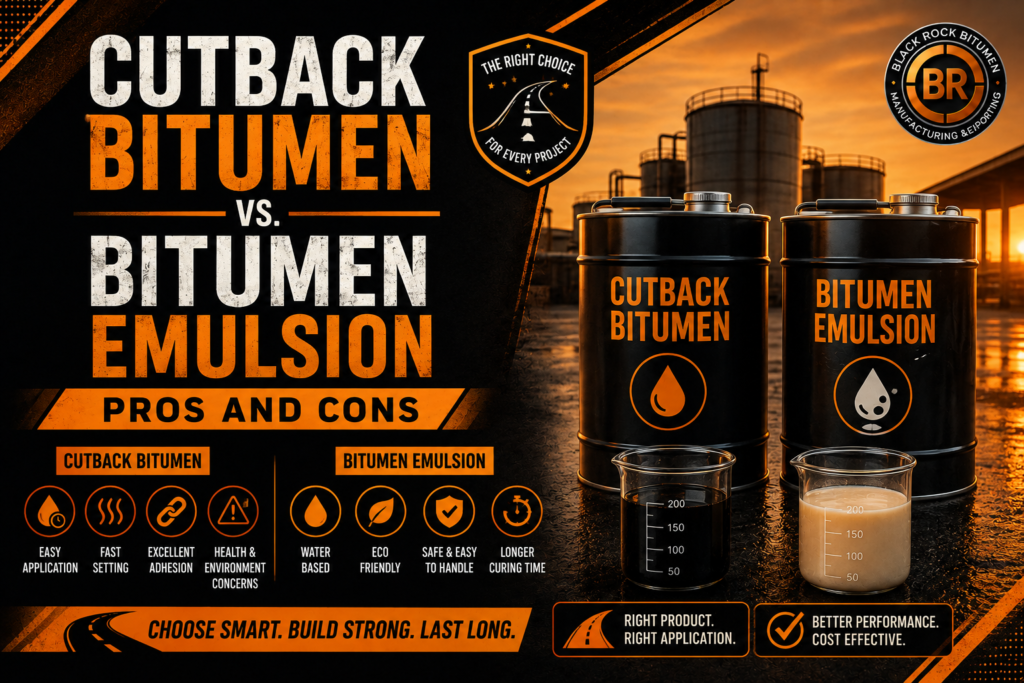
When a road project needs a liquid bituminous binder, the choice is not always as simple as picking a grade and placing an order.
Two products that often come up are cutback bitumen and bitumen emulsion. Both make bitumen easier to apply than conventional hot paving-grade binder, but they do it in completely different ways.
Cutback bitumen uses a petroleum-based solvent to reduce the viscosity of bitumen. Bitumen emulsion disperses tiny bitumen droplets in water with the help of an emulsifying agent. After application, the two products follow different curing or breaking processes before the residual bitumen forms the working binder.
That difference affects almost everything that matters on site: application temperature, curing, storage, environmental considerations, aggregate moisture, equipment and the type of road treatment being carried out.
So which is better? There is no universal winner. The right choice depends on the application, weather, aggregate, curing requirements and project specification.
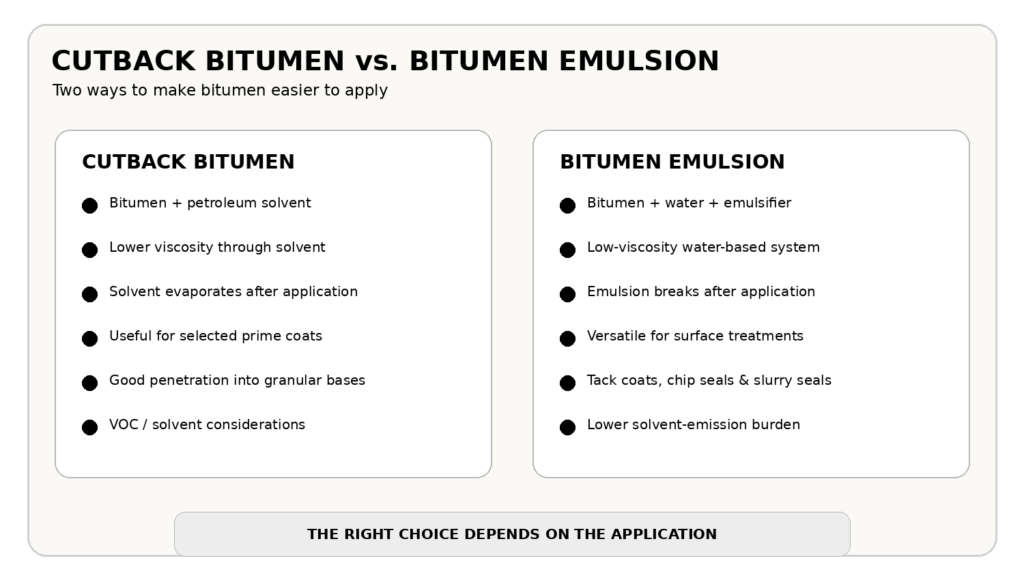
Alt text: Side-by-side comparison of cutback bitumen and bitumen emulsion, showing their composition, curing mechanism, common applications, environmental considerations and typical advantages.
What Is Cutback Bitumen?
Cutback bitumen is conventional bitumen blended with a petroleum-based solvent to reduce its viscosity. The solvent makes the binder more fluid so it can penetrate, spray or mix more easily at lower temperatures than conventional hot bitumen.
Cutbacks are commonly grouped by curing rate: rapid-curing (RC), medium-curing (MC) and slow-curing (SC). The classification relates to the volatility of the solvent and therefore how quickly it leaves the material after application.
Black Rock Bitumen’s MC-30 Cutback Bitumen is described for deep and uniform penetration into granular base courses, while MC-70 Cutback Bitumen provides a higher-viscosity medium-curing option.
The basic process is simple: bitumen is diluted with solvent, applied, and then the solvent evaporates so the remaining bitumen becomes the binder.
What Is Bitumen Emulsion?
Bitumen emulsion takes a different route. Instead of using petroleum solvent, it disperses small bitumen droplets through water using an emulsifying system.
FHWA describes asphalt emulsions as systems containing asphalt, water and a small amount of emulsifying agent. After application, the emulsion breaks, the water separates or evaporates, and the asphalt droplets come together to form the residual binder.
Emulsions are commonly classified by charge and setting behaviour, including cationic and anionic systems as well as rapid-, medium- and slow-setting grades.
Black Rock Bitumen’s Bitumen Emulsion range includes cationic and anionic emulsions for applications such as tack coats, surface dressing, slurry seals and soil stabilisation.
The simple version is: bitumen + water + emulsifier → workable liquid → application → breaking → residual bitumen.
Cutback Bitumen vs. Bitumen Emulsion at a Glance
| Factor | Cutback Bitumen | Bitumen Emulsion |
| How viscosity is reduced | Petroleum solvent | Water + emulsifier |
| Application temperature | Lower than hot bitumen; grade dependent | Generally low |
| Main curing mechanism | Solvent evaporation | Breaking + water evaporation |
| Petroleum solvent | Yes | No petroleum solvent required for the emulsion |
| Typical applications | Prime coats, penetration work, selected surface treatments | Tack coats, surface dressing, slurry seals, maintenance |
| Moisture considerations | Application dependent | Certain cationic grades can work with damp aggregates |
| Environmental considerations | VOC / solvent emissions | Generally lower solvent-emission burden |
| Storage | Solvent-compatible storage and fire controls | Protect from freezing/contamination; follow agitation requirements |
| Best fit | Specific penetration and curing requirements | Versatile surface treatment and maintenance work |
The Pros of Cutback Bitumen
1. Good Penetration Into Granular Materials
One of the main reasons cutbacks are used is their ability to penetrate granular and absorbent surfaces. A medium-curing cutback can remain fluid long enough to enter a prepared base before the solvent evaporates.
That makes selected MC grades useful for prime coat work, particularly where the project requires penetration into a granular base rather than simply bonding two existing asphalt layers.
2. Useful for Specific Lower-Temperature Applications
Because the solvent reduces viscosity, cutback bitumen can be applied without heating the base bitumen to the same temperatures required for conventional hot application. That can be useful when site conditions or equipment make high-temperature application difficult.
However, lower application temperature does not mean that safety requirements disappear. Petroleum solvents still require appropriate storage, ventilation, ignition control, transport and spill procedures.
3. Different Curing Rates Are Available
RC, MC and SC classifications allow contractors to select a cutback according to the curing behaviour required by the application. That can be useful when the project needs a particular penetration profile or working time.
The Cons of Cutback Bitumen
1. Petroleum Solvents Create Environmental Concerns
The biggest drawback of cutback bitumen is the solvent itself. After application, the solvent evaporates. FHWA notes that the use of asphalt cutbacks has been curtailed in many applications because they can produce significant volatile organic compound emissions.
That does not automatically make every cutback application unsuitable. But environmental requirements, local regulations and the project specification need to be considered before choosing one.
2. Solvent Handling Adds Safety Requirements
A product containing volatile petroleum solvent requires careful attention to storage, ignition sources, ventilation, fire protection, transport and spill control. These requirements become especially important when large quantities are stored at an asphalt plant or project site.
3. Curing Depends on Solvent Evaporation
Cutback bitumen needs the solvent to leave the material. Temperature, airflow, application thickness and weather can influence how quickly that happens. If curing is slower than expected, the surface may not behave as the contractor intended.
The Pros of Bitumen Emulsion
1. Lower Application Temperatures
One of the biggest advantages of emulsion is its ability to be applied at much lower temperatures than conventional hot bitumen. The bitumen is already dispersed in water, so there is no need to heat it to the same temperature simply to make it fluid.
2. No Petroleum Solvent Is Needed to Make It Fluid
Instead of kerosene, naphtha or another petroleum solvent, the emulsion uses water and an emulsifying system. FHWA guidance identifies emulsions as an important alternative in applications where reducing energy use and pollution from solvent evaporation is desirable.
3. Versatile Road Applications
Emulsions are used across a wide range of road maintenance and construction treatments, including tack coats, chip seals, surface dressing, slurry seals, microsurfacing, cold mixes and soil stabilisation.
4. Useful With Damp Aggregates in Suitable Grades
Some cationic emulsions are formulated to provide good adhesion with mineral aggregates and can be useful where perfectly dry conditions are difficult to guarantee. The exact grade still needs to be matched to the aggregate, moisture conditions and application.
The Cons of Bitumen Emulsion
1. Water Has to Leave the System
An emulsion contains a substantial amount of water. After application, that water needs to separate and/or evaporate so the residual bitumen can form the intended binder film.
Weather therefore matters. Rain soon after application can interfere with breaking and curing depending on the emulsion grade and treatment.
2. Aggregate Compatibility Matters
Not every emulsion behaves identically with every aggregate. Aggregate chemistry, surface condition, moisture content and the emulsion formulation can all affect adhesion and breaking. This is why choosing simply “an emulsion” is not enough.
3. Storage Needs Attention
Emulsions are water-based systems and have different storage requirements from conventional bitumen and cutbacks. Freezing must be avoided, contamination must be controlled and the supplier’s storage and agitation requirements should be followed.
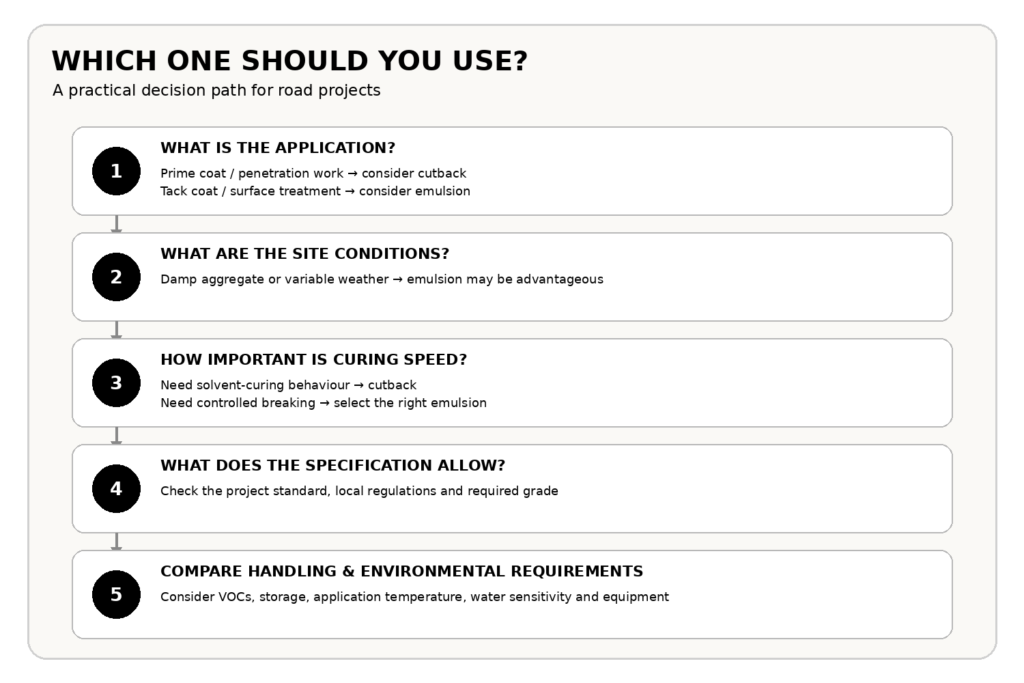
Alt text: Decision flowchart for choosing between cutback bitumen and bitumen emulsion based on application, site conditions, curing requirements, project specification and handling considerations.
Which One Is Better for Prime Coats?
This is one of the areas where the distinction becomes especially useful. Cutback bitumen has traditionally been associated with prime coat applications because its lower viscosity can help the binder penetrate a prepared granular base.
However, the choice is not automatic. The project specification, base characteristics, climate and environmental requirements should all be checked. In some projects, a suitable emulsion may provide an alternative where solvent-based products are undesirable.
If the project is specifically considering a medium-curing cutback, see MC-30 Cutback Bitumen for the product specification.
Which One Is Better for Tack Coats?
For tack coats, bitumen emulsion is often the more practical choice because the material can be applied as a low-viscosity spray and then break to leave a thin residual bitumen film that bonds the asphalt layers.
The exact emulsion grade matters. Application rate, surface cleanliness, temperature, aggregate or existing pavement condition and breaking behaviour all affect the result.
Black Rock Bitumen’s Bitumen Emulsion range covers products intended for tack coats and other surface treatments.
What About Hot and Tropical Climates?
Hot climates do not automatically mean cutback or emulsion. The choice still comes down to the treatment being performed and how the material behaves under local conditions.
For projects in Africa, South America and Southeast Asia, contractors may have to work with high pavement temperatures, intense rainfall and high humidity. Emulsion can be attractive for applications where lower-temperature handling and reduced solvent use are priorities, but its breaking and curing behaviour still has to be considered against weather conditions.
Cutback can remain useful where penetration and solvent-curing behaviour are specifically required, provided the project permits the product and appropriate environmental and safety controls are in place.
Environmental Considerations
Environmental requirements are increasingly influencing binder selection. The most obvious distinction is that cutback bitumen contains a petroleum solvent that evaporates, while emulsion uses water as its dispersion medium.
FHWA’s sustainability guidance notes that asphalt emulsions can offer environmental advantages compared with cutbacks in suitable applications because they avoid the same solvent-emission pathway. That does not mean emulsions have zero environmental impact; manufacturing, transport, heating, water content and the full pavement system still matter.
The practical takeaway is to compare the complete application rather than assuming one product is automatically “green.”
A Simple Decision Checklist
1. What are you actually treating? Prime coat, tack coat, chip seal, slurry seal, maintenance treatment or another application?
2. Does the project need penetration? If deep penetration into a granular base is central to the treatment, a suitable cutback may be appropriate.
3. Can the site handle water-based curing? If rain or persistent moisture is expected, check the emulsion’s breaking and curing requirements carefully.
4. Are solvent emissions restricted? Environmental and local regulations may favour an emulsion where the specification allows it.
5. What does the project specification say? Always confirm the required grade, test standard and application method before procurement.
How to Choose Between Cutback Bitumen and Emulsion
The best decision is not based on which product is more modern. It is based on which material behaves the way the project needs it to behave.
Choose cutback when the application specifically benefits from solvent-assisted penetration or a defined curing profile, and when the project permits solvent-containing products.
Choose emulsion when lower-temperature application, surface treatment versatility, reduced solvent emissions or compatibility with particular aggregates and moisture conditions are more important.
And in both cases, grade selection matters. A rapid-setting emulsion is not interchangeable with a slow-setting emulsion, just as MC-30 is not interchangeable with every other cutback grade.
Frequently Asked Questions
Is bitumen emulsion safer than cutback bitumen? They have different hazards. Emulsions avoid the petroleum solvent used in cutbacks, but storage, transport, application and site safety requirements still apply.
Is cutback bitumen still used? Yes. It remains useful in selected applications, particularly where solvent-assisted penetration and curing behaviour are required and the product is permitted by the project specification.
Can bitumen emulsion be used as a prime coat? Certain emulsions can be used for prime or related applications, but suitability depends on the emulsion grade, base material and project specification.
Which is better in wet weather? There is no universal answer. Some cationic emulsions are designed to work with damp aggregates, but rain can interfere with breaking and curing. Cutback curing also depends on solvent evaporation.
Which one has lower VOC emissions? Bitumen emulsion generally has a lower solvent-emission burden because water, rather than a petroleum solvent, is used to reduce viscosity.
Can I substitute an emulsion for cutback without changing the application? Not automatically. The product chemistry, application rate, curing/breaking behaviour and specification all need to be checked before substitution.
The Bottom Line
Cutback bitumen and bitumen emulsion solve the same broad problem — making bitumen easier to apply — but they solve it in very different ways.
Cutback bitumen uses petroleum solvent and can be particularly useful where penetration and solvent-curing behaviour are required. Its disadvantages include solvent handling, VOC emissions and the need for careful curing conditions.
Bitumen emulsion uses water and an emulsifying system. It offers lower-temperature application, broad versatility and a lower solvent-emission burden, but breaking, curing, aggregate compatibility and storage all need to be managed correctly.
For a broader look at the products available, compare Black Rock Bitumen’s Cutback Bitumen, MC-30, MC-70, and Bitumen Emulsion ranges. You can also review the Bitumen Grades & Standards for Infrastructure Tenders and Bitumen Storage, Handling & Transport Standards before finalising a procurement specification.