In Vietnam and Thailand, air temperatures have climbed as high as 42.7°C in recent years — and that heat doesn’t stay in the air. It sinks into the road. Pavement surface temperatures in those conditions have been measured hitting 75°C, and researchers tracking the fallout found a sharp jump in rutting, shoving, and potholes on both new and previously well-performing highways once that heat took hold (ResearchGate).
That’s not a freak event. It’s what happens when a road gets built with the wrong bitumen grade for its climate — or with a grade that was right for the climate ten years ago but not for the one showing up now.
Grade selection is the single biggest lever you have over how long a road lasts. Get it right and a well-built pavement can run 15 to 20 years with minimal upkeep (Research and Markets). Get it wrong and you’re looking at rutting within a single hot season, or cracking through the first cold snap — regardless of how good the aggregate or the paving crew was. This guide breaks down how to actually make that call.
What “Grade” Actually Measures
Before matching a grade to a climate, it helps to know what the numbers mean.
Penetration grade is the most widely used system globally, referenced in both ASTM and EN standards. A needle is pressed into a bitumen sample at 25°C, and the depth it sinks — in tenths of a millimeter — becomes the grade. Lower numbers mean a harder binder built for heat; higher numbers mean a softer, more flexible binder built for cold (EN 12591; ASTM D946). A 40/50 grade is hard and heat-resistant. A 160/220 grade is soft and built to stay flexible when it’s cold.
Performance Grade (PG), developed under the Superpave system, skips the indirect penetration measurement and grades bitumen directly against the temperature extremes it needs to survive. A PG 70-22 is rated to resist rutting up to 70°C and resist low-temperature cracking down to -22°C. It’s a more direct, more predictive system — engineers can match a binder to actual regional temperature data rather than inferring performance from a lab proxy (AASHTO M 320 and M 332; Asphalt Institute MS-2).
Polymer Modified Bitumen (PMB) takes either system and widens its usable range. Adding polymers like SBS improves resistance to rutting at high temperatures and resistance to cracking at low temperatures simultaneously — useful anywhere the daily or seasonal temperature swing is wide, or where traffic loads are heavy enough to punish a standard grade (EN 14023).
Viscosity Grade (VG) is the governing system across India, Nepal, Bangladesh, and increasingly parts of East Africa — a significant share of the market this guide covers. Instead of penetration depth or temperature-extreme performance, bitumen is graded by its absolute viscosity at 60°C (IS 73; AASHTO M 226). VG30 is the standard grade for most conventional high-heat, high-traffic paving in these markets; VG40 steps up for heavier loads or hotter conditions, playing a similar role to a harder penetration grade or higher PG elsewhere in this guide.
Matching Grade to Climate
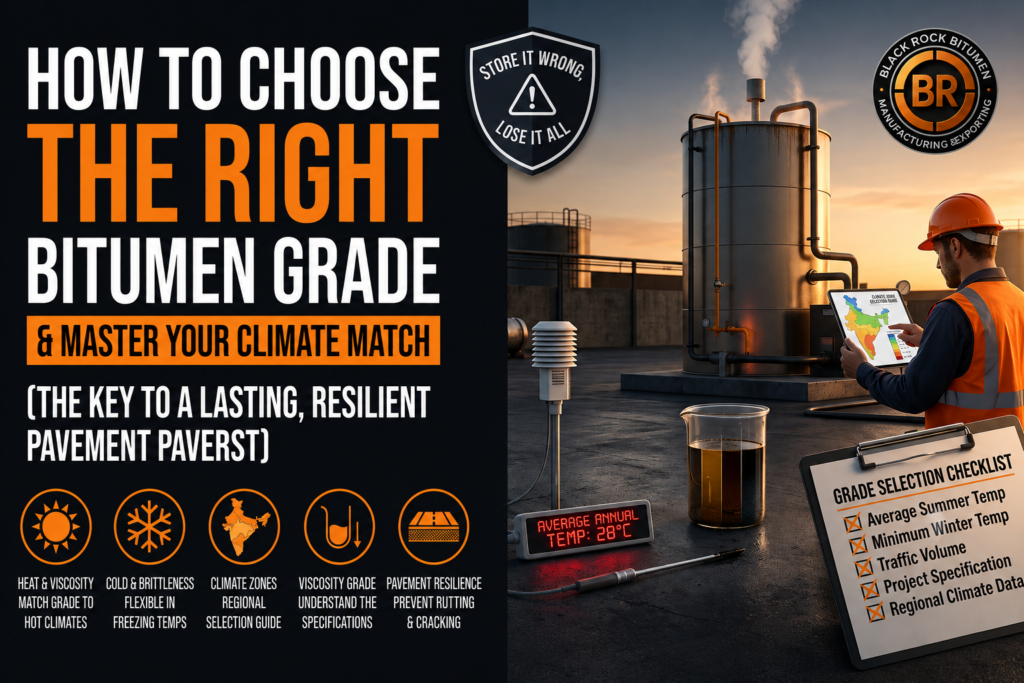
The rule of thumb is simple even if the underlying chemistry isn’t: harder bitumen for heat, softer bitumen for cold, and modified bitumen wherever the extremes overlap or traffic is heavy.
| Climate type | Typical conditions | Recommended grade | Why |
| Hot, arid | Persistent 40°C+ ambient, low rainfall | 40/50 or PG 70-XX and harder | Resists softening and rutting under sustained heat |
| Hot, humid tropical | High heat plus heavy seasonal rainfall | 60/70 or PMB | Grade handles the heat and rutting resistance; pair it with an anti-stripping additive or hydrated lime and proper drainage to handle the moisture separately |
| Warm temperate | Moderate heat, occasional cool spells | 80/100 | Enough flexibility without excessive softening in the warm months |
| Variable or highland | Big swings between hot days and cool nights or seasons | PMB with a wide PG span (e.g. PG 70-16 or PG 76-16) | Resists both daytime rutting and cooler-season stiffening with one binder, without paying for a low-temperature spec these climates don’t need |
| Hot climates under IS 73 (India, Nepal, Bangladesh) | Sustained high heat, monsoon-season humidity | VG30, or VG40 for heavier traffic/heat | Region’s governing viscosity-grade system; VG30 balances rutting resistance and workability, VG40 for higher-stress conditions |
This is a starting point, not a substitute for actual project-level temperature data — but it covers most of the climate zones across Africa, South America, and Southeast Asia.
It’s worth pausing on the difference between “hot and dry” and “hot and humid,” because the two get treated as interchangeable far more often than they should be. A hot, arid climate stresses bitumen almost entirely through heat — the binder needs to resist softening and flowing under sustained high temperatures, and rainfall barely factors into the equation. A hot, humid tropical climate adds a second stress on top of that: repeated wetting and drying cycles, standing water on the surface, and moisture working its way into microcracks before they’ve had a chance to seal.
That moisture risk isn’t primarily a grade problem, though. It’s stripping — a failure of adhesion between the binder and the aggregate, not a failure of the binder’s heat or cold performance. The fix is an anti-stripping additive or hydrated lime, paired with proper drainage design, not a softer grade. A grade chosen correctly for heat and traffic still needs that separate protection in a high-rainfall climate; a reader who buys the right grade but skips the anti-strip step can still lose the road to moisture damage.
Why the Region You’re Building In Changes the Math
Average annual temperature is a poor predictor on its own. What actually breaks a road is the peak surface temperature during the worst week of the year, combined with how much moisture the pavement sees.
Researchers modeling pavement temperatures in Ghana’s Forest and Savannah zones found that predicting real in-pavement temperature — not just air temperature — was essential for getting binder selection right, since the two track very differently across a tropical climate (International Journal of Pavement Research and Technology). A study measuring pavement conditions in tropical Indonesia found surface temperatures at the very top of the asphalt layer swinging as high as 45.65°C during sunny periods, even with air temperature holding well below 37°C (Scientific.Net) — a reminder that pavement temperature and air temperature are two different numbers, and only one of them is what your bitumen actually experiences.
South America tells a similar story from the demand side. Brazil’s bitumen import volumes have climbed sharply in early 2026, as the country expands its road network. Brazil’s binder specifications are set by ANP (Agência Nacional do Petróleo, Gás Natural e Biocombustíveis) resolution rather than a single test method, and CAP 50/70 — a penetration-grade cement — is the country’s workhorse for tropical and subtropical paving, balancing rutting resistance with the workability contractors need in high-heat, high-rainfall conditions. The same trade-off shows up across most equatorial and near-equatorial markets. The broader Latin American bitumen market is expected to keep growing at a compound rate of roughly 3.2% through 2033, with demand increasingly favoring PMB specifically because of its resistance to deformation under extreme weather (Market Data Forecast).
Traffic Load Is the Second Variable — Don’t Skip It
Climate sets the baseline, but traffic pushes the requirement higher. A rural access road and a heavy-truck highway in the exact same climate zone don’t need the same grade. Heavy, slow-moving, or channelized traffic — think intersections, bus stops, loading zones, and toll plazas — concentrates stress on a small area of pavement under maximum solar heating, which is exactly where standard grades fail first and where PMB earns its higher price tag by extending the resurfacing interval significantly (Asphalt Institute research on PMB service-life extension).
There’s a standardised way to apply that upgrade rather than guessing at it. Under AASHTO M 320, this is called grade bumping: bump the high-temperature grade by one full grade for slow-moving traffic, and by two grades for standing traffic such as intersections, toll plazas, and bus stops. It formalises the advice above into something you can actually specify and cite on a project.
A practical way to think about it: pick your grade for the climate first, then upgrade toward a harder grade or a PMB if the traffic volume or axle loads on the route are heavy. Downgrading a grade to save money on a high-traffic road almost always costs more in early resurfacing than it saved on the original purchase.
There’s also a compounding effect worth flagging: heavy traffic and hot climates don’t just add together, they multiply. A moderate-traffic road in a hot climate might tolerate a standard penetration grade for years. The same traffic volume concentrated at a signalized intersection or a weigh station — where trucks slow down, idle, and load the same few square meters of pavement over and over — can rut that identical grade within a single season. The fix usually isn’t repaving the whole route in a harder grade; it’s identifying those specific high-stress points and specifying PMB or a harder grade just for them.
Common Mistakes in Grade Selection
Choosing based on price alone. A softer, cheaper grade might look like a win on the purchase order and a total loss once it starts rutting in month four of a hot season.
Using average annual temperature instead of peak conditions. The number that matters is the hottest week of the year at pavement-surface depth, not the yearly average — the Indonesia and Ghana research above shows how far apart those two figures can be.
Treating moisture as a grade problem instead of a stripping problem. Grades that perform fine in hot-and-dry conditions don’t fail in hot-and-wet ones because of the grade itself — they fail because nobody added an anti-stripping additive or fixed the drainage. Moisture damage is an adhesion failure between binder and aggregate, not something a softer or different grade solves on its own.
Assuming one grade fits the whole project. A single route can cross climate zones — coastal humidity, then inland heat, then highland cooling — and a grade chosen for the coastal segment may be wrong by the time the road reaches altitude.
Not accounting for future traffic growth. A grade sized for today’s traffic volume can be under-specified within a few years on a fast-growing corridor.
A Simple Decision Path
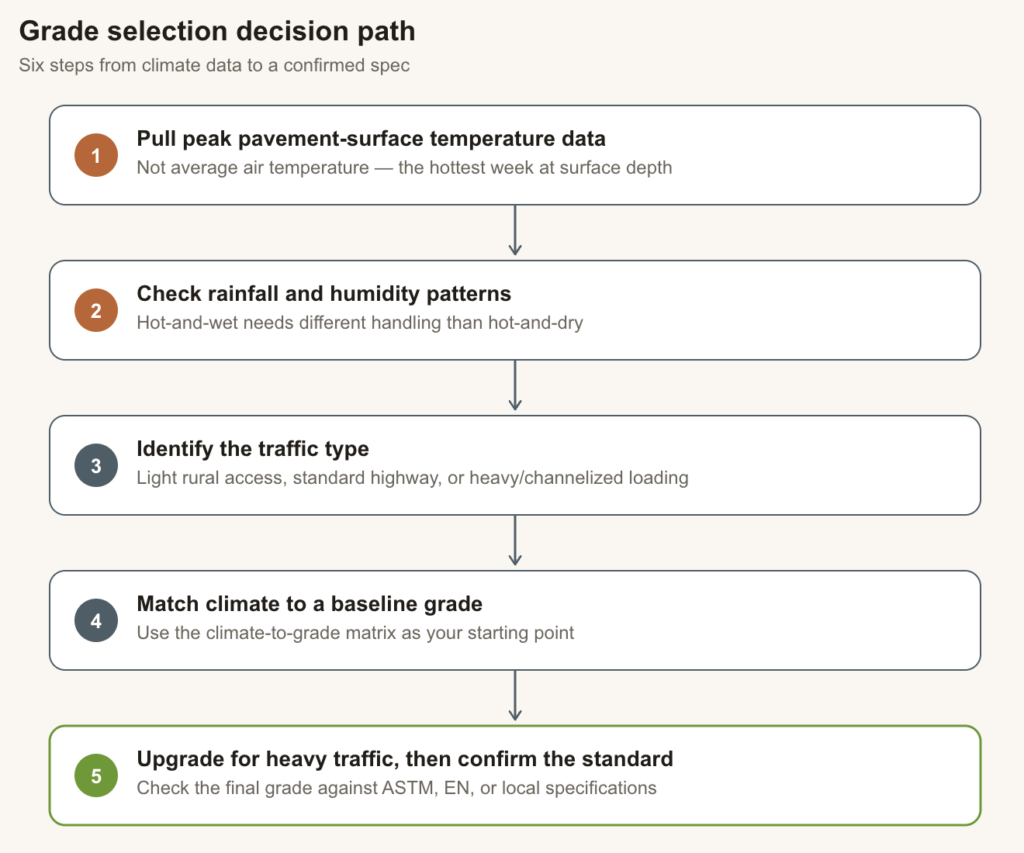
- Pull peak pavement-surface temperature data for the region, not just average air temperature. LTPPBind (the FHWA’s climate database and binder-selection tool) is the standard source for this; as a practical shortcut, pavement surface temperature runs roughly 20–25°C above peak air temperature, with design temperature taken at 20 mm depth.
- Check seasonal rainfall and humidity patterns — hot-and-wet needs an anti-stripping additive or hydrated lime and good drainage on top of whatever hot-and-dry needs.
- Identify the traffic type: light rural access, standard highway, or heavy/channelized loading.
- Match climate to a baseline grade using the table above.
- Upgrade using grade bumping under AASHTO M 320 — one grade for slow-moving traffic, two for standing traffic — if intersection density or future growth pushes past what the baseline grade can handle.
- Confirm the final grade against your national or regional standard (ASTM, EN, or local equivalents like Brazil’s ANP resolutions) before finalizing the order.
Frequently Asked Questions
What bitumen grade is best for extremely hot climates? Harder penetration grades like 40/50, or Performance Grades in the PG 70 range and above, resist softening and rutting best under sustained high heat. For heavy traffic on top of extreme heat, Polymer Modified Bitumen extends performance further.
Can one bitumen grade work for both hot and cold seasons? Standard penetration grades struggle to cover both extremes well. Polymer Modified Bitumen with a wide PG span — for example, PG 70-16 or PG 76-16, the range that fits most tropical highland and variable-climate corridors — is designed to resist summer rutting and cooler-season stiffening with a single binder.
Does rainfall affect which bitumen grade I should choose? Not directly. Grade should be chosen for heat and traffic; rainfall and humidity are handled separately, with an anti-stripping additive or hydrated lime and proper drainage design. Skipping that step — not the underlying grade choice — is what causes moisture damage in hot, humid climates.
Is Polymer Modified Bitumen worth the extra cost? On high-traffic roads, extreme climates, or routes crossing multiple climate zones, yes — the extended resurfacing interval it provides usually outweighs the higher upfront price. On low-traffic, moderate-climate roads, a standard penetration grade is often sufficient.
The Bottom Line
There’s no universal “best” bitumen grade — only the right grade for a specific combination of peak temperature, moisture, and traffic. The mistake most projects make isn’t a bad grade choice in isolation; it’s picking a grade based on price or habit rather than the actual conditions the road will face. Pull real temperature data, account for traffic, check the grade against your local standard, and handle moisture with anti-stripping measures rather than a softer grade before the order goes in.
If you’re sourcing for a specific market, our Penetration Grade Bitumen and Performance Grades ranges cover both systems described above, and our Polymer Modified Bitumen line is built for the high-traffic and wide-temperature-swing cases this guide flags. We also supply into specific regional markets — see our pages on sourcing bitumen in Nigeria, bitumen in Kenya, bitumen in Malaysia, and bitumen in Venezuela for climate and standards context specific to those markets.