It usually happens mid-shift. The drums will not empty, or the tank will not pump, and a crew is standing waiting for a decision. The instinctive response — turn the heat up — is right about a third of the time and makes things permanently worse the rest of the time.
The order in which you check matters. If the bitumen is simply cold, more heat is the answer. If it is the wrong grade, or if it has already hardened in service, more heat degrades it further and the damage cannot be undone.
Black Rock Bitumen supplies paving binders to contractors across Africa, Asia and the Middle East, and this is one of the most common calls we take. What follows is the sequence we work through with them.
Key takeaway: measure before you heat. Take the actual temperature of the material, compare the certificate of analysis against your purchase order, and only then decide whether this is a heating problem, a supply problem or a degradation problem. Never exceed the maximum safe handling temperature for the grade — 200 °C for paving and air-rectified bitumen, and whatever the data sheet states for an oxidised grade.
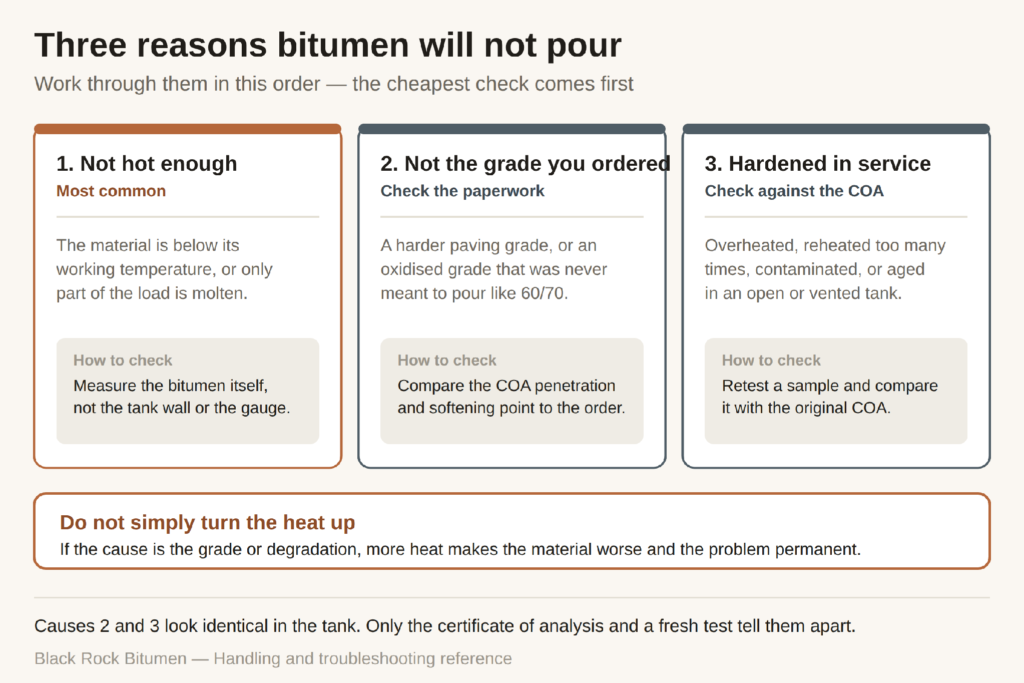
Figure 1. The three causes, in the order they should be checked. Causes 2 and 3 look identical in the tank, so only the certificate of analysis and a fresh test tell them apart.
Alt text: Diagnostic chart of the three reasons bitumen will not pour and how to check each one.
Start With Your Situation
The four situations below narrow the likely cause before you touch anything.
| Situation | Most likely causes | First thing to check |
|---|---|---|
| Drums that will not melt, or melt only in the middle | Insufficient heating time; heat applied to one spot; ambient temperature; harder or oxidised grade than expected | How long has heat been applied, and to how much of the drum surface? |
| A tank or tanker that has set solid and will not pump | Heating coils failed or not submerged; material left below pumping temperature too long; water or contamination; wrong grade loaded | Is the coil or burner actually working, and what does the thermometer read at depth? |
| Material that pours, but is stiffer than it should be | Below working temperature; harder grade supplied; binder hardened by overheating or repeated reheating | Compare the COA with the order, and take a sample for retesting |
| It poured fine yesterday and will not pour today | Temperature, or something that changed in the tank: a failed coil, a new delivery blended in, or water ingress | What changed since the last successful transfer? |
That last row is worth reading carefully, because it is frequently misdiagnosed as a material fault. A load that behaved yesterday and will not behave today points to the equipment or to something added since, not to the grade that was delivered weeks ago.
Cause 1: It Is Not Hot Enough, or Not Evenly Hot
Bitumen is thermoplastic. It does not have a melting point in the way ice does; it softens progressively, and its viscosity falls steeply as temperature rises. That steepness cuts both ways: a modest drop in temperature makes a large difference to how it behaves, which is why material can look workable in one part of a tank and solid in another.
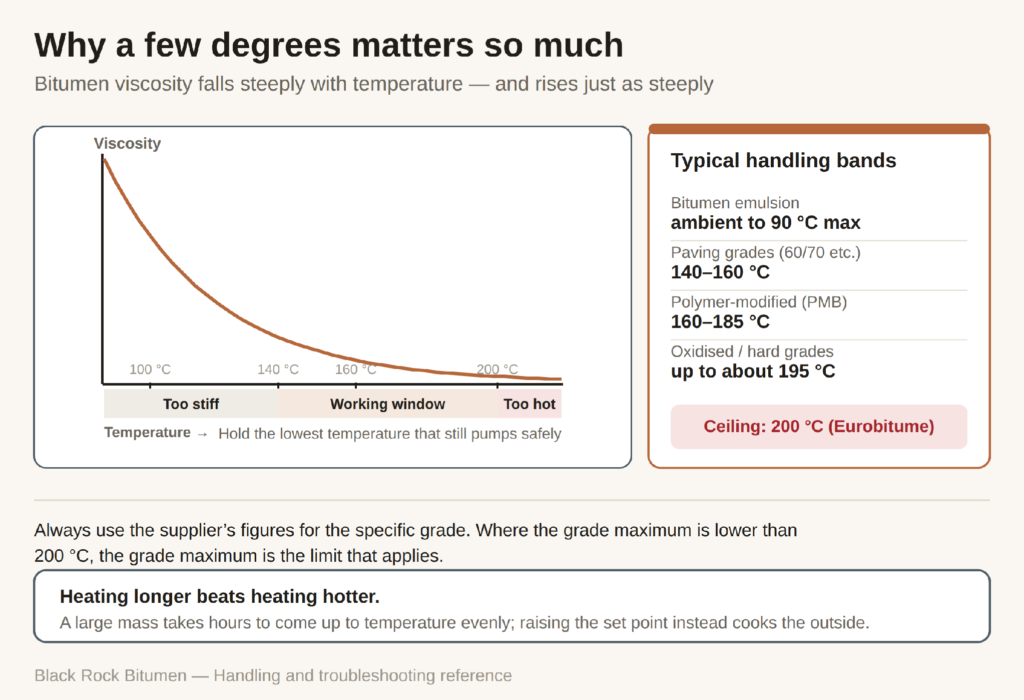
Figure 2. Viscosity falls steeply as temperature rises, and climbs just as steeply on the way down. The bands are typical figures for guidance; the grade’s own data sheet always governs, and for oxidised grades the maximum may be above the 200 °C shown here for paving and air-rectified bitumen.
Alt text: Chart of bitumen viscosity against temperature, with typical handling bands for each product type.
Typical Handling Temperatures
| Product | Typical working temperature | Notes |
|---|---|---|
| Bitumen emulsion | Ambient up to about 90 °C maximum | Overheating breaks the emulsion in the tank. It is not a material you can “heat harder”. |
| Paving grades (60/70, 80/100, etc.) | Typically 140–160 °C for storage and pumping | Mixing at the asphalt plant is hotter, but storage and transfer should sit in this band |
| Polymer-modified bitumen (PMB) | Typically 160–185 °C | Needs agitation as well as heat; separated polymer will not redisperse on its own |
| Oxidised and hard grades | Per the product data sheet | Designed to be stiff at ambient; the data sheet maximum may exceed 200 °C |
| Safe handling ceiling | 200 °C for paving and air-rectified bitumen | Eurobitume’s maximum safe handling and storage temperature |
Temperature bands are typical figures for guidance; always use the supplier’s data sheet for the specific grade. The ceiling comes from Eurobitume’s technical guidance on maximum safe handling temperatures, which sets 200 °C for paving and air-rectified bitumen and a higher figure of 230 °C for severely oxidised grades.
Those two numbers together cause confusion on site, so it is worth stating plainly: if you are handling an oxidised grade, use the maximum on that grade’s data sheet, which may legitimately sit above 200 °C. For everything else — paving grades, PMB, emulsion — 200 °C is a ceiling that should never be approached, let alone crossed, and the grade’s own maximum is usually well below it.
Why Heating Longer Beats Heating Hotter
A drum holds around 180 kg of material with poor thermal conductivity. Heat has to travel inward from the shell, and that takes hours, not minutes. The common failure is impatience: the operator raises the set point because the middle is still solid, which cooks the outer layer while the core is still cold. The result is a partly degraded binder and a drum that still will not empty cleanly.
The same applies to tanks. If a load has gone cold, bring it up slowly with the heating system it was designed for, circulate it if you can, and give it time. Industrial drum decanters work on exactly this principle — thermal oil circulating through coils, transferring heat indirectly and evenly, precisely so that no part of the material is exposed to a flame.
Checks for a Heating Problem
- Measure the bitumen itself with a calibrated thermometer, at depth if you can, rather than reading the tank wall or trusting a gauge nobody has checked.
- Confirm the heating system is working: burner firing, thermal oil circulating, coils submerged and not fouled.
- Check whether the coils are actually covered by material — an exposed coil overheats the binder around it and heats nothing else.
- Look for a cold core: if the outer material is fluid and the centre is solid, the problem is heat distribution and time, not set point.
- Check ambient conditions and insulation, especially for overnight standing in a cold climate or a shaded yard.
- Circulate or agitate if the equipment allows, so heat moves through the load rather than pooling.
Cause 2: It Is Not the Grade You Thought You Ordered
If the material is at the correct temperature and still will not behave, the next question is what is actually in the drum. Two mix-ups account for most cases.
A Harder Paving Grade Than Expected
40/50 is stiffer than 60/70, which is stiffer than 80/100. These are different products with different penetration and softening point ranges, and a load of 40/50 delivered against an order for 80/100 will feel wrong at the temperature the crew is used to. It is not defective; it is a different grade. Our bitumen grade selection guide explains how these designations relate to one another and to EN and Indian Standard equivalents.
An Oxidised (Blown) Grade Instead of a Paving Grade
This is the one that catches people out, and it is worth understanding properly. Oxidised or blown bitumen is made by blowing air through hot bitumen, which raises the softening point and lowers the penetration. It is an industrial product for roofing, waterproofing and insulation, standardised under EN 13304 and, in India, IS 702. It is supposed to be hard.
The trap is the designation. Paving grades are written penetration first: 60/70 means a penetration of 60 to 70 dmm. Oxidised grades are written softening point first: 85/25 means a softening point around 85 °C and a penetration of about 25 dmm. A buyer reading “85/25” as a softer product than “60/70” has it exactly backwards.
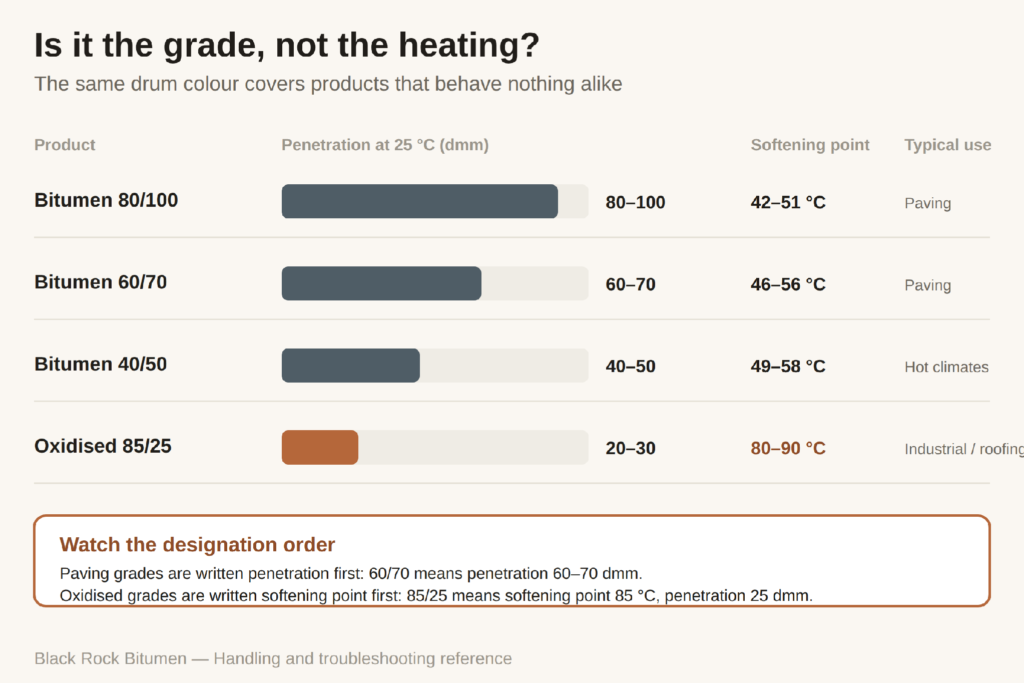
Figure 3. Products that look identical in the drum. Penetration and softening point ranges are indicative of commercial practice rather than quoted from a single standard: ASTM D946 does not specify a softening point, and 80/100 is not a grade in either ASTM D946 or EN 12591. Always read the values from the batch certificate.
Alt text: Comparison of penetration and softening point for 80/100, 60/70, 40/50 and oxidised 85/25 bitumen.
Two other product families behave differently again. Cutback bitumen contains solvent and is fluid at much lower temperatures. Bitumen emulsion is bitumen dispersed in water and is applied warm, not hot. If someone has ordered one and received another, no amount of heating will make the material behave as expected.
How to Confirm the Grade
| Check | What it tells you |
|---|---|
| The purchase order against the delivery note and drum markings | Whether the right product was picked and shipped |
| The batch certificate of analysis | The measured penetration and softening point of what was supplied |
| Penetration at 25 °C, ASTM D5 | The single most direct measure of hardness for a paving grade |
| Softening point, ASTM D36 (ring and ball) | A high result relative to the grade points to an oxidised or hardened binder |
| Which standard the COA cites | ASTM D946, EN 12591 and IS 73 grade the same material differently, so the limits differ |
If the COA matches your order and the material still behaves wrongly, the problem is either temperature or degradation. If the COA does not match your order, you have a supply issue to raise with the supplier before you do anything else to the material. Our guide to testing bitumen quality before purchase covers the checks that catch this at the door rather than in the tank.
Cause 3: It Has Hardened Since It Was Made
Bitumen ages. Oxygen, heat and time all stiffen it, and the process is not reversible. A binder that left the refinery within specification can arrive on site outside it if it has been badly handled in between.
| Mechanism | What happens | Typical evidence |
|---|---|---|
| Overheating | Held above the grade maximum, the binder oxidises and light fractions are driven off | Penetration lower and softening point higher than the COA; a burnt or acrid smell |
| Repeated reheating | Each heating cycle ages the material further | Progressive stiffening across a tank that has been drawn down and topped up repeatedly |
| Prolonged hot storage | Even within limits, weeks at temperature age the binder | Gradual hardening with no single incident to point to |
| Air ingress | An open, vented or partly empty tank exposes a large surface to oxygen | Skin or crust on the surface; stiffer material near the top |
| Water contamination | Causes foaming and boil-over, and can leave the load unusable | Bubbling, spitting or sudden level rise on heating — stop immediately |
| Contamination with another product | Cross-loading or an uncleaned tank leaves residue of a different grade | Properties between two grades and matching neither |
| Polymer separation in PMB | Without agitation, polymer separates from the base bitumen | Inconsistent material from top to bottom of the tank |
The test for this is simple in principle: take a representative sample and retest penetration and softening point, then compare with the batch COA. A significantly lower penetration and higher softening point than the certificate means the binder has hardened since it was tested. Our guide to storage and handling mistakes sets out the practices that prevent this, and it is worth reading before the next load rather than after.
One practical warning about the water case. If a load foams, bubbles or rises on heating, shut the heat off and stand clear. Water flashing to steam inside hot bitumen throws material violently out of the opening, and this is one of the most common causes of serious burns in the industry.
What Never to Do
Bitumen is safe when it is handled correctly, and the hazards are well understood: burns from hot material, emissions that rise with temperature, and boil-over where water is present. Eurobitume publishes safe handling guidance covering all three. The items below are the ones that come up specifically when someone is trying to get stiff material moving.
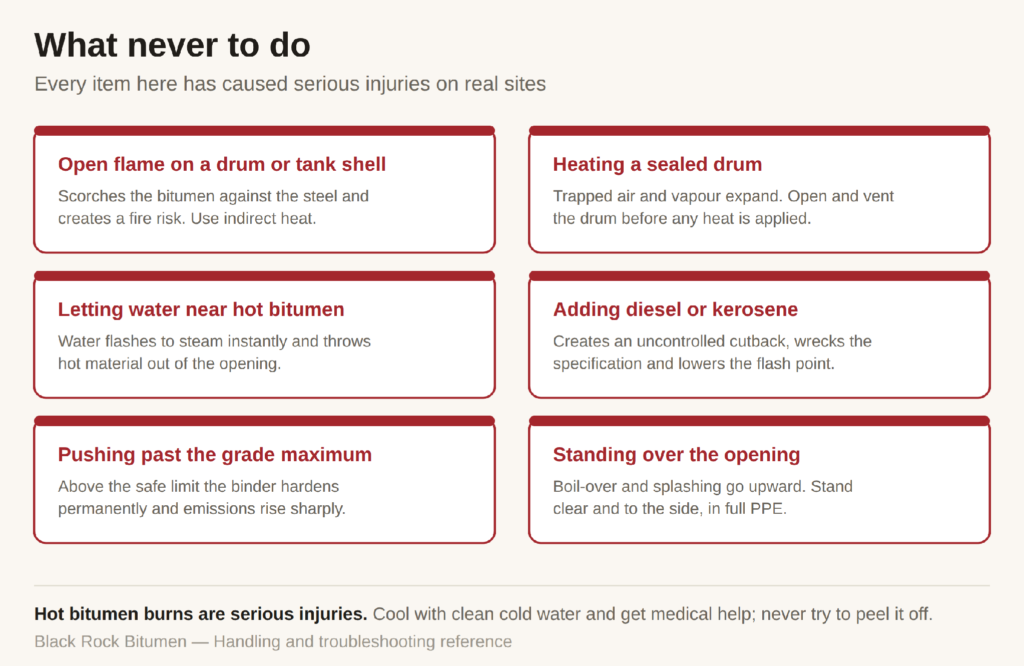
Figure 4. Every item here has caused serious injuries on real sites. The common thread is improvising heat or chemistry under time pressure.
Alt text: Six things never to do when bitumen will not pour, from open flame to adding solvent.
Never apply an open flame to a drum or tank shell. It scorches the binder against the steel, degrades it permanently and creates a fire risk. Use indirect heating — thermal oil, hot air, electric band heaters or a proper drum decanter.
Never heat a sealed or unopened drum. Trapped air and vapour expand. Open and vent before any heat is applied.
Never let water near hot bitumen. Water flashes to steam instantly and ejects hot material. Check for rainwater in drum rims, condensate in tanks and moisture in hoses before heating.
Never add diesel, kerosene or used oil to thin it. It creates an uncontrolled cutback, destroys the specification you paid for, and lowers the flash point — turning a handling problem into a fire risk.
Never exceed the maximum for the grade. Above the grade maximum the binder hardens permanently and emissions climb. For paving and air-rectified bitumen the ceiling is 200 °C; for oxidised grades, follow the data sheet.
Never stand over an opening while heating. Boil-over and splashing go upward. Stand clear and to the side, in full PPE — face shield, gauntlets, and clothing with no gaps at the wrists, neck or ankles.
If Hot Bitumen Contacts Skin
Cool the affected area immediately with clean, cool running water and keep cooling for at least ten to twenty minutes — long enough to take the heat out of the tissue beneath the bitumen, which retains heat far longer than water does. Then get medical attention.
Do not attempt to remove the bitumen, and do not use solvents, petrol, diesel or thinners on skin: they damage the tissue further and are absorbed through the burn. The bitumen itself is sterile and can be removed later under medical supervision. Follow the first-aid instructions in your own safety data sheet, and make sure the crew has read them before the work starts rather than during it.
Can Hardened Bitumen Be Recovered?
It depends which cause you are dealing with.
| Cause | Recoverable? | What to do |
|---|---|---|
| Simply cold | Yes | Reheat slowly and evenly within the grade limits; it will behave normally again |
| Wrong grade supplied | Not by heating | Raise it with the supplier; the material may still be usable on another application |
| Mildly aged in storage | Sometimes, with testing | Retest and check against the specification; the project may still accept it |
| Overheated past the grade maximum | No | The change is permanent. Retest and treat it as a different, harder material |
| Water-contaminated | Usually not | Stop heating, make the area safe and consult the supplier before any further handling |
| Separated PMB | Sometimes | Restore agitation and retest for homogeneity; badly separated material may not recover |
The commercial point is that blending hardened material into a specification job is rarely a saving. If the binder no longer meets the grade, it will not perform as the mix design assumed, and the cost of premature failure dwarfs the value of the load.
If you are unsure whether a load is still usable, send us the batch COA and the retest results and we will help you read them against the specification. For the wider question of which grade a project needs, see our guide to choosing a grade for your climate.
How to Stop It Happening Again
- Store at the lowest temperature that still allows safe pumping, rather than keeping tanks hot for convenience.
- Record tank temperatures and heating hours, so that a slow drift is visible before it becomes a problem.
- Keep tanks sealed and check vents and gaskets, to limit both air ingress and water.
- Agitate polymer-modified bitumen on a schedule from the day it arrives, not when a problem appears.
- Plan drum melting time realistically into the programme, so nobody is tempted to raise the set point.
- Order the grade the climate and specification require, rather than whichever grade is available.
- Check the COA against the order on delivery, before the material goes into a tank.
- Clean tanks between different products, and never load a new grade onto the residue of another.
Grade selection is part of prevention. A binder that is correct for a Gulf summer may be stiffer than a crew expects during a cold night shift, and for performance-graded binder the Superpave PG guide explains how that temperature range is set in the first place.
Getting the Right Product in the First Place
Black Rock Bitumen supplies penetration grade bitumen from 20/30 to 200/300 including 60/70 and 80/100, viscosity grades to IS 73, performance grades, polymer-modified bitumen, bitumen emulsions and industrial oxidised grades — each supplied with a batch certificate of analysis and a safety data sheet stating the grade, the governing standard and the recommended handling temperatures.
Frequently Asked Questions
Why is my bitumen too hard to pour? Usually one of three reasons: it is below its working temperature or unevenly heated, it is a harder or oxidised grade than expected, or it has hardened through overheating, repeated reheating, ageing or contamination. Measure the temperature and compare the certificate of analysis with your order before deciding.
What temperature should bitumen be to pour? It depends on the product. Paving grades such as 60/70 are typically handled at around 140–160 °C, polymer-modified bitumen at 160–185 °C, and emulsions at ambient up to a maximum of about 90 °C. Oxidised grades follow their own data sheet. Always use the supplier’s figures for the specific grade.
Can I just heat bitumen hotter to make it pour? Only within the limit for the grade. Eurobitume gives 200 °C as the maximum safe handling temperature for paving and air-rectified bitumen, with a higher limit for severely oxidised grades. Above the limit the binder hardens permanently, emissions rise, and the material is worse than when you started.
Why does only the middle of my bitumen drum stay solid? Bitumen conducts heat poorly, so heat travels slowly inward from the drum shell. A solid core means the drum needs more time and more evenly distributed heat, not a higher set point.
Is it safe to heat a bitumen drum with an open flame? No. Direct flame scorches the binder against the steel, degrades it permanently and creates a fire risk. Use indirect heating such as a thermal-oil drum decanter, hot-air unit or electric band heaters, and always open and vent the drum first.
Why is my bitumen foaming when I heat it? Almost certainly water in the material or in the tank. Water flashes to steam and can throw hot bitumen out of the opening. Stop heating, keep clear, make the area safe and contact your supplier before handling it further.
Is oxidised bitumen 85/25 softer than 60/70? No — much harder. Oxidised grades are written softening point first, so 85/25 means a softening point around 85 °C and a penetration of about 25 dmm. Paving grades are written penetration first, so 60/70 means a penetration of 60–70 dmm.
Can hardened bitumen be softened again? If it is simply cold, yes — reheat it slowly within the grade limits. If it has been overheated or oxidised, no: the change is chemical and permanent, and the material should be retested and treated as a harder product.
The Bottom Line
Bitumen that will not pour is a diagnosis before it is a decision. Take the temperature of the material, read the certificate of analysis against your purchase order, and if neither explains it, sample and retest.
Heat solves the first cause and worsens the other two, which is why the instinct to raise the set point is the wrong first move. Work through the causes in order, stay inside the limit for the grade, and treat water near hot bitumen as the serious hazard it is.
If a load is behaving unexpectedly, send us the grade, the batch number and the COA and we will help you work out which of the three causes you are looking at — get in touch here.