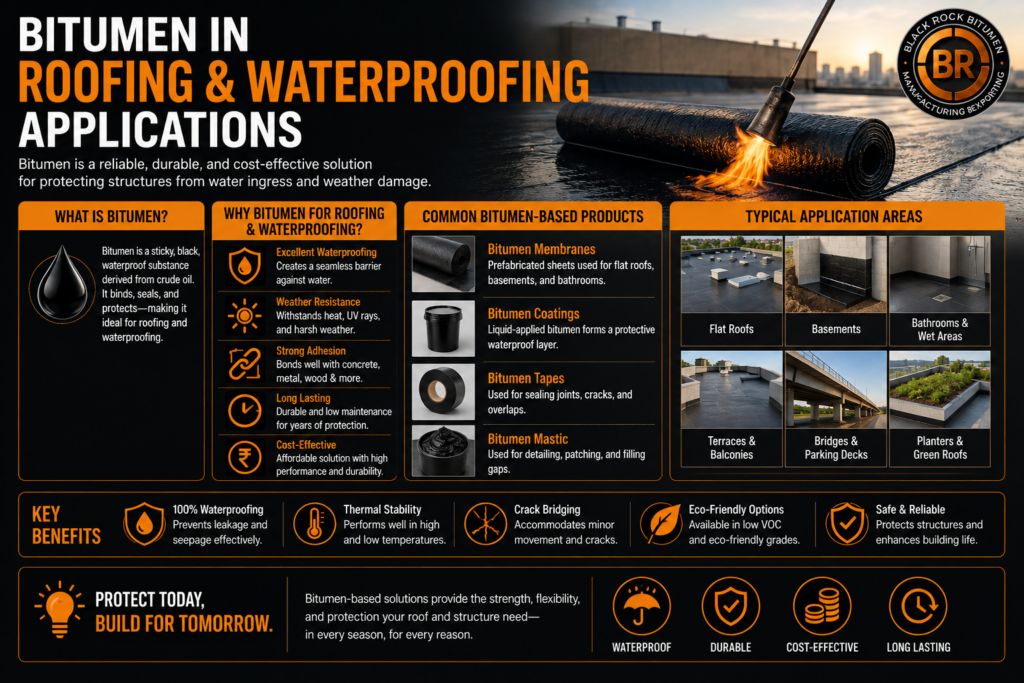
The global waterproofing membrane market is expected to grow from $38.78 billion in 2025 to $51.90 billion by 2030, and the Middle East and Africa region is specifically flagged as one of the fastest-growing markets in that forecast — driven by exactly the conditions that define this region: scorching heat, intense UV radiation, and in some areas, heavy seasonal rainfall (GlobeNewswire / Research and Markets). Bituminous membranes remain the dominant, most cost-effective choice in that market, with modified bitumen products alone accounting for over 30% of total segment revenue (Verified Market Research).
That dominance isn’t nostalgia. Bitumen has stayed the default roofing and waterproofing material because it does the one thing those two applications both need: it forms a continuous, water-shedding barrier that adheres to almost any structural substrate. But “bitumen” in a roofing context is a different product than the paving-grade bitumen used on a highway, and choosing the wrong version — or the wrong application method for your climate — is a common, expensive mistake.
Here’s how bitumen actually gets used in roofing and waterproofing, and how to choose the right type for the conditions you’re building in.
Why Roofing Bitumen Isn’t Paving Bitumen
Standard penetration-grade bitumen, the kind graded 60/70 or 80/100 for road construction, is engineered around a completely different problem: resisting deformation under wheel loads at road-surface temperatures. A roof doesn’t carry traffic, but it does sit exposed to direct sun for hours at a stretch, often reaching surface temperatures well above ambient air temperature. A standard paving grade applied to a roof in that kind of heat can soften and slump exactly the way you don’t want a waterproofing layer to behave.
That’s why roofing and waterproofing bitumen is almost always oxidized (air-blown) bitumen instead. Producers pass hot air through straight-run bitumen at elevated temperatures, which raises the softening point significantly and reduces penetration compared to the original feedstock — trading some flexibility for a much higher resistance to heat and flow. Oxidized bitumen grades commonly used in roofing and waterproofing range from around 75/25 up through 115/15, with the first number indicating the nominal softening point in °C and the second indicating penetration in tenths of a millimeter.
| Grade | Softening point | Penetration | Typical use |
| 75/25 | 75–85°C | 20–30 dmm | Roofing felt, bituminous adhesives, insulation board lamination |
| 85/25 | 85–95°C | 20–30 dmm | Pipeline anti-corrosion coating, high-temperature protective coatings |
| 85/35 | ~85°C | ~35 dmm | Roofing felts, waterproofing membranes, expansion joint fillers |
| 90/25 | ~90°C | ~25 dmm | General waterproofing, roofing, insulation, industrial applications |
| 105/15 | 105–115°C | 10–20 dmm | Industrial roofing, heavy-duty waterproofing in extreme heat |
| 105/35 | 105°C+ | 30–35 dmm | Membrane manufacturing where high softening point and flexibility are both required |
| 115/15 | 115°C | 15 dmm | Extreme heat applications, tropical climates, industrial durability |
The pattern is the same one that governs paving grades — harder, higher-softening-point bitumen for hotter conditions — but the whole range sits at a much higher softening point than any paving grade, because roofing bitumen has to resist flow at surface temperatures paving bitumen never sees.
The Two Membrane Families: SBS and APP
Most modern roofing bitumen isn’t used raw — it’s modified with a polymer and manufactured into a reinforced membrane sheet. There are two dominant families, and picking between them matters more in hot climates than most buyers realize.
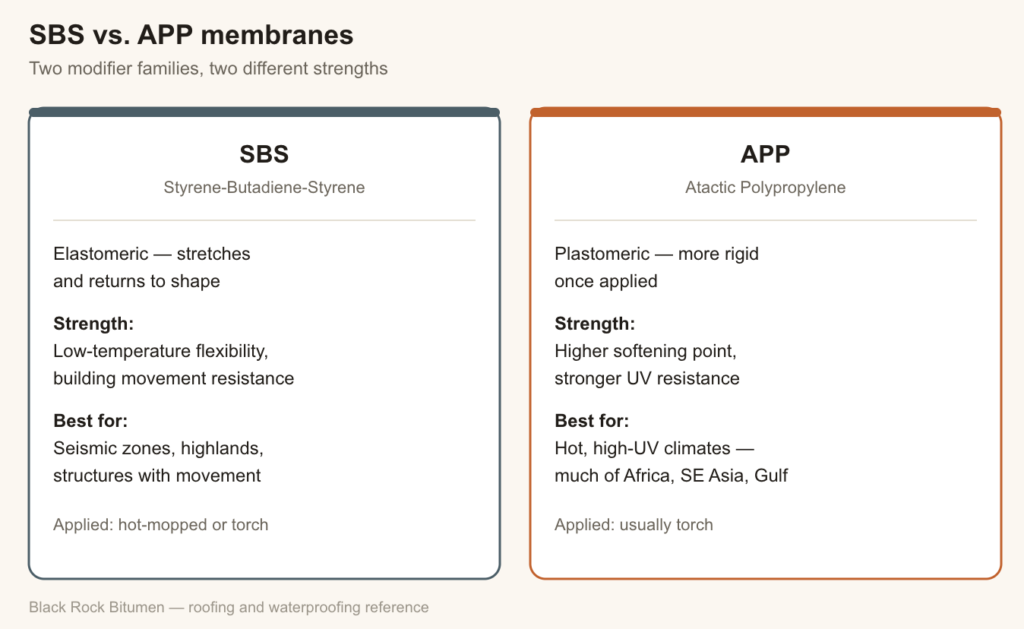
SBS (Styrene-Butadiene-Styrene) modified bitumen blends bitumen with a synthetic rubber, producing a membrane that’s elastomeric — it stretches and returns to shape, giving it excellent flexibility at low temperatures and strong resistance to building movement (Siplast).
APP (Atactic Polypropylene) modified bitumen blends bitumen with a plastic modifier instead, producing a plastomeric membrane that’s more rigid once applied. APP membranes trade some low-temperature flexibility for a meaningfully higher softening point and stronger resistance to UV degradation and foot traffic (GAF; Polyglass).
That trade-off is exactly why APP tends to be the more common choice across the hot, high-UV climates found through much of Africa, South America, and Southeast Asia — the properties it sacrifices matter less where sub-zero flexibility was never the concern, and the properties it gains matter more where UV exposure and sustained heat are the dominant stress. SBS still has a clear place in this region too, particularly on structures with more building movement or in cooler highland zones where flexibility matters more than peak heat resistance.
How the Membrane Actually Gets Installed
The polymer type determines performance, but the installation method determines how the membrane bonds to the roof — and each method carries its own trade-offs.
Torch-applied. An open flame heats the underside of the membrane until it melts, fusing it directly to the substrate. This is the most common method for APP membranes specifically, and it produces a strong, continuous weld — but it requires strict safety protocols and adequate ventilation, and it’s genuinely unsuitable for occupied buildings or anywhere flammable materials sit nearby (architecturelab.net).
Hot-mopped. Hot asphalt is applied directly to the substrate and the membrane is unrolled straight into it, common with SBS systems. It creates a durable bond without an open flame, though it still requires on-site heating equipment.
Cold-applied adhesive. The membrane bonds using a cold adhesive rather than heat, which makes it a practical option for reroofing occupied buildings — schools, hospitals, offices — where flame or heavy fumes aren’t acceptable.
Self-adhesive (peel-and-stick). No torch, no hot asphalt, no separate adhesive — the membrane carries a factory-applied adhesive backing and is pressed directly onto the substrate. It’s the fastest and safest method to install, though it depends heavily on a clean, properly primed surface for a lasting bond.
Matching the System to the Climate
Roofing gets most of the attention in this conversation, but below-grade waterproofing — foundations, basements, retaining walls, and podium decks — faces a genuinely different set of stresses and deserves its own thinking. A roof deals primarily with heat, UV exposure, and thermal cycling. A foundation deals with sustained hydrostatic pressure, soil contact, and zero opportunity for inspection or repair once the structure is built over it. That’s why below-grade waterproofing tends to lean on oxidized bitumen membranes with a reinforced carrier layer rather than the lighter systems that work fine on an accessible rooftop — the margin for error is much smaller when the membrane in question won’t be looked at again for decades.
| Climate condition | Recommended approach | Why |
| Extreme, sustained heat | High-softening-point oxidized bitumen (105/15–115/15) with APP membrane | Resists softening and flow at peak roof-surface temperatures |
| Hot, humid tropical | APP or SBS membrane, self-adhesive or cold-applied where possible | Balances heat resistance with moisture-driven substrate movement |
| High building movement or seismic activity | SBS-modified membrane | Elastomeric flexibility absorbs structural movement without cracking |
| Dense urban or occupied buildings | Cold-applied or self-adhesive systems | Avoids open-flame risk during installation or reroofing |
| Below-grade waterproofing (foundations, basements) | Oxidized bitumen membranes with reinforced carrier | Continuous, puncture-resistant barrier against sustained water pressure |
Common Mistakes in Roofing and Waterproofing Bitumen
Using paving-grade bitumen on a roof. It happens more often than it should, usually as a cost-saving shortcut. A binder engineered for road temperatures will underperform badly at roof-surface temperatures, leading to slumping, bleeding, and premature failure.
Choosing SBS purely on cost in an extreme-heat climate. SBS membranes can still work in hot regions, but without adequate surfacing or a high enough grade selection, their lower softening point becomes a liability under sustained peak heat.
Skipping the primer coat. Especially with self-adhesive systems, adhesion depends on proper substrate preparation. A membrane applied over an unprimed or dusty surface can look fine on installation day and fail within a season.
Torch-applying near flammable materials or in poorly ventilated conditions. This is a safety issue as much as a technical one — torch application demands the same handling discipline covered in our guide to bitumen storage, handling, and transport standards for safe project execution.
Assuming one membrane type suits every part of a building. A roof, a foundation, and a below-grade retaining wall face different stresses — heat and UV above ground, sustained water pressure below it — and often call for different formulations even on the same project.
Frequently Asked Questions
What’s the difference between roofing bitumen and paving bitumen? Roofing and waterproofing bitumen is almost always oxidized (air-blown) bitumen, engineered for a much higher softening point than paving grades so it resists flow at high roof-surface temperatures. Paving bitumen is engineered for load resistance under traffic, not sustained heat exposure.
Is SBS or APP better for hot climates? APP membranes generally hold up better under sustained heat and UV exposure due to their higher softening point, making them a common choice across hot, high-UV regions. SBS remains preferable where flexibility and resistance to building movement matter more than peak heat resistance.
Is torch-applied roofing safe? It’s safe when done correctly, with proper ventilation, fire safety protocols, and a suitably prepared substrate — but it’s genuinely unsuitable for occupied buildings or sites with nearby flammable materials, where cold-applied or self-adhesive systems are the better choice.
How long does a bitumen roofing or waterproofing membrane typically last? Properly applied oxidized bitumen and modified bitumen membrane systems commonly deliver 10 to 15 years of service life, with the exact figure depending on grade selection, membrane type, climate exposure, and installation quality.
The Bottom Line
Bitumen remains the default material for roofing and waterproofing because it works — but “bitumen” covers a wide range of products, from oxidized grades to SBS and APP membranes, each suited to different climates and installation constraints. Match the grade’s softening point to your actual roof-surface temperature, choose the membrane family based on your climate’s dominant stress, and pick an installation method that fits your site’s safety constraints, not just your budget.
Black Rock Bitumen supplies the full oxidized bitumen range for roofing and waterproofing applications, from Bitumen 75/25 and Bitumen 85/25 through the extreme-heat Bitumen 115/15 grade. Browse the complete Oxidized Bitumen range, or see our Waterproof Membrane products for pre-manufactured membrane systems.