A stretch of Dutch highway doesn’t look any different from the road beside it, but part of its binder isn’t petroleum bitumen at all — it’s lignin, a natural compound extracted from paper industry waste. Researchers at Wageningen University have already worked lignin into dozens of road sections across the Netherlands, and when it replaces half the fossil bitumen in a mix, the resulting asphalt carries roughly 30% lower CO2 emissions. Full replacement, if it gets there, would roughly double that reduction (Wageningen University & Research).
That’s one data point in a much bigger shift. The recycled asphalt market alone is projected to grow from $9 billion in 2025 to nearly $13.9 billion by 2036 (FactMR), and the market for crumb-rubber-modified bitumen — made from recycled tires — is expected to climb from $1.84 billion in 2025 to $3.67 billion by 2034, a 7.5% annual growth rate; this estimate covers the narrower devulcanized CRMB-for-asphalt segment, not the broader CRMB market (24ChemicalResearch). None of this is a niche experiment anymore. It’s where real capital is moving.
Here’s where the industry is actually headed, what’s already commercially real versus still in the lab, and what any of it means for buyers sourcing bitumen today.
Why the Industry Is Looking Beyond Petroleum Bitumen
Three pressures are driving this shift at once. Crude oil price volatility makes bitumen supply and cost inherently unpredictable, since it’s a byproduct of a market it doesn’t control. Carbon footprint targets are pushing infrastructure spending toward lower-emission materials across public procurement policy in multiple regions. And a genuinely separate driver — waste management — has created regulatory pressure of its own: EU waste policy restricts the landfilling of waste suitable for recycling or recovery and has long restricted the landfilling of used tyres, reinforcing the circular-economy case for recovering tyre rubber rather than treating it as waste (European Commission).
Those three pressures point toward different solutions, which is why the industry isn’t converging on one single alternative — it’s developing several in parallel.
Pathway 1: Lignin and Plant-Based Bio-Binders
Lignin is a structural polymer found in plant cell walls, and it’s the second most abundant natural polymer on Earth after cellulose. Chemically, its structure resembles bitumen closely enough that researchers have spent over a decade testing it as a partial or, eventually, full replacement (Springer Nature).
Researchers generally classify bio-based binder replacement into three tiers depending on how much of the bitumen gets replaced:
Bitumen modifier — under 10% replacement, added to enhance specific properties like aging resistance
Bitumen extender — 25% to 75% replacement, genuinely reducing petroleum content at scale
Direct alternative — full or near-full replacement, still largely experimental
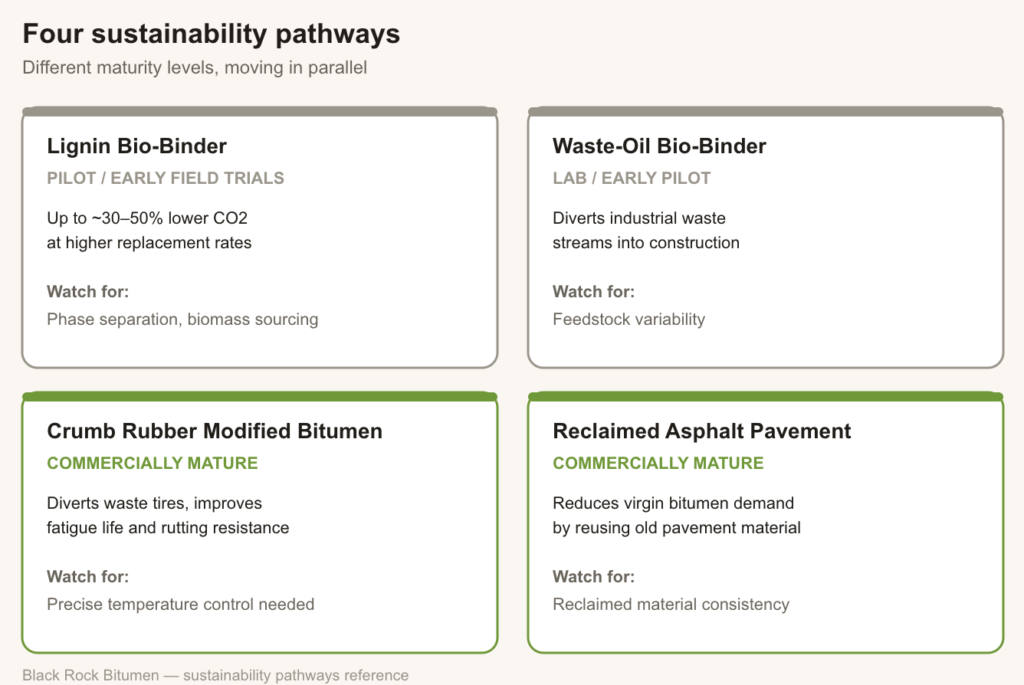
Alt text: Four sustainability pathways for bitumen: lignin bio-binder, waste-oil bio-binder, crumb rubber modified bitumen, and reclaimed asphalt pavement, with maturity levels and key considerations.
A German field study on partial lignin substitution found preliminary results promising enough to start shaping recommendations for which asphalt mixture types and pavement layers the material suits (Springer Nature). Separate lab research modeling the full life cycle found organic bio-bitumen could reduce climate change impact by close to 50%, and lignin-modified bitumen by roughly 9.4% — though the same research flagged a real trade-off: sourcing biomass at scale increases land use and resource consumption in ways that need better sourcing strategies before this becomes a clean net win (ScienceDirect).
The limitation that keeps showing up across this research: higher lignin dosages can cause phase separation from the base bitumen, requiring continuous stirring to keep the blend stable — a real handling and storage complication, not just a lab curiosity (MDPI).
Pathway 2: Waste-Oil and Bio-Resource Binders
Beyond lignin, researchers have tested a genuinely wide range of waste-derived materials as bitumen extenders and modifiers: waste cooking oil, animal fat byproducts, soybean straw, algae, and cellulosic feedstocks (Western Research Institute; NCBI). In one laboratory study, a bio-oil derived from a paper industry byproduct was blended at 10% into a standard 50/70 penetration grade bitumen and tested against a straight bitumen reference mix, with results promising enough to support continued development.
The common thread across all of these is circularity — turning a waste stream from another industry (food processing, agriculture, paper manufacturing) into a construction input, which reduces both petroleum demand and the waste stream itself. The trade-off is consistency: waste-derived feedstocks vary more than refined petroleum bitumen, which makes quality control a bigger challenge at commercial scale.
Pathway 3: Crumb Rubber Modified Bitumen (CRMB)
Verified Market ReportsBusiness Research InsightsUnlike lignin and bio-oils, this pathway is already commercially mature. Crumb rubber, ground from end-of-life tires, gets blended into bitumen to improve flexibility, rutting resistance, and fatigue performance, while diverting waste tires from landfill. The market reflects that maturity — a broader CRMB market estimate puts the segment at $3.5 billion in 2024, growing toward $5.8 billion by 2033 (Verified Market Reports). This broader estimate should not be compared directly with the narrower $1.84 billion-to-$3.67 billion devulcanized CRMB-for-asphalt estimate cited in the introduction. Within the broader modified bitumen category, crumb-rubber-modified asphalt already holds close to a 20% market share, with reported performance gains including roughly 20% higher fatigue resistance and up to 18% longer pavement life before major maintenance (Business Research Insights).
This is also the pathway most directly relevant to buyers today, since crumb-rubber-modified binders are already a standard commercial product rather than a research project.
Pathway 4: Reclaimed Asphalt Pavement (RAP)
Rather than modifying fresh bitumen, RAP recycles old asphalt pavement itself back into new road construction, recovering both the aggregate and the aged binder. It’s currently the single largest recycled-material segment in this space, holding an estimated 62% share of the broader recycled asphalt market (FactMR). Real capacity is coming online to support it — an AUD $20 million plant in Queensland, Australia now produces asphalt with up to 30% recycled bitumen content for projects within a 200-kilometer radius, and a commercial RAP plant in Ohio, USA is scaling from 100,000 to a targeted 1,000,000 tons of annual production within a few years (Mordor Intelligence).
RAP’s advantage is that it doesn’t require a new binder chemistry at all — it reduces virgin bitumen demand simply by reusing what’s already been produced once, which makes it one of the most immediately scalable sustainability levers available to a road authority right now.
Comparing the Pathways
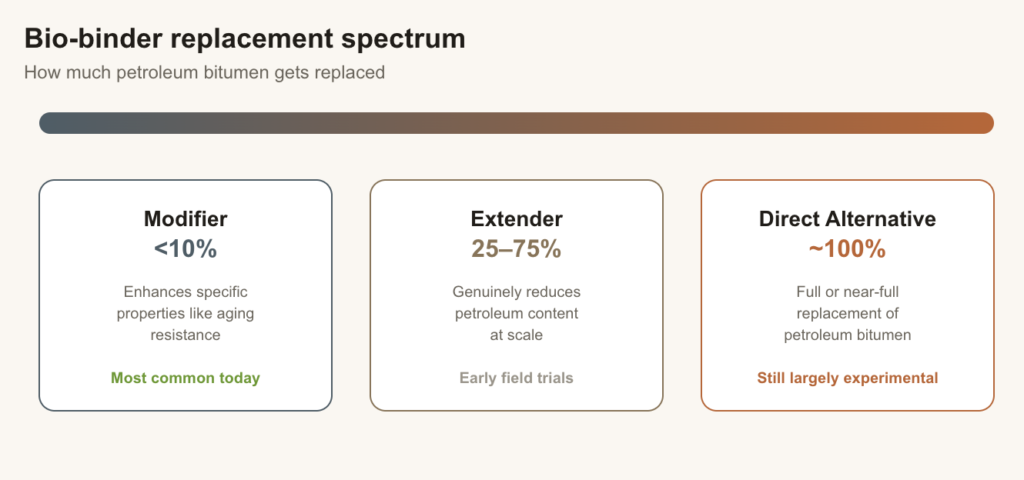
Alt text: Bio-binder replacement spectrum showing modifier below 10 percent, extender at 25 to 75 percent, and direct alternative at about 100 percent replacement.
| Pathway | Maturity | Typical replacement | Key benefit | Current limitation |
| Lignin bio-binder | Pilot / early field trials | Under 10% (modifier); 25–75% (extender/research) | Up to ~30–50% lower CO2 at higher replacement | Phase separation at higher dosages, biomass sourcing trade-offs |
| Waste-oil bio-binder | Lab / early pilot | Typically under 10% | Diverts industrial waste streams | Feedstock variability, limited long-term field data |
| Crumb Rubber Modified Bitumen | Commercially mature | Full binder modification | Diverts waste tires, improves fatigue life | Requires precise temperature control during production |
| Reclaimed Asphalt Pavement (RAP) | Commercially mature | Up to ~30% of mix | Reduces virgin bitumen demand directly | Requires quality control on reclaimed material consistency |
What This Means for Buyers Today
If you’re sourcing bitumen for a project in Africa, South America, or Southeast Asia right now, it’s worth being clear-eyed about where each pathway actually stands. Lignin and waste-oil bio-binders remain largely confined to pilot projects and research programs in Europe and North America — genuinely promising, but not yet something most suppliers can deliver at commercial scale or with the field-performance history a large infrastructure project needs.
Crumb Rubber Modified Bitumen and Reclaimed Asphalt Pavement are a different story — both are commercially available now, with real performance track records, and both deliver a genuine sustainability benefit without asking a project to accept unproven binder chemistry. For most buyers today, that makes CRMB and RAP the practical near-term path toward more sustainable paving. Black Rock Bitumen already supplies the commercially mature CRMB and cold patch options discussed here, while bio-binders remain the pathway to watch over the next several years as field data accumulates and production scales up.
Polymer Modified Bitumen more broadly also plays into this conversation indirectly — extending pavement service life, even without a bio-based ingredient, reduces how often a road needs resurfacing, which is itself a meaningful reduction in lifetime material and carbon demand per kilometer of road.
Frequently Asked Questions
Is bio-bitumen ready for large-scale commercial use? Not yet, for most applications. Lignin and waste-oil-based binders remain largely in pilot and field-trial stages, mostly in Europe. Crumb Rubber Modified Bitumen and Reclaimed Asphalt Pavement, by contrast, are already commercially mature and widely available.
What’s the difference between a bio-binder “modifier,” “extender,” and “direct alternative”? These describe how much petroleum bitumen gets replaced: a modifier replaces under 10%, an extender replaces 25% to 75%, and a direct alternative aims for full or near-full replacement. Most current commercial and pilot activity sits in the modifier and lower-extender range.
Does using recycled or bio-based bitumen sacrifice performance? Not necessarily. Crumb Rubber Modified Bitumen has shown improved fatigue resistance and longer service life in commercial use. Bio-binders at lower replacement percentages have shown comparable or improved performance in several studies, though data at higher replacement levels and over longer service periods is still developing.
What’s the most accessible sustainable option for a project right now? Reclaimed Asphalt Pavement and Crumb Rubber Modified Bitumen are the most commercially mature options available today, with established supply chains and field performance data, compared to bio-based binders which remain earlier-stage.
The Bottom Line
The bitumen industry isn’t waiting for one silver-bullet replacement — it’s developing several sustainability pathways in parallel, at different speeds. Reclaimed Asphalt Pavement and Crumb Rubber Modified Bitumen are already real, commercially available options today. Lignin and other bio-based binders are the genuinely promising next wave, worth watching closely but not yet ready to replace proven petroleum bitumen on a large infrastructure project. Knowing which category a given “sustainable” product actually falls into is the difference between a real decision and a marketing claim.
Review note: This article should be reviewed every six months because market figures, pilot projects, regulatory developments, and commercial availability can change quickly.
See our Polymer Modified Bitumen range, which includes Crumb Rubber Modified Binders, for the most commercially mature sustainable option available today, or our Cold Patch Mixture for maintenance applications that extend pavement life between major resurfacing cycles.