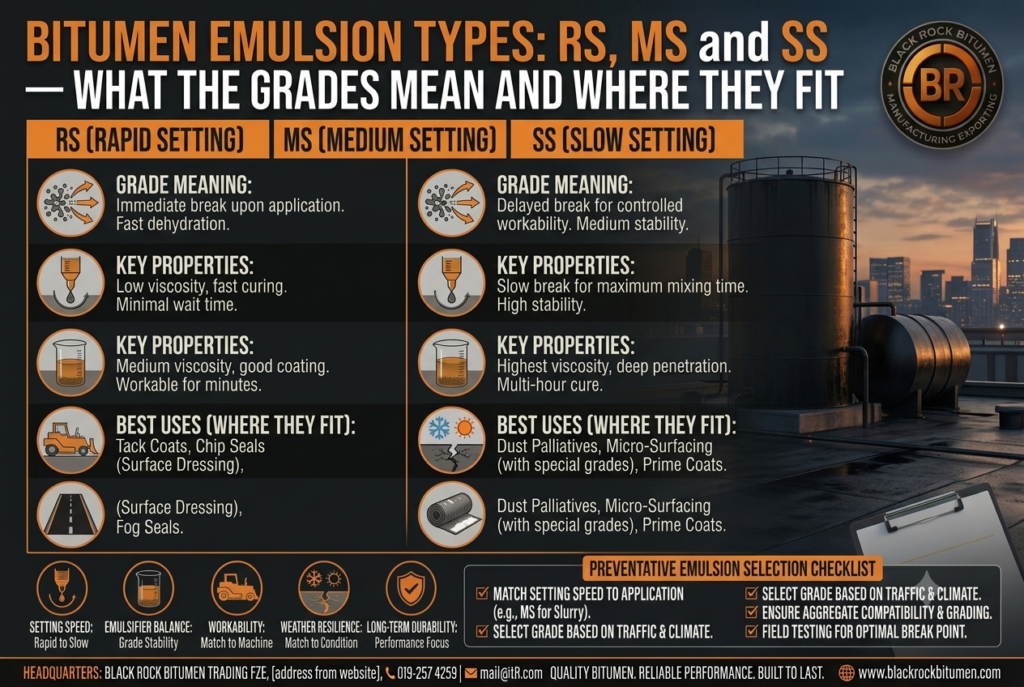
Author: Farheen Fatima — Content Writer, Global Bitumen Supply & Market Insights, Black Rock Bitumen.
Published: [Insert original publication date] | Last updated: 28 August 2026
If a bitumen emulsion specification says RS-2, MS-2, SS-1h or CRS-2, the letters are not random product codes. They tell you how the emulsion is expected to behave during application — how quickly it breaks, how it interacts with aggregate, and how much working time the crew has before the water separates from the asphalt residue.
That distinction matters because rapid setting is not automatically better than slow setting. The correct emulsion is the one that matches the application, aggregate, weather, traffic, and required working time.
ASTM D3628 explains the selection principle: emulsion type and grade should be chosen according to the construction method, aggregate properties, and environmental conditions. ASTM D3628 That is a much better starting point than choosing a grade because the name sounds stronger or faster.
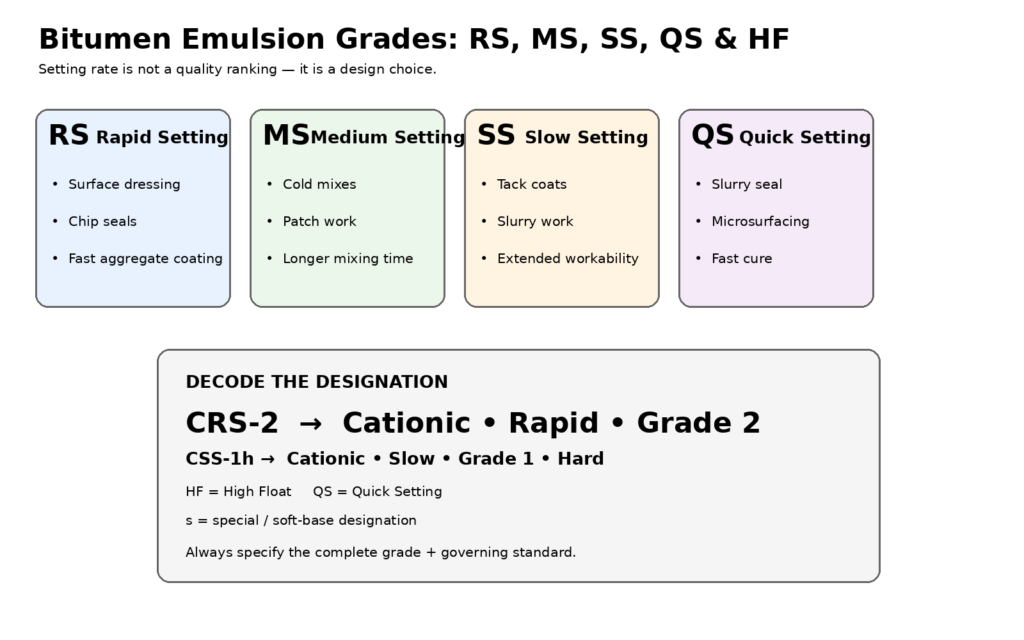
Alt text: Infographic decoding RS, MS, SS and QS bitumen emulsion setting families, showing typical applications and explaining cationic grade notation such as CRS-2 and CSS-1h, plus high-float and special-grade designations.
The Basics: What Is a Bitumen Emulsion?
A bitumen emulsion is a dispersion of bitumen droplets in water, stabilised with an emulsifying agent. Instead of heating the binder to the temperatures required for conventional hot-applied asphalt work, the emulsion can be stored and applied in a water-based form. After application, the emulsion breaks and the water separates, leaving the bitumen residue behind.
The useful part is not simply that it is cold applied. The emulsion lets engineers control how quickly the binder becomes continuous enough to perform the intended job. That is why setting rate is central to grade selection.
Black Rock Bitumen supplies cationic and anionic emulsion grades for export, including CRS, CSS, RS, SS, MS, HFMS and QS families. Its Black Rock Bitumen Bitumen Emulsion range The range is supplied for road construction and maintenance applications.
RS vs. MS vs. SS: The Simple Difference
| Family | Meaning | Typical role | What the contractor needs |
| RS | Rapid Setting | Surface dressing, chip seals, spray applications | Fast break and rapid aggregate coating |
| MS | Medium Setting | Cold mixes, patching, maintenance work | More mixing time than rapid-setting grades |
| SS | Slow Setting | Tack coats, slurry work, stabilization and fine aggregate mixes | Longer workability and controlled breaking |
| QS | Quick Setting | Slurry seal and microsurfacing | Fast cure after placement while allowing the treatment to be worked |
| HF | High Float | High-float surface treatments and cold-mix applications | Gel structure helps reduce binder drainage |
The key is to separate the setting family from the charge. RS, MS, SS and QS describe setting behaviour. The emulsion can also be cationic or anionic. For example, CRS-2 is a cationic rapid-setting grade, while RS-2 is an anionic rapid-setting grade. CSS-1h is cationic, slow-setting and a hard grade; SS-1 is anionic and slow-setting.
ASTM D977 covers emulsified asphalt grades within its scope, while cationic emulsified asphalt is covered separately by ASTM D2397/D2397M. ASTM road and paving standards The current listings identify D977-20(2026)e1 and D2397/D2397M-25e1.
1. RS — Rapid-Setting Emulsions
Rapid-setting emulsions are designed to break relatively quickly after contact with the aggregate or pavement surface. They are commonly associated with surface dressing and chip-seal work, where the binder needs to hold aggregate rapidly enough for the construction sequence to move forward.
Typical grades include RS-1 and RS-2 on the anionic side and CRS-1 and CRS-2 on the cationic side. The cationic versions are useful where strong aggregate adhesion is required. Black Rock Bitumen’s CRS-70 page describes the grade for tack coats, surface dressing, spray sealing and patch repairs. CRS-70 product page.
A rapid-setting grade can be the wrong choice when the crew needs substantial mixing time. If the emulsion breaks before the aggregate is properly coated or the mix is placed, the faster product has become the worse product.
2. MS — Medium-Setting Emulsions
Medium-setting emulsions sit between rapid and slow families. They are commonly used in cold mixes and maintenance work where the binder needs enough time to mix and coat aggregate before breaking.
The MS family becomes particularly useful when the job involves a mixture rather than a simple spray-and-cover sequence. The contractor needs workable material long enough to produce uniform coating, but not necessarily the extended working time associated with a slow-setting system.
High-float medium-setting grades add another layer. HFMS grades are formulated to provide a gel-like structure after breaking, helping limit binder drainage from coarse aggregate. That makes them relevant to chip seals and cold-mix work where aggregate structure and climate create drainage risks.
3. SS — Slow-Setting Emulsions
Slow-setting emulsions are designed to give the contractor more time for mixing, coating and placement. They are commonly associated with fine aggregate mixes, slurry work, stabilization and certain tack-coat applications.
SS-1 is an anionic slow-setting emulsion. Black Rock Bitumen describes SS-1 as a low-viscosity grade intended for cold mix, slurry seal, soil stabilization and maintenance work. SS-1 product page.
Cationic slow-setting grades such as CSS-1 and CSS-1h are specified separately under the cationic framework. Black Rock Bitumen’s CSS-1h page identifies it as a cationic slow-setting, hard-base emulsion. CSS-1h product page.
One important correction to the common shorthand: slurry seals are not simply SS grades. Quick-setting emulsions are also important — especially for slurry seal and microsurfacing — because the treatment needs a controlled working window followed by relatively rapid cure.
4. QS — The Grade Family That Often Gets Missed
Quick-setting emulsions deserve their own line in any modern emulsion guide. QS grades are used where a treatment must be mixed and placed but then gain stability quickly. They are particularly relevant to slurry seal and microsurfacing.
CQS-1h and QS-1h are examples encountered in specifications, while latex-modified quick-setting grades are used for higher-performance microsurfacing systems. The exact designation should always be checked against the governing specification and project method rather than inferred from the application name alone.
This is why a procurement order should never say only slow-setting emulsion for slurry. It should name the complete grade and standard.
5. HF — Why High-Float Grades Matter in Hot Climates
High-float emulsions are designed to produce a gel structure in the residual binder. The float characteristic is intended to help control binder drainage and improve the behaviour of certain surface treatments and cold mixes.
For projects in hot regions across Africa, South America and Southeast Asia, this family deserves attention because high ambient temperatures can increase the risk of binder movement before the treatment has stabilised. HFMS and HFRS grades are not automatically the right answer, but they belong in the selection conversation whenever drainage and aggregate structure are concerns.
Black Rock Bitumen supplies HFMS grades, including HFMS-2s, described as a high-float anionic medium-setting emulsion for cold mixes, patch repairs and specialised road construction. HFMS-2s product page
6. How to Decode a Grade Like CRS-2 or CSS-1h
| Code element | Example | What it tells you |
| Charge | C | Cationic emulsion — positive particle charge |
| Setting family | RS / MS / SS / QS | Rapid, medium, slow or quick setting |
| Grade number | 1 / 2 | Grade within the family; exact meaning depends on the governing standard |
| h | CSS-1h | Harder residual asphalt designation in the relevant grade system |
| HF | HFMS-2 | High-float formulation |
| s | HFMS-2s | Special designation whose exact meaning must be read against the governing specification |
The important procurement lesson is that a short code is a compact specification, not a universal language. ASTM, AASHTO and EN systems do not necessarily encode properties in exactly the same position or with the same meaning. The complete grade, standard and test requirements should travel together on the purchase order.
7. Residue Content: The Number Behind the Water
An emulsion contains water as part of the delivery form, but the pavement ultimately relies on the residual binder. Commercial emulsions commonly contain roughly 55–70% binder residue, depending on grade and specification. For slurry work, ISSA guidance commonly uses a minimum residual asphalt content around 60%, but the actual project specification controls.
That number matters because application rates cannot be compared intelligently without knowing whether you are comparing the emulsion itself or the residual binder left after breaking. A nominal 1.0 kg/m² application rate does not mean 1.0 kg/m² of asphalt residue.
ASTM specifications include residue-related testing, alongside viscosity, storage stability, demulsibility, coating behaviour, sieve tests and other properties. ASTM D977 and the applicable cationic specification should be checked for CRS/CSS grades.
8. Application Temperature: Emulsion Does Not Mean No Temperature Control
Emulsions are water-based, but temperature still matters. Spray temperature affects viscosity, spray pattern and application quality. A Nevada DOT specification, for example, lists broad grade-specific ranges such as 10–54°C for SS-1/CSS-1 and 43–71°C for CRS-1/CRS-2 in the cited applications. Other agencies and product specifications can differ.
| Grade family | Illustrative spray range | Important caution |
| SS-1 / CSS-1 | 10–54°C in the cited Nevada specification | Use project/manufacturer limits |
| CRS-1 / CRS-2 | 43–71°C in the cited Nevada specification | Higher than slow-setting examples |
| MS / HFMS | Often moderate-temperature application | Exact range depends on grade and specification |
| General emulsions | About 10–71°C can appear across agency guidance | Do not use one blanket temperature for every grade |
The practical rule is simple: use the manufacturer’s recommended range and the project specification. Nevada DOT specification Do not heat an emulsion merely because the weather is cold, and do not assume a hotter application will improve spray quality.
9. Dilution: Water Quality and Mixing Direction Matter
Some tack-coat and fog-seal applications use diluted emulsion, but dilution is not a universal permission. The project specification must allow it, and the emulsion manufacturer should confirm the dilution method.
Where dilution is permitted, use clean, compatible water with low mineral content. Water should be added to the emulsion in a controlled way rather than treating the tank as a place to improvise the mixture. Some agencies explicitly prohibit dilution for particular grades or applications, while others allow defined ratios.
For detailed guidance on emulsified asphalt practices, see the National Academies guidance. Always follow the specific product and project requirements.
10. Storage, Freezing and Handling
Bitumen emulsion is not infinitely stable. ASTM D977 states that emulsified asphalt separated by freezing should no longer be tested. Freezing can permanently disrupt the emulsion structure.
• Protect tanks and drums from freezing and severe temperature swings.
• Avoid unnecessary long-term storage; follow the supplier’s storage-life guidance.
• Use gentle circulation or agitation where the product instructions require it.
• Do not aggressively mix an emulsion that has visibly broken or separated.
• Inspect the product before application if it has been stored for an extended period.
11. ASTM, AASHTO and EN: Which Standard Should You Check?
| Framework | What it covers | Buyer action |
| ASTM D977 | Emulsified asphalt specification within its scope | Use for the applicable non-cationic/anionic grade family |
| ASTM D2397/D2397M | Cationic emulsified asphalt | Use for CRS/CSS and other cationic grades covered by the standard |
| AASHTO M 140 / M 208 | Emulsified asphalt specifications used in highway work | Check the project tender for the specified AASHTO grade |
| EN 13808 | Framework for specifying cationic bituminous emulsions | Use the required EN performance classes and designation |
| ISSA / ASTM D3910 / ASTM D6372 | Slurry seal and microsurfacing practice | Use where the treatment is specified under these systems |
EN 13808 provides the European framework for specifying cationic bituminous emulsions used in road and paved-area construction and maintenance. BSI EN 13808 summary The governing project specification should decide the grade.
For procurement in international markets, do not assume an ASTM grade has a one-to-one EN or AASHTO equivalent. Ask the project engineer or specification writer which framework governs the work.
12. Common Procurement Mistakes
• Choosing RS because rapid sounds like higher quality.
• Ordering SS emulsion without stating charge, grade, hard/soft designation and governing standard.
• Assuming slurry seal always means SS rather than checking whether a QS system is specified.
• Ignoring high-float grades in hot-climate surface-treatment work.
• Comparing emulsion price per tonne without comparing residual binder content.
• Using a dilution ratio from another project without checking the specification.
• Allowing an emulsion to freeze and then assuming it can simply be remixed.
• Using one spray temperature for every emulsion grade.
How Black Rock Bitumen Can Help You Select the Right Emulsion
For international buyers, selection should begin with the treatment rather than the product name. Black Rock Bitumen’s bitumen emulsion range includes cationic and anionic families supplied for road construction and maintenance applications.
For a project in West or East Africa, South America, or Southeast Asia, provide the supplier with the aggregate type, intended treatment, climate, expected traffic, application method, required standard and delivery destination. That gives the supplier enough information to recommend a grade rather than simply quoting the nearest available code.
If you are comparing emulsions with cutback bitumen, Black Rock Bitumen’s Cutback Bitumen vs. Bitumen Emulsion guide provides useful background on where emulsion fits within the broader bitumen family.
FAQs
Is RS better than SS bitumen emulsion?
No. RS and SS describe different setting behaviour. RS is designed to break faster; SS provides more working time. The correct choice depends on the treatment, aggregate, weather and construction sequence.
What is the difference between CRS and CSS?
Both are cationic emulsion families. CRS is rapid-setting, while CSS is slow-setting. The complete grade and governing standard determine the detailed requirements.
What is QS bitumen emulsion used for?
Quick-setting emulsions are commonly associated with slurry seal and microsurfacing systems where the material needs workable placement followed by relatively fast setting.
What are high-float emulsions used for?
High-float grades are used where the residual binder’s gel structure can help control drainage, particularly in surface treatments and some cold-mix applications.
How much residue is in bitumen emulsion?
Many commercial emulsions fall around 55–70% binder residue, but the exact value depends on grade and specification. Always use the product’s certified specification rather than a generic range.
Can bitumen emulsion be diluted with water?
Some grades and applications permit controlled dilution, while others prohibit it. The project specification and manufacturer instructions must be followed, including water quality and mixing procedure.
Can bitumen emulsion freeze?
Yes. Freezing can irreversibly destabilise an emulsion. ASTM D977 states that emulsified asphalt separated by freezing should no longer be tested.
The Bottom Line
RS, MS and SS are not three competing versions of the same product. They are different tools for different pavement applications.
**RS (Rapid Setting)** is the choice to investigate when fast breaking is needed, particularly for chip seals and certain surface treatments. **MS (Medium Setting)** gives more working time and is commonly used for mixes, patching and recycling with suitable aggregates. **SS (Slow Setting)** provides the longest working time and is commonly associated with fine-aggregate mixes, fog seals and other applications where controlled setting is important.
But the setting rate is only one part of the decision. Charge, viscosity, base asphalt, aggregate compatibility, climate, application method and project specification all matter.
If you are sourcing emulsion for an infrastructure project, start with the exact application and applicable specification. Then compare the required Bitumen Grades & Standards for Infrastructure Tenders with the supplier’s product documentation. Review the COA vs. TDS vs. MSDS documentation before approving a shipment, and check the relevant Bitumen Emulsion supply details. For projects where conventional penetration grades are more appropriate, compare Penetration Grade Bitumen and Performance Grade Bitumen as part of the overall binder-selection process.