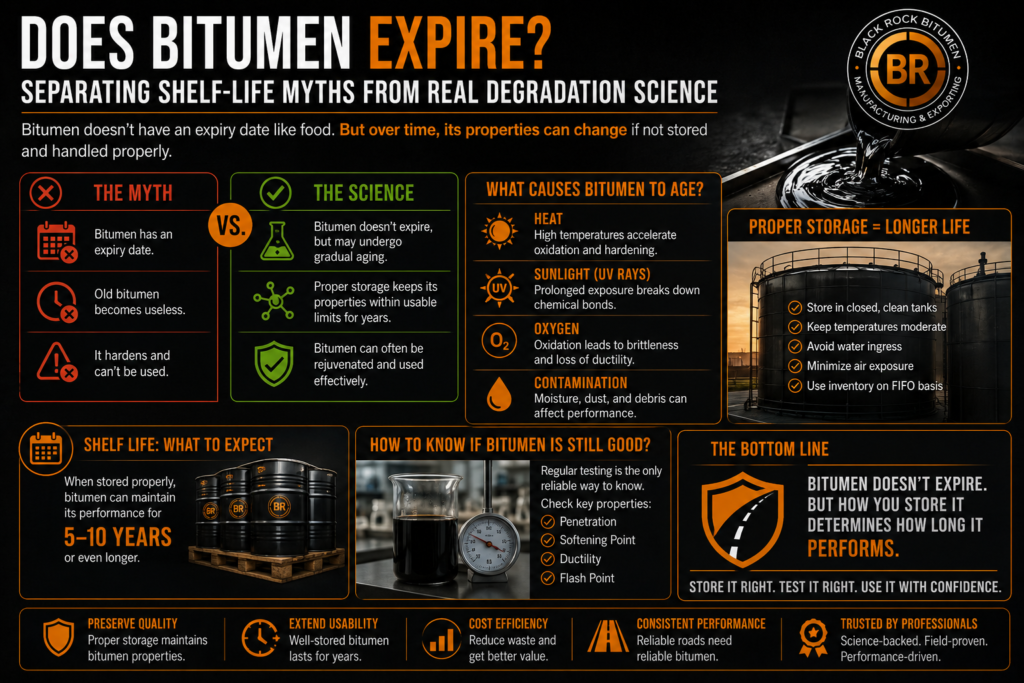
Bitumen does not usually ‘expire’ like a packaged food or medicine. It ages and can degrade, but the calendar alone does not tell you whether an old batch is still suitable for use.
The more useful question is: how was the bitumen stored, how long has it been there, what has happened to it during storage and transport, and does it still meet the governing specification?
For buyers moving bitumen internationally from Dubai into Africa, South America and Southeast Asia, this distinction matters. Ocean transit, port delays, customs clearance, inland transport and storage can all extend the time between production and application. A production date is therefore important, but it is only one part of the decision.
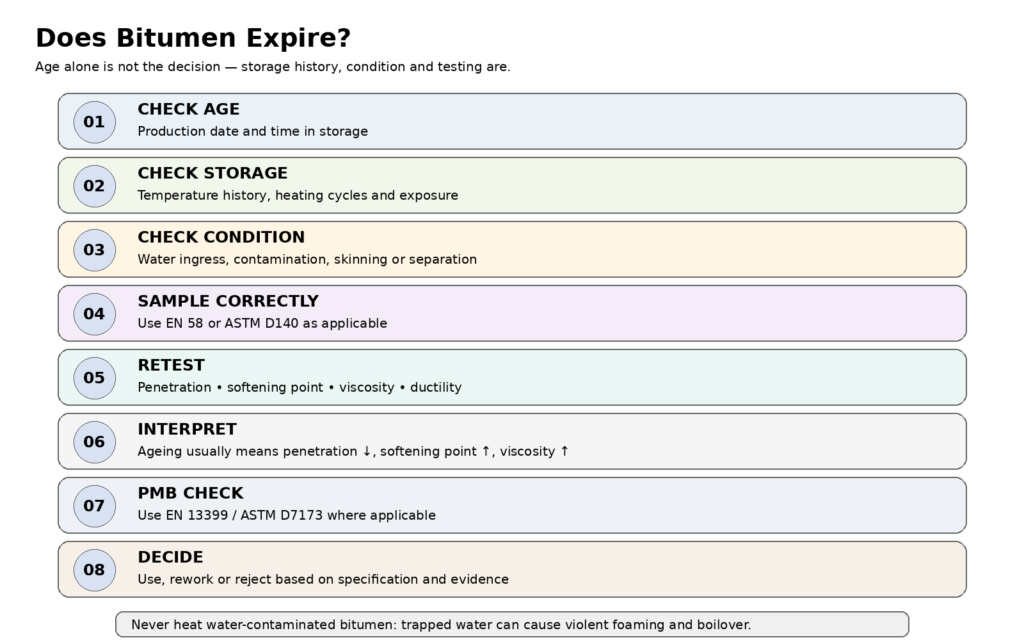
Alt text: Infographic showing an eight-step process for evaluating older bitumen, from checking production age and storage conditions through sampling, retesting, PMB stability testing and final specification-based acceptance.
Does Bitumen Have an Expiry Date?
In most paving applications, bitumen is better understood as a material that undergoes ageing rather than a product that suddenly becomes unusable on a particular calendar date.
Oxidation and other changes can alter binder properties over time. Heat exposure accelerates ageing, while repeated heating and cooling can also affect the material. PMB can introduce an additional issue: storage stability and possible phase separation if the formulation and storage conditions are not suitable.
That means an old batch should not be accepted or rejected solely because it is old. Its condition and test results should be compared with the applicable specification and, where relevant, the original COA.
Myth 1: If It Is Old, It Is Automatically Bad
Not necessarily. A batch that has been stored correctly may remain usable beyond the period a buyer initially expected, while a newer batch that has been overheated, contaminated or exposed to water can present a serious problem.
The practical question is whether the binder still meets the required specification and is suitable for the intended application.
| What to check | Why it matters |
| Production date | Establishes age and supports traceability |
| Storage history | Shows duration and temperature exposure |
| Original COA | Provides the baseline test results |
| Current sample | Shows present material condition |
| Governing specification | Defines acceptance requirements |
| Batch / shipment records | Connects the sample to the delivered material |
Myth 2: If It Looks Fine, It Is Fine
Visual appearance is useful, but it is not a substitute for testing. Bitumen can look normal while its penetration, viscosity or softening point has changed.
For older stock, compare the current test results with the original certificate and the governing specification. A meaningful change in properties may indicate ageing even when the material still looks uniform.
What Does Ageing Look Like in Test Results?
| Property | Typical ageing direction | What it can indicate |
| Penetration | Decreases | Binder becomes harder / less penetrable |
| Softening point | Increases | Binder becomes harder at elevated temperature |
| Viscosity | Increases | Binder becomes more resistant to flow |
| Ductility | May decrease | Loss of flexibility can accompany ageing |
These trends are diagnostic indicators, not universal acceptance thresholds. The actual pass/fail decision must be made against the governing product specification and the original material requirements.
Myth 3: Heating Makes Old Bitumen New Again
Heating can restore workability by reducing viscosity, but it does not reverse chemical ageing. If oxidation has changed the binder, bringing it back to a pumping temperature does not restore its original molecular structure.
This distinction matters when older material has been stored for a long period or subjected to repeated heating. Heating should be used to handle the product correctly, not as a way to ‘reset’ its age.
The same principle applies to PMB. Temperature can affect handling and storage behaviour, but it does not make a separated or chemically aged binder automatically equivalent to fresh material.
Storage Temperature: The Number the Storekeeper Needs
Storage temperature needs to be high enough to keep the binder workable and low enough to avoid unnecessary thermal ageing. The exact working range depends on the grade, formulation, equipment and supplier’s handling instructions.
| Situation | Practical guidance |
| Routine storage | Follow the product-specific storage temperature supplied by the manufacturer / supplier. |
| Extended hot storage | Avoid unnecessary time at elevated temperature because oxidation and ageing accelerate. |
| Heating for pumping | Heat only to the temperature needed for safe pumping and handling. |
| Below pumpable range | The binder may require controlled reheating before transfer. |
| PMB storage | Follow the specific product’s temperature and circulation requirements to maintain stability. |
Do not treat one temperature as a universal limit for every bitumen product. The storage and handling guide for the specific grade should control the operating range.
For detailed handling considerations, see Bitumen Storage and Handling.
Why Storage History Matters More Than the Calendar
Two drums produced on the same day can age differently if one is stored under controlled conditions and the other is exposed to water, repeated heating or poor handling.
For bulk material, ask for storage temperature history and the number of heating cycles where available. For drums, inspect the containers and look for water ingress, damaged closures, standing water or conditions that could allow contamination.
For international shipments, transit time also matters. A batch can spend time at the export terminal, on the vessel, at the destination terminal and in inland transport before it reaches the project. A buyer should therefore think in terms of total time and thermal history, not simply manufacturing date.
Myth 4: All Bitumen Has the Same Storage Behaviour
Different binders behave differently. Conventional paving grades, PMB and other bituminous products can have different storage requirements.
PMB deserves particular attention because polymer-modified systems can experience phase separation if they are stored incorrectly or for too long without the circulation or temperature management required by the formulation.
PMB Storage Stability: EN 13399 and ASTM D7173
EN 13399 is the storage-stability test for polymer-modified bitumen. The test evaluates separation after holding the material at elevated temperature for an extended period; the commonly referenced procedure uses a vertical tube at 163°C for 72 hours.
ASTM D7173 provides an equivalent approach for evaluating separation tendency in polymer-modified asphalt binders.
See EN 13399 — Bitumen and bituminous binders: Determination of storage stability of modified bitumen for the European standard reference.
See ASTM D7173 — Standard Test Method for Determining the Separation Tendency of Polymer from Polymer Modified Asphalt for the ASTM method.
Sampling Older Bitumen Correctly
Retesting is only useful when the sample represents the material that will actually be used. For international cargo, sampling should be documented so the buyer can establish where the sample came from and when it was taken.
Common sampling standards include EN 58 and ASTM D140. The sampling point, container or tank identification, date, sampler and batch reference should be recorded.
ASTM D140 — Sampling Bituminous Materials provides the ASTM sampling framework.
For a dispute, a sealed retention sample is particularly useful. It gives the supplier and buyer a reference sample from the same batch that can be re-tested using the agreed methods.
What Tests Should You Run on Older Stock?
| Test / check | Why run it | Interpretation |
| Penetration | Checks consistency / hardness | A fall relative to the original COA can indicate hardening |
| Softening point | Checks temperature-related consistency | A rise can indicate ageing / hardening |
| Viscosity | Checks flow behaviour | An increase can indicate oxidation / hardening |
| Ductility, where specified | Checks flexibility | A reduction may indicate ageing |
| PMB storage stability, where applicable | Checks polymer separation tendency | Use EN 13399 / ASTM D7173 framework as specified |
| Visual / container inspection | Checks contamination and physical condition | Water, damaged drums or separation require investigation |
The exact test set should follow the product specification. A test result should always be read with its method, unit, temperature and acceptance limit.
What Does a Failed Retest Actually Mean?
A retest should not be reduced to ‘pass’ or ‘fail’ without context. Compare the result against three things: the original COA, the current governing specification and the intended application.
For example, a meaningful drop in penetration combined with a rise in softening point and viscosity is consistent with oxidative hardening. That pattern is more informative than any single result viewed in isolation.
If the material no longer meets the required specification, it should not simply be accepted because it can still be pumped. The next step should be determined with the project engineer, supplier and applicable specification.
Water Ingress: The Safety Issue You Cannot Ignore
Water contamination is not just a quality problem. Water trapped in bitumen can vaporise rapidly when the material is heated. The resulting steam can cause violent foaming, splashing and potentially boilover.
This is particularly important with old drums. A drum that has been stored outdoors or exposed to standing water can develop water ingress around closures or seams.
Never assume an old drum is safe to heat because the bitumen inside looks normal. Inspect the container and follow the supplier’s heating and handling procedure before reheating older stock.
How to Store Bitumen Drums Properly
| Storage practice | Why it matters |
| Keep drums off the ground | Reduces exposure to standing water and surface contamination |
| Protect from standing water | Helps prevent water entering around closures and seams |
| Store so water cannot pool on the lid | Reduces the chance of water ingress |
| Protect containers from damage | Preserves closures and container integrity |
| Record production / receipt dates | Supports stock rotation and traceability |
| Keep storage records | Allows later investigation of age and conditions |
Good drum storage does not stop ageing, but it reduces avoidable contamination and handling problems.
Older Bitumen During International Transit
For a Dubai-based exporter serving Africa, South America and Southeast Asia, international transit is part of the product’s storage history.
A shipment may experience loading delays, ocean transit, destination-port waiting time, customs clearance and inland transport. These stages can extend the time between production and use and may introduce additional heating or storage cycles.
Buyers should therefore ask suppliers for the production date, batch number, storage / transit history where available, original COA and current documentation. Where the cargo has experienced unusual delays or prolonged hot storage, retesting becomes more important.
This is also why shipping format matters. Drums, flexitanks, bitumen bags and heated tank containers do not create the same thermal history. The receiving operation should be prepared for the actual format and condition of the cargo.
For more on packaging choices, see Bulk vs. Drum vs. Flexitank: How Bitumen Is Packaged and Shipped.
Decision Matrix: Can Older Bitumen Still Be Used?
| Situation | Recommended approach |
| Old, correctly stored, documentation complete | Review COA and storage history; sample and verify against specification if age / history warrants |
| Old but storage history unknown | Sample and retest before use |
| Penetration lower + softening point higher + viscosity higher | Investigate oxidative ageing and compare with specification |
| Water suspected in drums | Do not heat until container and material condition are assessed safely |
| PMB stored for extended period | Check product-specific storage requirements and storage stability / separation where applicable |
| Visible separation | Do not assume reheating fixes it; investigate product and storage history |
| Missing batch traceability | Do not treat a generic certificate as proof of delivered-batch compliance |
| Cargo delayed unusually long in transit | Review thermal history and consider retesting before application |
What Black Rock Bitumen Can Provide Buyers
For a buyer deciding whether older material is acceptable, traceability is as important as the product’s age. Black Rock Bitumen can support the procurement decision by providing product and shipment documentation relevant to the supplied batch, subject to the order and destination requirements.
For international procurement, buyers should ask for the production / batch reference, applicable product specification, COA and current SDS, together with the relevant shipping and conformity documentation.
See Black Rock Bitumen’s bitumen product range and request the documentation applicable to the specific grade and shipment.
The companion How to Read a Bitumen COA Line by Line guide explains how to check batch results, methods and traceability.
For document roles, see COA vs. TDS vs. MSDS: Which Document Tells You What.
Four Common Myths About Bitumen Shelf Life
| Myth | Reality |
| If it is old, it is bad. | Age is a reason to investigate, not an automatic rejection criterion. |
| If it looks fine, it is fine. | Appearance cannot confirm that specification properties are still within limits. |
| Heating makes old bitumen new again. | Heating restores workability; it does not reverse chemical ageing. |
| All bitumen stores the same way. | Storage requirements differ by grade and formulation, especially for PMB. |
Buyer Checklist Before Using Older Bitumen
Record the production date and batch number.
Obtain the original COA and governing product specification.
Review storage and transit history, including prolonged heating where known.
Inspect drums, tanks or containers for water ingress and physical damage.
Sample using an applicable recognised procedure such as EN 58 or ASTM D140.
Retest the properties required by the governing specification.
Compare current results with the original COA.
Check PMB storage stability / separation requirements where applicable.
Keep a sealed retention sample when practical.
Document the acceptance decision and supporting evidence.
FAQs
Does bitumen expire?
Bitumen does not normally have a simple calendar expiry in the way many packaged products do. It can age and degrade, so older material should be assessed using its storage history, condition, testing and governing specification.
How long can bitumen be stored?
There is no single safe storage period for every grade. Storage duration depends on formulation, temperature, heating cycles, equipment and supplier guidance.
Does heating restore old bitumen?
No. Heating can restore workability but cannot reverse chemical ageing.
How do I test old bitumen?
Sample the material using an applicable standard such as EN 58 or ASTM D140, then run the properties required by the governing specification and compare them with the original COA.
What happens if water gets into bitumen?
Water can create a serious heating hazard because it can vaporise rapidly, causing violent foaming, splashing and potentially boilover.
How is PMB checked after storage?
Where applicable, assess storage stability / separation using the product specification and methods such as EN 13399 or ASTM D7173.
What does ageing usually do to bitumen?
Oxidative ageing commonly results in lower penetration, higher softening point and higher viscosity, although acceptance must be based on the governing specification.
Why does transit time matter?
Ocean transit, terminal delays and inland transport extend the time between production and application and may add storage or heating cycles.
The Bottom Line
Does bitumen expire? The better answer is: **bitumen degrades, and the rate of degradation depends on the material and how it has been stored and handled.**
There is no reason to reject a batch simply because it is old, but there is also no reason to assume an old batch is fine without evidence when storage history is uncertain.
For buyers and contractors, the practical rule is straightforward: track the batch, control storage temperature, avoid unnecessary heating cycles, follow supplier instructions, and test material when age or storage history creates uncertainty.
In other words, stop asking only, “How old is this bitumen?” Ask, **“What has happened to it since it was produced, and does it still meet the specification today?”**
For a complete quality-control workflow, start with How to Read a Bitumen Certificate of Analysis (COA) Line by Line and COA vs. TDS vs. MSDS to understand the documentation. Then review Bitumen Grades & Standards for Infrastructure Tenders to confirm the governing requirements. For modified binders, see Polymer Modified Bitumen and for shipping considerations see Bulk vs. Drum vs. Flexitank.