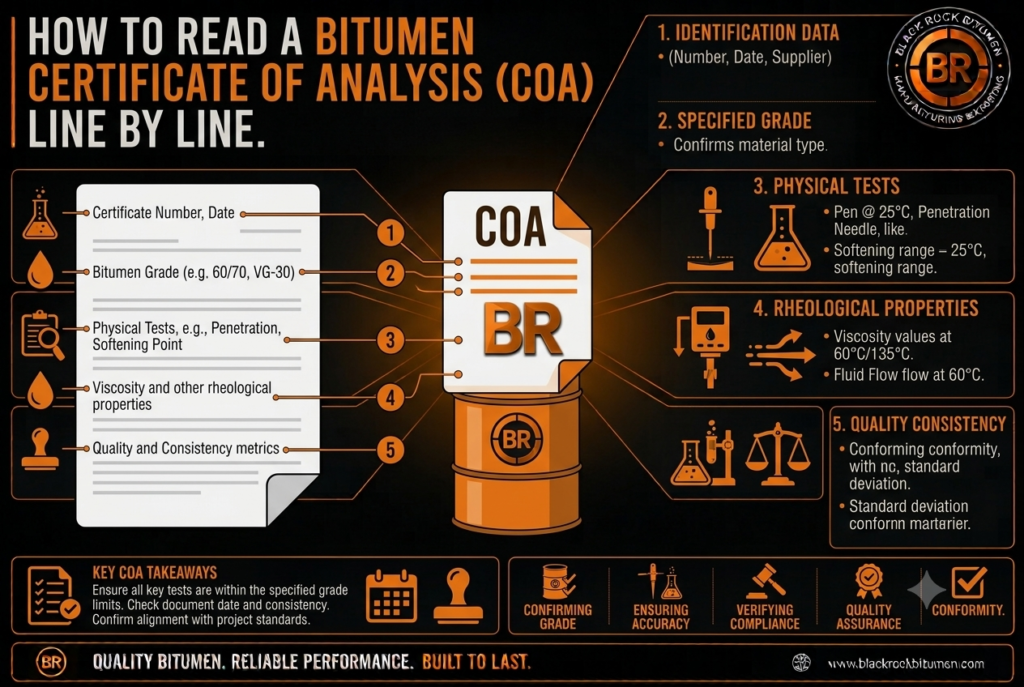
If you buy bitumen internationally, three documents show up again and again: the **Certificate of Analysis (COA)**, the **Technical Data Sheet (TDS)** and the **Safety Data Sheet (SDS)**. They may sit in the same email, but they answer different questions.
The easiest way to remember the difference is this: **PROJECT REQUIREMENT → PRODUCT/TDS → BATCH/COA → SAFETY/SDS**. A TDS describes what a product is intended to be. A COA reports what was measured on a particular batch. An SDS explains hazards, safe handling and transport information.
A fourth document sometimes appears alongside them: the **Certificate of Conformity (CoC)**. A CoC is a supplier declaration that the supplied product conforms to the stated specification; it is not the same thing as a batch COA, which reports measured test results.
For buyers, that distinction is practical. A TDS can show a typical or representative value, while the COA should show the result for the actual batch being shipped. If you are approving cargo, the batch-specific evidence matters.
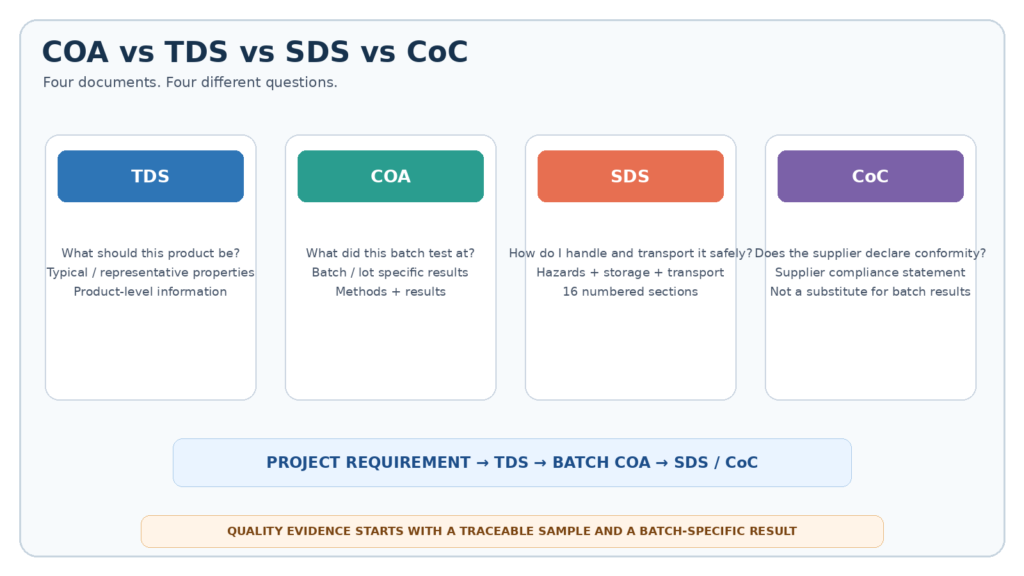
Alt text: Infographic comparing a TDS, COA, SDS and Certificate of Conformity, showing that the TDS describes the product, the COA reports batch-specific test results, the SDS covers hazards and transport in a standard 16-section format, and the CoC is a supplier conformity declaration.
This guide walks through the most common lines you will see on a penetration-grade bitumen COA and explains what each one tells you — without turning the document into a laboratory textbook.
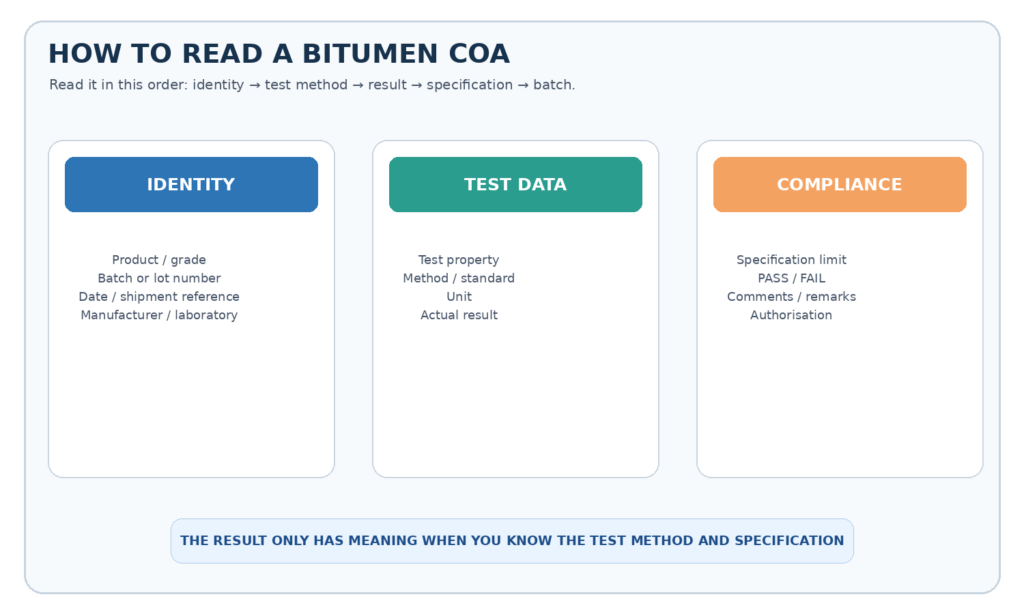
Alt text: Colour infographic showing the three stages of reading a bitumen COA: identity, test data and compliance.
Before looking at individual product types, know the red flags that should stop a buyer from treating a document as proof of batch quality.
**Red flags include:** a TDS presented as if it were a COA; missing batch or lot number; results without test methods; results that cannot be traced to a sample; no sampling information; unexplained discrepancies between COA, invoice and product specification; an outdated SDS; and no indication of the laboratory’s competence or accreditation for the methods used.
| COA field | What to check | Why it matters |
| Product name | Exact product and grade | Confirms the COA belongs to the product ordered |
| Batch / lot number | Unique batch or lot reference | Links the test results to a specific shipment or production batch |
| Sample / test date | Date sampled and/or tested | Helps establish when the results were generated |
| Manufacturer / supplier | Legal or identifiable issuing party | Provides traceability |
| Order / shipment reference | PO, invoice, vessel or shipment reference where available | Helps connect the COA to the cargo |
| Specification | ASTM, EN or project specification | Tells you which acceptance limits apply |
| Laboratory / authorised signatory | Testing laboratory or responsible person | Adds traceability to the reported results |
The last point is easy to miss. Where third-party or accredited testing is required, ask whether the laboratory is accredited to **ISO/IEC 17025** for the relevant methods. An in-house COA and an ISO/IEC 17025-accredited laboratory report are not automatically equivalent; the buyer should understand who performed the tests, under what scope and with what quality controls.
A generic technical data sheet is not the same thing as a shipment COA. A TDS describes the product; a COA should identify the tested material or batch and report its test results.
Line 1: Product / Grade
Start with the product name.
You might see a designation such as **Bitumen 60/70**, **80/100**, or another penetration grade. The grade is a classification, not a complete description of everything the binder can do.
For penetration grades, the numbers relate to the penetration test result at the specified test conditions. The applicable standard then defines the acceptable range and other required properties.
A useful COA should let you connect five things: **product → batch → sample → test method → result**. If one of those links is missing, the certificate becomes harder to rely on.
Sampling deserves particular attention in international trade. Ask **who sampled, when, where the sample was taken, how it was collected and which sampling procedure was followed**. Common standards include **EN 58** for sampling bituminous binders and **ASTM D140/D140M** for sampling asphalt materials. A precise laboratory result is only meaningful if the sample represents the delivered cargo.
For larger shipments, buyers should also ask whether a sealed **retention sample** is held against the batch. A retention sample gives both parties a defined physical reference if a quality dispute appears after delivery, allowing the original material to be re-tested rather than relying only on paperwork or a new sample taken later.
The laboratory matters too. Where the contract or quality system requires accredited testing, check that the laboratory is **ISO/IEC 17025 accredited for the relevant test methods**. Accreditation is scope-specific, so “ISO 17025” alone is not enough; the relevant methods should fall within the laboratory’s accredited scope.
Under ASTM D5, penetration is determined under specified conditions and is reported in units of 0.1 mm. In practical terms, it gives an indication of the binder’s consistency under the test conditions.
For a 60/70 penetration grade, a result within the applicable 60–70 range is consistent with that grade. The exact acceptance limits, however, should always be taken from the governing specification named on the COA or purchase order rather than copied from a generic table.
| COA line | What to read | What it tells you |
| Penetration | Result + temperature + unit + method | Consistency / penetration classification under the specified test conditions |
| Example | 64 × 0.1 mm @ 25°C | Falls within a typical 60/70 penetration range |
| Method | ASTM D5 or EN 1426, for example | Defines how the result was measured |
| Specification | Required range | Determines pass / fail |
Do not compare penetration numbers from different test methods or temperatures as though they were automatically equivalent. The test method and conditions are part of the result.
What Should a Bitumen COA Actually Show?
The exact parameter set depends on the governing specification. A useful comparison is below; it is not a substitute for the full applicable standard.
ASTM D36/D36M describes bitumen as a viscoelastic material that gradually becomes softer and less viscous as temperature rises. The ring-and-ball test provides a defined and reproducible way to determine a softening point. ASTM also notes that the result is useful for classification, shipment uniformity and indicating the tendency of bitumen to flow at elevated temperatures. citeturn0search0turn0search4
If a COA for a 60/70 grade reports a softening point of 52°C, you would compare that number against the applicable specification. A result that satisfies the penetration range but fails the required softening-point limit is not automatically acceptable.
Read penetration and softening point together. They describe different aspects of the binder and should both be checked against the governing specification.
Line 4: Ductility
Ductility is commonly reported in centimetres and indicates how far the bitumen specimen can elongate under the specified test conditions before breaking.
ASTM D113 is the commonly referenced method for ductility of bituminous materials.
On a COA, check three things: the reported result, the test temperature / conditions where stated, and the minimum or required value in the specification.
A result such as “>100 cm” means the specimen exceeded the instrument or reporting threshold rather than giving you an exact value above 100 cm.
Do not treat ductility as a standalone score for overall pavement performance. It is one property within a broader specification.
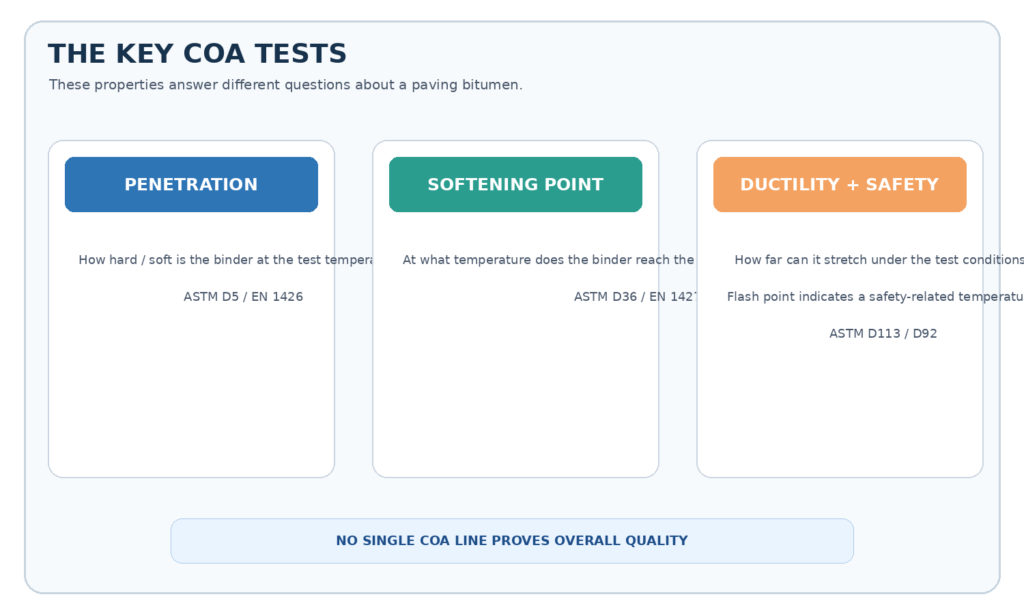
Alt text: Colour infographic explaining three groups of key COA tests: penetration, softening point, and ductility plus flash point.
Line 5: Flash Point
An SDS is structured differently from a COA or TDS. Under the GHS-aligned 16-section format, the sections follow a standard sequence so users can find safety information quickly.
The most useful sections for bitumen logistics are **Section 2: Hazard identification; Section 7: Handling and storage; Section 8: Exposure controls/personal protection; Section 9: Physical and chemical properties; Section 10: Stability and reactivity; Section 14: Transport information; and Section 15: Regulatory information**.
For hot bitumen shipments, **Section 14** is particularly important because it is where the transport classification is normally stated. Where the applicable conditions are met, hot bitumen may be listed as **UN 3257, Elevated Temperature Liquid, N.O.S. (Bitumen), Class 9, Packing Group III**. Buyers should check the actual current SDS for the product and transport condition rather than copying a classification from another supplier. This connects directly with the shipping guidance in Black Rock Bitumen’s Bulk vs. Drum vs. Flexitank article.
When reading the line, confirm the test method, reported temperature and specification limit. A high flash point does not mean the bitumen is automatically a better road binder; it is a different characteristic with an important handling and safety role.
This is particularly relevant when bitumen is heated during storage, loading and application.
Line 6: Solubility
Solubility is used to assess the portion of the bituminous material that is soluble in the specified solvent under the test method.
Certificate of Conformity: What It Adds
A **Certificate of Conformity (CoC)** is different from a COA. The CoC is a supplier declaration that the product conforms to a named specification or contractual requirement. The COA provides batch-specific measured results. A CoC can therefore support a compliance statement, but it should not be used as a substitute for the actual batch test results when those results are required.
The practical buyer question is simple: **Does the reported result meet the specified minimum?**
Do not confuse solubility with purity in a broad, everyday sense. It is a defined laboratory property measured under a defined method.
Line 7: Specific Gravity / Relative Density
Specific gravity or relative density may appear on the COA, often referenced to 25°C.
It helps describe the density relationship of the binder and can be useful in quantity calculations, material characterisation and quality control.
ASTM D70 is a commonly referenced method for specific gravity and density of semi-solid bituminous materials.
If the COA reports 1.03 at 25°C, check the unit / reference temperature and the method before comparing it with another supplier’s value.
Line 8: Loss on Heating / Ageing Tests
Some COAs include a loss-on-heating or ageing-related line. The exact test depends on the specification.
You may see tests such as the Thin-Film Oven Test (TFOT) under ASTM D1754 or Rolling Thin Film Oven Test (RTFOT) under ASTM D2872 in specifications for asphalt binders.
These tests are used to assess changes in binder properties associated with controlled heating and ageing procedures.
A COA might report mass change, retained penetration, viscosity change or another post-ageing property depending on the specification.
The important point is that an ageing line should be read together with its test method and acceptance limit. Do not interpret a single “loss on heating” percentage without knowing which test was used.
Line 9: Viscosity
Viscosity may appear on some bitumen COAs, particularly where the product specification requires it.
Viscosity describes resistance to flow under specified conditions. Because bitumen is highly temperature-dependent, the test temperature is critical.
A result such as viscosity at 135°C is not directly comparable with a result at 60°C.
Always read the full line: **property + temperature + unit + test method + result + specification**.
What Buyers Should Expect From a Bitumen Supplier
A supplier should be able to explain what documentation accompanies the shipment and how the batch is traceable. For Black Rock Bitumen, the practical expectation should be a document set that connects the **product specification, batch identity, test results, safety information and shipment paperwork** rather than treating each document as a standalone attachment.
For a Dubai-based export shipment, buyers should confirm the applicable product specification, batch COA, current SDS, commercial and transport documents, and any destination-specific conformity or inspection documents required by the importing market. Where accredited laboratory testing is specified, the buyer should also be able to identify the testing laboratory and the relevant accreditation scope.
That is the standard buyers should use when comparing suppliers: not simply “Did they send a PDF?” but **“Can I trace the cargo from specification to batch to sample to test result to shipment?”**
| Property | Common method example | Typical unit / reporting format |
| Penetration | ASTM D5 / EN 1426 | 0.1 mm at specified temperature |
| Softening point | ASTM D36 / EN 1427 | °C |
| Ductility | ASTM D113 | cm |
| Flash point | ASTM D92 | °C |
| Solubility | ASTM D2042 / EN 12592 | % by mass |
| Specific gravity | ASTM D70 | Relative density / specific gravity |
| TFOT | ASTM D1754 | Mass change / post-heating properties |
| RTFOT | ASTM D2872 | Mass change / retained properties |
| Viscosity | ASTM D4402 or other specified method | Pa·s, cP or specified unit |
The table is a reading guide, not a substitute for the governing product standard. Always use the method and acceptance criteria specified for the particular grade and contract.
The Most Important Part: Result vs Specification
Once you understand each line, the actual COA check becomes much easier.
| Test | Reported result | Specification | Buyer action |
| Penetration | Actual batch value | Required range | Confirm it falls within range |
| Softening point | Actual °C | Minimum / range | Confirm compliance |
| Ductility | Actual cm or threshold | Minimum | Confirm compliance |
| Flash point | Actual °C | Minimum | Confirm compliance and method |
| Solubility | Actual % | Minimum | Confirm compliance |
| Specific gravity | Actual value | Range if specified | Check against contract / standard |
| Ageing / heating | Actual change / retained property | Specified limit | Confirm method and limit |
| Viscosity | Actual value at stated temperature | Specified limit / range | Confirm temperature and method |
This is the difference between **reading a COA** and simply looking at numbers. Every result needs a reference point.
How to Read a COA Line by Line: A Worked Example
Imagine the following simplified COA for a penetration-grade 60/70 bitumen:
| Property | Test method | Result | Specification |
| Penetration @ 25°C | ASTM D5 | 64 (0.1 mm) | 60–70 |
| Softening point | ASTM D36 | 52°C | 49–56°C* |
| Ductility @ 25°C | ASTM D113 | >100 cm | 100 cm min* |
| Flash point | ASTM D92 | 285°C | 230°C min* |
| Solubility | ASTM D2042 | 99.7% | 99% min* |
| Specific gravity @ 25°C | ASTM D70 | 1.04 | As specified* |
Reading it properly means checking each result against the specification marked on the actual purchase order or governing standard. The asterisks above are illustrative — exact limits vary by standard and grade.
The example also shows why you should not stop at penetration. A binder can sit inside the penetration range while another required property fails its limit.
COA Red Flags That Should Make You Pause
Before approving a shipment, start with the project specification and compare it against the product TDS. Then verify the actual batch through the COA, check the sampling and laboratory details, and use the current SDS for safety and transport information. For deeper procurement guidance, review Black Rock Bitumen’s Bitumen Grades & Standards for Infrastructure Tenders, How to Read a Bitumen Certificate of Analysis (COA) Line by Line, Bulk vs. Drum vs. Flexitank: How Bitumen Is Packaged and Shipped, HS Codes and Import Documentation for Bitumen Shipments, and Bitumen Storage, Handling & Transport Standards.
Alt text: Colour infographic showing three bitumen COA red flags: missing batch information, missing test methods, and mismatched product or specification information.
| Red flag | Why it matters | What to do |
| No batch / lot number | You cannot confidently link results to the cargo | Request a batch-specific COA |
| No test methods | You do not know how the result was measured | Ask for the applicable methods |
| No specification limits | A result cannot be judged as pass / fail | Request the governing specification |
| Grade mismatch | COA may not belong to the ordered product | Stop and resolve before acceptance |
| Different quantities / references | Documents may relate to another shipment | Reconcile invoice, B/L, packing list and COA |
| Unclear laboratory / issuer | Traceability is weaker | Request issuer and testing details |
| Results copied identically across unrelated batches | May indicate a generic document rather than batch testing | Ask for original batch records / testing evidence |
| Unit or temperature missing | Result may be impossible to interpret correctly | Request the complete test line |
COA vs TDS vs SDS: Do Not Treat Them as the Same Document
A COA answers: **What did this tested batch achieve?**
A TDS answers: **What is this product and what are its technical characteristics?**
An SDS answers: **How should the material be handled safely, and what hazards and precautions apply?**
Is a TDS the same as a COA? No. A TDS describes product characteristics and typical or representative values. A COA reports results for a specific batch.
What is the difference between a COA and a Certificate of Conformity? A COA reports measured batch results. A CoC is a supplier declaration that the product conforms to a stated specification or requirement.
What should I check on a COA first? Confirm the product, grade, batch number, sampling information, test methods, actual results, specification limits and laboratory details.
Does the laboratory need to be accredited? Where the project or contract requires accredited testing, verify ISO/IEC 17025 accreditation for the relevant methods and scope. Accreditation is not a generic quality badge; the test method must fall within the laboratory’s accredited scope.
Why does sampling matter? The COA represents the sample that was tested. If the sample was not representative of the delivered material, even an accurate laboratory result may not represent the shipment.
What is an SDS used for? It provides hazard, handling, storage, emergency and transport information. Under the standard 16-section format, transport information is in Section 14 and regulatory information is in Section 15.
Should a supplier keep a retention sample? For quality-assurance and dispute-resolution purposes, a sealed retention sample can provide a physical reference for re-testing the original batch. The retention period and procedure should follow the contract, quality system and applicable requirements.
Where can I find the UN 3257 classification? Check the current product SDS, normally in Section 14, and confirm the classification against the applicable transport rules for the shipment.
4. Check methods. Make sure each reported test uses the method required by the contract or standard.
5. Check units and temperatures. A result without its conditions can be misleading.
6. Compare against the actual specification. Use the contract’s governing standard rather than a random online specification table.
7. Check dates. Make sure the testing and shipment references make sense.
8. Cross-check documents. Product description and grade should agree across COA, invoice, packing list and shipping documents.
9. Ask questions before loading. It is much easier to resolve a documentation discrepancy before the cargo sails.
Why the COA Matters for International Bitumen Buyers
For buyers sourcing bitumen internationally, the COA is one part of a larger verification process.
A buyer may need to confirm technical compliance, contract compliance, shipment identity and destination requirements at the same time.
This is particularly important when the cargo is moving in bulk, drums or flexitanks. The physical shipment format changes logistics, but the technical batch still needs to be traceable to the COA.
A clear document trail reduces the chance of receiving a cargo that is technically different from what was ordered or discovering a discrepancy only after arrival.
What a Good COA Should Let You Answer
| Question | Can the COA answer it? | What you need |
| What product is this? | Yes | Product name / grade |
| Which batch was tested? | Yes | Batch / lot number |
| When was it tested? | Usually | Test / sample date |
| What was the result? | Yes | Actual result for each property |
| How was it tested? | Yes | Recognised test method |
| Did it meet the specification? | Yes, if limits are shown or referenced | Specification and acceptance limits |
| Is this definitely the cargo shipped? | Not by itself | Cross-check batch / shipment / invoice / B/L |
| Is it safe to handle? | Not fully | Use the SDS as well |
Frequently Asked Questions
What is a bitumen COA? A Certificate of Analysis reports laboratory test results for a specified product or batch and is used to verify compliance with the applicable specification.
What is the first thing to check on a COA? Check the product grade, batch / lot reference and applicable specification before interpreting the test values.
What does penetration tell you? It reports the penetration of the bituminous material under specified test conditions and is used in penetration-grade classification.
What does softening point tell you? It provides a defined measure of the temperature at which the bitumen reaches the specified softening condition. ASTM notes that it is useful for classification, shipment uniformity and indicating flow tendency at elevated temperatures. citeturn0search0
What does ductility tell you? It measures elongation under the specified test conditions. It is one property within the overall binder specification.
Why is the test method important? Because the method defines how the reported result was obtained. The same property name without the method and conditions can be difficult to interpret correctly.
Can a TDS replace a COA? No. A TDS describes product characteristics; a COA provides batch-related test results.
Can a COA replace an SDS? No. The SDS covers safety, hazards and handling information.
What if the COA result is within range but the batch number is missing? Ask for a corrected or traceable batch-specific COA. A technically plausible number is not enough if you cannot link it to the cargo.
Should buyers accept a COA without test methods? They should request clarification. The test method is part of understanding what the reported result actually represents.
The Bottom Line
A bitumen COA is easiest to understand when you stop reading it as a list of numbers.
Read it as a chain:
**Product → Batch → Test Method → Result → Specification → Compliance.**
Start by confirming that the COA belongs to the product and shipment you ordered. Then work through each required property, check the method and conditions, compare the actual result with the governing specification, and finally cross-check the COA against the commercial and shipping documents.
For procurement teams, this approach turns the COA from a document you file away into a practical quality-control tool.
Before approving a shipment, review the COA vs. TDS vs. MSDS documentation, then compare the applicable Bitumen Grades & Standards for Infrastructure Tenders. If you are selecting the binder itself, review Penetration Grade Bitumen, Performance Grade Bitumen and Polymer Modified Bitumen where relevant. For shipment preparation, also review Bulk vs. Drum vs. Flexitank: How Bitumen Is Packaged and Shipped and the relevant HS Codes and Import Documentation for Bitumen Shipments so the technical, commercial and customs paperwork stays aligned.
| Specification / framework | Typical core properties to verify | Common test methods | Buyer check |
| EN 12591 | Penetration, softening point, kinematic viscosity, solubility, flash point and other specified requirements | EN 1426, EN 1427, EN 12595, EN 12592 and applicable EN methods | Confirm exact grade + all limits |
| ASTM penetration-grade framework | Penetration plus specification-dependent softening point, ductility, flash point, solubility and other requirements | ASTM D5, D36, D113 and applicable ASTM methods | Confirm the exact ASTM grade/specification |
| IS 73 | Penetration, softening point, ductility, flash point, solubility and other specified requirements | IS methods specified by the governing edition | Confirm the exact IS 73 grade and edition |