



No products in the cart.
- Blog
- Uses & applications
- Crumb Rubber Modified Bitumen (CRMB): Turning Scrap Tires into High-Performance Binder
Crumb Rubber Modified Bitumen (CRMB): Turning Scrap Tires into High-Performance Binder
Uses & applications

Saniya MirzaBlack Rock Bitumen · Dubai, UAE
3 min read
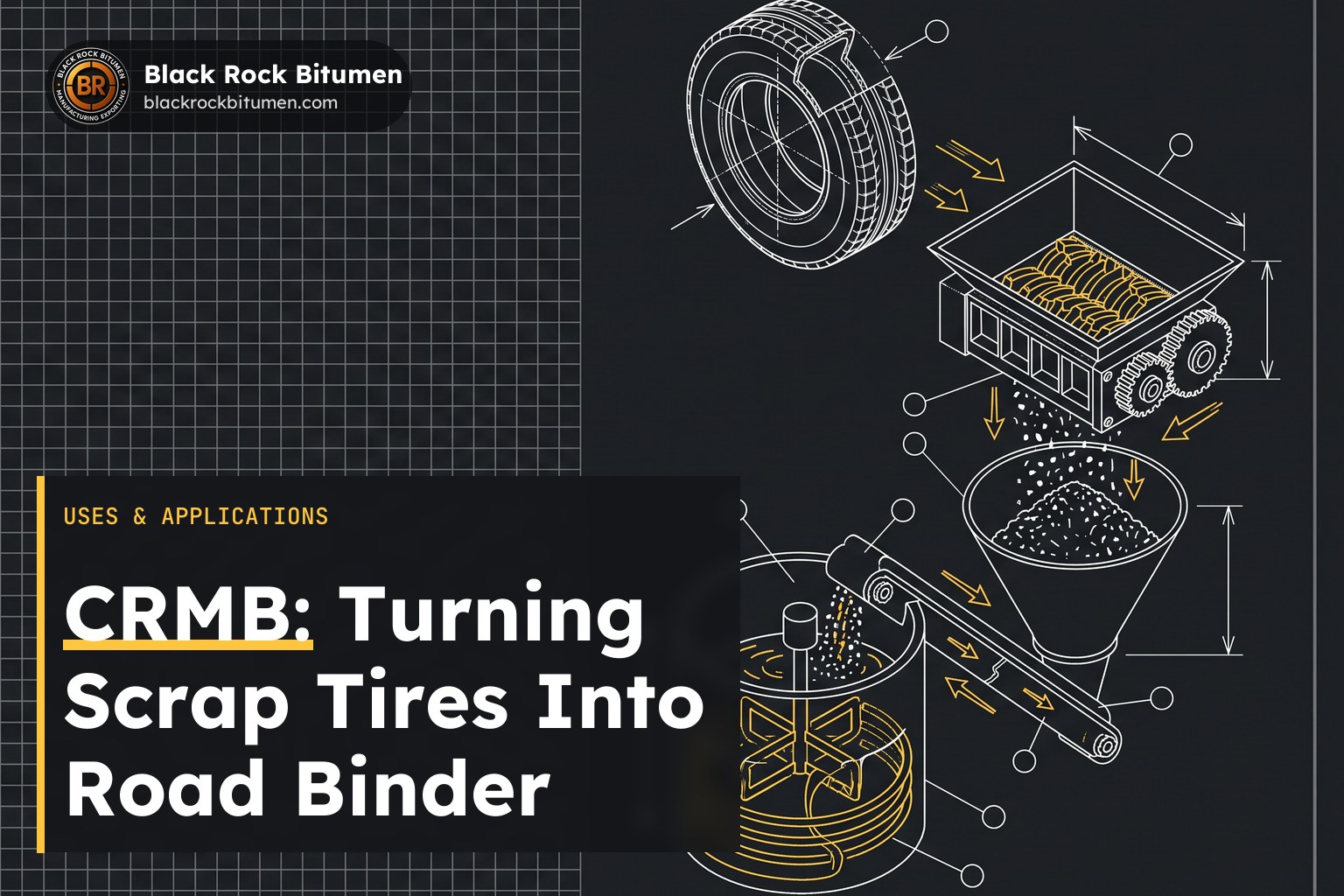
Table of contents
With hundreds of millions of waste tires generated globally each year, scrap tire disposal presents a major environmental challenge. At the same time, modern highway networks face heavy traffic volumes and axle loads that quickly degrade standard neat bitumen.
Crumb Rubber Modified Bitumen (CRMB) addresses both problems. By incorporating recycled tire rubber into asphalt binder, highway engineers can improve rutting resistance, delay fatigue cracking, reduce tire-pavement noise and divert waste rubber from landfills into high-performance infrastructure.
What Is Crumb Rubber Modified Bitumen (CRMB)?
Crumb Rubber Modified Bitumen is produced by blending processed scrap tire rubber, ground into fine particles (approximately 0.18 mm to 0.60 mm, or 30 to 80 mesh), with standard paving-grade bitumen (such as Pen 60/70 or VG-30) at elevated temperatures (170°C to 190°C).
The crumb rubber used in CRMB is sourced from passenger car and heavy truck tires, which consist of natural rubber, synthetic rubber (styrene-butadiene), carbon black, anti-aging additives and trace minerals.
The Crumb Rubber Modification Process
- Scrap tires are shredded and steel/fiber is removed.
- Fine ambient or cryogenic grinding produces crumb rubber powder (30 to 80 mesh).
- Base bitumen (VG-30 or 60/70) and the crumb rubber are combined in a high-shear blending tank at 170°C to 190°C.
- A swelling and digestion phase follows, producing the finished Crumb Rubber Modified Bitumen.
The Reaction Mechanism: Swelling and Digestion
Unlike synthetic polymers such as SBS that dissolve into a continuous phase, rubber particles absorb the aromatic oils (maltenes) from the base bitumen.
As the rubber particles digest at high temperature, they swell to 2 to 3 times their original size. This swelling increases the overall viscosity of the binder, creates a flexible rubberized matrix and raises the softening point, transforming a rigid base bitumen into an elastic, high-viscosity binder.
Manufacturing Processes: Wet Process vs Dry Process
In asphalt engineering, crumb rubber is integrated into pavements using two primary methods.
| Attribute | Wet Process (CRMB Binder) | Dry Process (Rubber-Modified Aggregate) |
| Addition point | Blended directly into the liquid bitumen binder at high heat before plant mixing | Added as a portion of the fine aggregate directly into the hot asphalt plant pugmill |
| Interaction | Chemical digestion and swelling occur; fundamental binder properties are altered | Rubber acts mainly as a flexible aggregate filler with minimal binder modification |
| Binder consistency | Highly uniform viscosity and elastic recovery throughout the mix | Variable dispersion; higher risk of localized stripping or raveling if improperly mixed |
| Field performance | Preferred method; excellent rutting and fatigue cracking resistance | Used mainly for low-volume roads or specialized gap-graded layers |
Key Technical Performance Advantages
Integrating crumb rubber delivers measurable engineering upgrades across several critical parameters.
1. High Softening Point and Superior Rut Resistance
Standard VG-30 or Pen 60/70 bitumens have softening points around 47°C to 54°C. High-grade CRMB formulations achieve softening points between 60°C and 70°C. This high-temperature stiffness helps prevent plastic flow, flushing and wheel-path rutting in extreme summer heat under slow-moving, heavy axle loads.
2. Enhanced Low-Temperature Flexibility
The natural and synthetic rubber polymers retain their elasticity at sub-zero temperatures. CRMB lowers the glass transition temperature of the binder, allowing the asphalt surface to flex under thermal contraction without developing transverse thermal cracks.
3. Increased Film Thickness and Resistance to Aging
Because CRMB has higher zero-shear viscosity, asphalt plants can coat aggregate particles with much thicker binder films without binder draindown during transport and laydown. Thicker binder films protect against oxidative aging and water intrusion.
4. Improved Skid Resistance and Noise Reduction
Pavements built with CRMB (especially when combined with Stone Matrix Asphalt or Open-Graded Friction Courses) offer superior micro-texture for tire grip and reduce tire-pavement noise by 2 to 3 decibels (dB).
CRMB Standard Specifications (IS 15388 / ASTM D6114)
Typical physical properties for standard CRMB grades (for example, CRMB 55 and CRMB 60) show its balanced performance profile.
| Property | Standard Test Method | CRMB 55 | CRMB 60 |
| Penetration at 25°C (0.1 mm) | ASTM D5 / IS 1203 | 50-60 | 40-50 |
| Softening point (°C, min) | ASTM D36 / IS 1205 | 55 | 60 |
| Elastic recovery at 15°C (%, min) | ASTM D6084 / IS 15388 | 50% | 60% |
| Flash point (°C, min) | ASTM D92 / IS 1209 | 220 | 220 |
| Separation, difference in softening point (°C, max) | ASTM D5976 / IS 15388 | 4.0 | 4.0 |
Critical Field Handling and Storage Challenges
While CRMB provides high durability, contractors must manage two technical vulnerabilities during field handling.
Phase Separation in Storage
Because ground rubber particles do not fully dissolve, they tend to settle to the bottom of storage tanks during static holding. CRMB storage tanks must be equipped with continuous mechanical agitators or high-capacity recirculation pumps to maintain uniform dispersion if held above 160°C.
Elevated Plant and Laydown Temperatures
Due to its higher viscosity, CRMB requires higher production temperatures. Hot Mix Asphalt (HMA) must be mixed at 160°C to 175°C and compacted at 140°C to 150°C before the mix cools and locks up.
Engineering and Procurement Takeaway
Crumb Rubber Modified Bitumen (CRMB) turns an environmental pollutant into a functional asset for highway infrastructure. While CRMB carries a moderate initial material premium over neat bitumen, its ability to extend fatigue life by 1.5x to 2x, improve rutting resistance and lower tire-pavement noise delivers a clear return on investment for high-traffic corridors, expressways and urban arteries.
About the author:
Saniya Mirza
Content Writer, Black Rock Bitumen
Saniya Mirza writes the Black Rock Bitumen guides on bitumen grades, testing, storage, shipping and supply, in plain language for buyers, contractors and engineers.