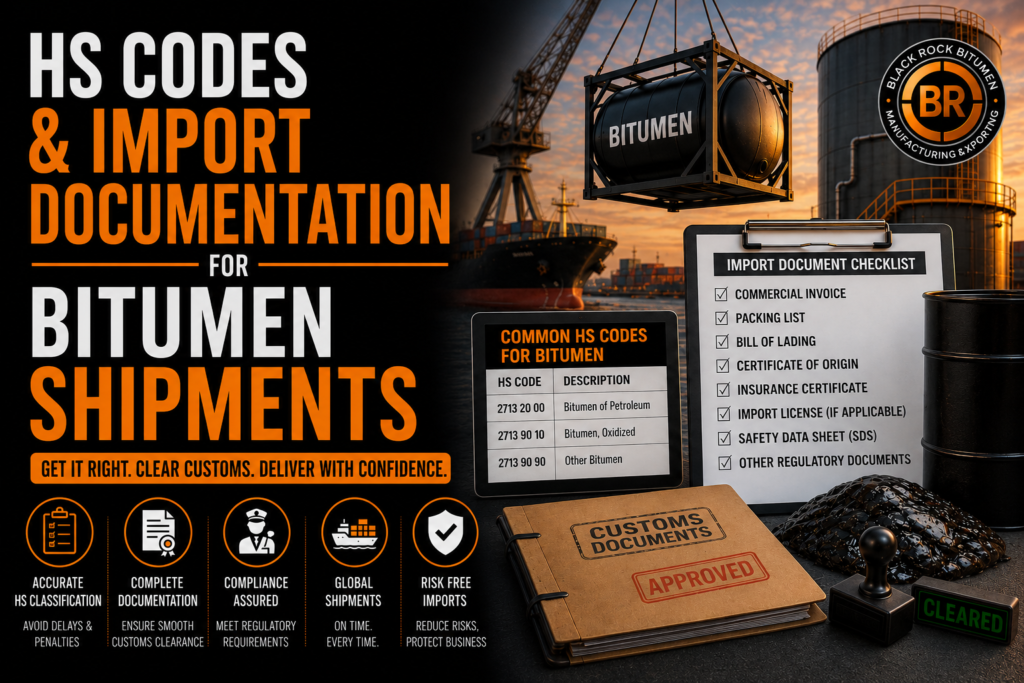
Ordering bitumen internationally is not just about choosing the right grade and agreeing on a price.
Before a shipment reaches the port, someone has to classify the product, prepare the commercial documents, declare the correct quantity and value, provide transport documents, and satisfy the destination country’s customs and regulatory requirements.
One small mistake can create a surprisingly large problem. A wrong HS code can send a declaration into the wrong tariff category. A mismatch between the invoice and packing list can hold up clearance. Missing origin or technical documents can create another round of questions when the cargo is already at the port.
The good news is that the process becomes much easier when you know what each document is actually for.
For petroleum bitumen, the international Harmonized System places the product under **HS heading 2713, subheading 2713.20 — Petroleum bitumen**. The World Customs Organization’s HS structure separately identifies natural bitumen and asphalt under heading 2714 and bituminous mixtures under heading 2715. citeturn0search1turn0search6
This guide explains the main HS classifications buyers should know, the import documents normally involved in a bitumen shipment, and the checks that can help prevent customs delays.
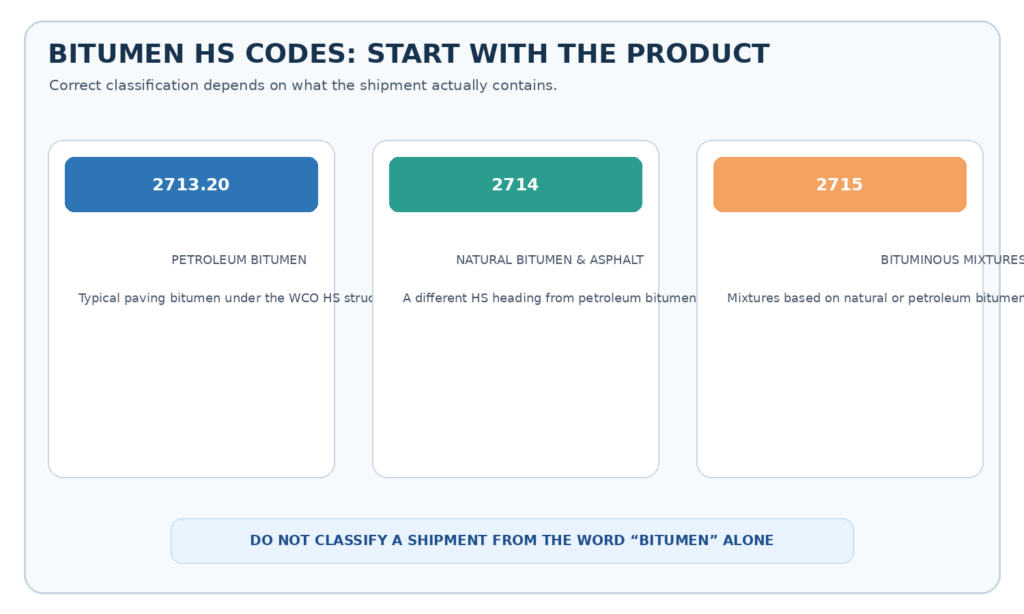
Alt text: Colour infographic showing three key HS classifications relevant to bitumen trade: 2713.20 petroleum bitumen, heading 2714 natural bitumen and asphalt, and heading 2715 bituminous mixtures.
What Is an HS Code?
HS stands for **Harmonized System**. It is the international product-classification system developed by the World Customs Organization and used by customs authorities to identify traded goods.
The WCO states that the HS 2022 nomenclature is used worldwide for uniform classification of goods traded internationally. The system entered into force on 1 January 2022, with national and regional tariff schedules extending the international six-digit structure further where required. citeturn0search9
The first six digits form the international HS classification. Individual customs territories can then add additional digits to create more detailed national or regional tariff codes.
That distinction is important for bitumen buyers. **2713.20 is the international six-digit subheading for petroleum bitumen, but it may not be the complete code required for customs entry in your destination country.**
The Main HS Code for Petroleum Bitumen
| Product | WCO HS classification | Important distinction |
| Petroleum bitumen | 2713.20 | Petroleum bitumen under heading 2713 |
| Natural bitumen / natural asphalt | Heading 2714 | Different from petroleum-derived bitumen |
| Bituminous mixtures | Heading 2715 | Mixtures based on natural asphalt, natural bitumen, petroleum bitumen or certain other bituminous materials |
| Other petroleum residues | 2713.90 | Not the normal classification for petroleum bitumen |
The WCO identifies heading 2713 as covering petroleum coke, petroleum bitumen and other residues of petroleum oils or oils obtained from bituminous minerals. Within that heading, 2713.20 is specifically petroleum bitumen. citeturn0search1
Heading 2714 is separate and covers natural bitumen and asphalt, while heading 2715 covers certain bituminous mixtures. citeturn0search6turn0search7
Why the Exact Product Description Matters
Customs classification is based on the product being imported, not simply the marketing name on a sales brochure.
For example, a shipment described commercially as “bitumen” could refer to petroleum bitumen, natural bitumen or a formulated bituminous mixture. Those products can fall under different HS headings.
That is why the invoice and customs declaration should use a clear product description such as the actual petroleum-bitumen grade, physical form and intended commercial identity rather than a vague description.
The description should also be consistent across the invoice, packing list, bill of lading and customs declaration.
UAE / GCC: Why the Six-Digit Code Is Not Always Enough
For shipments entering the UAE, the classification process goes beyond the international six-digit HS structure.
Dubai Customs explains that the GCC has adopted a **unified 12-digit customs structure**, extending the Harmonized System for greater precision in customs classification and tariff application. citeturn0search0
That means an importer should not simply copy “2713.20” into every UAE customs declaration and assume the job is finished. The applicable GCC/UAE tariff extension should be confirmed for the actual product.
Dubai Customs provides an HS Code Search / Al Munasiq platform to help identify the applicable classification, tariff information and restrictions. citeturn0search2
For a shipment routed through Dubai, this is especially relevant because the exporter, importer, customs broker and shipping documents should all be aligned before cargo arrival.
Do HS Codes Change by Bitumen Grade?
A common misconception is that 40/50, 60/70, 80/100 or other penetration grades automatically receive different international HS codes.
The WCO six-digit structure identifies petroleum bitumen at 2713.20; the grade itself does not create a different six-digit HS heading simply because the penetration value changes. The destination country’s extended tariff classification should still be verified before filing.
Performance Grade and modified products need particular care because the exact formulation and destination tariff rules should be checked rather than assuming every product marketed as “bitumen” is identical for customs purposes.
The Core Import Documents for a Bitumen Shipment
The exact document list depends on the importing country, port, product and transaction structure. But international bitumen shipments commonly involve a commercial document set plus transport, origin and technical documentation.
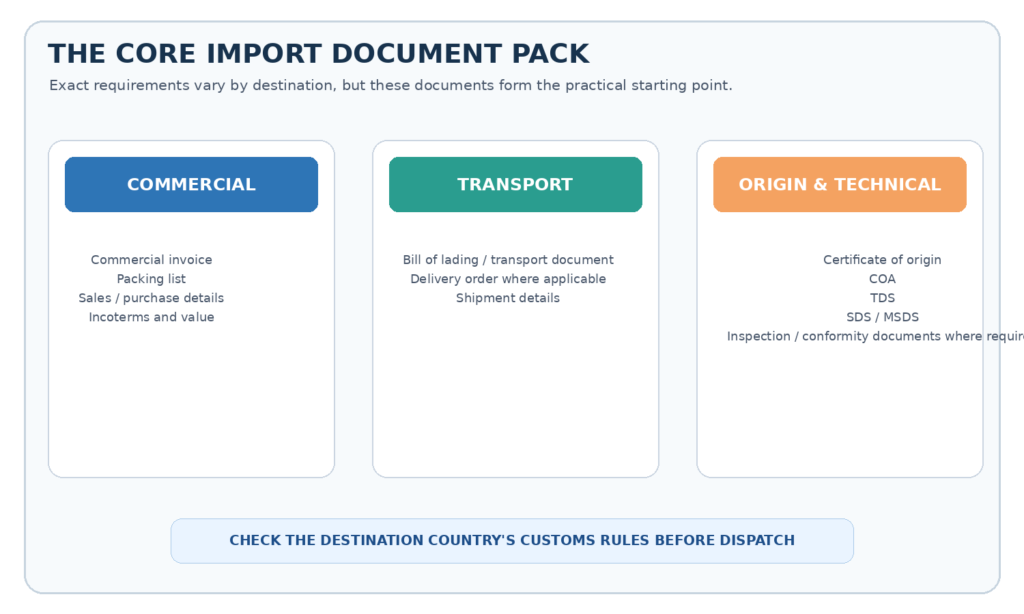
Alt text: Colour infographic showing the core import document groups for bitumen shipments: commercial documents, transport documents, and origin and technical documents.
| Document | What it tells customs / buyer | Common reason it matters |
| Commercial Invoice | Seller, buyer, product description, quantity, price, currency, Incoterm and transaction value | Used for customs valuation and commercial verification |
| Packing List | Package count, net/gross weight, dimensions and packaging details | Helps customs and logistics teams reconcile the physical shipment |
| Bill of Lading | Carrier, shipper, consignee, vessel, port and cargo details | Core transport document for ocean shipments |
| Certificate of Origin | Country of origin of the goods | Used for origin verification and, where applicable, tariff treatment |
| Certificate of Analysis (COA) | Actual batch test results against specified properties | Confirms the supplied batch’s technical characteristics |
| Technical Data Sheet (TDS) | Product specifications and typical technical information | Explains product characteristics and intended use |
| SDS / MSDS | Hazard, handling, storage and safety information | Supports safe handling and regulatory compliance |
| Inspection / conformity documents | Third-party or regulatory confirmation where required | May be required by the destination or contract |
Destination-specific requirements can add documents. For example, Sharjah Customs lists delivery order, packing list, original invoice, attested certificate of origin, bill of lading and inspection report among documents for import operations. citeturn0search13
Commercial Invoice: The Document Customs Starts With
The commercial invoice is one of the most important documents in an international shipment because it establishes the commercial transaction.
For bitumen, it should clearly identify:
Seller and buyer Legal names and addresses should match the transaction and shipping instructions.
Product State the actual bitumen product and grade clearly.
HS code Use the confirmed destination classification rather than guessing.
Quantity Show the quantity and unit clearly, such as metric tonnes or kilograms.
Unit price and total value State the agreed commercial value and currency.
Incoterm Identify the agreed delivery term, such as FOB, CFR or CIF, where applicable.
Country of origin State the actual origin consistent with the certificate of origin.
Packaging If relevant, identify bulk, drums, flexitanks or other packaging.
Packing List: Make the Physical Cargo Match the Paperwork
The packing list should allow the importer, freight forwarder and customs authority to understand what is physically arriving.
For packaged bitumen, that can include the number of drums, net weight per drum, gross weight, total net weight, pallet information and marks or numbers.
For bulk shipments, the document structure may look different because the cargo is not divided into individual packages. The quantity, vessel, tanks and shipment references should still reconcile with the commercial and transport documents.
A simple rule helps: **the invoice tells customs what was sold; the packing list helps show what was shipped.**
Bill of Lading: The Transport Record
For ocean shipments, the bill of lading connects the commercial transaction to the physical movement of the cargo.
Check that the product description, shipper, consignee, notify party, port of loading, port of discharge and quantity are consistent with the commercial documents.
A mismatch does not automatically mean the shipment cannot clear, but it can trigger additional checks and delay the release process.
Certificate of Origin: Where Did the Bitumen Come From?
The certificate of origin identifies the country of origin of the goods.
This is particularly important when a buyer has specified a particular origin, when an importing country applies origin-based measures, or when preferential tariff treatment is being claimed under an applicable trade agreement.
Do not confuse **country of origin** with **country of export**. A shipment can be exported from one country while the goods have a different origin under the applicable rules.
Dubai and GCC customs systems can require detailed origin and classification information, so the certificate should be checked against the invoice and customs declaration before shipment.
COA vs TDS vs SDS: Why Importers Need All Three
These documents are often grouped together, but they answer different questions.
| Document | Main question it answers | What it should not be treated as |
| COA | Did this batch meet the stated test requirements? | A complete product specification for every possible use |
| TDS | What is this product and what are its technical characteristics / intended applications? | Proof that every individual shipment batch has those exact values |
| SDS / MSDS | How should the product be handled safely and what hazards / precautions apply? | A substitute for technical performance specifications |
This distinction becomes important during customs or quality checks. A TDS may show typical or specified properties, while the COA relates to the tested shipment batch. The SDS focuses on safety and handling.
For a deeper explanation, see COA vs. TDS vs. MSDS: Which Document Tells You What?.
HS Code vs Product Grade: Do Not Mix Them Up
An HS code is a customs classification. A bitumen grade is a technical product designation.
For example, a buyer might order a particular penetration grade for a road project. The project specification may care about penetration, softening point, ductility, flash point or other properties. Customs cares about correctly classifying the product under the applicable tariff structure.
The two systems work together, but they are not interchangeable.
| Procurement field | Example of what it controls |
| Product grade | Technical suitability for the pavement / application |
| HS code | Customs classification and tariff treatment |
| COA | Actual batch quality / test results |
| TDS | Product specification and typical characteristics |
| SDS | Safety, handling and hazard information |
| Certificate of origin | Country of origin |
| Incoterm | Commercial allocation of cost, risk and delivery responsibilities |
Common HS Classification Mistakes in Bitumen Trade
Using “2713.20” without checking the destination extension. The six-digit WCO code may need additional national or regional digits.
Confusing petroleum bitumen with natural bitumen. Natural bitumen and asphalt are under heading 2714, not 2713.20. citeturn0search7
Confusing bitumen with bituminous mixtures. Heading 2715 covers certain mixtures and is separate from petroleum bitumen under 2713.20. citeturn0search6
Copying an old tariff code from a previous shipment. Tariff schedules can change, and destination-country extensions must be checked.
Using different product descriptions across documents. Inconsistent descriptions can trigger customs queries.
Letting the supplier and importer use different classifications. The parties should confirm the destination classification before shipping rather than fixing it after arrival.
Import Documentation Checklist Before Dispatch
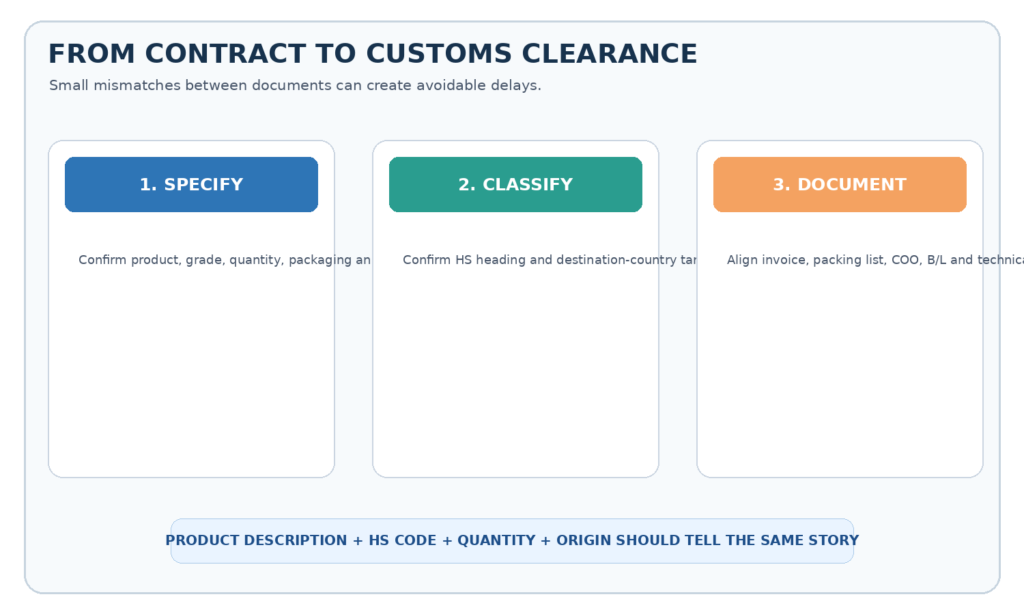
Alt text: Colour infographic showing a three-stage bitumen customs workflow: specify the product, confirm the HS classification, and align all commercial, transport, origin and technical documents.
| Before shipment | Check |
| Product identity | Exact product, grade, packaging and quantity are confirmed |
| HS classification | Destination-country code is verified, including any national / GCC extension |
| Invoice | Description, HS code, quantity, value, origin and Incoterm are consistent |
| Packing list | Weights and package information reconcile with invoice and shipment |
| Certificate of origin | Origin matches the invoice and shipment |
| Bill of lading instructions | Consignee, notify party, ports, quantity and description are correct |
| COA | Batch number and test results match the shipped material |
| TDS | Product characteristics and intended use are available |
| SDS | Current safety and handling document is available |
| Inspection / conformity | Any destination-specific inspection or conformity requirement is completed |
| Importer details | Importer / customs broker has the correct registration and clearance information |
| Final document cross-check | All documents tell the same story before the vessel sails |
What Happens If the HS Code Is Wrong?
A wrong classification can affect more than the duty calculation.
HS classification can influence tariff treatment, statistical reporting, restrictions, permits and the customs declaration itself. Dubai Customs explains that its integrated tariff is intended to improve classification accuracy, tariff application, trade statistics and identification of restricted or prohibited goods. citeturn0search0
That is why classification should be settled before dispatch whenever possible.
If the importer is unsure, use the relevant customs authority’s tariff-classification service or work with a qualified customs broker. Dubai Customs provides an HS Code Search platform, while Abu Dhabi Customs also directs traders to its Smart HS Classification Tool for determining the appropriate code and related requirements. citeturn0search2turn0search3
UAE Exporters: What Should Be Prepared Before the Cargo Leaves?
For a Dubai-based exporter, the best approach is to prepare the document pack around the destination market rather than assuming one universal checklist works everywhere.
At minimum, the commercial invoice, packing list, transport documentation, origin documentation and technical documents should be internally consistent.
If the destination requires an import permit, inspection certificate, conformity document, legalization or special declaration, that requirement should be confirmed before loading.
The importer and customs broker should also confirm the destination tariff code. The exporter can provide the proposed HS classification, but the final import declaration remains subject to the destination customs authority’s rules.
What Buyers in Africa, South America and Southeast Asia Should Check
For international buyers, the most useful question is not simply “What documents do you have?” It is “Do the documents match the destination country’s clearance process?”
African, South American and Southeast Asian markets can have different customs systems, tariff extensions, origin requirements and inspection procedures. A document pack that clears one port does not automatically guarantee clearance at another.
Before the cargo leaves Dubai, the buyer should confirm:
Destination HS code Confirm the full tariff code used by the importing country.
Import permits Check whether the product or shipment requires any permit or approval.
Inspection requirements Confirm whether pre-shipment or destination inspection is required.
Origin rules Confirm whether a specific certificate format or attestation is needed.
Technical documentation Confirm whether the importer or regulator needs a COA, TDS, SDS or conformity certificate.
Packaging rules Check whether drums, bulk or flexitank shipments have destination-specific requirements.
Customs broker requirements Send the complete document set early enough for pre-clearance review.
Bulk vs Drums vs Flexitank: Does Packaging Change the Documents?
The HS classification is based on the product, not simply whether it is shipped in bulk or packaged. But packaging affects the transport and commercial documentation.
For drums, the packing list can identify the number of drums and weights. For bulk cargo, the transport documentation will generally identify the cargo quantity and vessel or tank arrangements rather than individual packages.
Flexitank shipments need particular attention to packaging and transport details because the bitumen’s physical state, temperature control and equipment requirements must be consistent with the agreed shipping method.
For more on shipment formats, see Bulk vs. Drum vs. Flexitank: How Bitumen Is Packaged and Shipped.
A Simple Rule for Avoiding Customs Delays
Before dispatch, compare the following five fields across every document:
| Field | Should match across |
| Product description | Invoice, packing list, B/L, customs declaration |
| HS code | Invoice / customs declaration / broker documentation |
| Quantity | Invoice, packing list, B/L and declaration |
| Origin | Invoice, certificate of origin and declaration |
| Shipment references | Invoice, packing list, B/L and inspection documents |
If one document says one thing and another says something different, resolve the discrepancy before the cargo arrives.
Frequently Asked Questions
What is the HS code for petroleum bitumen? The World Customs Organization’s HS 2022 structure places petroleum bitumen under HS subheading 2713.20. Destination countries can extend the six-digit code further. citeturn0search1turn0search9
Is HS 2713.20 the same in every country? The six-digit international subheading is harmonised, but countries and customs unions can add further digits and national requirements. The GCC uses a unified 12-digit customs structure. citeturn0search0
Is natural bitumen classified under 2713.20? No. The WCO places natural bitumen and asphalt under heading 2714, while petroleum bitumen is under 2713.20. citeturn0search1turn0search7
Are bituminous mixtures classified as petroleum bitumen? Not automatically. Heading 2715 separately covers certain bituminous mixtures. citeturn0search6
What documents are normally needed for a bitumen import? Common documents include a commercial invoice, packing list, bill of lading, certificate of origin and technical documents such as COA, TDS and SDS. Destination-specific requirements can add inspection, conformity or permit documents.
Does the COA replace the TDS? No. The COA relates to the tested batch, while the TDS explains product characteristics and intended use.
Does the SDS prove bitumen quality? No. The SDS is primarily a safety and handling document; it is not a substitute for technical specifications or a batch COA.
Can the seller choose the HS code? The seller can propose a classification, but the importer and destination customs authority determine the applicable import classification under local rules. It should be confirmed before shipment.
What should I do if I am unsure about the HS code? Check the destination customs authority’s tariff-classification system or consult a qualified customs broker before dispatch. Dubai Customs provides an HS Code Search platform. citeturn0search2
The Bottom Line
Importing bitumen successfully is partly a product-selection exercise and partly a documentation exercise.
For petroleum bitumen, the international HS classification is **2713.20**, but that six-digit code is only the starting point. Destination customs authorities may extend it with additional digits, and the exact classification should be verified before the shipment leaves the exporting country.
The documentation should then tell one consistent story: what the product is, how much is being shipped, where it came from, what it is worth, how it is being transported and whether the supplied batch meets the required specification.
For procurement teams, start by confirming the applicable Bitumen Grades & Standards for Infrastructure Tenders and then align the product description with the correct customs classification. Before dispatch, compare the COA vs. TDS vs. MSDS documentation, and if the shipment is being supplied in different formats, review Bulk vs. Drum vs. Flexitank Bitumen Packaging. For the technical product itself, buyers can also review Penetration Grade Bitumen, Performance Grade Bitumen and Bitumen Emulsion depending on the application. Finally, make sure the destination-country customs requirements are confirmed with the importer or customs broker before loading.