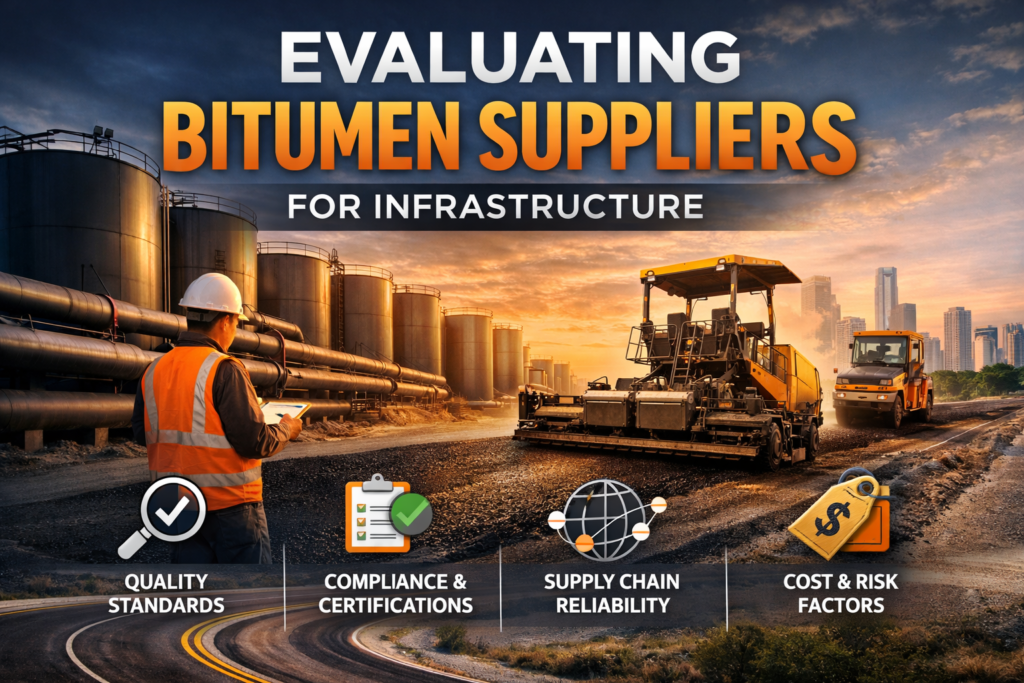
Bitumen procurement in 2026 is not what it was five years ago.
Supply chains are tighter.
Audit scrutiny is higher.
ESG scoring is embedded in government tenders.
Performance-grade specifications are replacing traditional penetration standards.
Logistics volatility is no longer an exception; it’s the baseline.
Yet many infrastructure authorities still evaluate suppliers using outdated, price-first criteria.
That gap creates risk.
Because when supplier evaluation frameworks don’t evolve with market realities, projects absorb the shock.
Higher lifecycle costs.
Unexpected shipment delays.
Premature pavement distress.
Contract disputes that stall progress.
The truth is this:
Evaluating bitumen suppliers today requires more than checking certifications and comparing rates.
It requires a structured, risk-based framework that aligns compliance, quality, logistics, financial strength, and sustainability into one clear decision model.
In this guide, you’ll learn exactly how infrastructure authorities and EPC contractors should approach evaluating bitumen suppliers in 2026, using a practical 9-step framework you can apply immediately.
No theory.
No generic advice.
Just structured procurement intelligence.
Key Takeaways
If you’re short on time, here’s the core logic behind strong bitumen supplier selection criteria:
- Compliance first, certifications and standards are non-negotiable
- Consistency beats price; lifecycle cost matters more than upfront savings.
- Manufacturers outperform traders in reliability
. - Logistics capability matters as much as product quality.
- Transparent pricing reduces financial risk
- Documentation prevents disputes and audit failures
- Financially stable suppliers survive volatility.
- ESG readiness increasingly affects government tenders
Get these right, and everything downstream improves.
Miss even two and the risk multiplies.
Why This Matters Now (Trends + Data)
Let’s ground this in reality.
1. Infrastructure Spending Is Exploding
According to global infrastructure projections, governments are investing trillions in transport networks, highways, and mobility corridors through 2040.
Roads alone represent nearly 30% of total infrastructure spend.
That scale creates stress.
Bitumen demand is growing at approximately 3–4% CAGR globally, with export-grade supply heavily concentrated in the Middle East and Asia-Pacific.
When demand rises faster than stable supply capacity, risk increases.
And procurement teams feel it first.
2. Supply Chain Volatility Is No Longer Temporary
Since 2022:
- Construction material delays have increased significantly
- Bulk cargo freight rates remain volatile.
- Energy-linked input costs affect bitumen pricing.
- Port congestion continues to disrupt timelines.
Even a 14-day delay in bulk liquid cargo can disrupt paving schedules and idle machinery, burning capital daily.
3. Poor Supplier Selection Has Measurable Consequences
Substandard bitumen doesn’t fail immediately.
It fails structurally.
Research across global road authorities shows:
- Roads built with inconsistent bitumen grades show 35–45% earlier surface distress
- Premature rutting increases maintenance costs by up to 40%
- Procurement-related disputes account for over 20% of infrastructure delays.
That’s not an engineering problem.
That’s a supplier evaluation problem.
And that’s why infrastructure procurement bitumen decisions need to become risk-managed processes, not lowest-bid events.
The 9-Step Framework to Evaluate Bitumen Suppliers
This framework is designed for infrastructure authorities, EPC contractors, and government tender committees evaluating government tender bitumen suppliers.
You can apply this globally.
Step 1: Regulatory Compliance & Certifications
This is the first filter.
If a supplier fails here, stop immediately.
Minimum Expectations
- ISO 9001 – Quality Management
- ISO 14001 – Environmental Management
- ISO 45001 – Occupational Health & Safety
Depending on the region:
- ASTM D946 / D6373
- AASHTO M20 / M320
- BS EN 12591
- AS 2008
Compliance isn’t paperwork.
It reflects process discipline, traceability, and standardised quality control.
Suppliers without certification may still offer competitive prices, but statistically, non-certified suppliers show significantly higher defect rates.
When evaluating ISO certified bitumen suppliers, verify certificates independently.
Don’t accept PDFs without validation.
Step 2: Bitumen Quality & Grade Consistency
This is where real performance begins.
Many suppliers provide acceptable first shipments.
The real question is:
Can they maintain grade consistency over 12 months?
Critical Parameters to Verify
Parameter | Why It Matters |
Penetration | Indicates hardness |
Softening Point | Temperature resistance |
Ductility | Crack resistance |
Viscosity | Workability |
Aging Resistance | Long-term durability |
Inconsistent penetration grades increase cracking risk significantly within the first three years.
Ask:
- Are batch-wise test certificates provided?
- Are tests conducted by third-party accredited labs?
- Can historical data be shared across multiple shipments?
In road construction bitumen sourcing, consistency matters more than a marginal cost difference.
Because maintenance costs multiply small quality failures.
Step 3: Manufacturing Capability vs Trading Only
Not all suppliers are equal.
There are three primary categories:
- Manufacturers – Own and operate production facilities
- Manufacturer-Traders – Produce and trade
- Pure Traders – Purchase and resell
Here’s the risk difference:
Manufacturers control:
- Blending
- Storage
- Quality checks
- Production scheduling
- Raw material sourcing
Pure traders depend entirely on upstream producers.
In volatile markets, traders are more exposed to allocation issues and shipment delays.
Manufacturer-linked suppliers show fewer delivery failures and lower dispute frequency.
When conducting evaluations of bitumen suppliers, always ask:
“Do you control production, or are you dependent on third-party allocations?”
That single answer changes your risk profile.
Step 4: Supply Chain Reliability & Logistics Capability
Even perfect quality is useless if shipments arrive late.
Bitumen is temperature-sensitive, handling-sensitive, and logistics-intensive.
Evaluate Logistics Across Five Dimensions
- Heated storage tank facilities
- Contamination control processes
- Packaging flexibility (bulk, drums, jumbo bags)
- Port access & shipping partnerships
- Emergency buffer stock availability
Logistics disruptions can increase total project costs by 18–25%.
Ask suppliers:
- What is your average shipment lead time?
- How many export ports do you operate from?
- What happens if vessel schedules shift?
- Do you offer shipment tracking transparency?
Strong bitumen supply chain reliability reduces idle equipment costs and dispute exposure.
Step 5: Pricing Transparency & Risk Hedging
Low prices win tenders.
Transparent prices win projects.
There’s a difference.
Transparent pricing should include:
- Base bitumen cost
- Freight cost breakdown
- Handling & storage fees
- Price validity period
- Currency risk clarity
- Fuel adjustment mechanisms
Opaque pricing creates downstream disputes.
Projects with transparent pricing models experience fewer cost overruns.
When evaluating bids, shift the conversation from:
“Who is the cheapest?”
To:
“Who is clearest?”
That’s a better predictor of long-term success.
Step 6: Technical Support & Documentation
This is the most underestimated factor in bitumen supplier selection criteria.
Missing documentation leads to audit rejection, delayed payments, and contractual disputes.
Must-Have Documents
- Technical Data Sheets (TDS)
- Safety Data Sheets (SDS)
- Batch Test Reports
- Storage & Handling Guidelines
- Performance Grade Compatibility Notes
Suppliers should assign a technical contact.
Not just a sales representative.
In infrastructure projects, documentation equals protection.
Step 7: Past Performance & References
History leaves patterns.
Ask for:
- Government clients
- EPC contractor partnerships
- Export destinations
- Repeat contract rates
Suppliers with repeat government contracts demonstrate reliability.
Reference calls reveal more than marketing brochures ever will.
Ask previous clients:
- Were deliveries on time?
- Were grades consistent?
- Were disputes handled professionally?
Step 8: Sustainability & ESG Readiness
This is no longer optional.
Over two-thirds of government tenders now include ESG scoring.
Authorities increasingly request:
- Emission disclosures
- Modified bitumen options
- Recycling initiatives
- Environmental compliance documentation
Even if ESG scoring is low today, it won’t stay that way.
Forward-thinking authorities integrate sustainability into procurement scoring.
Step 9: Financial Stability & Scale
This is about survivability.
During commodity volatility periods, smaller suppliers frequently exit markets.
Evaluate:
- Years in operation
- Annual export volume
- Insurance coverage
- Banking relationships
- Audited financial statements
If a supplier collapses mid-project, switching costs are massive.
Financially stable partners reduce systemic risk.
Trends & Market Insights (2024–2026)
Procurement is evolving.
Here’s what’s changing:
Shift Toward Performance Grade Bitumen
Authorities increasingly prefer performance-based grading over traditional penetration grades.
Why?
Because performance grading accounts for climate conditions and traffic stress, improving durability.
Long-Term Contracts Replacing Spot Purchases
Spot buying increases volatility risk.
Long-term supply agreements reduce price shock exposure.
Increased Audit Scrutiny
Digital traceability, batch documentation, and shipment transparency are becoming mandatory.
Manual records are being phased out.
Logistics Costs Rising
Freight rates remain elevated.
Authorities now evaluate:
- Port efficiency
- Vessel reliability
- Regional storage hubs
Procurement is no longer just about material; i t’s about supply architecture.
Bitumen Supplier Evaluation Checklist (Template)
Use this internal scoring system.
Compliance
☐ ISO 9001
☐ ISO 14001
☐ ISO 45001
☐ Regional standards compliance
Quality
☐ Consistent grade history
☐ Third-party test reports
☐ Ageing performance data
Manufacturing
☐ Own production facility
☐ Blending control
☐ Quality labs
Logistics
☐ Heated storage
☐ Multiple shipping routes
☐ Buffer stock
Pricing
☐ Transparent breakdown
☐ Currency clarity
☐ Risk clauses
Technical Support
☐ Complete documentation
☐ Dedicated technical contact
Risk
☐ Financial stability
☐ Insurance coverage
☐ ESG reporting
Score each category 1–5.
Any score below 3 signals risk.
Common Procurement Mistakes (And How to Fix Them)
Mistake | Fix |
Choosing the lowest bidder | Evaluate lifecycle cost |
Ignoring logistics | Audit the supply chain |
Weak documentation | Demand full TDS/SDS |
No reference checks | Call past clients |
Short-term contracts | Lock strategic agreements |
No annual re-evaluation | Conduct periodic audits |
Procurement failures rarely stem from a lack of intelligence.
They stem from a lack of structure.
Tools Stack for Infrastructure Procurement Teams
Tool | Purpose |
Excel / Google Sheets | Supplier scoring matrix |
ISO Verification Portals | Certificate validation |
SGS / Intertek | Third-party testing |
Power BI | Supplier performance dashboard |
ERP Integration | Documentation tracking |
Contract Templates | Risk allocation clauses |
Technology reduces human bias.
Data beats assumptions.
7-Day Action Plan for Authorities & EPC Contractors
Most procurement teams don’t lack intelligence.
They lack structure.
Here’s a practical 7-day execution roadmap you can use to evaluate bitumen suppliers with discipline, not assumptions.
This works for infrastructure authorities, EPC contractors, and government tender committees.
Day 1–2: Map the Supplier Landscape
Start with visibility.
List:
- All current bitumen suppliers
- Past suppliers from the last 3–5 years
- Potential new suppliers (local + international)
- Manufacturer-linked suppliers vs pure traders
- Regional export-capable suppliers
Segment them by:
- Grade capability (Penetration / Performance Grade)
- Export markets served
- Production vs trading model
- Contract size capacity
Your goal is not too narrow yet.
Your goal is to see the full ecosystem.
Many procurement risks begin because teams only evaluate 2–3 familiar names.
Widening the funnel improves leverage and reduces dependency risk.
Deliverable by the end of Day 2:
A structured supplier master list in Excel or ERP with basic profiling fields.
Day 3: Request Hard Documentation (Not Marketing Material)
Now move from visibility to verification.
Send a standardised documentation request that includes:
- ISO 9001, 14001, 45001 certificates
- Regional compliance certifications
- Last 6 months of batch-wise test reports
- Third-party lab test confirmations
- Audited financial statements (if applicable)
- Insurance certificates
- ESG disclosures (if required)
- List of key government/EPC clients
This step immediately filters unserious suppliers.
Professional suppliers respond quickly and transparently.
Weak suppliers delay, deflect, or provide incomplete documentation.
Deliverable by the end of Day 3:
Document repository organised by supplier.
Day 4: Score Suppliers Using a Weighted Evaluation Matrix
Now apply structure.
Create a weighted scoring model across key categories:
- Compliance (20%)
- Quality consistency (20%)
- Manufacturing capability (15%)
- Logistics infrastructure (15%)
- Pricing transparency (10%)
- Technical documentation (10%)
- Financial stability (5%)
- ESG readiness (5%)
Score each category from 1–5.
Multiply by weight.
This removes emotion from procurement.
It also creates defensible audit documentation for internal review committees.
Deliverable by the end of Day 4:
Ranked supplier list with risk-based scoring.
Day 5: Conduct Reference Validation Calls
Paper credibility is not operational credibility.
Speak to at least:
- One government client
- One EPC contractor
- One long-term buyer (if possible)
Ask direct questions:
- Were deliveries on time?
- Were grade specifications consistent?
- How were disputes handled?
- Did pricing remain stable?
- Would you work with them again?
Patterns emerge quickly.
If multiple references mention shipment variability or documentation gaps, believe them.
Deliverable by the end of Day 5:
Reference validation summary for top suppliers.
Day 6: Stress-Test Logistics & Pricing Risk
Now simulate real-world disruption.
Ask shortlisted suppliers:
- What happens if the shipment is delayed 14–21 days?
- What contingency stock do you hold?
- How do you hedge currency exposure?
- Is pricing linked to an index?
- What happens during refinery maintenance shutdowns?
- What ports do you export from?
Also assess:
- Storage tank capacity
- Vessel access frequency
- Freight route alternatives
- Seasonal bottlenecks
This is where strong suppliers separate themselves from opportunistic traders.
Deliverable by the end of Day 6:
Risk mitigation profile for each shortlisted supplier.
Day 7: Strategic Shortlisting & Negotiation Planning
Now narrow.
Select 1–2 suppliers based on:
- Risk-adjusted score
- Reference validation
- Logistics resilience
- Financial strength
Then prepare negotiation priorities:
- Long-term supply agreements
- Price validity structure
- Volume commitments
- Quality dispute resolution clauses
- Performance guarantees
- Escalation mechanisms
Do not negotiate only on price.
Negotiate on:
- Risk allocation
- Service levels
- Documentation standards
- Delivery KPIs
This is how procurement becomes strategic, not transactional.
Deliverable by the end of Day 7:
Approved shortlist + negotiation framework.
Optional: Post-Selection Governance Plan
After selection, implement:
- Quarterly performance review
- Annual supplier re-evaluation
- Batch consistency monitoring
- Logistics performance dashboard
- ESG reporting updates
Procurement is not a one-time decision.
It is an ongoing risk management process.
Conclusion + Soft CTA
Choosing a bitumen supplier isn’t a line item.
It’s a risky decision.
When you apply structured bitumen supplier selection criteria, verify bitumen quality standards, assess bitumen supply chain reliability, and prioritise long-term partnership over short-term savings, projects run more smoothly
Roads last longer.
Budgets stabilize.
Disputes decline.
Procurement becomes strategic.
At Black Rock Bitumen, we work with infrastructure authorities and EPC contractors globally to supply, manufacture, and trade bitumen with reliability, transparency, and technical precision.
If you want help evaluating, sourcing, or securing a reliable bitumen supply for your next project, reach out for a technical consultation and supply assessment.
Because in infrastructure, procurement is performance.
And performance starts with the right supplier.
Frequently Asked Questions
1. How do governments evaluate bitumen suppliers?
Through certifications, quality testing, logistics audits, pricing transparency, and risk scoring frameworks.
2. Is cheaper bitumen always worse?
Not necessarily. But inconsistent quality increases lifecycle maintenance costs significantly.
3. What certifications should a bitumen supplier have?
ISO 9001, ISO 14001, ISO 45001, plus regional standards compliance.
4. Manufacturer vs trader, who is better?
Manufacturers provide better control, consistency, and delivery reliability.
5. How important is logistics in bitumen supply?
Extremely. Delays can increase project costs by 20% or more.