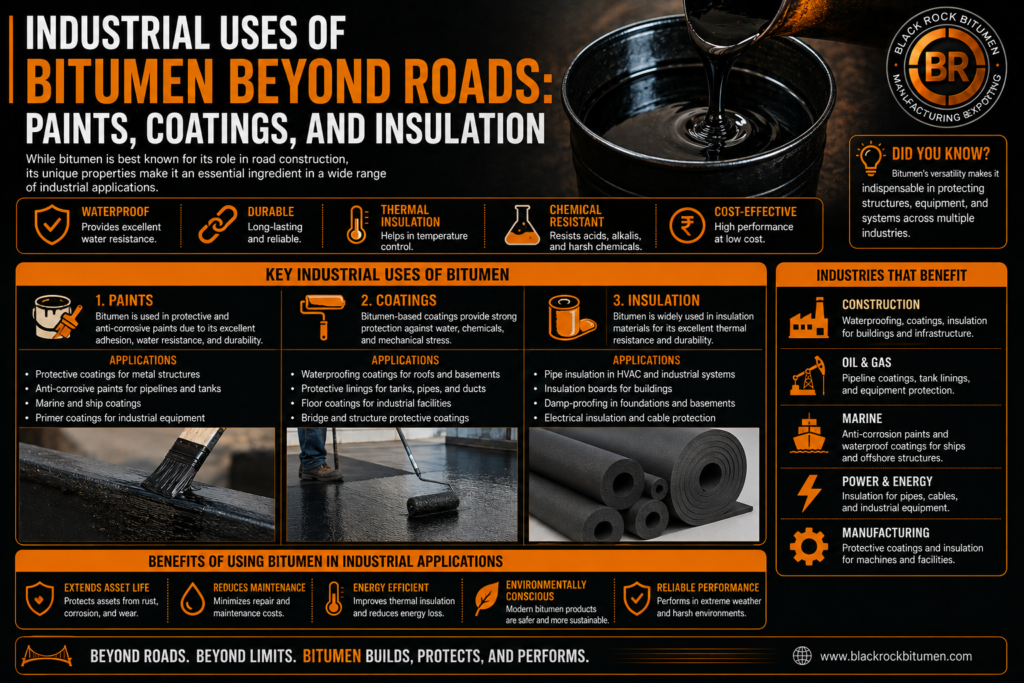
Ask most people what bitumen is for and you’ll get one answer: roads. That’s fair — paving is still the largest single use of the material by volume. But there’s a genuinely large, fast-growing industry built entirely around the other things bitumen does well, and it has almost nothing to do with traffic.
Here’s where bitumen shows up once you look past pavement — and why its chemistry makes it useful for problems that have nothing to do with holding up traffic loads.
For Black Rock Bitumen, a Dubai-based supplier serving Africa, South America, and Southeast Asia, this side of the business matters for a practical reason: industrial development in these regions doesn’t stop at roads. Pipeline networks, water treatment infrastructure, port facilities, and manufacturing plants all need the same corrosion protection, waterproofing, and insulation that bitumen has quietly provided for over a century — often sourced through the same supply channels as paving-grade material, just specified differently.
Why Bitumen Works Outside of Roads
The global pipe coatings market alone is projected to grow from $8.93 billion in 2025 to $17.29 billion by 2035, with bituminous coatings accounting for roughly 11% of that market specifically (Global Growth Insights). Bituminous paints are growing even faster in relative terms — from $1.45 billion in 2026 to a projected $2.65 billion by 2034, a 7.8% annual growth rate (Straits Research). None of that volume touches a highway.
The same properties that make bitumen a good road binder — waterproofing, chemical resistance, adhesion to almost any surface, and relatively low cost — translate directly into industrial applications. It also has high electrical resistivity and useful dielectric strength, making it an effective insulator where moisture resistance matters. That opens up a use case that has nothing to do with waterproofing at all. Combine those properties and you get a material that shows up in protective coatings, pipeline linings, electrical insulation, and sound dampening — four genuinely different industries, all relying on the same underlying substance.
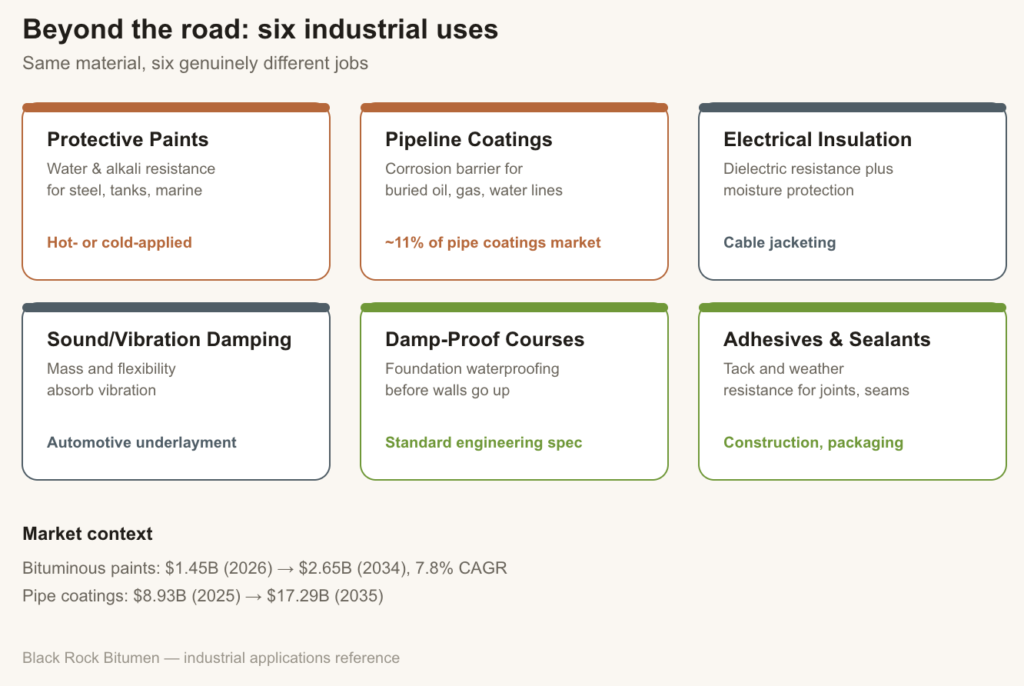
Alt text: Six industrial uses of bitumen beyond roads — protective paints and coatings, pipeline coatings, electrical insulation, sound and vibration damping, damp-proof membranes, and adhesives and sealants — with market context for bituminous paints and pipe coatings.
Bituminous Paints and Protective Coatings
Bituminous paint is bitumen dissolved in a solvent — typically mineral spirits or naphtha — and applied as a liquid or semi-liquid coating. It’s one of the most widely used protective coatings for metal, concrete, and wood because it resists both water and alkaline conditions, extending the service life of the substrate underneath
These coatings come in two main forms:
Hot-applied coatings are heated to reach the correct application viscosity, and are the standard choice for buried pipelines and large structural surfaces where a thick, durable film is the priority.
Cold-applied coatings use solvents or water to reach application viscosity instead of heat, making them practical for sites where heating equipment isn’t available or where a faster-drying finish is needed. Filler content varies substantially by formulation and end use; some cold-applied coatings use mineral fillers, while hot-applied mastics can contain much higher filler loadings. The product specification should govern rather than a single generic percentage.
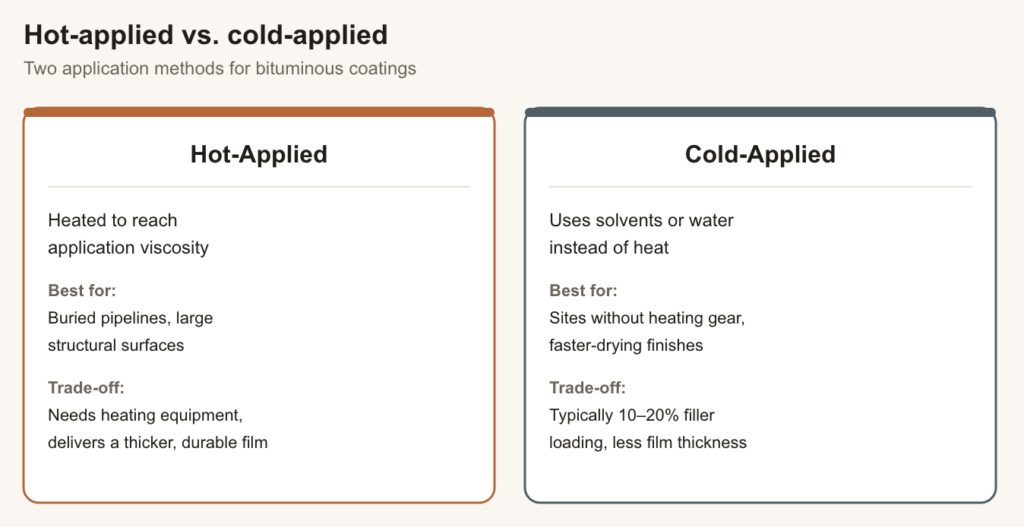
Alt text: Comparison of hot-applied and cold-applied bituminous coatings, showing heating requirements, typical applications, and practical trade-offs between thicker durable films and easier site application.
Typical applications for bituminous protective coatings include fire escapes, water storage tanks, boat hulls, railings, corrugated metal sheeting, cladding, and structural steel — anywhere a surface needs long-term protection from moisture and corrosion without the cost of a specialty industrial coating system
Potable-water caution: listing water storage tanks as an application does not mean every bituminous coating is suitable for drinking-water contact. Specify a product with the approval required in the project jurisdiction — for example WRAS in the UK or NSF/ANSI 61 in the United States — and confirm the exact formulation. Coal-tar-based products should not be assumed acceptable for potable-water contact; the applicable approval and specification requirements must be met.
Pipeline and Underground Structure Coatings
Bituminous wraps and hot-applied coatings have a long history on buried and submerged steel, particularly where sustained moisture exposure, aggressive soil chemistry, and limited maintenance access make corrosion protection important. They remain relevant in selected water, wastewater, low-pressure buried service, and rehabilitation applications, but they are not the default coating for new high-pressure transmission pipelines
Bituminous pipeline coating should also be distinguished from legacy coal-tar enamel. Coal-tar systems were historically widely used on pipelines and water infrastructure, but coal-tar products have a different chemical and health profile and are now heavily restricted in many applications. See the Bitumen vs. Asphalt vs. Tar guide for the distinction before specifying a coating.
This isn’t a niche application. The broader anti-corrosion coatings market is valued at $25.62 billion in 2026 and projected to reach $29.87 billion by 2031, with the oil and gas sector alone accounting for close to a third of demand (Mordor Intelligence). The Middle East and Africa region specifically shows meaningful projected growth in this market, driven by expanding energy infrastructure and pipeline development — directly relevant if you’re sourcing coatings-grade bitumen for projects in that region rather than importing a specialty system from further afield.
For new high-pressure transmission pipelines, modern specifications commonly favour systems such as fusion-bonded epoxy (FBE) and multilayer FBE/polyolefin systems. Bitumen-based enamel remains a defined coating option under EN 10300 for specified steel pipeline applications, with the applicable design temperature and project specification controlling the choice.
Water and wastewater infrastructure represents another major share of demand for these coatings, since municipal pipe networks face the same underground corrosion exposure as oil and gas lines, just with a different set of chemical stresses to manage.
Electrical and Acoustic Insulation
Bitumen’s high electrical resistivity and useful dielectric strength make it practical for insulating cables and electrical components, particularly where moisture resistance matters alongside dielectric performance It won’t replace purpose-built polymer insulation in high-precision electronics, but for cable jacketing and electrical infrastructure exposed to the elements, the combination of insulating and waterproofing properties in one material is genuinely useful.
The same material also does double duty as a sound and vibration damper. Bitumen-based pads remain used underneath vehicle floor carpets and body panels specifically to absorb road noise and vibration — if a car’s floor feels dense and solid underfoot, that’s often the bitumen-based deadening layer doing its job The same acoustic-damping principle extends to industrial soundproofing applications, where mass and flexibility both help absorb vibration rather than transmit it.
Damp-Proofing and Foundation Protection
Before a building’s walls go up, its foundation needs a barrier against rising moisture, and bitumen coatings applied directly to foundation walls form a damp-proof membrane (DPM) or tanking layer — not a damp-proof course (DPC). A DPC is the horizontal barrier built into masonry to stop rising damp, whereas a DPM or tanking treatment protects a foundation or basement surface from moisture ingress. This sits alongside, but is distinct from, the roofing and waterproofing membrane applications covered elsewhere — foundation damp-proofing is typically a painted or sprayed coating rather than a manufactured membrane sheet, though both rely on the same underlying waterproofing chemistry.
Adhesives and Sealants
Bitumen’s natural tack and flexibility make it a base material for a wide range of industrial adhesives and sealants — sealing joints and seams in roofing systems, filling cracks in concrete and masonry, and bonding applications across construction, automotive, and packaging industries These products trade the load-bearing role bitumen plays in a road for a purely adhesive one, relying on the same stickiness and weather resistance in a completely different context.
Which Standard Governs Which Coating Type?
The product category is only the starting point. The governing standard depends on the coating formulation, substrate, service environment, and whether the coating contacts potable water.
For potable-water service, the standard or approval must be checked against the exact product. BS 3416:1991 specifically covers cold-applied bitumen coatings suitable for potable-water contact, while BS 6949:1991 excludes potable-water contact. In the U.S., NSF/ANSI 61 covers protective coatings and other components that contact drinking water.
| Standard | Application / scope | How to use it |
| ASTM D41/D41M | Asphalt primer for roofing, dampproofing and waterproofing | Use for asphaltic primer; check the current edition and project specification. |
| ASTM D1187/D1187M | Asphalt-base emulsions used as protective coatings for metal | Relevant to relatively thick-film protective emulsions for metal. |
| ASTM D449 | Asphalt used in dampproofing and waterproofing | Applies to asphalt used as a mopping coat or membrane-waterproofing cement. |
| BS 3416:1991 | Cold-applied bitumen coatings suitable for contact with potable water | Relevant only where the product meets the standard’s potable-water requirements. |
| BS 6949:1991 | Cold-applied bitumen coatings excluding potable-water contact | Use for general cold-applied corrosion-protection/waterproofing coatings where potable-water contact is not involved. |
| BS 4147:1980 | Legacy hot-applied bituminous pipe-coating reference | Superseded by EN 10300; treat as a legacy reference rather than the current governing standard. |
| EN 10300:2005 | Factory-applied hot-applied bitumen-based external coatings for steel pipeline tubes and fittings | Current European reference for specified bituminous hot-applied pipeline coatings. |
| AWWA C203 | Coal-tar protective coatings and linings for steel water pipe | Important as a coal-tar reference when distinguishing legacy coal-tar systems from petroleum-bitumen coatings. |
Application Summary
| Application | Bitumen form | Key property relied on | Typical industry |
| Protective paint/coating | Cutback (solvent) or emulsion | Water and alkali resistance | General industrial, marine, structural steel |
| Pipeline coating | Hot-applied or cold-applied bitumen | Corrosion barrier, moisture resistance | Oil & gas, water & wastewater |
| Electrical insulation | Oxidized or straight bitumen compound | Dielectric resistance, waterproofing | Cable manufacturing, electrical infrastructure |
| Sound/vibration damping | Bitumen-based composite pads | Mass damping, flexibility | Automotive, industrial soundproofing |
| Damp-proof membrane | Painted or sprayed bitumen coating | Waterproofing, adhesion to masonry | Building construction, foundations |
| Adhesives and sealants | Modified or straight bitumen | Tack, flexibility, weather resistance | Construction, automotive, packaging |
What to Watch For When Sourcing for Industrial Applications
Don’t assume paving-grade bitumen suits a coating application. Industrial coatings typically require specifically formulated cutback or emulsion products, not standard road-paving penetration grades applied straight.
Match hot-applied versus cold-applied to your site conditions. Hot-applied coatings need heating equipment and deliver a thicker, more durable film; cold-applied products trade some durability for practicality where heating isn’t feasible.
Watch the regulatory direction on solvents. Low-VOC and water-borne formulations are an active direction in coating development, but the exact share of innovation varies by market definition and should not be treated as a universal percentage.
Confirm the specification, not just the material. “Bituminous coating” covers a wide range of formulations with different filler loadings, solvent systems, and application methods. Match the actual product spec to your project’s environmental exposure, not just the general material category.
Related reading: for roofing and waterproofing applications, see our oxidized-bitumen guidance; for the Bitumen vs. Asphalt vs. Tar guide and Types of Bitumen Grades and Their Uses, see the Black Rock Bitumen blog archive.
Frequently Asked Questions
Can regular road bitumen be used as a protective coating? Not directly. Industrial coatings are specifically formulated as cutback (solvent-thinned) or emulsion products designed for brushing, spraying, or dipping — not the straight penetration-grade bitumen used in road paving.
Is bitumen a good electrical insulator? Bitumen has useful dielectric properties and is genuinely used in cable insulation and electrical infrastructure, particularly where moisture resistance matters alongside insulation. It doesn’t replace purpose-built polymer insulation for precision electronics.
What’s the difference between hot-applied and cold-applied bituminous coatings? Hot-applied coatings are heated to reach application viscosity and are standard for buried pipelines and large structural surfaces. Cold-applied coatings use solvents or water instead of heat, making them more practical where heating equipment isn’t available.
Why is bitumen used for soundproofing? Its mass and flexibility absorb vibration rather than transmitting it, which is why bitumen-based pads are commonly used under vehicle floors and in industrial soundproofing applications.
The Bottom Line
Roads get the attention, but the industrial side of the bitumen industry — coatings, pipeline protection, insulation, adhesives — is a substantial, fast-growing market in its own right. If you’re sourcing for one of these applications, the underlying material may be the same bitumen you know from paving, but the formulation, application method, and specification all need to match the actual use case, not just the general material category.
Black Rock Bitumen supplies across the grades relevant to these applications — see our Oxidized Bitumen range for coatings and industrial protection uses, our Waterproof Membrane products for damp-proofing and building protection, and our Polymer Modified Bitumen line where enhanced flexibility or durability is required.