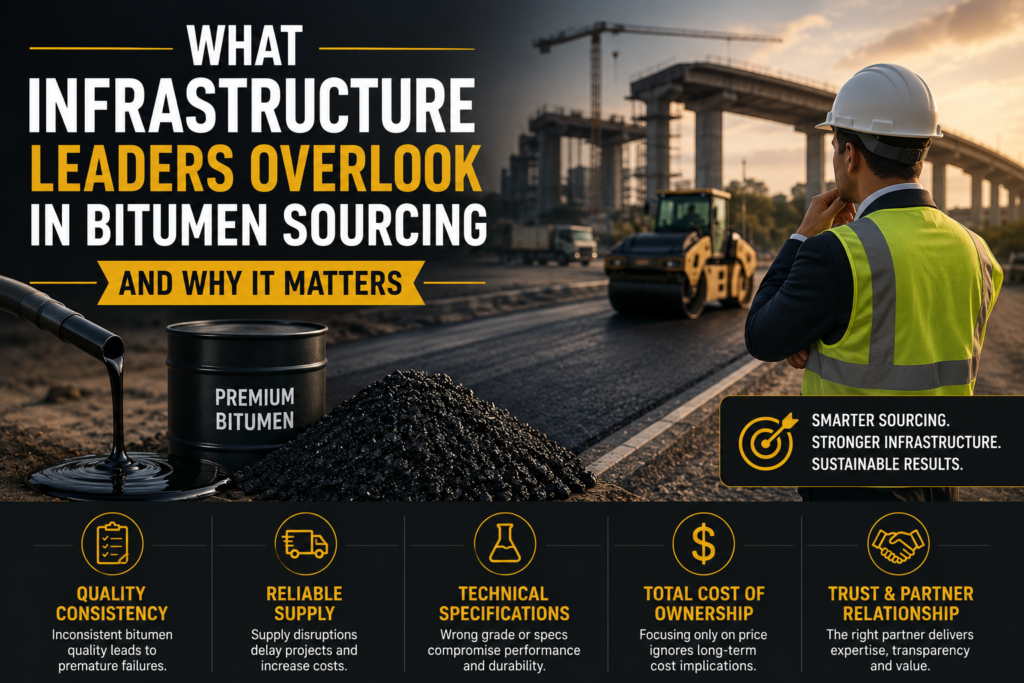
A single kilometer of failed roadway can cost governments and contractors millions in repairs, delays, and reputational damage. Yet many infrastructure teams still treat bitumen sourcing like a commodity purchase instead of a long-term performance decision.
That’s the mistake.
Because when roads crack early, rut under heat, or fail during monsoon seasons, the issue often starts long before the asphalt is laid. It starts with sourcing.
And if you’re managing highways, airport runways, industrial roads, or large-scale infrastructure projects across the UAE, Saudi Arabia, India, or Africa, overlooking the wrong details in bitumen procurement can quietly destroy project margins.
The reality is simple: not all bitumen suppliers are equal. And the cheapest quote can become the most expensive decision on the project.
The Real Cost of Poor Bitumen Sourcing
Most procurement teams focus on three things:
- Price per ton
- Delivery timeline
- Basic grade availability
That sounds reasonable. But it ignores the factors that actually determine pavement lifespan, project stability, and long-term maintenance costs.
According to multiple infrastructure studies, premature road failures can increase lifecycle costs by 30% to 50% over the original construction estimate. In high-temperature regions like the Middle East and parts of Africa, poor-quality bitumen accelerates rutting, oxidation, and cracking even faster.
That means your sourcing decision directly affects:
- Road durability
- Maintenance frequency
- Contractor liability
- Public safety
- Budget overruns
- Project timelines
And here’s where things get worse. Many suppliers in the global market operate with inconsistent refinery sourcing, unstable supply chains, poor storage practices, or weak quality control systems. On paper, the product may meet specifications. In the field, it behaves differently. That gap is where infrastructure failures begin.
Why Infrastructure Buyers Often Miss the Warning Signs
Procurement pressure is real. Deadlines get tighter. Budgets shrink. Governments push aggressive completion schedules. So buyers prioritize immediate availability over long-term performance.
But bitumen isn’t just another raw material. It’s a temperature-sensitive, performance-critical binding agent that directly influences pavement behavior under stress. Even small inconsistencies can create major downstream problems.
For example:
- A slightly off penetration value can affect flexibility
- Poor adhesion properties increase moisture damage
- Inconsistent viscosity impacts mixing and compaction
- Contaminated material weakens pavement structure
Most of these problems don’t appear immediately. They surface months later — after heavy traffic loads, extreme heat cycles, or seasonal rains. And by then, the procurement decision is impossible to reverse.
The takeaway: Short-term sourcing decisions create long-term infrastructure consequences.
The 6 Things Infrastructure Leaders Overlook in Bitumen Sourcing
1. They Focus on Price Instead of Lifecycle Performance
This is the biggest mistake in infrastructure procurement. A lower upfront bitumen price may look attractive during tender evaluation. But if that material reduces pavement lifespan by even 15%, the total cost impact becomes enormous.
Think about the math. If a highway requires resurfacing two years earlier than expected, you’re not just paying for additional material. You’re paying for:
- Labor
- Traffic disruption
- Equipment mobilization
- Public inconvenience
- Political pressure
- Lost productivity
A World Bank transport assessment once highlighted that poor road conditions can increase vehicle operating costs by up to 40% in developing regions. That means low-quality bitumen doesn’t just hurt the contractor — it affects the entire economy.
What Smart Buyers Do Instead
Top infrastructure teams evaluate bitumen based on lifecycle value, not just procurement cost. They ask questions like:
- How stable is the grade consistency?
- What is the refinery source?
- Does the supplier provide testing documentation?
- How does the material perform in extreme climates?
- Is the product optimized for regional conditions?
That shift changes everything. Because roads are long-term assets. And sourcing should reflect that reality.
The takeaway: Cheap bitumen often becomes expensive infrastructure.
2. They Ignore Climate-Specific Performance Requirements
Bitumen performance changes dramatically based on climate. What works in one region can fail in another. This matters especially across the Middle East, India, and Africa, where infrastructure faces:
- Extreme heat
- Heavy axle loads
- Monsoon exposure
- Oxidation stress
- Desert temperature swings
For example, pavement temperatures in Gulf countries can exceed 70°C during peak summer conditions. Standard-grade material may soften excessively under these conditions, leading to rutting and deformation. On the other hand, roads in monsoon-prone regions require stronger moisture resistance and adhesion performance. Yet many buyers still source generic grades without considering environmental realities.
Climate-Adaptive Sourcing Matters More Than Ever
Modern infrastructure projects increasingly rely on tailored bitumen solutions, including:
- Penetration grade bitumen
- Polymer modified bitumen (PMB)
- VG grades for specific climates
- Oxidation-resistant formulations
The right specification depends on traffic density, temperature ranges, and pavement design. This is where an experienced bitumen supplier UAE partner becomes valuable — not because they simply sell product, but because they understand how environmental variables impact road performance across different geographies.
Why Regional Knowledge Creates Better Roads
Suppliers serving multiple regions gain practical field insight. They understand:
- How bitumen behaves in Gulf heat
- Which grades perform better in African freight corridors
- What works under Indian monsoon conditions
- How shipping and storage affect product integrity
That expertise reduces costly sourcing errors and leads to more durable infrastructure.
The takeaway: Climate compatibility is not optional in modern bitumen sourcing.
3. They Underestimate Supply Chain Stability
A delayed bitumen shipment can stop an entire infrastructure project. And when road construction timelines collapse, costs escalate fast. Idle labor, inactive machinery, and missed deadlines create a chain reaction across the project ecosystem. Yet many buyers still overlook supplier logistics capabilities during vendor selection.
Why Supply Reliability Is a Competitive Advantage
Global bitumen supply chains remain vulnerable to:
- Refinery disruptions
- Shipping delays
- Port congestion
- Geopolitical instability
- Seasonal demand spikes
When suppliers lack strong export infrastructure, buyers absorb the consequences. This becomes especially critical for contractors managing:
- Government tenders
- Highway megaprojects
- Airport expansions
- Industrial corridors
- Smart city developments
What Reliable Suppliers Actually Provide
Strong suppliers don’t just deliver bitumen. They build operational confidence through:
- Consistent export capability
- Proper storage infrastructure
- Timely shipment coordination
- Bulk supply scalability
- Technical documentation support
- Regional logistics expertise
This is one reason many international buyers work with established UAE exporters. The UAE sits at a strategic logistics crossroads connecting Asia, Africa, and the Middle East — improving export efficiency and delivery flexibility. Companies like Black Rock Bitumen leverage this regional advantage to support infrastructure buyers across multiple markets with stable, scalable supply solutions.
The takeaway: The strongest sourcing strategy fails without reliable delivery execution.
4. They Don’t Verify Quality Control Processes
Here’s something many procurement teams assume: “If the certificate says the grade is correct, the material must be fine.” Not always. Quality consistency depends heavily on storage, handling, refinery sourcing, and testing procedures. Even compliant material can degrade when operational controls are weak.
Why Quality Variability Creates Massive Risk
Bitumen is highly sensitive to:
- Heating temperatures
- Storage duration
- Contamination exposure
- Oxidation
- Transportation handling
If these variables aren’t controlled properly, material performance can change before it even reaches the asphalt plant. That creates unpredictability during mixing and paving — and unpredictability is expensive.
What Serious Infrastructure Buyers Check
Professional procurement teams evaluate supplier quality systems in detail. They verify:
- Laboratory testing standards
- Batch consistency protocols
- Temperature management systems
- Packaging integrity
- Export documentation
- Traceability processes
This matters even more when you buy bitumen in bulk for large infrastructure programs. At scale, small inconsistencies multiply quickly. A trusted supplier should be able to provide transparent technical documentation and maintain consistent quality across shipments. That’s not a premium feature — that’s the baseline expectation for critical infrastructure materials.
Why Reputation Matters in Export Markets
Infrastructure developers increasingly prefer suppliers with strong international track records. Export-focused companies typically operate under stricter quality expectations. Black Rock Bitumen, for example, serves clients across the Middle East, Asia, and Africa, where performance expectations vary significantly by region and project type. That kind of market exposure forces operational discipline — and discipline produces consistency.
The takeaway: Quality assurance is not paperwork — it’s infrastructure protection.
5. They Treat Bitumen as a Commodity Instead of a Strategic Material
This mindset quietly damages projects. When bitumen is viewed as “just another procurement item,” decisions become transactional. But infrastructure leaders who achieve better long-term outcomes approach sourcing strategically. They understand that bitumen influences:
- Pavement fatigue resistance
- Rutting performance
- Moisture damage
- Crack resistance
- Maintenance cycles
- User experience
That makes it a performance material, not just a construction input.
Strategic Procurement Changes Project Outcomes
The best infrastructure organizations collaborate closely with suppliers. They discuss:
- Traffic conditions
- Environmental exposure
- Project duration
- Storage logistics
- Application methods
- Regional challenges
This creates better specification alignment — and better alignment reduces failure risk.
Why Supplier Relationships Matter More Than Ever
Large infrastructure programs often span years. That means procurement needs evolve over time. A strategic supplier relationship provides:
- Stable long-term availability
- Technical guidance
- Flexible shipment planning
- Responsive issue resolution
- Scalable supply capacity
This is especially important for governments and EPC contractors managing multi-phase road networks. Transactional sourcing may save money initially — strategic sourcing protects the project over its full lifecycle.
The takeaway: Infrastructure durability begins with procurement strategy.
6. They Overlook the Financial Impact of Road Failure
Road failure isn’t just an engineering problem. It’s a financial problem. And in many cases, it becomes a political problem too. According to transport infrastructure research, delayed maintenance dramatically increases rehabilitation costs over time. Some studies suggest that every dollar spent on preventive maintenance can save several dollars in future reconstruction expenses. That’s why sourcing quality matters so much.
The Hidden Financial Chain Reaction
Poor-performing roads trigger:
- Emergency repairs
- Budget reallocations
- Contractor disputes
- Public complaints
- Traffic inefficiencies
- Reduced investor confidence
For freight corridors and industrial highways, road deterioration also affects trade efficiency and logistics performance. In developing economies, that has broader economic consequences.
Why Long-Term Thinking Wins
Infrastructure leaders who prioritize durable sourcing strategies often achieve:
- Lower lifecycle costs
- Reduced maintenance frequency
- Better project credibility
- Stronger operational efficiency
- Higher public satisfaction
And that advantage compounds over time — because every successful road project strengthens institutional confidence for future developments.
The takeaway: Bitumen sourcing decisions influence far more than pavement performance.
Why Black Rock Bitumen Fits Modern Infrastructure Demands
Most suppliers focus on selling material. Serious infrastructure partners focus on supporting project outcomes. That distinction matters.
Black Rock Bitumen has positioned itself as a premium export-focused supplier serving infrastructure, construction, and road development sectors across the UAE, Saudi Arabia, India, and African markets.
Infrastructure Buyers Need More Than Product Availability
Modern projects require suppliers who understand:
- International logistics
- Regional climate conditions
- Bulk export coordination
- Technical grade requirements
- Quality consistency expectations
Black Rock Bitumen supports these needs through a strong regional supply framework designed for large-scale infrastructure demand. That’s especially valuable for contractors and procurement teams managing cross-border projects where timing and reliability directly affect project profitability.
The UAE Advantage in Global Bitumen Supply
The UAE continues to strengthen its role as a strategic export hub for infrastructure materials. Its logistics connectivity supports faster trade access across:
- GCC countries
- East Africa
- South Asia
- North Africa
For buyers seeking a dependable bitumen supplier UAE, this creates operational advantages in both shipping efficiency and supply stability. And when projects depend on uninterrupted material flow, that advantage becomes critical.
The takeaway: Strong infrastructure requires strong sourcing partnerships.
A Real-World Scenario Most Infrastructure Teams Recognize
Imagine a government highway project scheduled across two phases. The contractor sources low-cost bitumen from multiple suppliers to reduce procurement expenses. Initially, everything appears fine — the material meets basic specifications.
But six months later:
- One section develops rutting under heavy truck traffic
- Another section shows early cracking
- Maintenance costs rise unexpectedly
- Public criticism increases
- Completion timelines slip
An investigation later reveals inconsistent material quality between shipments.
Now compare that with a project using a stable, quality-controlled supply chain from the start. The upfront procurement cost may have been slightly higher. But the road performs consistently. Maintenance reduces. Project credibility improves. And long-term costs remain under control.
That’s the difference strategic sourcing creates.
The Future of Infrastructure Procurement Is Changing
Infrastructure buyers are becoming more performance-focused. Governments and developers increasingly evaluate suppliers based on:
- Lifecycle value
- Sustainability
- Reliability
- Technical capability
- Supply chain resilience
That shift is reshaping the bitumen market. Suppliers who simply compete on price will struggle. Suppliers who deliver consistency, expertise, and operational reliability will lead the next decade of infrastructure development.
Global infrastructure spending continues to rise across the Middle East, Asia, and Africa. Road networks are expanding rapidly. Urbanization is accelerating. Freight movement is increasing. That means the demand for durable pavement systems will only grow — and durable roads start with smarter sourcing decisions.
The takeaway: Infrastructure procurement is moving from cost-focused to performance-focused decision-making.
Key Takeaways
- Low-cost bitumen can create massive long-term infrastructure costs through early pavement failure.
- Climate-specific sourcing plays a major role in road durability across the Middle East, India, and Africa.
- Reliable logistics and supply chain stability are essential for large-scale infrastructure projects.
- Quality assurance processes matter just as much as technical grade specifications.
- Strategic supplier partnerships outperform transactional sourcing models over the long term.
Ready to Strengthen Your Bitumen Supply Strategy?
If you’re managing highways, industrial roads, airport infrastructure, or government development projects, your sourcing decisions directly affect project performance for years to come.
Black Rock Bitumen works with contractors, procurement leaders, and infrastructure developers across the Middle East, Asia, and Africa to provide dependable bulk bitumen supply backed by quality consistency and export expertise.
Whether you need support for large-scale road construction, regional infrastructure expansion, or long-term procurement planning, the right sourcing partner can reduce risk and improve project outcomes.
Contact Black Rock Bitumen today to discuss your project requirements, request technical specifications, or get a competitive bulk supply quote tailored to your market.
Frequent Asked Questions
Why does bitumen sourcing matter so much for road project outcomes?
Bitumen is the binding agent that holds an asphalt pavement together. Its quality, consistency, and grade suitability directly determine how the road performs under traffic loads, heat, moisture, and time. A sourcing decision made at the procurement stage shapes pavement durability for the next 12–20 years. Poor sourcing can reduce pavement lifespan by 40–60% and increase lifecycle costs by 30–50% — far outweighing any savings made at the point of purchase.
What is the most common bitumen sourcing mistake infrastructure teams make?
Prioritizing price over performance. While it is natural to seek competitive pricing, selecting bitumen based on the lowest quote without evaluating grade consistency, refinery source, quality control systems, and climate suitability frequently leads to premature road failure. The cost of emergency repairs, resurfacing, and public disruption typically far exceeds the original procurement saving.
How does climate affect which bitumen grade should be specified?
Climate is one of the most critical factors in grade selection. In hot climates such as the Gulf region — where road surface temperatures can exceed 70°C — harder grades like Bitumen 60/70 are essential to prevent rutting and binder flow. In cold or temperate climates, softer grades like 80/100 are preferred to maintain flexibility and resist thermal cracking. Monsoon-prone regions require grades with superior moisture resistance and adhesion properties. Specifying a generic grade without accounting for local climate conditions is a leading cause of premature pavement failure.
What should procurement teams verify when assessing a bitumen supplier's quality control?
Professional procurement teams should verify the following before committing to a supplier: laboratory testing standards and accreditation, batch-specific Certificates of Analysis (not generic templates), temperature management during storage and loading, packaging integrity for drummed supply, export documentation completeness, and traceability processes linking each shipment to its refinery source and test data. For large-volume or multi-shipment contracts, consistency across batches is as important as the specification of any single batch.
Why is supply chain reliability as important as bitumen quality?
Even the highest-quality bitumen creates no value if it arrives late. A delayed shipment on a critical infrastructure project can idle construction crews, halt paving operations, and trigger liquidated damages under government contracts. Supply chain reliability — covering consistent export capacity, proper storage infrastructure, timely shipping coordination, and responsive communication — is therefore a fundamental supplier evaluation criterion, not a secondary consideration.
What is the difference between transactional and strategic bitumen sourcing?
Transactional sourcing treats each purchase independently, prioritizing the lowest spot price at the time of order. Strategic sourcing treats the supplier relationship as a long-term partnership, focusing on grade consistency, supply continuity, technical collaboration, and lifecycle value. For infrastructure programmes spanning multiple years and phases, strategic sourcing consistently delivers better project outcomes — lower maintenance costs, fewer emergency procurement events, and more predictable construction schedules.
How does bitumen quality affect road maintenance costs over time?
Poor-quality or incorrectly specified bitumen accelerates pavement deterioration — leading to more frequent crack sealing, pothole patching, overlay cycles, and ultimately full reconstruction ahead of the design life. Research on transport infrastructure consistently shows that every dollar invested in quality preventive maintenance saves multiple dollars in rehabilitation. Conversely, cutting procurement costs on bitumen typically increases total maintenance expenditure over the pavement’s lifetime by a significant multiple of the original saving.
Why do many infrastructure buyers prefer UAE-based bitumen suppliers?
The UAE offers a unique combination of strategic logistics positioning, multi-origin supply access, and established export infrastructure. Jebel Ali Port — one of the world’s largest container terminals — connects to over 180 ports globally, providing reliable shipping routes to GCC countries, East and West Africa, South Asia, and Southeast Asia. UAE-based exporters can source from multiple refinery origins, certify to multiple international standards (ASTM, EN 12591, IS 73, AASHTO), and maintain supply continuity even when individual refinery sources are disrupted. For international buyers, this combination of quality, flexibility, and logistics reliability is difficult to replicate from single-refinery suppliers.
At what point in a project should bitumen sourcing decisions be made?
Bitumen sourcing decisions should be made during the project planning and tender preparation phase — not after contracts are awarded and construction timelines are already running. Early supplier qualification allows time for proper vetting, grade specification confirmation, import permit applications (which can take 1–4 weeks in some markets), and the negotiation of multi-shipment contracts that offer better pricing and supply security than spot purchases. Starting the sourcing process after construction begins is one of the most common causes of emergency procurement, which almost always comes at a significant cost premium.

Content Writer, Global Bitumen Supply & Market Insights, Black Rock Bitumen
Farheen Fatima is an infrastructure materials writer specializing in bitumen supply, asphalt technology, and global road construction. He shares practical insights on bitumen grades, supplier evaluation, and international standards to help contractors and project teams make informed procurement decisions.