
Quick answer: Before accepting any bitumen shipment, check a recent Certificate of Analysis (COA) from a named lab, then confirm penetration, softening point, ductility, and flash point against your standard (ASTM or EN). Run a quick texture and smell check on arrival, and never accept off-spec material – even under deadline pressure. The full test-by-test breakdown, a quick-reference table, and a one-page checklist are below.
Here’s an uncomfortable fact about the bitumen trade: a supplier’s word is not a specification.
Researchers who investigated a string of premature asphalt failures in Ghana found something telling — the roads had records showing they were built to spec, but lab testing told a different story.
Pavements were suffering severe alligator cracking and rutting within months of opening to traffic, and the culprit was low bitumen content combined with aged binder in the asphalt layer (case histories on asphaltic pavement failures in Ghana).
The paperwork said one thing. The pavement said another.
And it isn’t unique to Ghana — the same pattern shows up across five major highways in Southeastern Nigeria (Arabian Journal of Geosciences).
The lesson is the same whether you’re building in Lagos, Bogotá, or Jakarta: “trust the supplier” isn’t a strategy. Testing is.
The good news: you don’t need a PhD to do this. You need to know five or six tests, what numbers to expect, and what red flags mean “walk away.” That’s what this guide covers.
What Is Bitumen Quality Testing?
Bitumen quality testing is the set of laboratory and field checks used to verify that a batch of bitumen meets the hardness, temperature stability, flexibility, and safety benchmarks specified for its intended use — before it’s accepted, paid for, or applied to a project.
At Black Rock Bitumen, we treat this as a non-negotiable step for every shipment, not an optional extra reserved for large contracts. If you want the full picture on how grade choice affects outcomes, our post on how inconsistent bitumen quality impacts road lifespan and maintenance budgets is a useful companion to this one, and our Penetration Grade Bitumen range shows how grades map to real specifications.
Why This Matters More Than Ever Right Now
The bitumen market continues to expand, reaching an estimated $60 billion in 2026 and projected to grow to around $72.7 billion by 2030, at a CAGR of about 4.9%. Growth is being driven by infrastructure modernization, road and highway construction, smart-city projects, and rising demand for high-performance and polymer-modified binders. (The Business Research Company).
Roadways alone account for more than half of global bitumen demand (Grand View Research), and much of the near-term growth is concentrated in exactly the regions leaning hardest on imported bitumen — Africa, South America, and Southeast Asia — where infrastructure spending keeps climbing.
That growth comes with a catch.
Buyers in these markets often can’t rely on a single domestic refinery the way a producing country can. They’re sourcing from whichever supplier has capacity and the best price that quarter, which is precisely the setup industry analysts flag as the biggest driver of inconsistent asphalt quality — different origins, different grades, different properties, batch to batch.
We’ve written before about how structured supply models reduce this kind of procurement risk — testing is the other half of that discipline. If you’re buying in bulk from a trading hub like Dubai, a bad batch doesn’t just cost you money. It costs you the road, the roof, or the reputation you’re trying to build with your own customers downstream.
That’s the real reason to care about testing. Not because a lab report looks impressive on file, but because a road built with under-spec bitumen doesn’t survive one monsoon.
The Core Tests You Actually Need to Know
You don’t need every test in the ASTM catalog. You need the handful that tell you whether the drum in front of you will hold up.
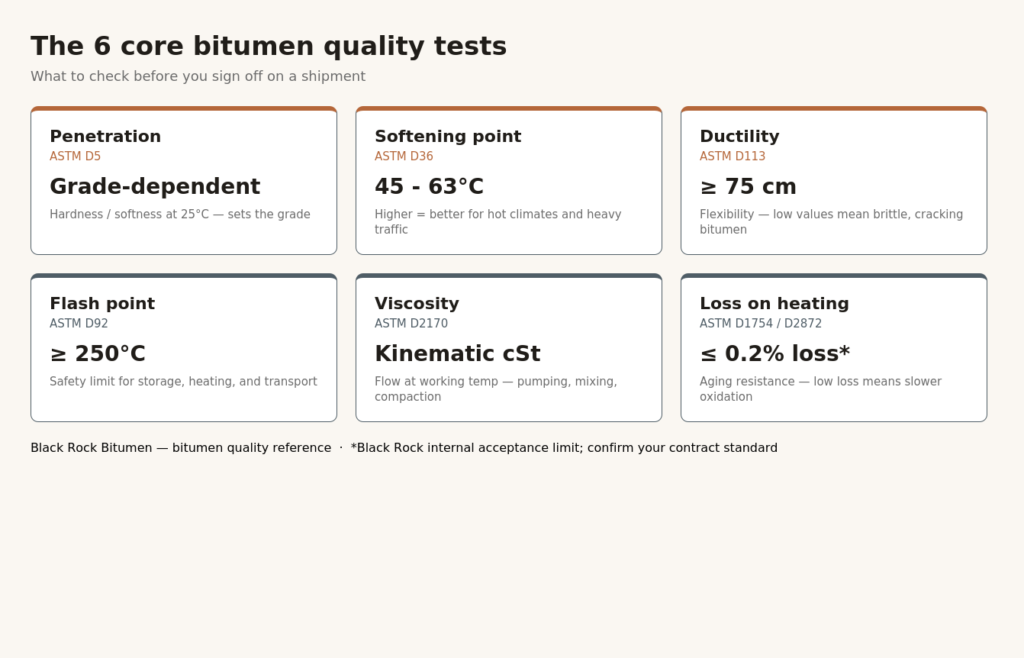
| Test | Standard | Benchmark | What it tells you |
| Penetration | ASTM D5 | Grade-dependent (e.g. 60/70) | Hardness at 25°C — the basis for grading |
| Softening point | ASTM D36 | 45–63°C | Temperature at which bitumen starts to flow |
| Ductility | ASTM D113 | ≥ 75 cm | Flexibility — resistance to cracking |
| Flash point | ASTM D92 | ≥ 250°C | Safety threshold for heating and transport |
| Viscosity | ASTM D2170 | Kinematic, in cSt | Flow behavior for pumping and mixing |
| Loss on heating | ASTM D1754 / D2872 | ≤ 0.2% weight loss | Long-term resistance to oxidation |
Note on benchmarks: the flash point and loss-on-heating figures above are Black Rock’s internal acceptance limits, which are stricter than the base minimums in some specifications — for example, ASTM D946 for 60/70 grade permits up to 1.0% loss on heating and sets a lower minimum flash point. Always confirm which standard your contract references.
1. Penetration Test (ASTM D5)
This is the test the entire bitumen grading system is built on. A needle loaded to 100 grams is dropped onto a bitumen sample at 25°C for 5 seconds, and the depth it sinks — measured in tenths of a millimeter — becomes the “penetration value” (Controls Group).
Why it matters: this number tells you how hard or soft the bitumen is. A higher penetration value means a softer binder, better suited to cold climates. A lower value means a harder, more temperature-stable binder for hot regions (Gulf Petro). Grades like VG30 or 60/70 are literally named after this test.
What to watch for: even small errors in pouring temperature or needle calibration throw off the result, so ask your supplier which lab ran the test and under what conditions.
2. Softening Point (Ring & Ball Test — ASTM D36 / EN 1427)
A steel ball sits on a bitumen-coated ring, both are heated in a water bath at a controlled rate, and the temperature at which the ball sinks through a 25mm gap is your softening point (Gulf Petro).
Why it matters: this tells you the temperature at which your bitumen stops behaving like a solid and starts flowing. Bitumen with a higher softening point (55–63°C) is what you want for hot climates and heavy-traffic roads. Lower softening points (42–49°C) work better in cooler regions.
Buyer tip: if you’re sourcing for a highway in a place that regularly hits 45°C+ in summer, and your supplier hands you bitumen with a softening point under 50°C, that’s a mismatch waiting to become rutting.
3. Ductility Test (ASTM D113)
This measures how far a bitumen thread can stretch before it snaps, tested at 25°C under ASTM D113 (IS 1208 specifies 27°C). The industry benchmark is a minimum of 75–100 cm depending on the standard you’re working to.
Why it matters: ductility is basically a proxy for flexibility. Low ductility means brittle bitumen that cracks under stress — the kind of thing that turns a smooth road into a spider web of fractures within a year.
4. Flash Point (ASTM D92)
This tells you the temperature at which bitumen vapors will ignite. The benchmark is a minimum of 250°C.
Why it matters: this isn’t about pavement performance — it’s about not burning down your storage yard. Bitumen well below the safe flash point is a genuine hazard during transport, heating, and mixing.
5. Viscosity Test (ASTM D2170)
Viscosity tells you how the bitumen will behave when it’s hot — how easily it pumps, mixes, and compacts. Get this wrong and your paving crew fights the material all day, which usually means uneven application and weak spots in the final surface.
For setting mixing and compaction temperatures, ASTM D4402 (Brookfield rotational viscosity) is the method most specifications call for.
6. Loss on Heating / Short-Term Ageing (ASTM D1754 or D2872)
This one simulates aging. The sample is heated, then re-tested for weight loss and penetration change. A low weight loss (under 0.2%) and low penetration change (under 20%) signal bitumen that resists oxidation over time.
Skip this test and you might get bitumen that performs fine on day one and turns brittle within two summers.
Note: ASTM D6 has been withdrawn. The Rolling Thin Film Oven Test (ASTM D2872, RTFOT) is the method most modern specifications reference for this property.
How Do You Read the Test Report Your Supplier Sends You?
Most suppliers will hand you a Certificate of Analysis (COA) instead of letting you run tests yourself. That’s fine — but don’t just glance at it and file it away. Check three things:
- Which lab ran it. An in-house lab result from the seller isn’t worthless, but a third-party or government-accredited lab result carries more weight, especially for large purchases.
- The standard referenced. ASTM and EN specifications have overlapping but not identical thresholds — EN standards are the common reference across Europe, Africa, and parts of the Middle East, while ASTM is the default across much of the Americas and Southeast Asia. Make sure the COA states which standard the numbers are measured against, and that it matches what your contract specifies.
- The date. Bitumen properties can shift with storage time and temperature exposure. A COA from six months ago tells you almost nothing about the drum sitting in front of you today.
If a supplier is reluctant to share a recent, lab-attributed COA, that reluctance is itself a data point.
What Field Checks Can You Do Before the Lab Report Arrives?
You won’t always have a lab on-site. Here’s what you can do with your own eyes and a bit of common sense, before the paperwork shows up:
- Look at the texture. Genuine bitumen is uniformly black, glossy, and smooth. Streaks, dull patches, or a chalky look can indicate dilution with mineral fillers or low-grade extenders — the kind of tampering that shows up later as the low bitumen content investigators keep finding at the root of premature pavement failures.
- Check the smell. Bitumen has a distinct petroleum odor. A significantly different or weaker smell can point to dilution.
- Weigh a sample against volume. Adulterants change density. If a drum feels lighter or heavier than a known-good reference for the same grade, ask questions.
- Ask for the source refinery and batch number. Legitimate suppliers can trace material back to a specific refinery run. Vague answers here are a warning sign.
None of this replaces lab testing. But it tells you whether it’s worth spending money on lab testing in the first place.
Sampling, Inspection, and What to Do With Off-Spec Material
Every test above is only as good as the sample it was run on. Here is how to get a sample worth trusting, where to send it, and what to do if the result comes back off-spec.
Take a Representative Sample (ASTM D140)
A bad sample invalidates every test in this guide before the lab even opens the drum. ASTM D140 sets out how to pull bitumen samples from tankers, drums, and bulk storage so the sample actually represents the batch — not just whatever was easiest to reach. Insist that whoever draws the sample follows it, and ask for the sampling location and method to be recorded on the COA.
Where to Test: Third-Party Labs
For anything beyond a small, low-stakes job, send the sample to an independent lab rather than relying on the supplier’s in-house result alone. SGS, Intertek, and Bureau Veritas all run bitumen testing internationally and are widely accepted by contract specifications. Turnaround for the core tests is typically a few working days; expect to pay a modest per-sample fee that is negligible against the cost of a bad batch.
Pre-Shipment Inspection at Load Port
For bulk or containerized orders, arrange inspection at the load port before the vessel sails, not after it arrives. A pre-shipment inspection clause — naming the inspector, the standard, and the sampling method — should sit in the contract itself, not be treated as an optional add-on you negotiate after a problem shows up.
When Material Is Off-Spec: Rejection and Contract Terms
Decide how you will handle an off-spec result before you need to, not while a tanker is idling at your gate. Build rejection rights into the contract: a stated right to reject or renegotiate if the COA falls outside agreed limits, letter of credit terms that tie payment to COA compliance rather than shipment alone, and a retention sample held by a neutral party in case of a later dispute. None of this helps if it is improvised after the material has already landed.
Match the Test to the Job, Not Just the Grade
A mistake a lot of buyers make: treating “bitumen testing” as one uniform checklist regardless of the application. It isn’t. Roads, roofing, and waterproofing fail in different ways, so the tests that matter most shift depending on what you’re building.
| Application | Priority tests | Why |
| Roads and highways | Penetration, softening point, viscosity | Managing rutting risk and workability during paving |
| Roofing | Softening point, ductility | Direct sun exposure and constant thermal cycling |
| Waterproofing | Adhesion, loss on heating | Failures show up years later as leaks, not immediately |
If your project sits in a high-consequence zone — extreme climate, heavy traffic, flat roofs, below-grade waterproofing — it’s worth paying for the extra performance and aging tests, not just the core four.
A Simple Pre-Purchase Checklist
Before you sign off on a bulk bitumen order, run through this:
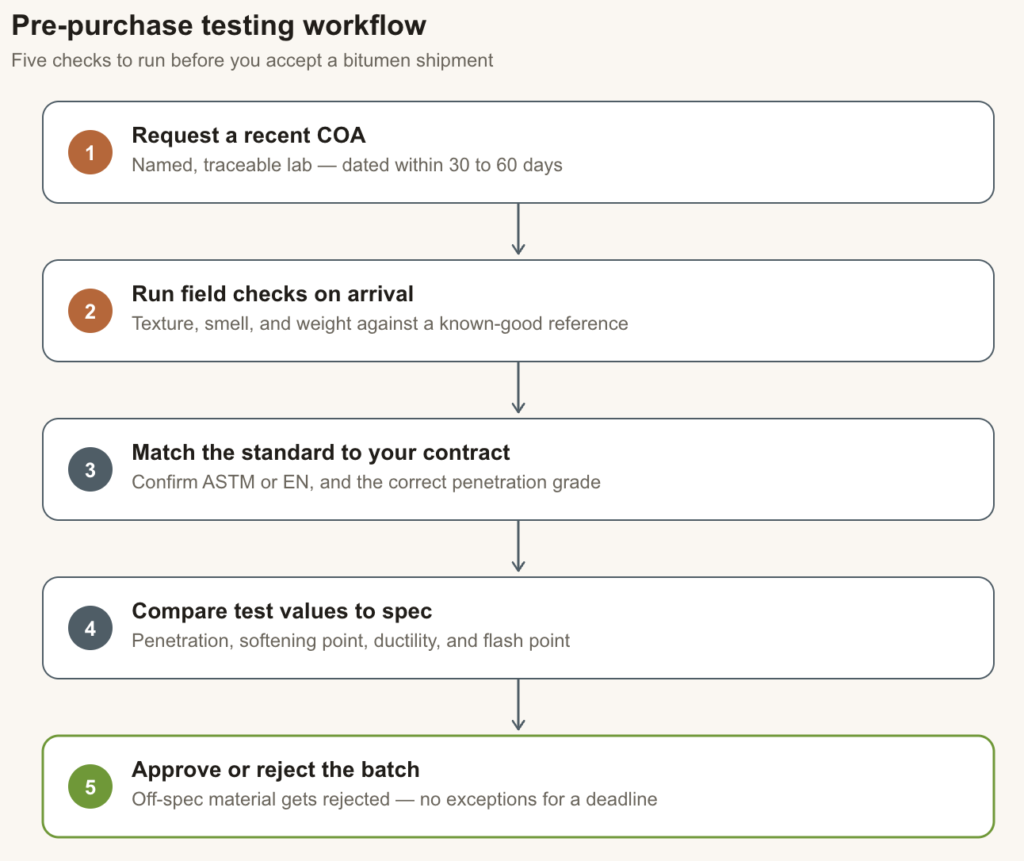
- Ask for a COA less than 30–60 days old, from a named, traceable lab.
- Confirm the standard (ASTM or EN) matches your contract requirement.
- Check penetration and softening point against the climate you’re building for.
- Confirm ductility meets the minimum for your standard (usually 75–100 cm).
- Verify flash point is safely above 250°C.
- Do a visual and smell check on an actual sample, not just the paperwork.
- Ask about source refinery and batch traceability.
- For high-stakes projects, request loss-on-heating data to gauge long-term durability.
Save this list — screenshot it or copy it into your notes before you’re on site. It takes ten minutes and it’s the difference between a road that lasts a decade and one that needs patching after the first heavy rain.
Frequently Asked Questions
Do I need to test every drum, or just a sample from the batch? For bulk orders, testing a representative sample from each batch or tanker load is standard practice — not every single drum. But if a shipment arrives from multiple sources or refineries, test each source separately. Mixing untested lots is how one bad batch contaminates an otherwise good order.
Can I test bitumen quality without a lab? Partially. The visual, smell, and weight checks covered above will catch obvious dilution or contamination. But they won’t tell you penetration grade, softening point, or long-term aging behavior. For anything beyond a small, low-stakes job, a lab test is worth the cost.
What’s the biggest red flag when buying bitumen? A supplier who won’t share a recent COA from a named, traceable lab, or who can’t tell you which refinery the batch came from. Legitimate suppliers answer both questions without hesitation.
Is cheaper bitumen ever worth the risk? Rarely, once you account for the cost of redoing the work. Roads and roofs built with under-spec or adulterated bitumen fail faster, and the cost of re-laying a road or re-sealing a roof almost always outpaces whatever you saved on the initial purchase.
The Bottom Line
Bitumen looks the same whether it’s premium paving grade or a diluted, under-spec substitute — until it’s already in the ground and failing. The tests above aren’t bureaucratic box-ticking. They’re the only real defense you have against buying a problem instead of a product.
How Black Rock answers this checklist: every shipment ships with a COA from a named, third-party-accredited lab, dated to the shipment rather than the season. Each COA is tied to a specific batch and source refinery, so you can trace a drum on your site back to the run it came from. We’d rather you check our numbers than take our word for them.
If you want to go deeper on sourcing itself, see our post on why road projects fail without a stable bitumen supply strategy, or read how inconsistent bitumen quality impacts road lifespan and maintenance budgets for a closer look at what happens downstream when testing gets skipped. And if you’re comparing grades for a specific climate or application, browse our Penetration Grade Bitumen and Polymer Modified Bitumen ranges before you finalize your spec.