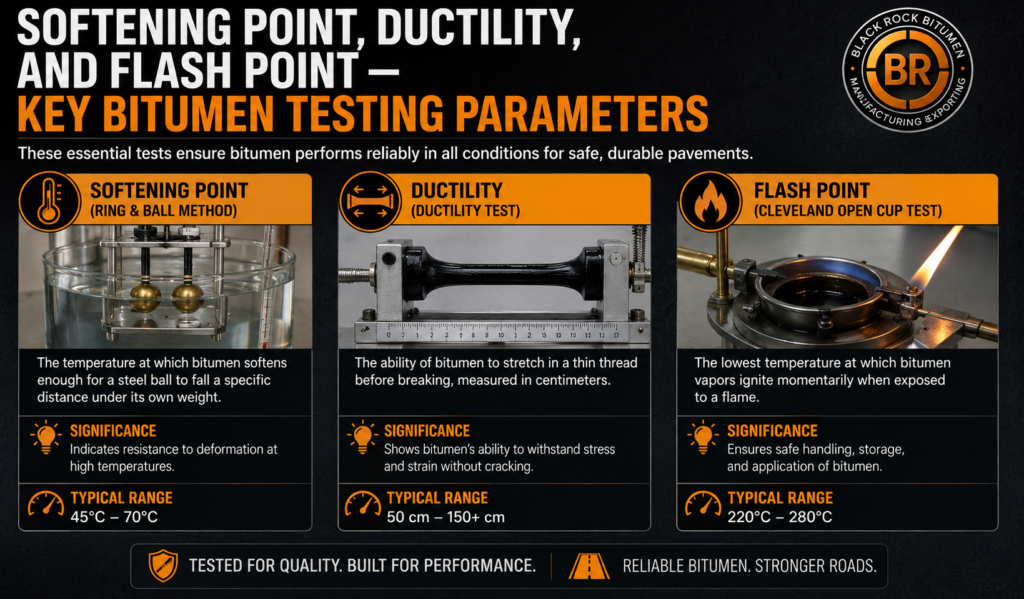
Three questions decide whether a batch of bitumen is worth accepting: how hot before it starts to flow, how far can it stretch before it snaps, and how hot before it catches fire. Those three questions map directly to three lab tests — softening point, ductility, and flash point — and together they tell you more about a binder’s real-world behavior than the penetration grade stamped on the drum ever will.
The flash point one is the easiest to see in practice. Paving-grade bitumen typically flashes somewhere in the 250–350°C range, while the material is handled, pumped, and mixed at 140–180°C. That gap — roughly a hundred degrees of headroom — is the entire reason a tank farm full of hot binder is a routine industrial operation rather than an incident waiting to happen. Narrow the gap, and everything about how the material has to be stored, vented, and documented changes. That’s exactly why these three parameters exist as separate checks rather than one combined number.
Here’s what each one actually measures, how the test works, and what the results mean for a buyer or an engineer deciding whether a batch is fit for purpose.
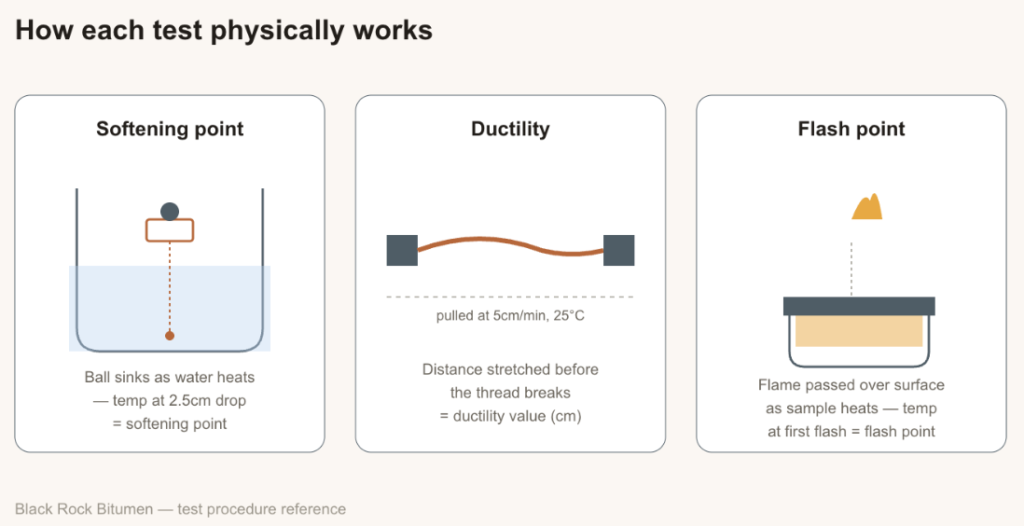
Diagram of the ring and ball softening point, ductility and Cleveland open cup flash point test procedures for bitumen
Softening Point: At What Temperature Does It Start to Flow?
Bitumen doesn’t have a melting point in the way ice or wax does. It’s a viscoelastic material that gradually softens as temperature rises, with no sharp line between solid and liquid. That gradual transition is exactly why the softening point test exists — it defines an arbitrary but standardized point on that curve so different batches and suppliers can be compared on equal footing.
How the test works: two horizontal discs of bitumen, cast in brass rings, each carry a small steel ball on top. The whole assembly sits in a water bath (or glycerine, for higher softening points) that’s heated at a controlled rate — typically 5°C per minute. As the bitumen softens, the ball sinks through the ring, dragging a skirt of bitumen down with it. The temperature recorded at the exact moment the ball-and-bitumen mass touches a reference plate 2.5 cm below is the softening point. This is the Ring & Ball test, standardized under ASTM D36 and EN 1427.
What it tells you: softening point is a direct read on temperature susceptibility. A bitumen with a higher softening point resists flowing at high service temperatures, which is exactly the property you need for hot climates and heavy traffic. Lower softening point bitumen is more prone to bleeding and rutting in the heat, but stays workable in cold conditions (theconstructor.org). It also tells you the ceiling for how hot you can heat the bitumen during storage before it starts losing structural integrity — which is exactly why this number matters as much for handling and storage as it does for pavement performance.
Softening point and penetration grade move together for straight-run bitumen — softer penetration grades have lower softening points — but they aren’t the same measurement, which is why full specification sheets list both rather than treating one as a proxy for the other.
That relationship breaks down entirely for polymer-modified bitumen, and it matters commercially. A polymer network raises the softening point substantially without a corresponding change in penetration, so a PMB can show a softening point 20°C above a straight-run grade of identical penetration. The practical consequence: PMB softening points cannot be benchmarked against penetration grade, and they cannot be compared like-for-like against straight-run figures. If you are evaluating a PMB against a paving grade on a softening point number alone, you are comparing two different things. Oxidized grades behave the same way for a different reason — the air-blowing process shifts the penetration–softening point relationship well away from the straight-run curve.
Ductility: How Far Can It Stretch Before It Breaks?
If softening point is about heat, ductility is about flexibility — and flexibility is what stops a road from cracking every time the temperature drops or a truck rolls over it.
How the test works: a briquette of bitumen, cast into a figure-eight brass mold with a 1 cm² cross-section at its narrowest point, is submerged in a water bath held at a standard temperature — usually 25°C. The two ends are then pulled apart at a fixed rate, typically 5 cm per minute, until the thread of bitumen connecting them finally snaps. The distance stretched, measured in centimeters, is the ductility value, tested under ASTM D113 (Virtual Labs).
Ductility values in practice range anywhere from about 5 cm for a brittle, low-quality sample up to well over 100 cm for a good paving-grade binder. Where a standard requires the test at all, the minimum is commonly 75 to 100 cm for paving-grade bitumen — ASTM D946 sets 100 cm at 25°C across its grades — below which the material is considered unfit for road use.
Which specifications actually require it — and which don’t. This is the part almost no supplier article gets right, and it decides what you should expect on a Certificate of Analysis. Ductility is a required parameter under ASTM D946, under IS 73 in India, and under many national standards across Africa and Asia. It is not required under EN 12591 at all — it does not appear anywhere in the EN paving-grade specification table. And Superpave dropped it entirely, replacing it with direct rheological measurements: the Dynamic Shear Rheometer for high-temperature behaviour and the Bending Beam Rheometer for low-temperature cracking. The reasoning behind both decisions is the same — ductility is a crude proxy that correlates poorly with field cracking performance, and the modern tests measure the property directly.
So the practical rule for an importer: a European or PG-spec COA with no ductility number is not incomplete — it is correct. An ASTM D946 or IS 73 COA with no ductility number is a gap, and you should ask for it. Confirm which specification your contract names before you decide whether a missing line is a problem.
What it tells you where it is used: a bitumen with good ductility forms a thin, cohesive film around aggregate particles that stretches with the pavement instead of cracking under it. Roads expand and contract with daily and seasonal temperature swings, and every time a heavy vehicle passes, the pavement flexes under the load. A brittle, low-ductility binder can’t absorb that movement — it cracks, and once the film cracks, water gets in and the failure accelerates fast. Ductility is broadly the inverse of hardness: harder, low-penetration grades tend toward lower ductility, which is one more reason a hard grade chosen purely for heat resistance deserves a second look on a route with heavy, repetitive traffic loading.
Ductility is also one of the first properties to drop as bitumen ages, which is why it survives as a useful check even where it isn’t the governing spec parameter. A batch that tests fine on delivery can lose ductility after sitting in storage too long or being reheated repeatedly. It is also a practical adulteration screen — cutting bitumen with the wrong material shows up in the ductility result quickly. Retesting a batch that’s been sitting for months is worth the lab fee before it goes into a high-value project.
Flash Point: At What Temperature Does It Become a Fire Hazard?
Softening point and ductility describe how bitumen performs on the road. Flash point describes what happens before it ever gets there — during heating, storage, and transport.
How the test works: a small sample is heated in a brass cup — the Cleveland Open Cup, per ASTM D92 and its European equivalent EN ISO 2592 — at a controlled rate. Once the temperature climbs toward the expected flash point, a small test flame is passed horizontally across the surface of the sample at regular intervals; the method requires the flame passes to begin well below the anticipated result, which is what makes the reading valid. The flash point is the lowest temperature at which the vapors above the sample ignite briefly. Keep heating past that point and you’ll reach the fire point — the temperature at which the material sustains a flame for at least five seconds rather than just flashing.
What it tells you: this is a safety threshold, not a performance indicator. EN 12591 paving grades carry minimum flash point requirements in the 220–240°C range depending on grade — 240°C for the hard grades, 230°C through the mid-range, 220°C for 160/220 — while typical measured values run considerably higher, often 250–350°C. Since bitumen is routinely heated to 140–180°C for handling, that margin is the whole point. A batch with a flash point sitting close to its normal handling temperature is a genuine fire risk during pumping, mixing, or application — and it’s exactly the kind of thing a rushed inspection skips because “the bitumen looks fine.” It doesn’t just affect handling in the field, either: flash point determines what kind of storage tank design, ventilation, and transport documentation a shipment legally requires (Gulf Petro).
One caveat on reading a low result: a flash point that comes back below the temperature the sample was heated to before flame passes began is not a failed batch — it is an invalid test. ASTM D92 requires the flame pass sequence to start well below the expected flash point. If a report shows that pattern, ask for the run to be repeated before you reject the cargo.
Two More Tests That Matter If You’re Buying PMB
The three tests above cover conventional paving grades. If you’re buying polymer-modified bitumen, two additional parameters govern whether the product will actually behave like PMB when it reaches site — and neither shows up on a standard paving-grade COA.
Elastic recovery (EN 13398) measures the property you’re paying the premium for. A PMB sample is stretched in the ductility apparatus, cut, and the two halves are left to retract; the percentage of the deformation recovered is the elastic recovery value. It’s the direct evidence that a functioning polymer network is present in the binder — not just that polymer was added somewhere upstream. A low elastic recovery figure on a product sold as PMB is the single most useful red flag on the certificate.
Storage stability (EN 13399) measures whether that polymer network stays where it should. A sample is held vertically in a tube at elevated temperature for three days, then the top and bottom sections are tested separately; a large difference in softening point between the two means the polymer has separated from the bitumen phase. This is the direct test for the separation problem that turns a PMB cargo into ordinary bitumen with an expensive invoice attached — and it’s the number to insist on when the material will sit in a hot storage tank for any length of time before use.
The Three Tests, Side by Side
Softening point, ductility and flash point compared — test standards, typical values and what each tells a bitumen buyer
| Test | Standard | What it measures | Typical value | What it tells a buyer |
| Softening point | ASTM D36 / EN 1427 | Temperature at which bitumen starts to flow | 30–63°C, depending on grade | Heat resistance — rutting risk in hot climates |
| Ductility | ASTM D113 (no direct EN counterpart) | Distance stretched before breaking | Typically 75–100+ cm minimum where required | Flexibility, ageing and adulteration check — required by ASTM and IS, not by EN 12591 |
| Flash point | ASTM D92 / EN ISO 2592 | Temperature at which vapors ignite | 220–240°C minimum for EN paving grades | Safety margin during heating, storage, and transport |
| Elastic recovery (PMB) | EN 13398 | Deformation recovered after stretching | Grade-dependent, expressed as % | Confirms a working polymer network is present |
| Storage stability (PMB) | EN 13399 | Softening point difference top vs bottom after 3 days | Small difference required | Whether the polymer will separate in a hot tank |
There is no clean EN equivalent to ASTM D113. EN 13589 is sometimes cited as one, but it is the force ductility test used for polymer-modified binders — it measures the energy absorbed during stretching, not the simple distance-to-break of the conventional test.
Why You Need All Three, Not Just One
Here’s the part that gets missed most often: none of these tests substitutes for the others, and a batch can pass one comfortably while sitting right on the edge of failure on another. A hard grade might have an excellent softening point for a hot climate but a marginal ductility value that won’t hold up under heavy traffic. A batch with a perfectly acceptable penetration and softening point could still carry a dangerously low flash point if something went wrong upstream in the refining process. Reading only the penetration number and assuming everything else “comes with it” is how a project ends up with a binder that looks right on paper and fails in the field.
The correct expectation on a Certificate of Analysis depends on which standard the contract names. Under ASTM D946 or IS 73, penetration and softening point without a ductility figure is a gap worth chasing. Under EN 12591, ductility was never part of the specification — what you should be checking instead is solubility, flash point, and the ageing results from the RTFOT (EN 12607-1). Under a Superpave PG spec, neither ductility nor penetration is the point; the DSR and BBR results are. Knowing which document you’re buying against tells you which missing line is an oversight and which is simply how that standard works.
Common Mistakes When Reading These Three Tests
Treating softening point as a performance guarantee on its own. It tells you when bitumen starts to flow, not how it behaves structurally once it’s in the pavement.
Comparing a PMB softening point against a straight-run grade. The polymer raises the softening point without a matching penetration change, so the two numbers aren’t measuring comparable materials. Benchmark PMB against PMB.
Chasing a ductility number that the governing standard doesn’t require. If the contract is written to EN 12591 or a PG spec, a missing ductility line is correct, not a red flag. Chase the parameters that specification actually governs.
Assuming ductility only matters in cold climates. Where it is required, heavy repetitive traffic loading flexes pavement in any climate. A hot-climate road with a hard, low-ductility binder can still crack under constant truck loading without a single freeze-thaw cycle.
Treating flash point as a fixed property of “bitumen” in general. It varies by grade, by crude source, and by refining process. Never assume one grade’s flash point applies to another, and never skip the number just because the material “always tests fine.”
Reading an invalid flash point run as a failed batch. If the reported flash point is below the temperature the operator heated to before starting flame passes, the procedure was wrong, not the bitumen.
Not retesting aged stock. All of these properties can shift after extended storage or repeated reheating. A batch that shipped with excellent numbers six months ago isn’t guaranteed to test the same way today.
Frequently Asked Questions
What is a good softening point for bitumen in a hot climate? For standard EN penetration grades, softening points in the 50–63°C range are typical for hot-climate, heavy-traffic applications, corresponding to harder grades like 20/30 through 40/60. The right number depends on your specific climate and traffic conditions.
What ductility value is acceptable for road construction? Where the standard requires it, the minimum is typically 75 to 100 cm for paving-grade bitumen — ASTM D946 requires 100 cm at 25°C. Values below the threshold suggest a brittle binder at higher risk of cracking under traffic and temperature stress.
Does EN 12591 bitumen need a ductility test? No. Ductility is not part of the EN 12591 specification, and Superpave PG grading replaced it with DSR and BBR measurements. It remains a required parameter under ASTM D946, IS 73, and a number of national standards across Africa and Asia. Check which standard your contract names before treating a missing ductility figure as a problem.
Why does flash point matter if I’m not the one heating the bitumen? Even if you’re not operating the heating equipment yourself, flash point affects what storage tank design, ventilation, and transport documentation your shipment requires — and a low flash point is a red flag worth raising with your supplier regardless of who’s handling it.
Can a bitumen sample pass penetration grading but fail ductility or flash point? Yes — these are independent physical properties measured by separate tests, and one result doesn’t predict another. What a complete Certificate of Analysis should contain depends on the governing standard: every parameter that standard specifies, which for EN 12591 does not include ductility and for ASTM D946 does.
What should I check on a PMB certificate that isn’t on a paving-grade one? Elastic recovery (EN 13398) and storage stability (EN 13399). The first confirms the polymer network is doing its job; the second confirms it won’t separate out in a hot storage tank before the material is used.
The Bottom Line
Penetration grade gets all the attention because it’s the number on the drum, but softening point, ductility, and flash point are what actually predict whether a binder survives its climate, its traffic load, and its own storage and handling without becoming a hazard. Ask for every parameter your governing specification requires on each Certificate of Analysis — and know which specification that is before you start reading the numbers. Primary references worth having on hand: ASTM D92 and EN ISO 2592 for flash point, ASTM D36 and EN 1427 for softening point, ASTM D113 for ductility, EN 13398 and EN 13399 for polymer-modified binders, and the Asphalt Institute MS-2 and Eurobitume technical guidance for the practical background behind all of them.
If you want to see how these properties tie back to grade selection, our Penetration Grade Bitumen range and our post on how inconsistent bitumen quality impacts road lifespan and maintenance budgets cover the practical side of this in more detail. For the storage and handling side of flash point specifically, see our guide to bitumen storage, handling, and transport standards.