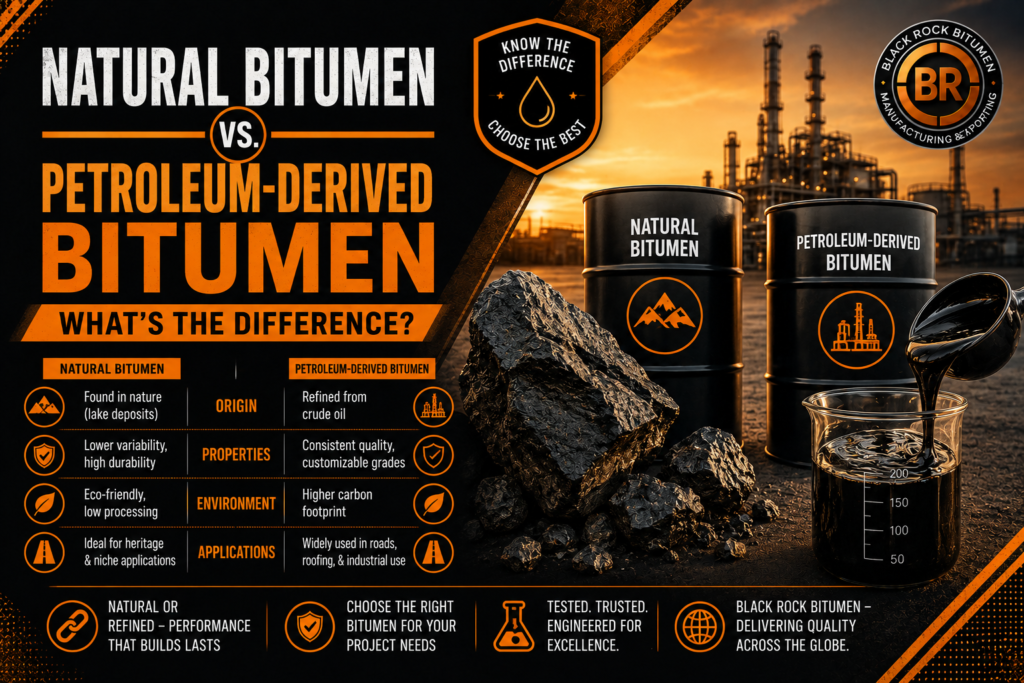
When people hear “bitumen,” they usually picture the black binder used in asphalt roads. But not all bitumen begins its life in a refinery.
Some bituminous materials occur naturally in geological deposits. They include natural asphalt, bituminous rocks and materials such as gilsonite. Others are produced commercially by processing crude oil in a refinery and separating the heavier fractions that become petroleum-derived bitumen.
At first glance, the two can look remarkably similar. Both are dark, viscous or solid hydrocarbon materials. Both can contribute to asphalt performance. But their origin, composition, consistency and typical ¡use can be very different.
So, is natural bitumen a replacement for petroleum-derived bitumen? Sometimes it can be used as a paving material or partial replacement, and in other cases it is more useful as a modifier. The answer depends on the specific natural material, how it is processed, and what the pavement is required to do.
For projects across Africa, South America and Southeast Asia, that distinction matters because procurement teams need to balance performance, specification compliance, supply consistency and lifecycle cost.
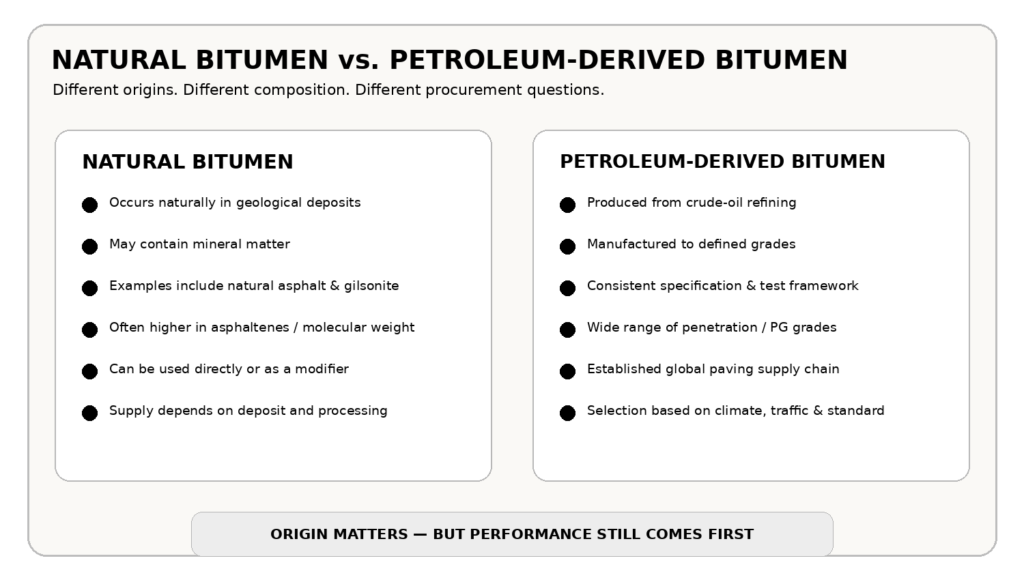
Alt text: Side-by-side comparison of natural bitumen and petroleum-derived bitumen, showing their origins, composition, specification, supply characteristics and typical roles in asphalt.
What Is Natural Bitumen?
Natural bitumen is bituminous material that occurs naturally in the earth rather than being produced as a refinery residue from crude oil. Geological processes can leave heavy hydrocarbon material concentrated in deposits, sometimes mixed with mineral matter.
Natural bitumen is not one single product. The term can cover different materials with very different compositions and physical properties. Examples discussed in pavement research include natural asphalt, bituminous sands, rock bitumen, Trinidad Lake Asphalt and gilsonite.
The 2023 Journal of Cleaner Production review of natural bitumen in pavement highlights this diversity and notes that natural bitumen can potentially replace petroleum bitumen fully or partially in pavement applications, although data availability and standardisation remain challenges for wider adoption. citeturn0search1turn0search5
That last point is important. You cannot specify “natural bitumen” as though it were automatically equivalent to a conventional 60/70 grade. The actual material needs to be tested.
What Is Petroleum-Derived Bitumen?
Petroleum-derived bitumen is produced from crude oil through refinery processing. It is the conventional paving binder used around the world and is manufactured into defined grades according to standards and performance requirements.
Depending on the specification system, petroleum bitumen may be classified by penetration, viscosity or performance grade. This gives engineers a familiar framework for selecting a binder according to climate, traffic and pavement requirements.
For example, Black Rock Bitumen’s Bitumen 60/70 is a conventional penetration-grade paving binder with a defined specification and test framework.
This standardisation is one of petroleum-derived bitumen’s biggest practical advantages. Buyers know what tests to request, engineers know what the grade represents, and suppliers can provide Certificates of Analysis against the specified requirements.
Natural Bitumen vs. Petroleum Bitumen: The Core Difference
The simplest distinction is origin. Natural bitumen forms through geological processes; petroleum-derived bitumen is manufactured from crude oil through refinery processing.
But origin is only the beginning. Natural materials can contain mineral matter and can have higher asphaltene content or molecular weight than conventional refinery bitumen. The 2023 review reports that these characteristics can produce harder, more viscous behaviour and influence stiffness and deformation resistance. citeturn0search9
Trinidad Lake Asphalt provides a useful example. Research comparing Trinidad Lake Asphalt with Trinidad petroleum bitumen found substantially different composition and rheological behaviour, with the natural asphalt showing higher asphaltene content and significant inorganic material. citeturn0search0
| Factor | Natural Bitumen | Petroleum-Derived Bitumen |
| Origin | Natural geological deposits | Crude-oil refining |
| Composition | Can include mineral matter and naturally concentrated heavy hydrocarbons | Refinery-controlled hydrocarbon fractions |
| Consistency | Varies significantly by deposit and processing | Manufactured to defined grades |
| Typical form | Solid, semi-solid or mineral-rich depending on source | Liquid when heated; solid/semi-solid at ambient temperature |
| Specification | May require project-specific testing | Established ASTM / EN / AASHTO grade systems |
| Paving role | Direct binder, partial replacement or modifier depending on material | Primary conventional paving binder |
| Supply | Deposit-dependent | Large established refining and trading network |
| Main procurement issue | Material consistency and qualification | Correct grade and specification compliance |
Why Natural Bitumen Can Be Interesting for Asphalt
Natural bitumen has attracted attention because some natural materials have properties that can improve asphalt stiffness and resistance to permanent deformation.
The 2023 literature review found that previous studies reported potential for natural bitumen to replace petroleum bitumen partially or completely in selected pavement applications. It also notes that mixtures containing natural bitumen can show improved performance, depending on the material and formulation. citeturn0search1
In one study of different natural asphalts and SBS-modified binders, several natural-asphalt formulations increased resistance to permanent strain and fatigue cracking. citeturn0search13
That does not mean every natural bitumen deposit will outperform a conventional binder. It means some natural materials have useful chemistry that can be engineered into pavement mixtures.
Natural Bitumen Can Act as a Modifier
This is an important distinction that is often missed.
Natural bitumen does not always have to replace petroleum-derived bitumen completely. It can also be blended with conventional binder to change the final asphalt properties.
Gilsonite, for example, is a natural resinous hydrocarbon that is compatible with petroleum asphalt and is commonly used as a hardening or reinforcing material. citeturn0search4
Research and industry literature describe natural-asphalt modification as a way of increasing stiffness and deformation resistance. However, the actual dosage, blending method and resulting performance need to be verified through laboratory testing rather than assumed from the name of the modifier.
For conventional high-performance alternatives, compare this approach with Black Rock Bitumen’s Polymer Modified Bitumen range and Performance Grade options.
The Pros of Natural Bitumen
1. Naturally High in Heavy Hydrocarbon Components
Many natural bitumens are rich in asphaltenes and other high-molecular-weight components. This can produce a harder, more viscous material with useful stiffness characteristics.
2. Potential for Improved Deformation Resistance
Because some natural materials are inherently hard, they can increase mixture stiffness and resistance to permanent deformation when appropriately incorporated.
3. Can Be Used as a Partial Replacement
Research has investigated natural bitumen as a partial or complete replacement for petroleum bitumen in asphalt mixtures. This creates another route for pavement designers looking beyond conventional refinery binders.
4. Potential Environmental Benefits in Some Supply Chains
The natural-bitumen literature identifies lower energy consumption as a potential benefit in some applications, particularly where the natural material can be transported efficiently and used with limited additional processing. That benefit is not automatic: mining, processing and transport still have environmental impacts.
The Cons of Natural Bitumen
1. Material Properties Can Vary
This is perhaps the biggest practical challenge. A geological deposit is not automatically a standardised commercial binder. Mineral content, chemistry, penetration, softening behaviour and other properties can vary.
2. Standardisation Can Be More Difficult
Road authorities are comfortable specifying conventional grades because the testing framework is well established. Natural bitumen may require additional qualification to demonstrate that the material meets the project’s performance requirements.
The 2023 review specifically identifies lack of available data, knowledge and systematic research as reasons some road authorities remain cautious about natural bitumen. citeturn0search5
3. Supply Is Deposit-Dependent
Petroleum-derived bitumen is connected to a large global refining and trading network. Natural bitumen depends on specific geological deposits and the commercial viability of extracting and processing them.
4. “Natural” Does Not Automatically Mean “Sustainable”
It is tempting to assume that a naturally occurring material has a lower environmental footprint. That conclusion cannot be made from origin alone. Extraction, processing, transport and the amount of material required all contribute to lifecycle impact.
The Pros of Petroleum-Derived Bitumen
1. Established Specification Systems
Petroleum-derived paving binders are available in well-established penetration, viscosity and performance-grade systems. Engineers can specify measurable requirements and suppliers can provide batch-level documentation.
Black Rock Bitumen’s Penetration Grade Bitumen range illustrates the breadth of conventional grades available for different climates and traffic conditions.
2. Consistent Commercial Supply
For international infrastructure projects, consistent supply matters. Petroleum-derived grades are produced at scale and traded globally, making them easier to source for large projects where the same specification has to be repeated across multiple shipments.
3. Straightforward Grade Selection
Engineers can select a grade based on climate, traffic, pavement design and the governing standard. For example, harder grades may be preferred for hot or heavily loaded conditions, while softer grades may be used where low-temperature flexibility is more important.
For a practical explanation of this process, see Bitumen Grades & Standards for Infrastructure Tenders.
The Cons of Petroleum-Derived Bitumen
1. Dependent on Crude-Oil Refining
Petroleum bitumen is tied to crude-oil processing and therefore to the broader petroleum supply chain. Availability and pricing can be affected by refinery operations, crude markets and logistics.
2. Refining Requires Energy
Production of petroleum bitumen involves refinery processing and energy use. The natural-bitumen literature identifies this as one reason researchers are investigating alternative sources and partial replacements. citeturn0search1
3. Conventional Bitumen Still Has Performance Limits
Petroleum-derived bitumen is not a single performance level. A conventional grade that works well for one project may be unsuitable for another. Climate, traffic and pavement design still determine whether a standard binder is enough or whether a modified or higher-performance binder is needed.

Alt text: Five-step decision path for evaluating natural bitumen, covering material identification, composition, intended role, project specification, and supply and testing requirements.
Natural Bitumen vs. Petroleum-Derived Bitumen: Which Should You Use?
The answer should start with the project, not the material’s origin.
If the project requires a widely recognised grade with predictable certification, large-volume supply and an established specification framework, petroleum-derived bitumen is usually the straightforward choice.
Natural bitumen becomes more interesting when a specific natural material has demonstrated suitable performance, the project specification allows it, and the supply chain can provide consistent material with reliable test data.
For some projects, the best solution may be somewhere in between: use petroleum-derived bitumen as the base binder and incorporate a qualified natural bitumen as a partial replacement or modifier.
What Should Buyers Test Before Ordering Natural Bitumen?
This is where procurement discipline matters most. A natural material should not be accepted simply because it is labelled natural asphalt or natural bitumen.
| Property / check | Why it matters |
| Penetration / consistency | Shows hardness and helps compare material behaviour |
| Softening point | Indicates high-temperature behaviour |
| Asphaltene content | Can strongly influence stiffness and rheology |
| Mineral / inorganic content | Important where natural material contains inherent mineral matter |
| Solubility | Helps understand binder purity and composition |
| Rheological performance | Shows how the material responds to temperature and loading |
| Blend compatibility | Essential if natural bitumen will be mixed with petroleum binder |
| Batch consistency | Critical for repeatable asphalt production |
| Certificate of Analysis | Provides documented evidence against agreed requirements |
A Practical Procurement Checklist
1. Identify exactly what the product is. Natural asphalt, gilsonite, bituminous rock and other natural materials are not interchangeable.
2. Request the full technical data. Do not rely on a generic product description.
3. Test compatibility with the project binder. If it will be blended with petroleum bitumen, verify the resulting properties.
4. Check the governing specification. Confirm whether the road authority permits natural bitumen or requires a defined conventional grade.
5. Evaluate supply consistency. A successful laboratory batch is not enough if commercial shipments vary significantly.
6. Compare lifecycle value. Consider performance, processing, transport, availability and maintenance—not simply purchase price.
What the Research Says About the Future
Natural bitumen is not a fringe topic in pavement research anymore. A 2023 review in the Journal of Cleaner Production examined natural asphalt resources, their physicochemical and rheological properties, pavement applications and reported field performance. The review concluded that natural bitumen has potential as a full or partial replacement for petroleum bitumen, while also identifying standardisation, knowledge and data gaps that need to be addressed for wider adoption. citeturn0search1
The direction of research is therefore less about declaring one material the universal winner and more about understanding where natural materials can provide measurable engineering or lifecycle advantages.
That is a useful way to look at the subject for infrastructure buyers: natural bitumen is an option to evaluate, not a shortcut around specification and testing.
Frequently Asked Questions
Is natural bitumen the same as petroleum bitumen? No. Natural bitumen occurs in geological deposits, while petroleum-derived bitumen is produced through crude-oil refining. Their composition and physical properties can differ significantly.
Is natural bitumen better than petroleum-derived bitumen? Not automatically. Some natural bitumens can improve stiffness and deformation resistance, but performance depends on the specific material, dosage, blend and pavement design.
Can natural bitumen replace petroleum bitumen completely? Research has investigated both partial and complete replacement, but whether full replacement is appropriate depends on the natural material and the governing project specification.
What is gilsonite? Gilsonite is a natural resinous hydrocarbon, also known as natural asphalt, asphaltite or uintaite. It can be used as a natural bituminous material or as a modifier for petroleum asphalt.
Is natural bitumen more environmentally friendly? It can have potential advantages in some supply chains, but “natural” does not automatically mean lower lifecycle impact. Extraction, processing and transport still need to be assessed.
Why is petroleum bitumen still more common? It has a mature global supply chain, established standards, predictable grades and extensive field experience, which makes procurement and specification easier for large infrastructure projects.
The Bottom Line
Natural bitumen and petroleum-derived bitumen are not simply two versions of the same product. They come from different sources, can have different compositions and behave differently in asphalt mixtures.
Petroleum-derived bitumen remains the practical choice for many road projects because it is manufactured to established grades, supported by international specifications and available through a mature global supply chain. Natural bitumen can be valuable where a particular deposit offers useful properties, especially when it can be used as a qualified binder or modifier.
For buyers comparing conventional options, start with Black Rock Bitumen’s Penetration Grade Bitumen, Bitumen 60/70, and Bitumen 80/100 pages. For projects where temperature and traffic demand more performance, compare Performance Grade Bitumen and Polymer Modified Bitumen. Before procurement, review the Bitumen Grades & Standards for Infrastructure Tenders and Bitumen Storage, Handling & Transport Standards so the selected material is matched to the project’s specification, handling requirements and expected service conditions.