Weekly Bitumen Market Report | May 15, 2026 | By Black Rock Bitumen
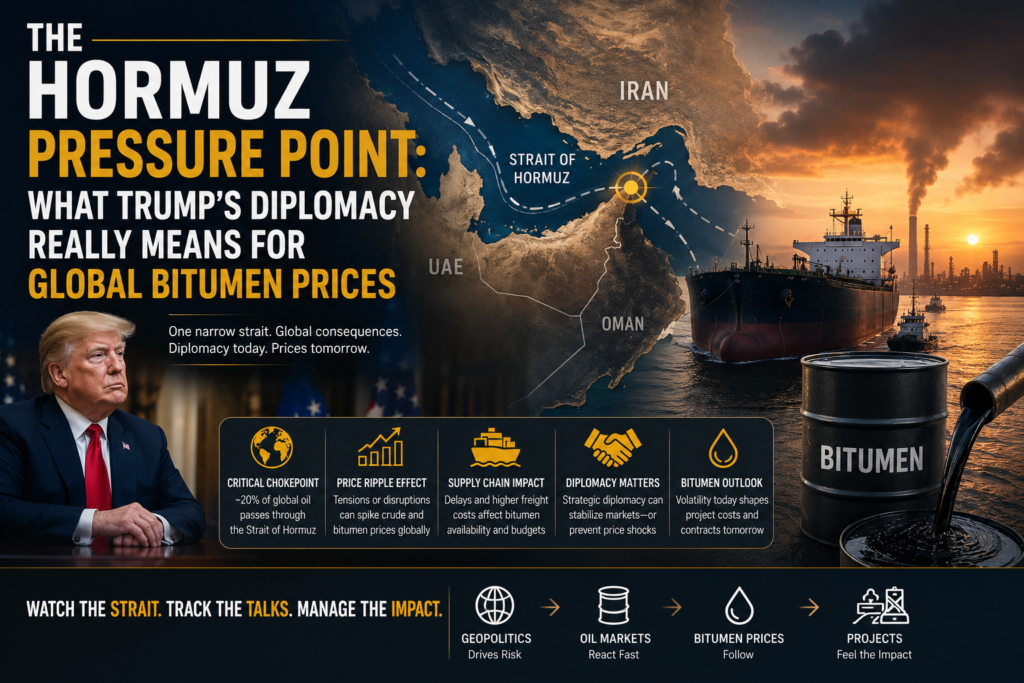
The Hormuz Pressure Point: What Trump’s Diplomacy Really Means for Global Bitumen Prices
Right now, geopolitics isn’t just a background risk for bitumen buyers. It is the single biggest variable sitting between you and your supply chain.
The global bitumen market in May 2026 is not being driven by demand cycles or seasonal paving trends. It is being driven entirely by geopolitics — and if you are sourcing bitumen for projects across South Asia, Southeast Asia, or Africa, you need to understand exactly what is happening and why it matters to your costs and delivery timelines.
In this report, Black Rock Bitumen breaks down the key developments shaping oil and bitumen prices this week, what they mean for buyers in your region, and the single most important question you should be asking your supplier right now.
Here Is What Is Actually Happening in the Market Right Now
The diplomatic situation between the United States and Iran has hit a critical inflection point. Washington has formally rejected Tehran’s latest negotiation proposal and has characterised the current ceasefire as being on shaky ground. The result is a market that looked like it might stabilise — and then repriced upward risk instead.
For bitumen buyers, this is not an abstract foreign policy story. Every tanker that cannot transit the Strait of Hormuz adds time, cost, and uncertainty to your procurement schedule. Reports from mid-May 2026 indicate that more than 1,500 vessels are currently stuck, delayed, or rerouted because of the ongoing disruption at Hormuz.
The key insight here is this: the gap between a headline price and an actually executable delivery is wider right now than at any point in the past two years. If your supplier is quoting aggressively, the harder question to ask is not whether the price looks good on paper — it is whether they can actually ship the cargo. Contact our team to understand how we verify every shipment before quoting.
The US–China Energy Chess Match and What It Means for Supply
Trump’s recent visit to Beijing was framed publicly as a diplomatic mission, but the real agenda was straightforward: push China to put pressure on Iran, and stabilise the Hormuz situation enough to prevent a further oil price spiral.
Both the United States and China have publicly opposed transit restrictions through the Hormuz Strait. But that shared public position has not translated into operational normalcy on the water. Shipping remains disrupted. Insurance premiums on Gulf-routed tankers remain elevated. And supply visibility remains deeply uncertain, a point confirmed in recent tracking data published by the U.S. Energy Information Administration (EIA).
For buyers working with Black Rock Bitumen, this environment means one thing above all: supply chain certainty commands a premium, and buyers who lock in verified, executable supply agreements now are positioning themselves ahead of the next disruption wave. We ship directly from Jebel Ali Port in Dubai — one of the most strategically located and operationally resilient export hubs in the world.
Brent Crude Is Back Above $100 — And the Market Isn’t Done Yet
Brent crude pushed back into the $100–$114 range this week, trading around $106 on May 14, 2026. The previous week saw a brief pullback, but that dip has been fully reversed. According to data tracked by the EIA and OPEC, the market is pricing in three simultaneous pressures:
1. The effective operational restriction of the Hormuz Strait — reducing available global supply volumes and raising transport costs across all petroleum products, including our core grades like Bitumen 60/70 and Bitumen 80/100.
2. OPEC’s downward revision of its 2026 demand growth forecast — with the organisation acknowledging that production has been directly impacted by the Hormuz disruption. You can follow OPEC’s latest releases at the OPEC Monthly Oil Market Report.
3. The ongoing risk of diplomatic breakdown — if negotiations collapse again, Brent could move significantly higher, dragging bitumen feedstock costs with it. For buyers of Polymer Modified Bitumen and Performance Grade Bitumen, where production costs are already elevated, this risk is especially acute.
Fuel oil — the primary raw material for bitumen production — has tracked Brent higher throughout this period. Singapore’s HSFO 180 moved from approximately $645 per metric tonne in early May to around $691 per metric tonne by mid-month. Persian Gulf HSFO similarly climbed from the $607 range to around $630 per metric tonne.
The critical tension in Asia right now is that feedstock costs are rising sharply, but end-market demand is not absorbing the increase — which is suppressing the full pass-through into bitumen prices, but only temporarily. Buyers in India, Malaysia, and China should take note.
Regional Bitumen Price Snapshot — Mid-May 2026
Singapore: $552–$564 per metric tonne | Trend: Stable | Demand is weak and capping price gains
South Korea: $512–$530 per metric tonne | Trend: Stable | Limited buying activity
Europe (Export): $620–$660 per metric tonne | Trend: Firm and elevated | Not a cheap market
China: Modest week-on-week uptick | Trend: Cautious | Rain, elevated prices, and financing pressure limiting demand. See our China bitumen supply page for more context.
India: Historically elevated levels | Trend: Post-shock acceptance | Market has absorbed high prices, not corrected them. Buyers can explore our India-specific supply options and Viscosity Grade Bitumen suitable for Indian IS standards.
Singapore HSFO 180 (Feedstock): ~$691 per metric tonne | Trend: Rising | Feedstock cost pressure building across all grades
Asia: Strong Feedstock Costs, Weak End-Market Demand
Singapore and South Korea are the two key pricing benchmarks for Asian bitumen. Despite fuel oil moving meaningfully higher, bitumen values in both markets have stayed in a compressed range. The reason is clear: construction and road-paving activity across East Asia remains subdued. Buyers are purchasing only for immediate requirements and are not building inventory.
China’s market has edged up week-on-week but buying is selective and low in volume. Wet weather, elevated delivered costs, and project financing delays are all preventing demand from turning broad-based. Buyers in China sourcing Chinese grade bitumen such as AH70 or AH90 should be engaging suppliers now before price floors shift upward.
India has shifted from crisis-mode pricing to a kind of resigned acceptance of higher price levels — which is not the same thing as a genuine market correction. Prices are high; buyers are simply adjusting to that reality. For Indian buyers, VG-30 and VG-40 remain the most in-demand grades, and current market conditions make supply agreement timing critical.
What this means for you: if you are a bitumen buyer in South Asia or Southeast Asia, the current moment represents a window of relative price stability. But it is fragile. Any escalation in the Hormuz situation could close that window rapidly. Locking in supply now with a reliable, verified partner is the strategically sound move. Contact Black Rock Bitumen for a confirmed quote.
What This Means for African Bitumen Buyers
African infrastructure projects — from road rehabilitation in Nigeria and Kenya to highway development in Cameroon, Angola, and Algeria — are directly exposed to current shipping disruptions. The longer Gulf routes remain operationally risky, the more freight costs eat into project budgets.
Dubai’s position at Jebel Ali Port means Black Rock Bitumen can offer some of the most competitive CFR pricing to East and West African ports, across grades including Bitumen 60/70, Oxidised Bitumen, and Bitumen Emulsion. Our packaging options — drums, jumbo bags, bitutainers, and bitubox — are tailored to African port infrastructure and customs requirements.
We also supply to Botswana, Egypt, and Burkina Faso. If your destination is not listed, contact us directly — we ship to over 40 countries.
The Black Rock Bitumen View
Markets like this one separate suppliers from genuine partners. When conditions are easy, anyone can quote a competitive price. When a critical waterway is effectively blocked, diplomatic talks are failing, and over a thousand vessels are sitting in queue — that is when who you work with determines whether your project stays on schedule.
At Black Rock Bitumen, our commitment in this environment is not to send you the most attractive number. It is to send you the most accurate one — and then back it up with confirmed supply, full documentation, and the operational depth to navigate disruption. We source directly from licensed Gulf refineries, provide real-time shipment tracking, and respond to quote requests within 24 hours.
We supply over 80 certified grades — from standard penetration grades to specialist polymer-modified and performance grades — all tested to ASTM, ISO, and AASHTO standards. Every shipment leaves with a Certificate of Analysis. No exceptions.
The buyers who will come out of this period in the strongest position are those who invested in verifiable supply relationships before conditions normalise. Not after. Get in touch today to secure your supply.
This report is prepared by Black Rock Bitumen for informational purposes only. Price references are indicative market assessments as of mid-May 2026 and should not be relied upon as final trading prices. For current pricing, contact our sales team directly. External links to EIA, OPEC, and Reuters are provided for reference only and do not constitute endorsement.
Frequently Asked Questions
Why is the Strait of Hormuz so important for bitumen prices?
The Strait of Hormuz is the transit route through which a significant share of the world's oil and petroleum products — including bitumen feedstocks — must pass. When shipping through Hormuz is disrupted or restricted, freight costs rise, delivery timelines extend, and available supply volumes fall. All of these factors push bitumen prices upward globally, particularly for buyers in Asia and Africa who rely heavily on Persian Gulf-origin product. Our Dubai-based export hub at Jebel Ali gives us operational flexibility that many Gulf-based suppliers do not have.
How do US–Iran tensions specifically affect bitumen buyers in global markets?
US–Iran tensions create two simultaneous pressures: they restrict tanker movements through Hormuz, reducing available supply; and they create sanctions-risk uncertainty that makes Iranian-origin product harder to purchase, finance, and ship. Global markets buyers are increasingly turning to Dubai-origin supply from trusted exporters like Black Rock Bitumen. We supply all major bitumen-standard grades including VG-10, VG-30, and VG-40.
What does "non-executable offer" mean in the current bitumen market?
A non-executable offer is a quoted price that cannot reliably be fulfilled at the stated terms — due to shipping restrictions, lack of confirmed cargo, or intermediary speculation. In the current market, some traders are quoting Iranian-origin bitumen at attractive prices through neighbouring countries, without verifying whether cargo can actually be loaded and shipped under prevailing conditions. Always request loading confirmations and prior shipment documentation before committing. At Black Rock Bitumen, we provide full pre-shipment documentation on every order, including Bill of Lading drafts, Certificate of Analysis, and MSDS.
Is now a good time to buy bitumen, or should I wait for prices to fall?
This depends on your project timeline and risk tolerance. The current market presents a window of relative stability — but the underlying geopolitical drivers remain unresolved. If a diplomatic breakthrough occurs, prices could ease. If talks collapse again, prices could move significantly higher, as noted in recent analysis from Reuters. For buyers with imminent project needs, locking in supply now with a trusted supplier provides cost certainty. Contact us to discuss a forward supply agreement.
Why are European bitumen prices higher than Asian prices right now?
European bitumen prices reflect stronger underlying infrastructure demand and a tighter supply situation. Asian markets — particularly Singapore and South Korea — are experiencing price compression because demand-side weakness is partially offsetting rising feedstock costs. Europe has less of that demand softness, which is keeping prices firm. For buyers in Australia, New Zealand, and the Pacific, our Australian Standard grades — C170, C240, C320, C450, and C600 — offer a competitively priced alternative to European supply.
How does Black Rock Bitumen ensure supply reliability during market disruptions?
Black Rock Bitumen maintains verified supply agreements across multiple refinery origins, reducing single-route dependency. Our process includes loading confirmation prior to contract finalisation, full documentation support (COA, BL, MSDS, Certificate of Origin), and proactive communication on any shipment changes. We ship using all packaging formats — drums, jumbo bags, bitutainers, and bitubox — to suit any destination port's requirements.
Which grades of bitumen are most affected by current supply chain disruptions?
Penetration grade bitumens — particularly 60/70 and 80/100 — dominate global trade volumes and are most directly affected by shipping disruptions. Oxidised bitumen and specialty grades sourced from Persian Gulf refiners face similar route-dependency issues. Bitumen from Dubai origin, including our full range of cutback bitumen, bitumen emulsion, and polymer modified bitumen, is less directly exposed to Hormuz disruption due to Jebel Ali's strategic positioning.
Which countries does Black Rock Bitumen export to?

Content Writer, Global Bitumen Supply & Market Insights, Black Rock Bitumen
Farheen Fatima is an infrastructure materials writer specializing in bitumen supply, asphalt technology, and global road construction. He shares practical insights on bitumen grades, supplier evaluation, and international standards to help contractors and project teams make informed procurement decisions.