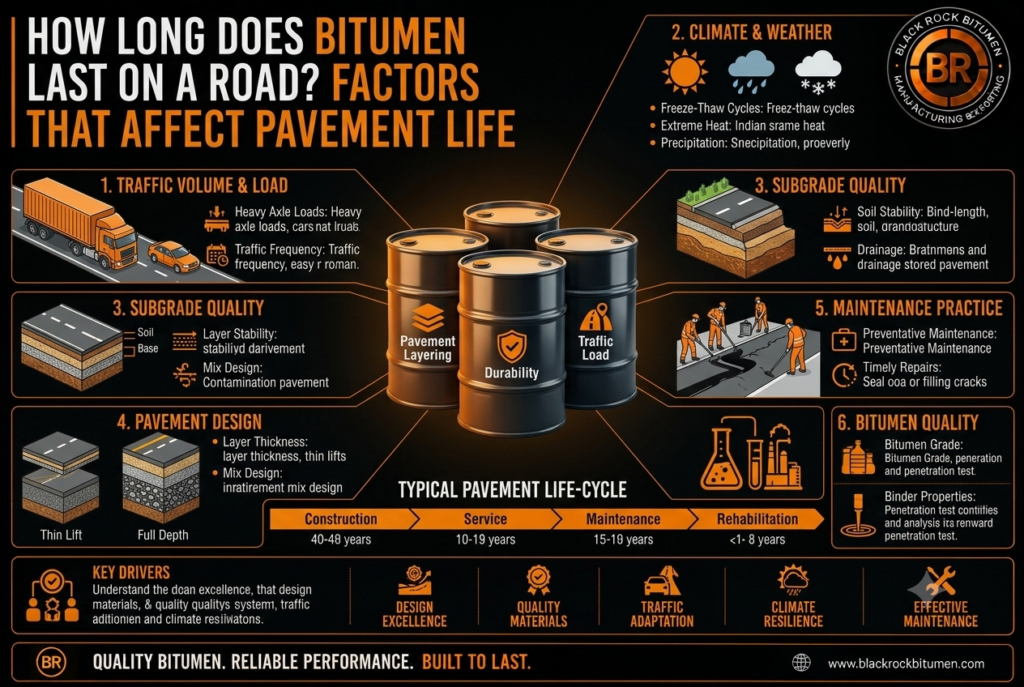
How long does bitumen last on a road? For a conventional asphalt pavement, around 20 years is a useful broad planning benchmark before extensive rehabilitation may be needed. That is not an expiry date or a guarantee: some pavements require major work sooner, while well-designed, well-built and well-maintained pavements can remain in service for 30 years, 50 years or longer.
The difference comes down to the pavement system, not the bitumen alone. Traffic loading, climate, pavement thickness, foundation strength, drainage, construction quality, binder selection and maintenance all influence how quickly the pavement deteriorates.
The Federal Highway Administration’s FHWA-HRT-13-038, Reformulated Pavement Remaining Service Life Framework, treats pavement life as a condition-and-treatment problem: deterioration accelerates as damage accumulates, and delaying treatment can increase the eventual repair cost. citeturn2search15turn1search3
That is why the useful question is not simply “When does bitumen expire?” It is: **How long can the pavement remain serviceable, and what interventions keep it from entering the rapid-deterioration phase?**
So the better question is not “When does bitumen expire?” It is: **What determines how long the pavement can keep performing — and what can be done to extend that life?**
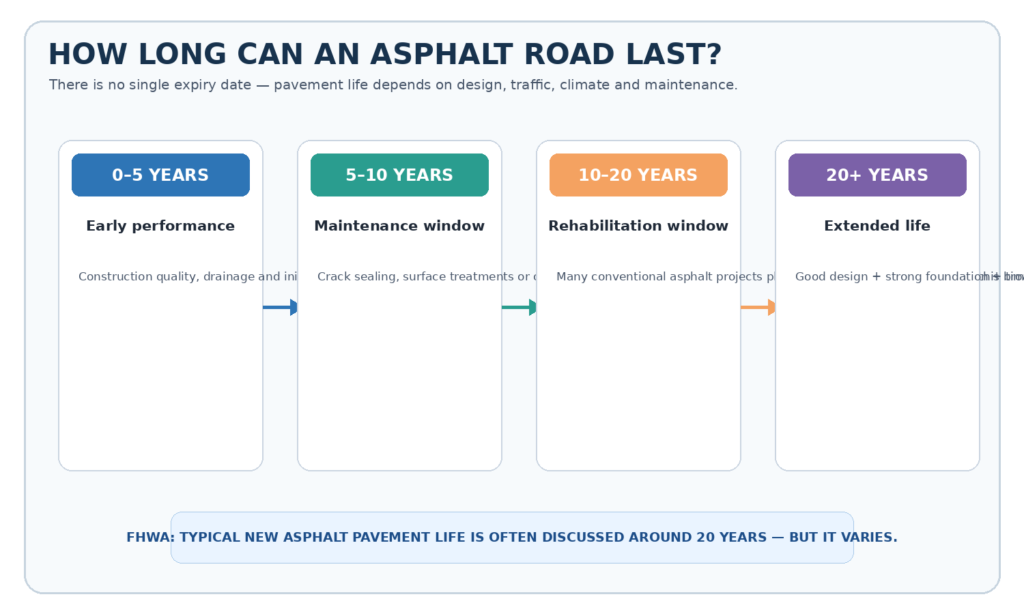
Alt text: Colour timeline infographic showing typical asphalt pavement life stages from early service through maintenance and rehabilitation, with a broad 20-year benchmark and longer-life possibilities.
First, What Does “Bitumen Lasting” Actually Mean?
Bitumen is only one component of an asphalt pavement. It binds aggregate together and contributes to the mixture’s flexibility, cohesion, water resistance and temperature-dependent behaviour.
When people say a road has “reached the end of its life,” they may actually be referring to several different things: surface cracking, rutting, loss of skid resistance, potholes, water damage, fatigue cracking or structural deterioration.
FHWA’s Pavement Remaining Service Interval Implementation Guidelines (FHWA-HRT-13-050) explains that pavements can move through maintenance, rehabilitation and reconstruction zones based on condition rather than a single fixed age. The framework reinforces an important point: a pavement can be treated and returned to a higher condition rather than simply being abandoned when it reaches its initial design benchmark. citeturn2search9
That means a road does not necessarily go from “good” to “finished” in one step.
So, How Many Years Does a Bitumen Road Last?
For a conventional asphalt pavement, **around 20 years is a useful broad planning benchmark before extensive rehabilitation may be required**, but it should never be treated as a guarantee.
The Asphalt Pavement Alliance/NAPA roadmap cited in the original article uses a 20-year expectation for new or rehabilitated asphalt pavement before extensive rehabilitation, while FHWA sources show representative ranges that vary by pavement type, location, traffic, thickness and existing condition. citeturn2file1
At the same time, FHWA’s longer-life pavement guidance identifies **30–60 years or more** as achievable objectives for some higher-volume facilities when structural capacity and material durability are increased and appropriate maintenance is provided.
In other words, 20 years is not a maximum. It is closer to a conventional planning reference. The actual service life depends heavily on what was designed, how it was built, how it is loaded and how it is maintained.
What Determines How Long Bitumen Lasts?
The answer usually comes down to a combination of material selection, pavement structure, construction quality, traffic, climate, water and maintenance.
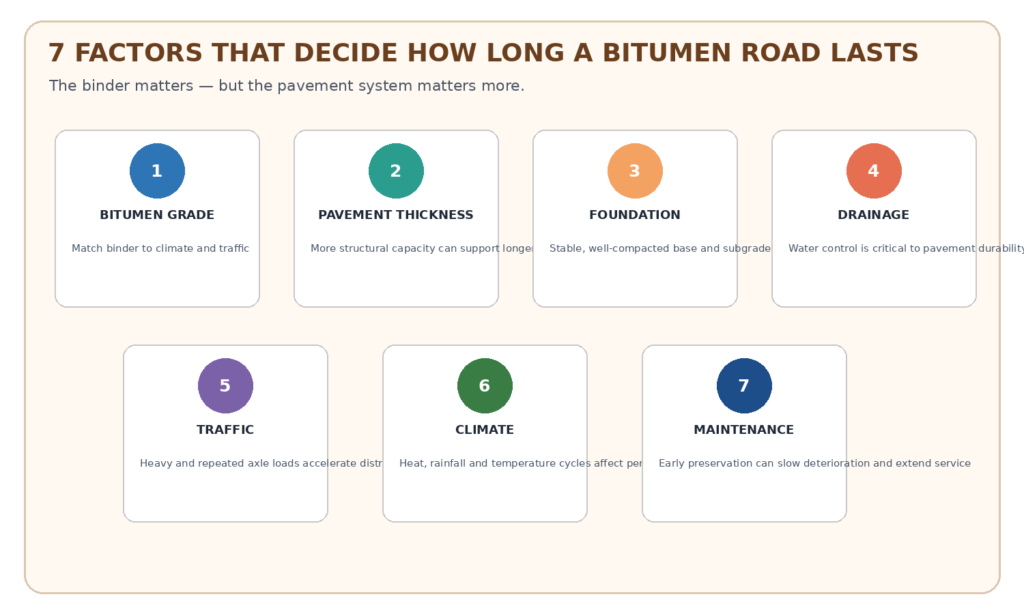
Alt text: Colour infographic showing seven factors that affect asphalt pavement life: bitumen grade, pavement thickness, foundation, drainage, traffic, climate and maintenance.
1. The Bitumen Grade Matters
Not every bitumen binder behaves the same way. The grade needs to be appropriate for the temperatures and loading the pavement will experience.
In a hot climate, a binder that becomes too soft at high pavement temperatures can contribute to rutting. In cooler conditions, the pavement needs enough flexibility to manage temperature-related contraction and cracking.
That is why binder selection should consider the actual pavement conditions rather than simply choosing whichever grade is cheapest or most readily available.
Black Rock Bitumen’s Penetration Grade Bitumen range provides conventional paving grades, while Performance Grade Bitumen can be considered when performance-based temperature selection is required.
2. Pavement Thickness Has a Major Effect
A thicker, structurally adequate pavement can distribute traffic loads more effectively than an under-designed structure.
FHWA’s longer-life design guidance explains that extended pavement life can be achieved through increased thickness, greater structural capacity, increased stiffness or strength in critical layers, and/or more durable materials. citeturn2search15
This is why simply adding a premium bitumen grade does not automatically turn a weak pavement into a long-life road. The entire pavement structure has to be designed for the expected loading.
3. The Foundation Is Just as Important as the Surface
Bitumen cannot compensate for a weak or poorly compacted foundation.
If the subgrade or base deforms under repeated traffic, the asphalt layers above it will eventually show the consequences. Cracking, rutting and unevenness can develop even when the binder itself meets every specification.
Good drainage and adequate compaction are therefore part of bitumen pavement durability, even though they happen below the binder layer.
4. Heavy Traffic Shortens the Margin for Error
A road used mostly by passenger vehicles experiences a very different loading pattern from a major freight corridor.
Repeated heavy axle loads, slow-moving trucks, braking and turning create higher stresses in asphalt. Industrial entrances, port access roads, bus stops and intersections can be particularly demanding.
This is one reason high-volume roads may justify performance-grade or polymer-modified binders, stronger pavement structures and more rigorous quality control.
For high-stress applications, see Black Rock Bitumen’s Polymer Modified Bitumen and performance-grade options.
5. Climate Changes How Bitumen Behaves
Bitumen is viscoelastic, which means temperature has a major influence on its behaviour.
High pavement temperatures can reduce binder stiffness and contribute to rutting if the binder and mix are not appropriate. Repeated temperature changes can also influence aging and cracking.
Rainfall creates another problem. Water entering cracks, joints, shoulders or pavement layers can weaken the supporting materials and accelerate deterioration.
For projects across Africa, South America and Southeast Asia, climate should therefore be part of the binder and pavement selection process from the beginning — especially on roads exposed to high temperatures, seasonal rainfall or high humidity. This is also important for projects supplied from Dubai, where Gulf heat can make high-temperature binder performance a central design consideration.
6. Water Is One of the Biggest Threats to Pavement Life
A well-designed asphalt pavement is not supposed to function as a sponge.
Once water enters through cracks, poorly sealed joints, damaged shoulders or inadequate drainage, it can weaken underlying layers and reduce pavement durability.
Good drainage, correct surface slopes, sealed cracks and timely maintenance can all help keep water away from vulnerable pavement layers.
This is also why a pavement that looks fine on top can sometimes deteriorate rapidly after a drainage problem develops underneath.
7. Construction Quality Can Make or Break Service Life
Even the right bitumen grade can underperform if the asphalt is produced, transported, placed or compacted incorrectly.
Compaction is particularly important. In-place air voids above roughly **8%** can increase permeability and allow greater water and oxygen access to the asphalt, accelerating oxidation and moisture-related damage; dense-graded mix design commonly targets about **4% design air voids**. These are useful engineering reference points, not universal acceptance limits for every mixture. citeturn0search12turn0search17
Temperature control also matters during asphalt production and placement. If the mix is outside the specified working range, achieving the required density and uniformity can become more difficult.
In short: buying high-quality bitumen is only one part of building a long-lasting road.
Does Bitumen Itself Deteriorate Over Time?
Yes. Asphalt binder changes as it ages.
Exposure to heat and oxygen can progressively harden the binder. Over time, that can reduce flexibility and make the asphalt more susceptible to cracking.
This is why asphalt specifications include controlled aging procedures. The **Rolling Thin-Film Oven Test (RTFOT)** — ASTM D2872 / EN 12607-1 — is used to simulate short-term aging associated with plant production and laydown. The **Pressure Aging Vessel (PAV)** — ASTM D6521 / EN 14769 — is used after RTFOT to simulate accelerated long-term oxidative aging during service. ASTM D6521 specifically describes PAV as simulating in-service oxidative aging and notes that it is normally used with RTFOT residue. citeturn0search0turn0search97
The important distinction is that binder aging is one mechanism within pavement deterioration. It is not the only reason a road eventually needs treatment.
Alt text: Pavement deterioration curve showing roughly 40% quality loss across the first 75% of pavement life, followed by another roughly 40% quality loss in the next 12% of life, illustrating why timely preventive maintenance matters.
How Maintenance Extends Road Life
One of the biggest mistakes in pavement management is waiting until the road looks badly damaged before doing anything.
Research on pavement preservation shows why timing matters financially. NCHRP Synthesis 223, *Cost-Effective Preventive Pavement Maintenance*, reported that each dollar spent on preventive maintenance at the correct point in the pavement life cycle could save roughly **$3–$4** in future rehabilitation costs. Later work by **Galehouse, Moulthrop and Hicks (2003)** reported savings of roughly **$6–$10 for every $1** spent on timely preventive maintenance. These are not guarantees for every project, but they make the budget case for early intervention very clearly. citeturn0search96turn1search5turn1search70
FHWA’s pavement preservation research also shows that treatment life varies substantially by treatment type and project conditions. Reported examples include **3–23 years for thin HMA overlays, 3–8 years for chip seals, 3–8 years for microsurfacing, 4–7 years for slurry seals, and 4–20 years for mill-and-resurface treatments**. These figures are research-based ranges, not promises for an individual road. citeturn1search68
These figures are not guarantees. They demonstrate an important principle: maintenance is not simply a cost added to pavement life. The right treatment at the right time can change the pavement’s future performance curve.
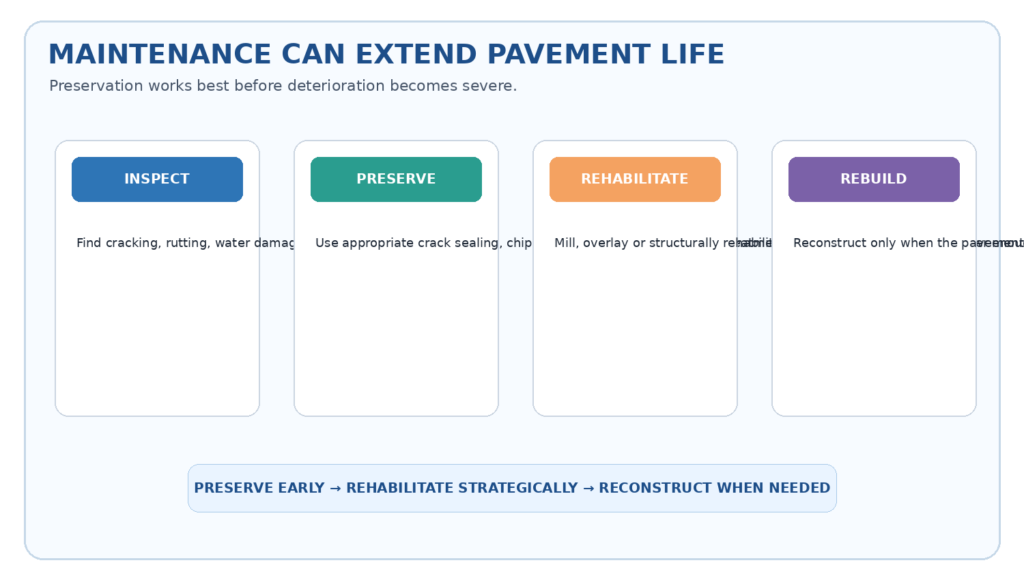
Alt text: Colour lifecycle infographic showing inspection, preservation, rehabilitation and reconstruction as stages for extending the service life of an asphalt pavement.
When Should a Road Be Maintained?
| Pavement condition | Typical response | Goal |
| Good, minor surface distress | Preventive maintenance / preservation | Slow deterioration before it accelerates |
| Early cracking or surface wear | Crack sealing, surface treatment or similar intervention | Keep water out and protect the surface |
| Moderate deterioration | Thin overlay, mill-and-resurface or rehabilitation | Restore function and extend service |
| Structural distress | Structural rehabilitation | Restore load-carrying capacity |
| Severe structural failure | Reconstruction | Replace the failed pavement structure |
FHWA’s pavement management framework emphasises that the timing of maintenance, preservation, rehabilitation and reconstruction should be based on pavement condition and predicted treatment needs rather than a single fixed age. citeturn0search2turn0search6
Can a Bitumen Road Last More Than 20 Years?
Absolutely.
FHWA describes longer-life pavement designs of **30 to 60 years or more** as achievable policy objectives for higher-volume facilities when the pavement is designed with greater structural capacity and/or more durable materials. citeturn0search28
FHWA also describes “perpetual pavement” concepts in which the pavement structure is designed to resist deep structural distress, while the upper surface is periodically renewed. The mechanism is important: the pavement is designed to keep tensile strain at the bottom of the asphalt structure below a fatigue endurance limit, so bottom-up fatigue cracking is greatly reduced or prevented under the design conditions; periodic surface renewal can then address surface ageing, rutting or other near-surface distress. Research on fatigue endurance limits supports this design concept. citeturn0search14turn0search15
That does not mean the same surface remains untouched for 50 years. Long pavement life usually comes from treating the road as an asset that needs periodic preservation and renewal.
How Bitumen Quality Affects Long-Term Performance
The binder supplied to a project should meet the specified grade and test requirements. A product that is outside specification can affect the asphalt mix’s workability, stiffness, adhesion or aging behaviour.
Quality control should therefore cover the entire supply chain: product selection, Certificate of Analysis, batch traceability, storage, heating, transport and delivery.
For procurement teams, Black Rock Bitumen’s Bitumen Grades & Standards for Infrastructure Tenders provides a useful framework for specifying the required grade and documentation.
Storage and handling also matter; see Bitumen Storage, Handling & Transport Standards.
How Long Does Bitumen Last in Different Road Applications?
| Application | Broad service-life reference | What affects it most |
| New asphalt pavement | Often planned around ~20 years before extensive rehabilitation; can be much longer | Structure, traffic, climate and maintenance |
| Asphalt overlay | Representative FHWA range around 8–12 years | Existing pavement condition, overlay design and traffic |
| Thin HMA overlay | Reported treatment range around 2–12 years in one FHWA dataset | Thickness, condition and traffic |
| Chip seal | Reported treatment range around 1–12 years | Traffic, aggregate, climate and application quality |
| Microsurfacing | Reported extended service range around 3–8 years | Surface condition and treatment quality |
| Mill and resurface | Reported treatment range around 4–20 years | Depth, existing pavement and structural condition |
These are research-based ranges rather than promises for an individual project. FHWA explicitly notes that treatment life varies by location, traffic, thickness and existing pavement condition. citeturn0search0turn0search10
What Can Make Bitumen Pavement Fail Early?
Poor drainage. Water can weaken supporting layers and accelerate deterioration.
Wrong binder selection. A binder unsuitable for the pavement’s temperature and traffic conditions can increase the risk of distress.
Under-designed pavement. Insufficient structural capacity can lead to fatigue and deformation.
Poor compaction. Excessive air voids can increase permeability and accelerate aging.
Poor tack coat or layer bonding. Weak interfaces can allow layers to move independently.
Delayed maintenance. Small cracks and surface defects can become much larger problems when water and traffic are allowed to work on them.
Poor storage or handling. Contamination, overheating or incorrect storage can affect binder quality before it reaches the mix.
A Practical Road-Life Checklist
1. Design for the actual traffic. Include heavy vehicles and concentrated loading, not just average traffic.
2. Match the binder to climate. Select a grade that can handle the expected pavement temperature range.
3. Build the foundation properly. Strong subgrade, base and drainage support everything above them.
4. Control asphalt production. Maintain the specified aggregate gradation, binder content and temperature.
5. Achieve proper compaction. Density is one of the most important construction quality controls.
6. Protect the pavement from water. Maintain drainage and address cracks before they become pathways for moisture.
7. Inspect regularly. Track cracking, rutting, surface wear and drainage problems.
8. Preserve early. Apply appropriate treatments while the pavement is still structurally sound.
Frequently Asked Questions
How long does bitumen last on a road? **Around 20 years is a useful broad planning benchmark for a conventional asphalt pavement before extensive rehabilitation**, but actual life can be shorter or much longer. Design, traffic, climate, thickness, drainage, construction and maintenance all matter.
Can an asphalt road last 30 years? Yes. FHWA identifies longer-life designs of 30–60 years or more as achievable for some higher-volume facilities when structural capacity and material durability are increased and appropriate maintenance is provided. citeturn0search28
Can an asphalt road last 50 years? Yes, in the context of long-life or perpetual pavement concepts. FHWA describes perpetual pavements designed to exceed 50 years without major structural rehabilitation, with periodic surface renewal. citeturn0search4
Does better bitumen make a road last longer? It can help when the binder is correctly matched to the climate, traffic and mix design, but binder quality alone cannot compensate for a weak foundation, poor drainage or poor construction.
How often should an asphalt road be maintained? There is no universal schedule. Maintenance should be triggered by pavement condition and the treatment’s intended purpose. FHWA reports that preventive maintenance can extend pavement life by an average of 5–10 years when applied at the right time. citeturn0search27
What is the biggest factor affecting road life? There is no single biggest factor. Pavement structure, traffic, climate, water, materials, construction quality and maintenance interact.
Does hot weather reduce bitumen life? High temperatures can accelerate binder aging and soften susceptible binders, increasing the risk of rutting if the binder and mixture are not properly selected. Climate should therefore be part of binder selection.
The Bottom Line
So, how long does bitumen last on a road? The most useful answer is not a single number.
A conventional asphalt pavement is often planned around **20 years before extensive rehabilitation**, but longer-life designs can reach **30–60 years or more**, and perpetual pavement concepts can be designed for 50+ years without major structural rehabilitation when their structural and fatigue requirements are met.
The difference comes down to what happens between construction and that eventual rehabilitation point. The right binder grade, adequate pavement thickness, strong foundations, good drainage, proper compaction and timely maintenance can all push pavement performance further.
For road owners and infrastructure buyers, that means the goal should not be to find a “bitumen that lasts forever.” The goal is to design and manage a pavement system that can be preserved, repaired and renewed before small problems become structural failures.
For teams planning long-life road projects, start with Bitumen Supply for Road Construction, Penetration Grade Bitumen and Performance Grade Bitumen. For roads exposed to heavy traffic or high pavement temperatures, compare Polymer Modified Bitumen. If the project includes tack coats, surface treatments or maintenance work, review Bitumen Emulsion and Cutback Bitumen. The companion guide, How Bitumen Is Used in Road Construction, explains how binder selection fits into the wider pavement system. Finally, use the Bitumen Grades & Standards for Infrastructure Tenders guidance and Bitumen Storage, Handling & Transport Standards to make sure the material specification and handling process support the service life you are designing for.