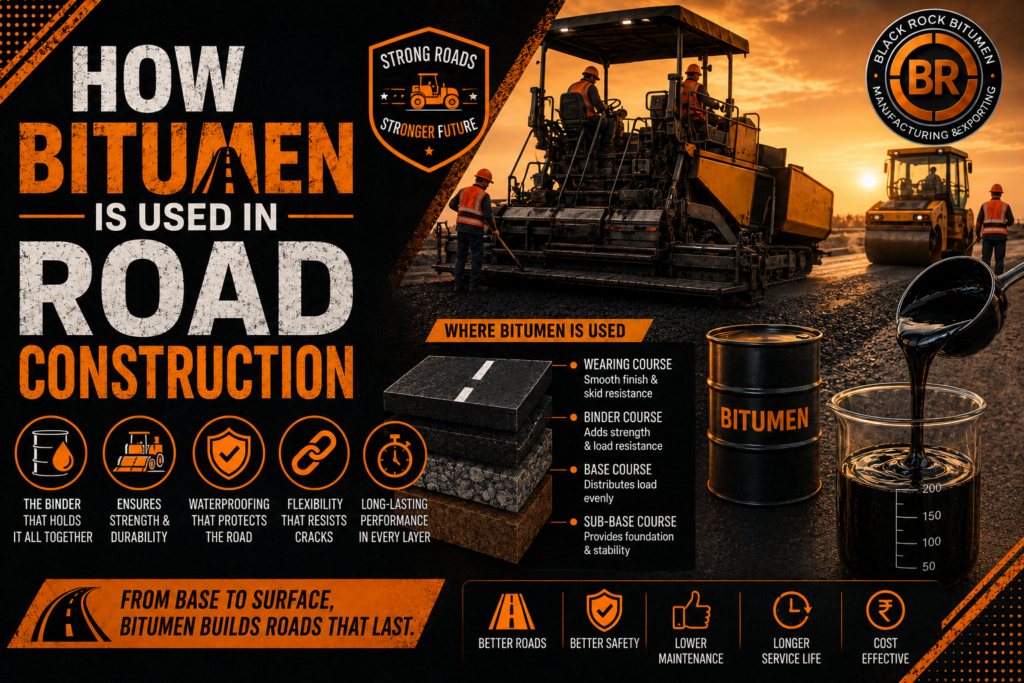
A road may look like one continuous surface, but underneath it is a carefully engineered system of layers. And somewhere between the aggregate, pavement structure and traffic loads sits a material doing one of the most important jobs: bitumen.
Bitumen acts as the binder that holds mineral aggregates together in asphalt. It helps create a surface that can carry traffic, resist water and accommodate repeated movement without behaving like a rigid concrete slab.
But saying “bitumen is used in roads” only tells half the story. The real question is how it is used — where it goes, what type is selected, how it is mixed or applied, and how construction quality affects the final pavement.
For infrastructure projects across Africa, South America and Southeast Asia, those details matter. Roads can face high temperatures, heavy freight traffic, intense rainfall, variable ground conditions and demanding construction schedules. The binder has to be selected and handled as part of the complete pavement system, not as an isolated commodity.
Here is how bitumen fits into the road construction process, from the foundation to the finished surface.
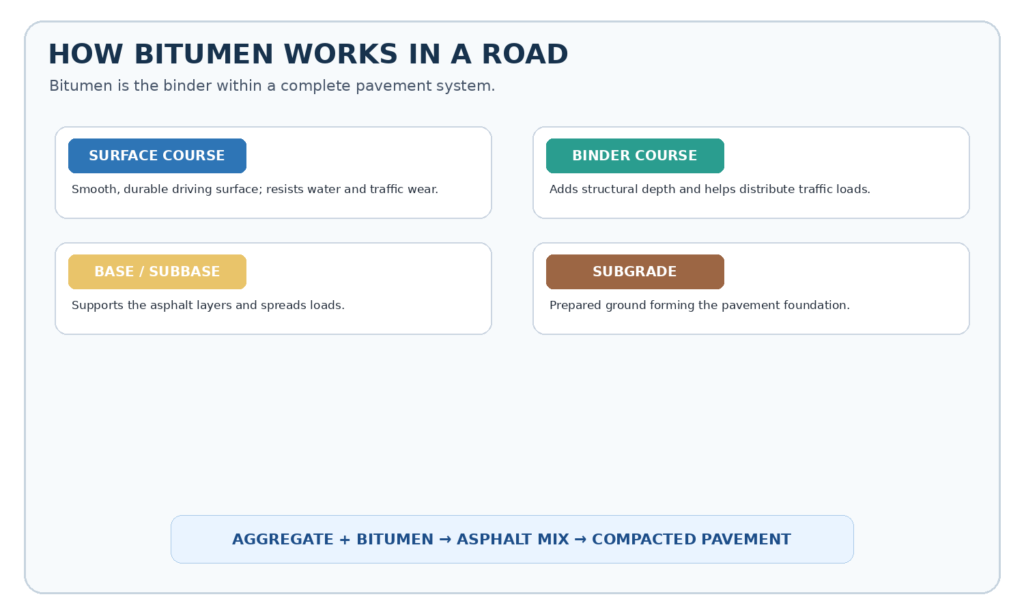
Alt text: Cross-section infographic showing a flexible road pavement with surface or wearing course, binder course, base or subbase and subgrade, explaining how bitumen binds aggregate into asphalt.
What Is Bitumen Doing in a Road?
At its simplest, bitumen is the binder in asphalt. FHWA notes that asphalt pavement mixtures are primarily made from aggregates and asphalt binder, with aggregate providing most of the load-bearing characteristics and binder coating and binding the aggregate particles together.
That binding role is critical. Aggregate particles are strong individually, but the pavement needs a continuous material to hold them together, transfer stresses and provide a cohesive surface.
Bitumen also has useful water-resistant and viscoelastic properties. It can flow under heat and become stiffer as it cools, allowing engineers to design asphalt mixtures around the temperatures and traffic conditions a road is expected to experience.
For a broader overview, see Black Rock Bitumen’s What Is Bitumen? Uses, Types & Benefits for Road Construction.
The Main Layers of a Bitumen Road
Bitumen does not simply form one thick layer across the entire road. Flexible pavements are built in layers, with each layer performing a different structural or functional role.
| Layer | Main purpose | Where bitumen fits |
| Surface / wearing course | Smooth, durable, water-resistant driving surface | Binder holds the surface aggregate together |
| Binder course | Adds structural depth and distributes traffic loads | Binder holds the coarser asphalt mixture |
| Base / subbase | Supports and spreads traffic loads | May be untreated or treated according to design |
| Subgrade | Prepared ground supporting the pavement | Must be properly compacted and drained |
FHWA describes the surface course as the top asphalt layer, with design objectives including waterproofing, skid resistance, rutting resistance and smoothness. Beneath it, a binder course can provide structural depth and economy.
Step 1: Select the Right Bitumen Grade
Before asphalt is mixed, the binder has to be selected. This is one of the decisions that can make or break long-term pavement performance.
The correct grade depends on factors such as climate, pavement temperature, traffic loading, pavement design and the specification governing the project. A binder that works well on a lightly trafficked road may not be the right choice for a heavily loaded freight corridor.
Black Rock Bitumen’s Penetration Grade Bitumen range includes conventional grades used in road paving.
Projects requiring performance-based selection can also review Performance Grade Bitumen and compare the required temperature and traffic performance.
The important point is that grade selection should happen before procurement, not after the material arrives on site.
Step 2: Prepare the Road Foundation
Bitumen cannot compensate for a weak foundation. Before asphalt is placed, the subgrade, subbase and base layers need to be prepared, shaped, drained and compacted according to the pavement design.
FHWA construction guidance emphasises that the underlying materials need appropriate compaction and quality control. If the base is unstable, the asphalt layers above it are being asked to solve a structural problem they were never designed to solve.
This is why road construction should be thought of as a system. Good bitumen plus poor foundation preparation can still produce premature distress.
Step 3: Use a Prime Coat Where Required
A prime coat is a liquid bituminous application placed on an untreated aggregate base when specified by the pavement design. It can penetrate or seal the upper part of the base and help create the required interface with the asphalt layer above.
FHWA describes prime coats as applications on untreated aggregate base layers that can minimise asphalt cement flow into the base and promote interface bonding.
The material used for a prime coat depends on the specification and project conditions. Emulsified asphalts are used in modern practice, while cutback asphalt has historically been used because of its penetration characteristics.
For liquid binders used in these applications, compare Black Rock Bitumen’s Bitumen Emulsion and Cutback Bitumen
Step 4: Produce the Asphalt Mix
For hot mix asphalt, bitumen is combined with carefully graded aggregates and other approved materials at an asphalt plant. The aggregate provides most of the structure; the binder coats the particles and holds the mixture together.
FHWA states that typical asphalt pavement mixtures contain roughly 90–95% aggregate by weight, with asphalt binder making up approximately 4–8%.
That may sound like a small percentage, but binder quality has an outsized effect on how the mixture behaves. Too little binder can reduce cohesion and durability. Too much can contribute to instability or bleeding, depending on the mix and conditions.
This is why asphalt mix design is not simply a matter of adding a fixed quantity of bitumen. Aggregate gradation, air voids, binder content, temperature and performance requirements all need to work together.
Step 5: Transport and Place the Asphalt
Once the asphalt mix is produced, it is transported to the paving site and placed with a paver. The construction team needs to control the mix temperature, delivery timing, paving speed and layer thickness so the material remains workable for compaction.
The goal is not merely to spread asphalt across the road. It is to create a uniform layer with the specified profile, thickness and density.
Poor control during this stage can create segregation, uneven thickness or temperature differences that make achieving consistent compaction more difficult.
Step 6: Apply Tack Coat Between Layers
One of the most overlooked uses of bitumen in road construction happens between asphalt layers.
A tack coat is a thin application of bituminous material placed between existing pavement and a new asphalt layer, or between pavement layers where bonding is required. Its job is to help the layers act as one system rather than sliding independently.
FHWA calls tack coats vital to bonding multiple asphalt layers into a monolithic system. Poor bonding can contribute to slippage cracking, delamination, fatigue cracking and potholes.
For projects using emulsion for tack applications, Black Rock Bitumen’s Bitumen Emulsion range is relevant to review.
Application rate matters too. Too little tack may not create adequate bond; too much can create an unstable interface. The project engineer should determine the required rate.
Step 7: Compact the Asphalt
Compaction is where the loose asphalt mixture becomes a dense pavement layer capable of carrying traffic.
Rollers are used to reduce air voids and bring the mixture to the required density while the material remains within its workable temperature range. The sequence and timing of compaction matter.
FHWA notes that proper compaction is critical for pavement performance. Inadequate compaction can contribute to rutting, cracking, raveling and water infiltration.
In other words, even a correctly specified bitumen grade can underperform if the asphalt mixture is not placed and compacted correctly.
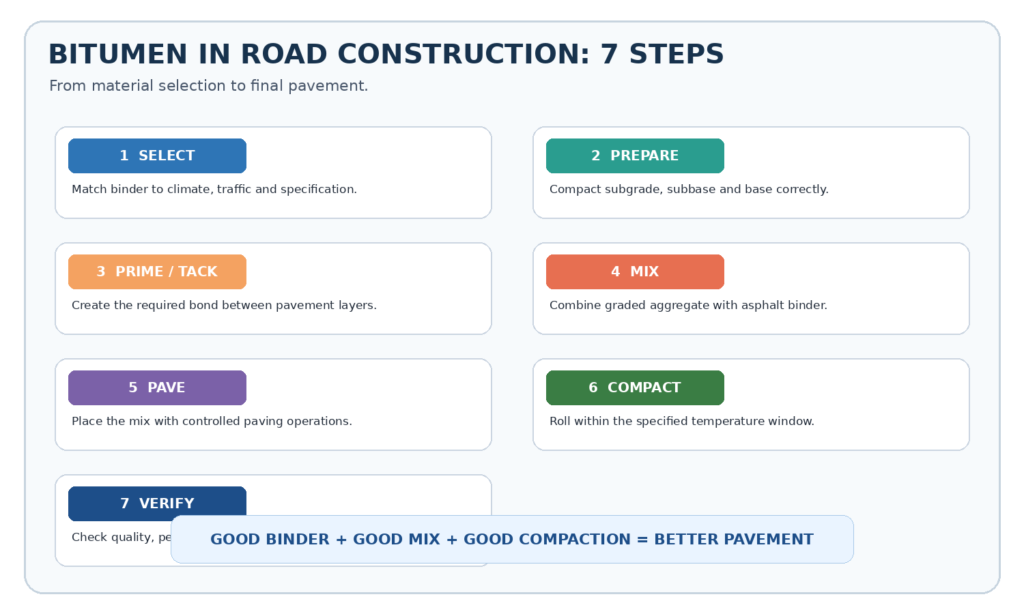
Alt text: Seven-step infographic showing bitumen grade selection, foundation preparation, prime or tack coat, asphalt mixing, paving, compaction and final verification.
Step 8: Verify the Pavement Before Opening
The finished pavement needs to meet the project’s quality and acceptance requirements before traffic is allowed onto it. Depending on the pavement type and specification, this includes checking density, smoothness, layer thickness, temperatures, surface condition and other construction controls.
For tack-coated surfaces, FHWA guidance states that paving should not begin until the emulsion has broken and reached the required condition.
Opening a road too early can create avoidable problems, particularly when the asphalt has not reached the required level of stability or when a surface treatment has not properly cured.
Where Different Bitumen Products Are Used
“Bitumen” is not one universal road-construction product. Different binder forms and grades are selected for different jobs.
| Product / binder type | Common road application | Why it is used |
| Penetration grade bitumen | Conventional asphalt paving | Established grade system and predictable binder properties |
| Performance Grade bitumen | Performance-based pavement design | Matches binder performance to temperature and traffic |
| Polymer Modified Bitumen | High-stress or high-performance pavements | Improves resistance to selected deformation and temperature-related stresses |
| Bitumen emulsion | Tack coats, surface treatments, cold mixes and maintenance | Low-viscosity application without relying on hot binder temperatures |
| Cutback bitumen | Selected prime and penetration applications | Solvent reduces viscosity and assists penetration / curing |
For high-performance applications, see Black Rock Bitumen’s PMB 25/55-65 product information.
How Climate Affects Bitumen Selection
Climate is one of the most important factors in deciding how a binder should perform.
In hot climates, high pavement temperatures can soften conventional binders and increase the risk of rutting if the binder and asphalt mixture are not appropriately designed. In colder conditions, the pavement needs enough flexibility to manage thermal contraction without excessive cracking.
Rainfall and humidity add another consideration. Water can affect aggregate-binder adhesion and pavement durability, which makes drainage, surface preparation and appropriate binder selection important.
This is especially relevant across Africa, South America and Southeast Asia, where road projects can range from hot arid conditions to tropical rainfall and high-volume freight routes.
For a deeper look at selecting grades around project conditions, see Bitumen Grades & Standards for Infrastructure Tenders.
How Traffic Affects Bitumen Selection
A road carrying passenger cars is not experiencing the same loading as a major freight corridor.
Heavy trucks, repeated axle loads, slow-moving traffic, braking and turning can all increase pavement stress. Intersections, roundabouts, bus stops, port entrances and industrial yards can experience concentrated loading even when the wider road carries moderate traffic.
This is one reason a performance-based binder or PMB may make sense for selected projects. The goal is not to use the most expensive binder everywhere. It is to match the binder’s performance to the conditions the pavement actually needs to survive.
For a closer look at modified binders, see Polymer Modified Bitumen and Black Rock Bitumen’s performance-grade information.
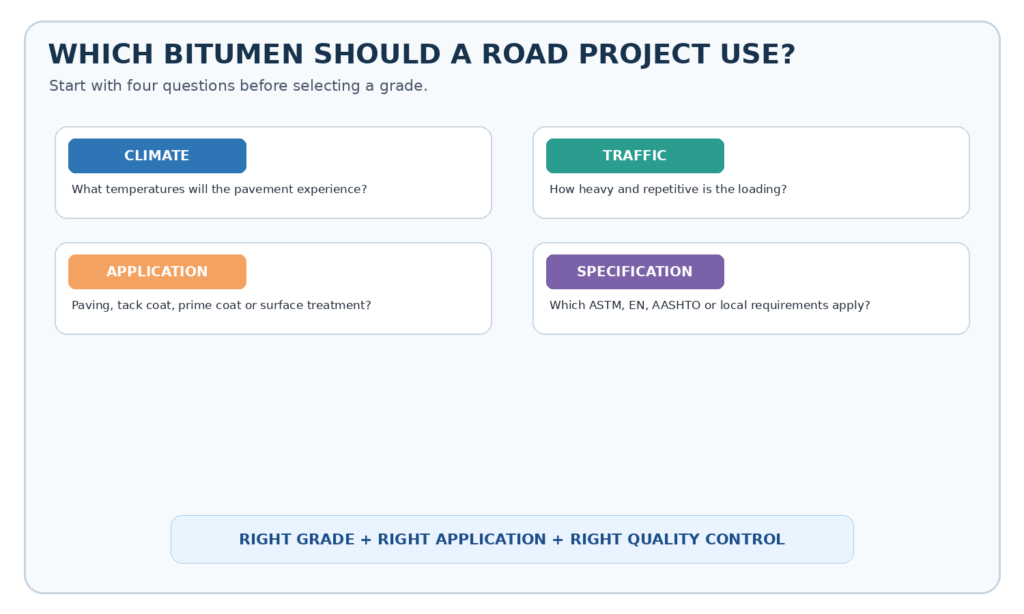
Alt text: Four-question infographic showing climate, traffic, application and project specification as the main factors for selecting a bitumen binder for road construction.
What Happens When Bitumen Quality Is Poor?
A road can be designed correctly and still fail earlier than expected if the binder supplied does not meet the required specification or is mishandled before use.
Potential problems include poor coating, inconsistent asphalt performance, premature rutting, cracking, poor adhesion and avoidable maintenance.
That is why testing and documentation matter. The supplied material should match the agreed specification, and storage and handling should preserve its condition until it reaches the asphalt plant or construction site.
Black Rock Bitumen’s Bitumen Storage, Handling & Transport Standards explains operational controls that help protect binder quality.
Bitumen and Road Maintenance
Bitumen is not only used when a road is first constructed. It also plays a major role in maintenance and rehabilitation.
Existing pavements can receive tack coats before overlays, emulsified asphalt treatments, surface dressing, slurry seals, microsurfacing and other preservation treatments. These methods can extend the useful life of a pavement when selected and applied correctly.
FHWA describes slurry seal and microsurfacing as thin surfacing treatments using aggregate, emulsified asphalt, fillers and additives. These treatments protect and improve the existing driving surface rather than providing the same structural function as a new pavement layer.
That makes bitumen a lifecycle material — not simply something purchased once at the start of a road project.
A Simple Road Construction Checklist
1. Start with the pavement design. Understand the required layer structure and performance objectives.
2. Select the binder against climate and traffic. Do not choose a grade based only on price or availability.
3. Verify the material specification. Check the required ASTM, EN, AASHTO or local standard.
4. Prepare the foundation properly. Compaction, drainage and surface condition affect everything above them.
5. Control the asphalt mix. Aggregate gradation, binder content and temperature need to stay within the job mix requirements.
6. Treat interfaces correctly. Use prime or tack coats where specified and apply them uniformly.
7. Compact at the right time. Density is critical to long-term pavement performance.
8. Protect the material before use. Storage, heating, transport and handling can affect binder quality.
Frequently Asked Questions
What is bitumen mainly used for in road construction? Its main role is as the binder in asphalt, coating and holding mineral aggregates together so they form a cohesive pavement mixture.
How much bitumen is in asphalt? FHWA guidance gives a typical range of about 4–8% asphalt binder by weight, with aggregates making up roughly 90–95% of the mixture. The exact content depends on the mix design.
Is bitumen used in every layer of a road? No. Flexible pavements have different layers. Bituminous asphalt is normally concentrated in the asphalt surface and binder courses, while base, subbase and subgrade materials may be unbound or treated according to the pavement design.
What is a tack coat used for? A tack coat provides bonding between asphalt layers or between an existing pavement and an overlay. Poor bonding can contribute to delamination and other pavement failures.
Why is compaction important? Compaction reduces air voids and develops the required pavement density. Poor compaction can contribute to rutting, cracking, raveling and water infiltration.
Which bitumen grade is best for road construction? There is no single best grade. The right choice depends on climate, traffic, pavement design, application and the governing specification.
Can bitumen roads be recycled? Yes. Asphalt pavement can be reclaimed and incorporated into new asphalt mixtures or other pavement applications when designed and processed appropriately.
The Bottom Line
Bitumen is far more than the black material you see on the road surface. It is part of a carefully engineered pavement system, working with aggregate, pavement layers, temperature, traffic and construction quality.
It can bind aggregate in asphalt, help create strong interfaces between pavement layers, support surface treatments and play a role in maintenance throughout the road’s life.
The best results come from treating bitumen as a performance material rather than a commodity. That means choosing the right grade, verifying quality, controlling storage and handling, and making sure the asphalt is mixed, placed and compacted correctly.
For project teams planning a new road or rehabilitation programme, start by reviewing Black Rock Bitumen’s Bitumen Supply for Road Construction, Penetration Grade Bitumen, and Performance Grade Bitumen. If the project includes high-stress sections, compare Polymer Modified Bitumen. For tack coats, surface treatments or lower-temperature applications, review Bitumen Emulsion and Cutback Bitumen. Before procurement, use the Bitumen Grades & Standards for Infrastructure Tenders guidance and Bitumen Storage, Handling & Transport Standards to keep material quality aligned from sourcing through final application.