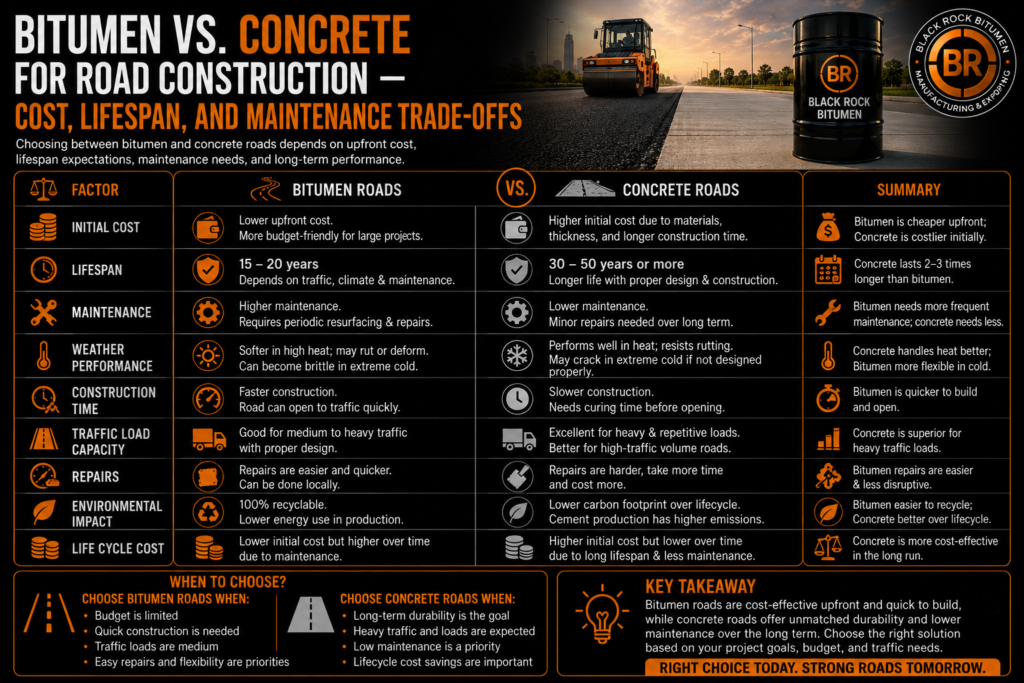
Bitumen vs. Concrete for Road Construction — Cost, Lifespan, and Maintenance Trade-Offs
When a road project reaches pavement selection, one question comes up again and again: should the road use a bitumen-based asphalt pavement or concrete?
The short answer is that there is no universal winner.
Bituminous and concrete pavements behave differently, cost differently and require different maintenance strategies. A road that needs rapid construction and staged resurfacing may favour a flexible pavement. A heavily trafficked facility where long service life and high stiffness are priorities may make concrete attractive.
The mistake is comparing only the initial price. A proper comparison considers construction cost, expected service life, maintenance, rehabilitation, traffic disruption, climate, material availability and the value of keeping the road operational.
FHWA pavement guidance treats pavement type selection as a project-specific decision involving structural performance, cost, traffic, climate, materials and other factors rather than a simple asphalt-versus-concrete rule. citeturn0search0turn0search2
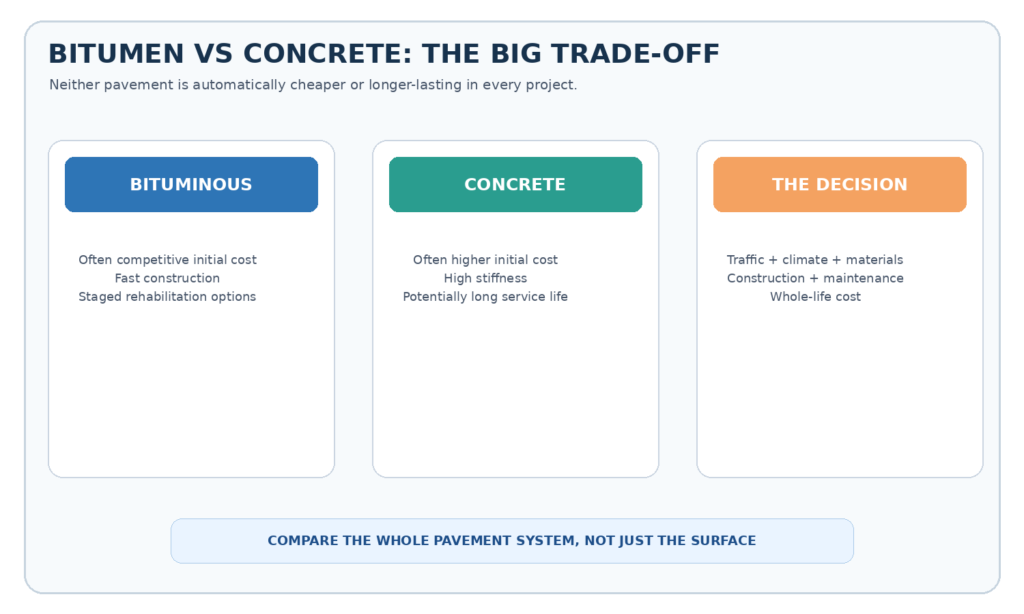
Alt text: Colour infographic comparing bituminous and concrete pavement on initial cost, construction, service life and whole-life decision factors.
What Are We Actually Comparing?
A “bitumen road” normally means a flexible pavement in which bitumen binds mineral aggregate in asphalt mixtures. The pavement can contain asphalt, granular base and subbase layers depending on design.
Concrete pavement is a rigid pavement in which a concrete slab carries a significant portion of the structural load and distributes stresses differently.
| Factor | Bituminous / asphalt | Concrete |
| Structural behaviour | Flexible; load is distributed through multiple layers | Rigid slab provides high structural stiffness |
| Primary binder / matrix | Bitumen binds aggregate | Cementitious concrete matrix |
| Construction | Often suited to staged paving and resurfacing | Placement and curing sequence affect opening schedule |
| Maintenance | Crack treatment, patching, resurfacing and overlays | Joint maintenance, slab repair, grinding and rehabilitation |
| Design emphasis | Layered structural capacity and asphalt performance | Slab thickness, joints, load transfer, subgrade and concrete properties |
Initial Construction Cost: Which Is Cheaper?
Asphalt is often competitive on initial construction cost, but the answer depends heavily on the project. FHWA notes that asphalt and concrete alternatives can have different initial and life-cycle costs and that pavement selection should account for agency and user costs over the analysis period. citeturn0search2
The initial estimate depends on excavation, drainage, subgrade improvement, base thickness, pavement thickness, plant and equipment, labour, transport, traffic management and construction schedule — not simply the price of bitumen or cement.
For bituminous pavement, delivered bitumen and aggregate prices can strongly influence cost. For concrete, cement, aggregates, reinforcement, batching, placement and curing can affect the estimate.
So the useful question is not “Is asphalt cheaper than concrete?” It is “Which pavement system delivers the required performance at the lowest whole-life cost for this site?”
Why Bituminous Pavement Can Be Attractive
Bituminous pavement can be attractive when the project values rapid construction, staged rehabilitation and the ability to add overlays later.
FHWA describes pavement preservation and rehabilitation strategies that can extend serviceability through treatments and overlays. citeturn0search5
That flexibility can be valuable on busy roads where keeping traffic moving is a major consideration.
However, a low initial cost is not automatically economical if the pavement requires frequent interventions or has been designed without adequate consideration of traffic, drainage and climate.
Why Concrete Can Justify a Higher Initial Cost
Concrete can have a higher upfront construction cost, but that cost may be justified where long service life and high structural capacity are important.
FHWA notes that concrete pavement can provide long service and that rigid pavement design and rehabilitation need to consider slab behaviour, load transfer, joints, drainage and other factors. citeturn0search1
The economic case can become stronger when frequent resurfacing would be difficult or expensive, particularly where lane closures create significant user costs.
Concrete is not maintenance-free. Joint deterioration, cracking, faulting, surface wear and slab damage can still require intervention.
Lifespan: How Long Does Each Road Last?
This is where simple internet comparisons can become misleading. You may see fixed numbers claiming that asphalt lasts a certain number of years and concrete lasts much longer. Those figures can be useful as broad planning assumptions, but they are not universal guarantees.
Actual pavement life depends on traffic loading, climate, drainage, materials, structural design, construction quality, maintenance and rehabilitation strategy.
| Life factor | Why it changes the result |
| Traffic loading | Heavy axle loads and repeated loading accelerate deterioration |
| Climate | Temperature, rainfall and moisture affect pavement behaviour |
| Drainage | Water infiltration and weak support can shorten service life |
| Materials | Binder, aggregate, cementitious materials and other inputs affect performance |
| Design | Thickness and structural capacity must match expected loading |
| Construction | Compaction, joints, curing and workmanship influence performance |
| Maintenance | Timely preservation can delay deterioration |
| Rehabilitation | A pavement may remain structurally useful while receiving overlays or repairs |
FHWA’s Long-Term Pavement Performance programme provides long-term field data because pavement performance varies with materials, climate, traffic and construction conditions. citeturn0search3
Lifespan Is Really About the Pavement System
An asphalt pavement that receives timely crack sealing, surface treatments and overlays can remain serviceable for a long period without complete reconstruction.
Likewise, a concrete pavement can require repairs or rehabilitation while its underlying structure remains useful.
| Lifespan question | Why it matters |
| How long until first maintenance? | Shows early intervention requirements |
| How long until major rehabilitation? | Useful for maintenance budgeting |
| How long until reconstruction? | Shows long-term structural performance |
| How often is resurfacing expected? | Important for asphalt life-cycle costing |
| How disruptive are interventions? | Captures traffic and user costs |
| What remains serviceable after repairs? | Helps compare rehabilitation options |
Maintenance: Where the Two Pavements Differ
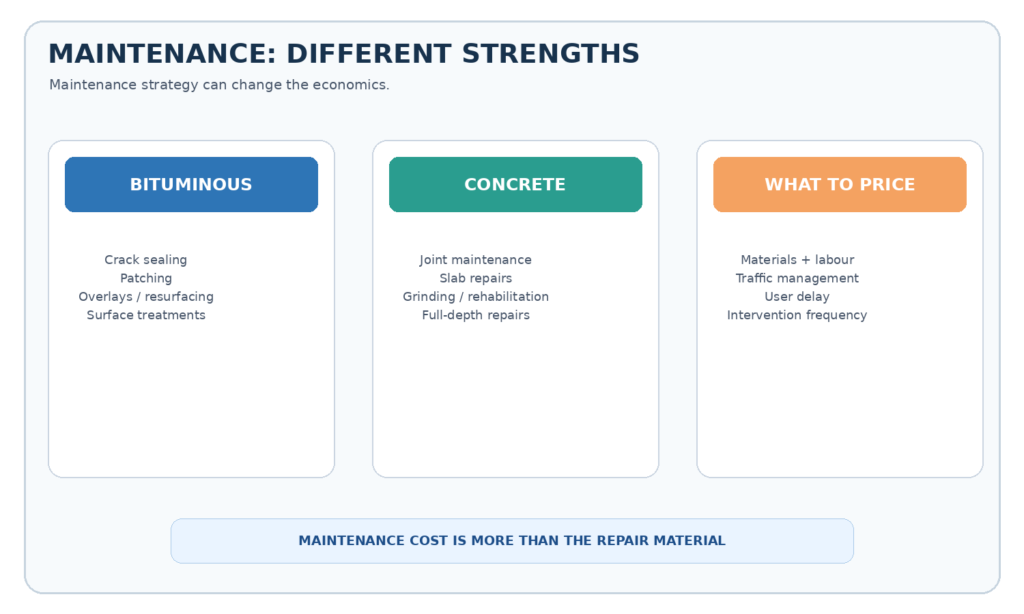
Alt text: Colour infographic comparing common maintenance strategies for bituminous and concrete pavements and the cost elements that should be considered.
Bituminous Pavement Maintenance
Common interventions include crack sealing, patching, surface treatments, milling and overlays. FHWA describes pavement preservation as applying treatments while pavement is still in good condition to delay more expensive rehabilitation. citeturn0search5
This is one of asphalt’s practical strengths: maintenance can often be performed in stages, allowing road agencies to target specific sections.
Concrete Pavement Maintenance
Concrete maintenance can involve joint resealing, partial- or full-depth repairs, slab replacement, diamond grinding and other rehabilitation techniques.
FHWA identifies concrete pavement preservation and rehabilitation strategies including joint repair and diamond grinding. citeturn0search6
Concrete should therefore not be described as maintenance-free. Its maintenance profile is simply different.
The Cost of Traffic Disruption
A road agency does not pay the only cost when a pavement is closed for maintenance. Drivers, freight operators, businesses and public transport users can also bear costs through delay and diversion.
FHWA’s pavement type selection guidance considers user costs and work-zone impacts when comparing pavement alternatives. citeturn0search2
For high-volume corridors, ports, logistics routes, airports and urban arterials, the duration and frequency of interventions can materially change the economic comparison.
Performance in Hot Climates
For projects across Africa, South America and Southeast Asia, pavement designers need to account for high pavement temperatures, solar exposure and seasonal rainfall.
Bitumen is temperature-sensitive. Excessive heat can contribute to softening and rutting when the binder and asphalt mixture are not appropriately selected and designed.
Concrete also responds to temperature changes. Thermal expansion, contraction, curling and joint behaviour must be considered.
The right question is not “Which material handles heat?” but “Which pavement system is designed for the actual climate and traffic conditions?”
For asphalt projects, buyers can review Penetration Grade Bitumen, Performance Grade Bitumen and Polymer Modified Bitumen when evaluating binder options.
Bitumen vs Concrete: Cost, Lifespan and Maintenance
| Category | Bitumen / Asphalt | Concrete |
| Initial cost | Often competitive; project-dependent | Often higher; project-dependent |
| Construction speed | Generally favourable for rapid paving and rehabilitation | Curing and construction sequence can affect opening |
| Routine maintenance | Crack sealing, patching, surface treatments | Joint maintenance and slab repairs |
| Major rehabilitation | Milling, overlays or reconstruction | Slab repair, grinding, overlays or reconstruction |
| Service life | Highly dependent on design, traffic, climate and maintenance | Can provide long service life when properly designed and maintained |
| Future flexibility | Overlays and staged rehabilitation are common | Some future changes can be more disruptive |
| Traffic disruption | Some resurfacing treatments can be relatively quick | Repairs may involve curing and more specialised work |
| Economic measure | Whole-life cost + user delay | Whole-life cost + user delay |
Whole-Life Cost: The Calculation That Matters
A pavement should ideally be compared over a defined analysis period rather than by initial construction price alone.
| Cost component | Include in comparison? |
| Initial construction | Yes |
| Routine maintenance | Yes |
| Periodic rehabilitation | Yes |
| Major reconstruction | Yes |
| Traffic management | Yes |
| User delay / road-user costs | Yes where relevant |
| Residual value | Yes where required by the analysis method |
FHWA life-cycle-cost guidance uses this broader approach to compare pavement alternatives. The exact analysis method should follow the project owner’s requirements. citeturn0search2
When Bitumen May Make More Sense
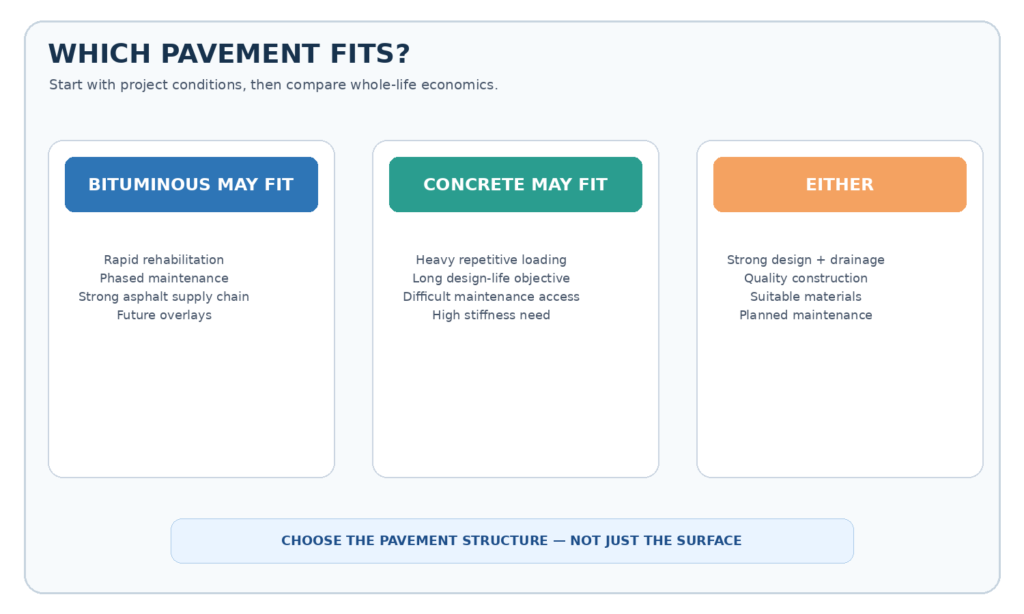
Alt text: Colour decision infographic showing conditions that may favour bituminous pavement, concrete pavement or either option based on project economics and performance.
Rapid rehabilitation A bituminous solution can be attractive when the project schedule is tight.
Staged maintenance Asphalt can be maintained and resurfaced in planned stages.
Strong local asphalt supply chain Existing plants, contractors, aggregate sources and technical capability can improve project economics.
Future overlays Flexible pavement systems can accommodate planned resurfacing.
Capital constraints A lower initial cost can be useful if whole-life performance still meets requirements.
When Concrete May Make More Sense
Heavy repetitive loading Rigid pavement can be attractive where high structural stiffness is a major requirement.
Difficult maintenance access Longer intervals between major interventions can have significant value.
Long analysis period Potential long service life can influence whole-life economics.
High disruption costs Reducing major intervention frequency can be economically valuable.
Competitive local concrete supply Local cement, aggregate, batching and placement capability can change the cost comparison.
Five Questions to Ask Before Choosing
1. What traffic will the road carry? Estimate traffic volumes, axle loads and expected growth.
2. What climate will the pavement experience? Consider temperature, rainfall, moisture and seasonal changes.
3. How much maintenance can the road tolerate? A road with frequent access restrictions may value a different maintenance profile.
4. What materials and contractors are available locally? Transport distance, plant capacity and construction expertise can change economics.
5. What is the whole-life cost? Compare construction, maintenance, rehabilitation and user-delay costs over a defined period.
Frequently Asked Questions
Is bitumen cheaper than concrete for roads? Bituminous pavement is often competitive on initial cost, but there is no universal answer. Local material prices, thickness, traffic, construction and maintenance requirements all affect the result.
Does concrete last longer than asphalt? Concrete can provide long service life, but asphalt can also remain serviceable for long periods when properly designed and maintained. Use the project’s actual maintenance and rehabilitation strategy.
Which road needs more maintenance? Neither has a universal answer. Asphalt commonly uses staged preservation and resurfacing, while concrete has different needs such as joint and slab maintenance.
Is asphalt better for heavy trucks? Not automatically. Both pavement types can be designed for heavy freight traffic. The selected structure and materials must match the expected loading.
Is concrete better in hot climates? Not automatically. Both require climate-specific design. Asphalt needs appropriate binder and mixture selection; concrete requires attention to thermal movement and slab behaviour.
Which is easier to repair? Many asphalt repairs and overlays can be staged quickly, while concrete repairs can be more specialised. The answer depends on the failure and site.
Should I compare only construction cost? No. Include maintenance, rehabilitation, traffic management, user delay and other relevant costs.
Can an asphalt road be resurfaced instead of reconstructed? Often, if the underlying structure remains suitable. The cause and depth of deterioration should be assessed first.
Can concrete be rehabilitated without full reconstruction? Yes. Techniques can include joint repair, slab repair and diamond grinding depending on pavement condition and type. citeturn0search6
The Bottom Line
Bitumen versus concrete is not a contest with one permanent winner.
Bituminous pavement can offer competitive initial costs, rapid construction and flexible maintenance options. Concrete can offer high stiffness and potentially long service life, particularly where long-term structural performance and fewer major interventions are priorities.
Neither material can overcome poor pavement design, inadequate drainage or poor construction.
The best choice comes from matching the pavement system to the traffic, climate, subgrade, construction conditions, maintenance strategy and whole-life budget.
For bitumen-focused projects, start with Bitumen Grades & Standards for Infrastructure Tenders and compare Penetration Grade Bitumen or Performance Grade Bitumen. If higher-performance binder modification is being considered, review Polymer Modified Bitumen. Buyers can also review COA vs. TDS vs. MSDS and How Bitumen Is Used in Road Construction to understand the binder’s role within the wider pavement system.