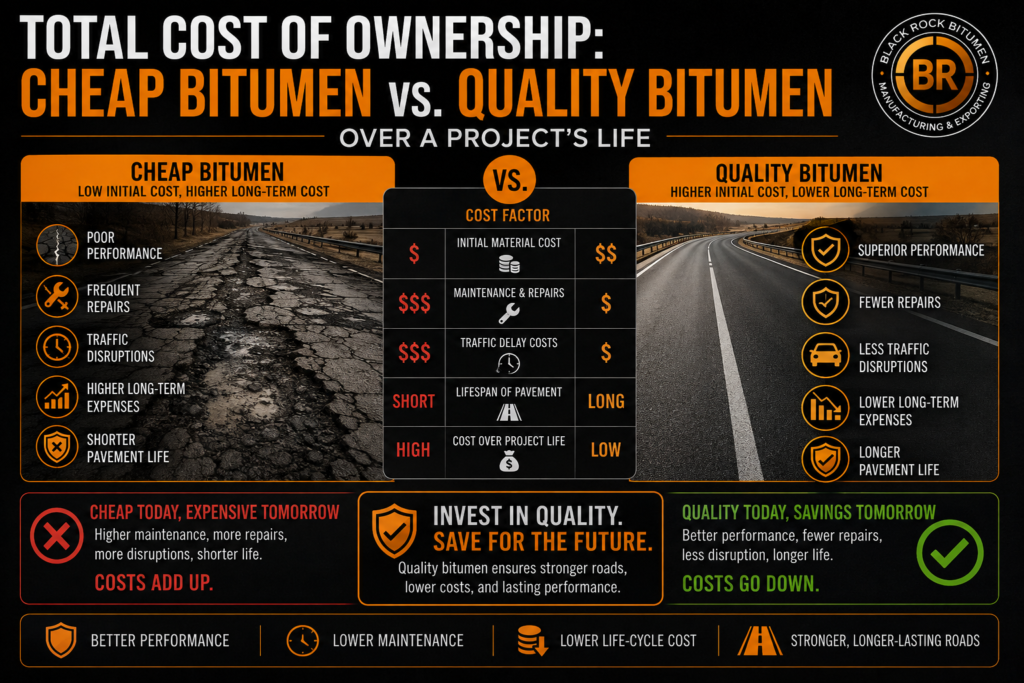
The lowest bitumen price is not necessarily the lowest project cost. A cheaper binder can reduce the purchase order today while increasing heating, logistics, testing, maintenance or rehabilitation costs later. But the reverse can also be true: a more expensive binder is not automatically better value.
The only reliable way to compare the two is to look beyond the purchase price and calculate the total cost of ownership (TCO) over a defined analysis period. That means including delivered cost, quality control, application, preservation, rehabilitation, financing and risk — and discounting future costs to present value.
For international buyers sourcing from Dubai into Africa, South America and Southeast Asia, this wider view is especially important because freight, insurance, payment terms, currency exposure and delivery risk can materially change the economics of a bitumen purchase.
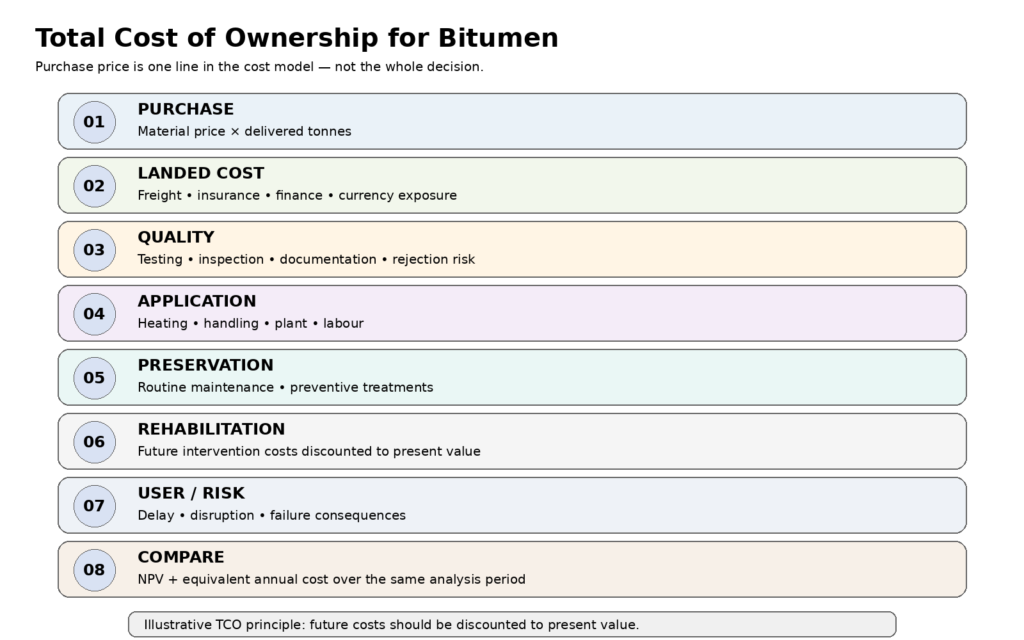
Alt text: Infographic showing the eight components of bitumen total cost of ownership, from purchase and landed cost through quality, application, preservation, rehabilitation, user risk and discounted life-cycle comparison.
Cheap Bitumen vs. Quality Bitumen: What Are You Actually Comparing?
When buyers say one bitumen is cheaper than another, they are usually comparing the material price per tonne. That is only the first line of the calculation.
| Cost layer | Questions to ask | Example impact |
| Purchase | What is the price per tonne? | Lower or higher invoice price |
| Landed cost | What are freight, insurance, port and handling costs? | A lower FOB price can arrive at a higher landed cost |
| Finance | What are payment terms, LC charges and cost of capital? | Longer payment cycles can carry a financing cost |
| Quality | What testing, inspection and documentation are included? | Better controls can reduce rejection and dispute risk |
| Application | What heating, handling and plant requirements apply? | Different products can change site energy and handling costs |
| Preservation | How often will preventive maintenance be required? | Earlier preservation can avoid expensive deterioration |
| Rehabilitation | When will major intervention be required? | Later costs need to be discounted |
| Risk / user cost | What happens if the pavement fails or work is delayed? | Traffic disruption and emergency work can dominate material savings |
The Key Principle: Expensive Is Not Always Better
A quality-focused option only makes economic sense if its additional cost buys a measurable project benefit. That benefit might be longer service life, fewer interventions, lower failure risk, better temperature performance or reduced maintenance frequency.
Likewise, the cheapest compliant material may be the best choice when both alternatives meet the project’s performance requirements and the more expensive option does not provide enough additional value.
This is why procurement should separate compliance from value. First ask whether the binder meets the required specification. Then ask whether a higher-performing option produces a sufficiently large life-cycle benefit to justify its additional cost.
A Worked TCO Example: Same Project, Two Binder Options
The following is an illustrative example, not a quotation or a prediction of pavement life. The purpose is to show how a buyer can turn the argument into an actual calculation.
Assumptions: a project uses 5,000 tonnes of binder; Option A costs USD 520/tonne delivered and Option B costs USD 570/tonne delivered; the higher-cost option therefore adds USD 50/tonne. The asphalt mix is assumed to contain 5% binder by mass. The project analysis period is 35 years. Option B is assumed, for illustration only, to avoid one rehabilitation intervention costing USD 900,000 in year 18. A real project must replace these assumptions with tender quantities, actual delivered prices and engineering-based intervention costs.
| Item | Option A: lower purchase cost | Option B: higher purchase cost |
| Binder quantity | 5,000 t | 5,000 t |
| Delivered binder price | USD 520/t | USD 570/t |
| Initial binder purchase | USD 2,600,000 | USD 2,850,000 |
| Initial premium | — | USD 250,000 |
| Illustrative avoided rehabilitation | — | USD 900,000 in year 18 |
| Discount rate | 4% real | 4% real |
| Present value of year-18 rehabilitation | USD 900,000 | — |
| Illustrative NPV difference before other costs | — | USD 250,000 − PV of USD 900,000 |
At a 4% real discount rate, the present value of USD 900,000 received as an avoided cost in year 18 is approximately USD 444,000. On those assumptions, Option B’s USD 250,000 upfront premium is smaller than the approximately USD 444,000 present value of the avoided intervention, producing an illustrative net present-value advantage of about USD 194,000 before differences in maintenance, finance, risk or user costs.
Change the assumptions and the conclusion changes. If the higher-priced binder does not actually avoid the intervention, the premium is simply an additional cost. If it avoids a larger or earlier intervention, its economic case becomes stronger.
That is the point of the model: do not assume that quality pays. Test the claim with project-specific numbers.
The Correct TCO Formula Includes Time Value
A simple undiscounted sum of purchase + logistics + maintenance + rehabilitation is not a proper life-cycle cost calculation because a dollar spent today is not economically equivalent to a dollar spent twenty years from now.
For pavement life-cycle cost analysis, future costs are discounted to present value. A simplified expression is:
NPV = Initial Cost + Σ [Future Costₜ ÷ (1 + r)ᵗ] − Residual Value
where r is the real discount rate and t is the year in which the future cost occurs.
The FHWA Life-Cycle Cost Analysis Primer explains the present-value approach used in pavement LCCA.
The exact discount rate, analysis period and treatment schedule should come from the project’s LCCA framework. The important point for procurement is that future maintenance and rehabilitation costs should not simply be added at face value.
Choose an Analysis Period Long Enough to Show the Difference
If one option is expected to require a major rehabilitation after 15 years and another after 20 or 25 years, a five- or ten-year comparison can hide the difference. Pavement LCCA therefore uses a sufficiently long analysis period to capture meaningful maintenance and rehabilitation events; 35 years or more is commonly used for major pavement comparisons.
The period should be long enough to capture at least one major rehabilitation for the alternatives being compared. It should also be identical for both options unless the analysis uses a method specifically designed to compare different lives.
Equivalent Annual Cost: When Service Lives Differ
Suppose Option A costs less but lasts 15 years before major rehabilitation, while Option B costs more but provides a longer service period. Comparing only their initial costs is misleading.
Equivalent annual cost (EAC) converts the present value of an option into an annualised cost over the selected life. It is useful when alternatives have different service lives because it puts them on a comparable annual basis.
A simplified EAC relationship is:
EAC = NPV × [r(1+r)ⁿ ÷ ((1+r)ⁿ − 1)]
For the broader pavement comparison, see Black Rock Bitumen’s Bitumen vs. Concrete for Road Construction — Cost, Lifespan and Maintenance Trade-offs and apply the same life-cycle logic rather than comparing construction price alone.
Preventive Maintenance: The Cost You Avoid Is Often More Important
The economics of preservation are one of the strongest reasons not to judge pavement quality by purchase price alone. Research by Galehouse, Moulthrop and Hicks reported that timely preventive maintenance can return roughly six to ten dollars in avoided rehabilitation for each dollar spent, while the earlier NCHRP Synthesis 223 cited a more conservative three-to-four-dollar range.
These figures should be treated as indicative findings, not universal guarantees. The return depends on pavement condition, treatment timing, traffic, climate, treatment quality and the type of rehabilitation avoided.
The practical lesson is simple: do not wait for a pavement problem to become expensive before considering preservation.
Where International Bitumen Buyers Can Lose Money
For an international purchase, the cost model should extend beyond the material and freight invoice. A USD 20 or USD 30 per tonne saving can disappear quickly if the transaction carries higher financing, inspection, storage or delivery risk.
| International cost line | What to include |
| Freight | Ocean freight, surcharges and route-specific charges |
| Insurance | Cargo insurance and coverage limits |
| Port / terminal | Handling, storage, discharge and heating where applicable |
| Finance | Letter of credit charges, bank fees and cost of capital |
| Payment terms | Cash-flow impact of advance payment versus credit |
| Currency | FX exposure between quotation, payment and delivery |
| Inspection | Independent inspection, sampling and laboratory costs |
| Documentation | Certificates, conformity documents and legalization / attestation where required |
| Delay / demurrage | Costs created by documentation, terminal or delivery delays |
| Rejection risk | Potential cost of non-conforming or poorly documented cargo |
The Nine-Point Supplier Comparison Scorecard
Use the following checklist when comparing two bitumen quotations. It is designed to stop a lower material price from hiding a higher delivered or life-cycle cost.
Confirm the exact product grade and governing specification.
Compare the delivered price, not only the quoted material price.
Confirm freight, insurance, port, terminal and heating assumptions.
Compare payment terms, LC / banking charges and currency exposure.
Check the COA, TDS, SDS, sampling and laboratory documentation.
Identify inspection, conformity and certification costs.
Estimate application, maintenance and preservation requirements.
Model rehabilitation timing and discount future costs to present value.
Include failure, delay and user-cost risk where the project decision warrants it.
How to Tell Whether a Higher-Quality Bitumen Is Actually Worth It
| Question | If the answer is yes | If the answer is no |
| Does it exceed the minimum specification in a relevant performance area? | There may be a measurable benefit to investigate. | The premium may have no technical justification |
| Will that performance reduce a known project risk? | Quantify the avoided cost. | Do not assign a benefit without evidence |
| Is the benefit likely to last over the analysis period? | Model when the benefit appears. | Avoid assuming permanent benefit |
| Can the benefit be verified through testing or project records? | Use evidence in the TCO model. | Treat the claim cautiously |
| Does the NPV / EAC improve after the premium? | The higher-cost option may be better value. | The cheaper option may be economically preferable |
What Quality Actually Costs — and What It Can Prevent
Quality is not just a higher test result. For an international bitumen buyer, quality includes consistent production, correct grade, representative sampling, reliable laboratory testing, batch traceability and complete documentation.
Those controls reduce the probability of a shipment being rejected, a batch being disputed or a project receiving material that does not match the purchase specification.
That is why the How to Read a Bitumen COA Line by Line guide should be used alongside any supplier comparison.
The related COA vs. TDS vs. MSDS article explains which document answers which procurement question.
How Black Rock Bitumen Fits Into the TCO Decision
Black Rock Bitumen is a Dubai-based supplier serving international buyers. For a TCO comparison, the relevant question is not simply whether its quoted price is lower or higher than another supplier’s. Buyers should evaluate the complete delivered offer: grade compliance, batch documentation, testing, traceability, shipping format, logistics assumptions and destination requirements.
Start with Black Rock Bitumen’s Bitumen Supply range and compare the complete product and specification against competing quotations.
For shipment packaging and landed-cost considerations, see Bulk vs. Drum vs. Flexitank: How Bitumen Is Packaged and Shipped.
For import paperwork and destination documentation, see HS Codes and Import Documentation for Bitumen Shipments.
A Simple Buyer Worksheet
| Input | Option A | Option B |
| Tonnes | [enter] | [enter] |
| Delivered price / tonne | [enter] | [enter] |
| Initial material cost | Calculate | Calculate |
| Freight / insurance | [enter] | [enter] |
| Finance / LC / currency cost | [enter] | [enter] |
| QA / inspection / documentation | [enter] | [enter] |
| Application cost | [enter] | [enter] |
| Annual maintenance | [enter] | [enter] |
| Major rehabilitation year | [enter] | [enter] |
| Rehabilitation cost | [enter] | [enter] |
| Discount rate | [enter] | [enter] |
| Analysis period | 35 years or project-defined | 35 years or project-defined |
| NPV | Calculate | Calculate |
| Equivalent annual cost | Calculate | Calculate |
FAQs
Is cheaper bitumen always the better option?
No. Compare specification compliance first, then delivered cost and life-cycle cost. A higher-priced option can be better value if it produces a verified and economically meaningful reduction in future costs.
What is total cost of ownership for bitumen?
It is the full economic cost of owning and using the material over the relevant project period, including purchase, logistics, finance, quality, application, maintenance, rehabilitation and relevant risk or user costs.
Why should future pavement costs be discounted?
Because costs occurring years later do not have the same present economic value as costs paid today. LCCA therefore discounts future costs to present value.
What is equivalent annual cost?
EAC converts an option’s present value into an annualised cost so alternatives with different service lives can be compared on a common basis.
How long should a pavement TCO analysis run?
The analysis period should be long enough to capture meaningful maintenance and at least one major rehabilitation for the alternatives being compared; 35 years or more is commonly used for major pavement comparisons.
Does higher-quality bitumen always last longer?
No. Service life depends on binder properties, mixture design, pavement structure, construction quality, climate, traffic and maintenance. A higher price alone does not prove longer life.
The Bottom Line
The cheapest bitumen is not necessarily the cheapest choice. But the most expensive bitumen is not automatically the best choice either.
The smart procurement decision sits between those two extremes: **buy material that demonstrably meets the project specification, is suitable for the climate and traffic, can be consistently supplied, and delivers the best expected whole-life value.**
For major infrastructure projects, the few dollars saved on the purchase price can become insignificant if they are followed by additional testing, rework, premature maintenance or traffic disruption.
The goal is not to pay more. It is to avoid paying twice.
For a complete procurement workflow, start with Bitumen Grades & Standards for Infrastructure Tenders, then review How to Read a Bitumen Certificate of Analysis (COA) Line by Line to verify batch results. Compare the relevant Performance Grade Bitumen or Penetration Grade Bitumen requirements, and if the application calls for modification, review Polymer Modified Bitumen. Finally, factor the shipment format and customs side into your TCO using Bulk vs. Drum vs. Flexitank and HS Codes and Import Documentation for Bitumen Shipments.