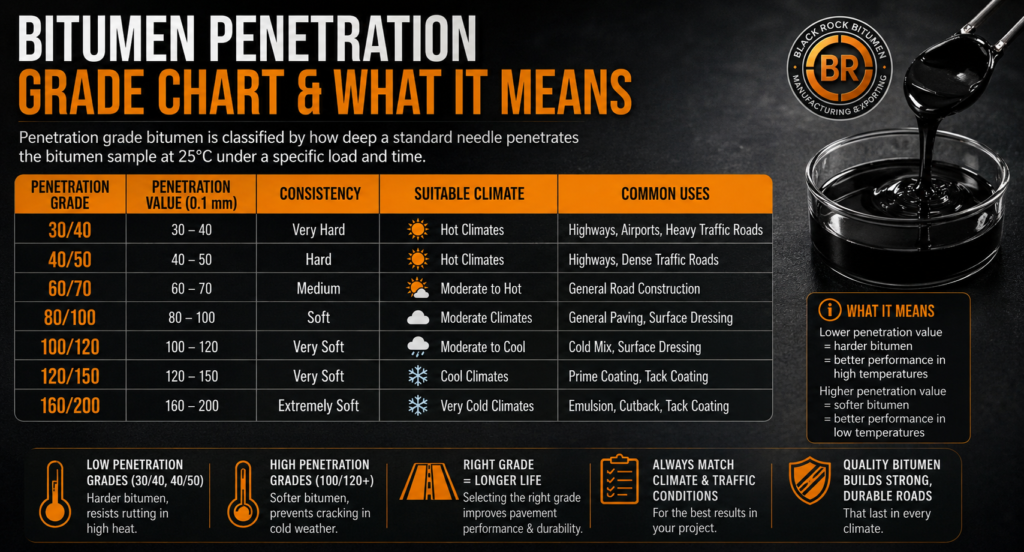
Look at a bitumen drum, a spec sheet, or a supplier’s price list, and you’ll see something like “60/70” or “80/100” stamped across it. Most buyers know those numbers mean something about hardness. Far fewer can actually read the chart behind them — which column tells you about heat resistance, which one tells you about durability over time, and which numbers on two different suppliers’ sheets are actually comparable.
That gap matters more than it looks. The penetration grade is the first data point you see on any bitumen order, and it’s often the only one anyone checks before signing off. Misreading it — assuming a bigger second number means “better,” or treating an EN grade and an ASTM grade with similar numbers as identical — is how the wrong binder ends up on the wrong road.
This is the reference guide: what the numbers actually measure, the full chart with real specification values, and how to read it the way an engineer would rather than the way a price list wants you to.
Why This Chart Matters More When You’re Importing
If you’re sourcing bitumen locally from a single refinery, grade consistency is mostly someone else’s problem — the refinery controls the process, and the chart is largely a formality. That changes the moment bitumen starts crossing borders. Buyers across Africa, South America, and Southeast Asia are frequently importing from multiple origins over the course of a single project, and every shipment’s spec sheet is the only real evidence of what’s actually in the drum or tank. If you can’t read the chart past the headline grade number, you’re trusting the supplier’s word on everything else it implies — softening behavior, aging resistance, purity. That’s a bigger risk on an imported shipment than on a domestic one, simply because there are more hands and more transit time between the refinery gate and your site.
What the Penetration Test Actually Measures
The number comes from a genuinely simple physical test. A needle loaded to 100 grams is lowered onto the surface of a bitumen sample held at exactly 25°C, released, and left for 5 seconds. Whatever depth it sinks to — measured in tenths of a millimeter — becomes the penetration value (Controls Group). A bitumen graded “60/70” means an actual sample of that batch penetrated somewhere between 60 and 70 tenths of a millimeter under those conditions.
That’s it. It’s not a direct measurement of strength, durability, or temperature performance — it’s a proxy. A deeper needle penetration means a softer, more workable binder, generally better suited to cold climates. A shallower penetration means a harder, stiffer binder that resists heat better (rahabitumen). The test has been used since the early 1900s specifically because it’s fast, cheap, and correlates reasonably well with real-world performance — even though it’s only measuring one property at one temperature.
How to Read the Two Numbers
Every penetration grade is written as a range: a minimum and a maximum. “40/60” doesn’t mean the bitumen has a penetration of exactly 40 or exactly 60 — it means any batch sold under that grade must test somewhere between those two values (grandpetroleum). A narrower range (like 20/30) signals a tighter manufacturing tolerance; a wider range (like 160/220) allows more batch-to-batch variation.
The rule of thumb that governs the whole chart: lower numbers are harder, for hot climates and heavy traffic. Higher numbers are softer, for cold climates and flexibility. Everything else in this guide is a variation on that one idea.
The Full EN 12591 Penetration Grade Chart
This is the standard reference chart under EN 12591, the European specification most widely used across Africa, the Middle East, and much of Asia for paving-grade bitumen (EN 12591:2009). Most published versions of this chart stop at the first four columns. The three on the right — the ageing requirements measured by the Rolling Thin Film Oven Test (EN 12607-1) — are part of the same specification table and are usually the first thing an engineer looks for:
| Grade | Penetration (0.1mm) | Softening point | Minimum flash point | Minimum solubility | Change of mass (max) | Retained penetration (min) | Increase in softening point (max) |
| 20/30 | 20 – 30 | 55 – 63°C | 240°C | 99.0% | 0.5% | 55% | 8°C |
| 30/45 | 30 – 45 | 52 – 60°C | 240°C | 99.0% | 0.5% | 53% | 8°C |
| 35/50 | 35 – 50 | 50 – 58°C | 240°C | 99.0% | 0.5% | 53% | 8°C |
| 40/60 | 40 – 60 | 48 – 56°C | 230°C | 99.0% | 0.5% | 50% | 9°C |
| 50/70 | 50 – 70 | 46 – 54°C | 230°C | 99.0% | 0.5% | 50% | 9°C |
| 70/100 | 70 – 100 | 43 – 51°C | 230°C | 99.0% | 0.8% | 46% | 9°C |
| 100/150 | 100 – 150 | 39 – 47°C | 230°C | 99.0% | 0.8% | 43% | 10°C |
| 160/220 | 160 – 220 | 35 – 43°C | 220°C | 99.0% | 1.0% | 37% | 11°C |
| 250/330 | 250 – 330 | 30 – 38°C | 180°C* | 99.0% | 1.0% | 35% | 11°C |
*Flash point for 250/330 is determined by the Pensky-Martens closed cup method (EN ISO 2719); every other grade in the table uses the Cleveland open cup method (EN ISO 2592). The three ageing columns are the Severity 1 limits — EN 12591 also permits a Severity 2 option, which allows a slightly larger increase in softening point when it is tied to a Fraass breaking point requirement.
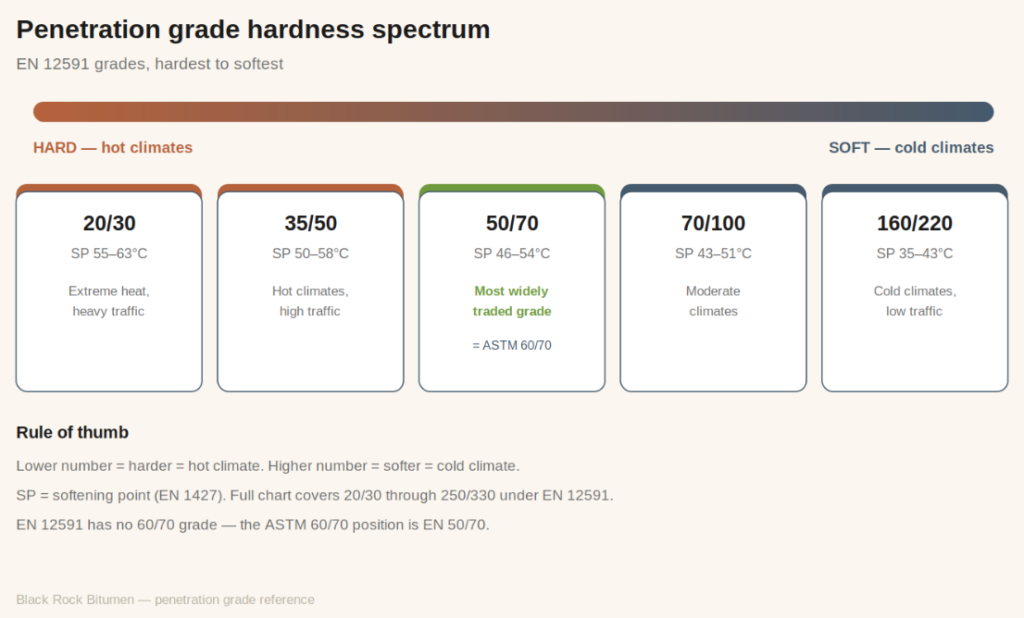
EN 12591 penetration grade hardness spectrum from 20/30 to 160/220, with softening point ranges and climate suitability
Notice the pattern running down that softening point column: as the penetration range gets softer (higher numbers), the softening point drops. That’s not a coincidence — it’s the same physical property showing up twice. A grade with a low softening point starts to flow at a lower temperature, which is exactly why the softer grades belong in cooler climates and the harder grades belong where the sun does more work.
The ASTM Side — And Why Most Charts Get It Wrong
The ASTM system is where published grade charts go wrong most often, including on supplier websites. ASTM D946 defines exactly five penetration grades. Everything else circulating as an “ASTM grade” is a trade designation from Middle East and Asian export markets, or a grade belonging to another national standard entirely:
| ASTM D946 grades | Widely traded export grades not defined in D946 |
| 40/50, 60/70, 85/100, 120/150, 200/300 | 10/20, 30/40, 60/80, 80/100, 100/120, and others |
This is not a technicality. A contract that specifies “ASTM 60/80” or “ASTM 80/100” is specifying something that does not exist in the standard it names — which means the acceptance criteria fall back on whatever the supplier’s own test report says, with no published table to check it against. If you’re buying one of those grades, ask the supplier which specification the values are actually being certified to.
For our own range: Bitumen 60/70 is a true ASTM D946 grade. Bitumen 20/30 and Bitumen 100/150 are EN 12591 grades. Bitumen 30/40, Bitumen 60/80, and Bitumen 80/100 are export trade grades — supplied against full test certification, but not against a D946 table. We list them that way deliberately, because a buyer who knows which of the three categories a grade belongs to knows exactly what documentation to ask for.
One further point that catches out procurement teams regularly: EN 12591 has no 60/70 grade. The EN grade sitting in the same position as ASTM 60–70 is 50/70. If your contract says ASTM 60/70 and your supplier quotes EN 50/70, that is the intended equivalent — not a substitution.
What Each Grade Is Actually Used For
| Grade | Typical climate fit | Common use |
| 20/30 (EN), 30/40 (trade) | Extremely hot, heavy traffic | Highways, airport runways, industrial pavements in intense heat |
| 35/50, 40/60 (EN) | Hot climates, high-traffic roads | Heavy-duty roads, expressways, hot-mix asphalt bases |
| 50/70 (EN) / 60/70 (ASTM) | Warm to moderate climates | The most widely traded position globally — general paving, urban roads |
| 60/80 (trade), 70/100 (EN) | Moderate climates | General-purpose paving where extreme heat isn’t the dominant risk |
| 80/100 (trade), 100/150 (EN) | Cooler or variable climates | Roads needing flexibility against cracking, moderate traffic |
| 160/220, 250/330 (EN) | Cold climates, low traffic, or specialty use | Surface dressing, industrial coatings, roofing-adjacent applications |
Grade 60/70 deserves a specific mention because it shows up so often it’s practically the industry default. It sits in the middle of the hardness spectrum, handles a genuinely wide range of climates without excelling at any extreme, and is commonly blended with polymers when a project needs more than what the base grade offers on its own (Highways Today). Just remember that its EN counterpart is written 50/70, not 60/70.
Reading the Chart Like a Buyer, Not Just a Spec Sheet
Four bitumen spec sheet columns explained — penetration, softening point, flash point and solubility with their EN and ASTM test standards
The penetration and softening point columns get most of the attention, but the other columns matter more than people give them credit for.
Flash point isn’t a performance number — it’s a safety number. It tells you the temperature at which vapors from the bitumen can ignite if exposed to a flame. Every grade in the EN chart carries a minimum flash point requirement specifically because handling temperatures for these products run well into the 140–180°C range, and a low flash point on a Certificate of Analysis is a red flag worth asking about, not a technicality to skip past.
Solubility is a purity check. A minimum solubility of 99.0% in toluene, tested to EN 12592, confirms the sample is genuinely bitumen and not diluted with fillers or contaminants that wouldn’t dissolve the same way. It’s a small number on the chart, but it’s one of the more direct tests for the kind of adulteration that shows up in lower-quality supply chains. (If a certificate quotes trichloroethylene as the solvent, it’s reporting the ASTM D2042 method, not the EN one — trichloroethylene has been phased out of most laboratories on health grounds.)
The softening point tells you the hot side of the story; the Fraass breaking point tells you the cold side. EN 12591 also specifies a Fraass breaking point — the temperature at which a thin film of the binder cracks under bending (EN 12593). If you’re supplying anywhere with a genuine winter, a highland region, or a wide day-to-night temperature swing, that number decides whether the surface survives its first cold season, and it belongs on any spec sheet you’re comparing.
Ageing resistance is the last column set, and the one most casual chart summaries leave off entirely. The test is the Rolling Thin Film Oven Test, EN 12607-1, which heats a moving film of binder at 163°C to simulate the hardening that happens during mixing and laying. Three numbers come out of it, all shown in the chart above: change of mass, retained penetration as a percentage of the original, and increase in softening point. A grade that starts in spec but ages poorly will still fail in the field even if the original batch tested perfectly — a 50/70 that retains only 40% of its penetration has failed the standard, whatever its fresh test result looked like.
Common Mistakes When Reading a Penetration Grade Chart
Assuming a higher second number is automatically “better.” It isn’t better or worse — it’s softer, which is only the right call in a colder climate or a lower-traffic application. A 160/220 grade on a hot, heavily trafficked highway will rut fast, not perform “better” because the number is bigger.
Treating EN and ASTM grades as interchangeable. The test method itself is the same in both systems — a 100 g needle at 25°C for 5 seconds, whether it’s run as EN 1426 or ASTM D5. What differs is how the grades are binned and what else the specification demands alongside penetration. EN 12591 has no 60/70 at all; the ASTM 60–70 position is EN 50/70. Confirm the standard, not just the numbers.
Ignoring the softening point column. Two grades with overlapping penetration ranges can still have meaningfully different softening points depending on the source crude and refining process. If a supplier only quotes the penetration number, ask for the full chart line.
Skipping the aging resistance data. A grade that passes fresh but degrades quickly under EN 12607-1 is a worse long-term buy than a grade with a slightly less impressive starting number but better retained properties.
Accepting an “ASTM” grade that isn’t in D946. If the grade isn’t one of the five defined grades, ask which specification the certificate is actually written against before the contract is signed, not after the cargo lands.
Frequently Asked Questions
What does “60/70” mean on a bitumen spec sheet? It means a sample of that batch, tested with a standard needle at 25°C, penetrated somewhere between 60 and 70 tenths of a millimeter. It’s a hardness range, not a single fixed value.
Is a higher penetration grade number stronger or better quality? No. A higher number means a softer bitumen, suited to colder climates or lower-traffic applications. A lower number means a harder bitumen, suited to hot climates and heavy traffic. Neither is universally “better” — it depends entirely on the project.
Are EN and ASTM penetration grades the same? They use the same penetration test — 100 g needle, 25°C, 5 seconds — run as EN 1426 or ASTM D5. What differs is the grade bands and the surrounding specification requirements. The clearest example: EN 12591 has no 60/70 grade at all. If your contract says ASTM 60/70 and your supplier quotes EN 50/70, that is the intended equivalent, not a substitution.
How many grades does ASTM D946 actually define? Five: 40/50, 60/70, 85/100, 120/150 and 200/300. Grades like 60/80, 80/100 and 30/40 are widely traded export designations, not D946 grades — they’re legitimate products, but the certificate needs to name the specification it was tested against.
Why does the softening point matter if I already know the penetration grade? The two numbers move together but aren’t identical — the softening point tells you the actual temperature at which the material starts to flow, which is the number most directly tied to rutting risk in hot climates.
What is the RTFOT and why should a buyer care? EN 12607-1, the Rolling Thin Film Oven Test, ages a thin film of binder at 163°C to simulate what happens during mixing and laying. It produces the change of mass, retained penetration and increase in softening point limits in the chart above. It’s the closest thing on a spec sheet to a durability figure.
The Bottom Line
The penetration grade chart looks like a simple lookup table, but it’s really a shorthand for how a binder will behave in the specific climate and traffic conditions of your project. Read past the first number, check the softening point, flash point and ageing columns, and confirm which standard you’re actually looking at before you order.
Black Rock Bitumen supplies the full EN and ASTM penetration grade range, from Bitumen 20/30 and Bitumen 30/40 at the hard end, through the widely used Bitumen 60/70, Bitumen 60/80, and Bitumen 80/100, to the softer Bitumen 100/150 for cooler or lower-traffic applications. Browse the complete range on our Penetration Grade Bitumen page, or see our Performance Grades line if your project calls for direct temperature-based PG specification instead.