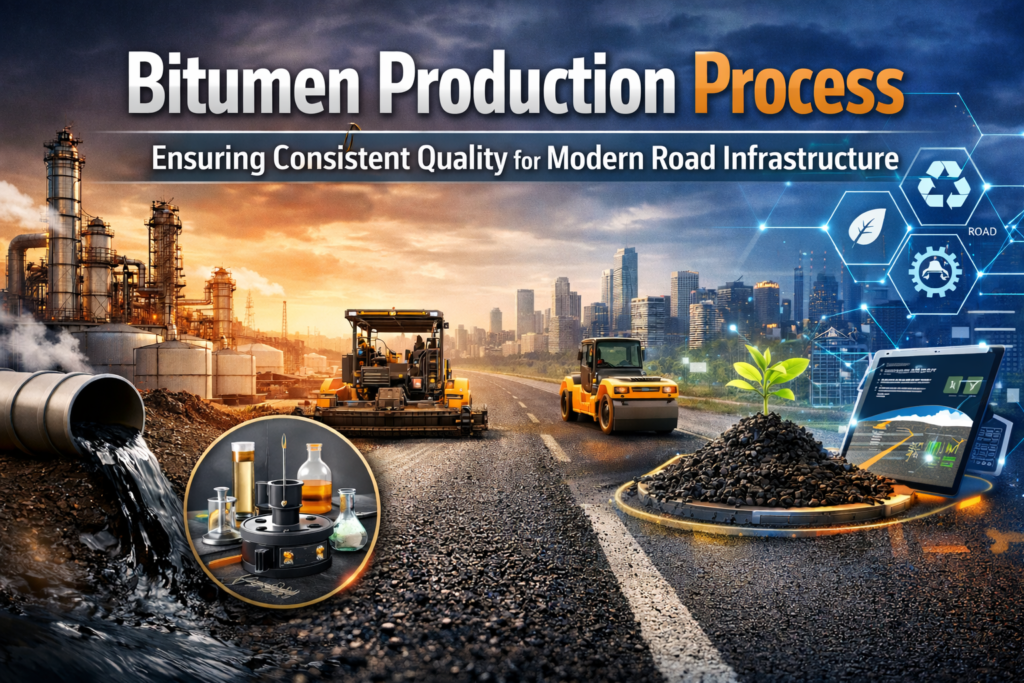
If your bitumen production isn’t rock solid, neither are the roads using the bitumen. That’s the hard truth.
Whether you’re a contractor in the UAE, a project manager in Australia, or a supply chain lead in the US, you know that bitumen production processes are the “glue” holding our modern world together. But here’s the problem: not all “glue” is created equal.
In fact, 85% of all bitumen is used as a binder in road asphalt. That’s nearly 102 million tonnes per year all around the world. With the market projected to grow past 173 million tons by 2030, the pressure to produce high-performance bitumen is higher than ever.
In this blog, I will be breaking down the ins and outs of bitumen manufacturing. You will know how it is made, why ensuring bitumen consistency is your secret weapon for profit, and lay out the 7-step framework you can use to ensure that every batch is perfect.
The Next Frontier: 3 Trends Reshaping Bitumen Production in 2026
If one wants to keep ahead of the competition, then there is a need to look beyond the standard refinery process. The industry is proceeding towards the “Triple threat” of innovation: sustainability, digitalisation, and nanotechnology.
1. The Rise of Commercial Bio-Bitumen
2026 is a historic landmark, with India achieving an incredible feat by making it to the list of countries that commercially produce bio-bitumen. * The Process: Pyrolysis is carried out on agricultural waste like rice straw.
- Why It Matters: This is not an experiment; it is safe to use this in place of conventional petroleum bitumen to the tune of 20-30%.
- Takeaway: For producers, it implies a significant reduction in carbon footprint as well as a means to counter rising import cost pressures.
2. Digital Twins: Real-Time Pavement Prognostics
The most advanced plants have begun adopting Digital Twin technology.
- What is it? A virtual copy or duplicate of a physical road or production batch that utilises real-time Internet of Things sensors.
- The “Smart Rock” Revolution: “Smart Rocks” – embedded sensors inside an asphalt mixture, communicating directly with a model.
- The Benefit: Instead of waiting for a road to crack, maintenance needs will be forecast months in advance using actual vehicle loads and thermal expansion. Consistency is no longer just verified at the plant; it’s now verified throughout the lifetime of the road.
3. Self-Healing Asphalt & Nanotechnology
Think of a road which can fix potholes itself.
- The Tech: As microcapsules containing rejuvenators or steel fibres are incorporated into the bitumen, roads can “heal” themselves from minor micro-cracks before more serious failures occur.
- Nano-Modified Bitumen: Here, we can see the use of carbon nanotubes for enhancing the binder at a molecular level, thus providing better adhesiveness as well as a large step up in “Service Life Expectancy” of the road. It is like the difference between a 10-year road and a 25-year road.
Why These Trends Matter to Your Bottom Line
These stories are not simply “cool tech” pieces; they are response mechanisms to the market forces we talked about earlier:
- Regulatory Compliance: With over 40 countries now having implemented carbon-related regulations in refineries, bio-bitumen is your “get out of jail free” card.
- Maintenance Phase: In the “maintenance-heavy” phase for regions such as India and the UAE, which starts 10 to 15 years after the “building phase,” your highest margin offerings will be “tech such as bitumen emulsions and self-healing binders.
- Smart Cities: Cities are increasingly seeking what we call ‘carbon reduction documentation. If you aren’t able to prove the sustainability of your bitumen, then you will not be able to bid on high-value contracts.
The Core Framework: Bitumen Production Steps
But how is bitumen really produced? It’s not just oil residue. It’s a crafted product. These are the processes for the production of bitumen for excellence and repetition.
Step 1: Understanding the Raw Material (Crude & Residue)
- Bitumen is the “bottom of the barrel” quite literally. The heavy stuff is left over after we’ve taken out the lighter stuff like gasoline and diesel fuel.
- The Key: The quality of your crude feedstock determines the viscosity and softening point of your bitumen.
- Pro Tip: API gravity and sulfur level analysis are a must before the feed enters the unit.
Step 2: Vacuum Distillation: The Core Production Unit
Moreover, since its boiling point is over 500°C, we cannot “boil” it at normal pressure without damaging or cracking those molecules.
What happens: We use the VDU in order to reduce the pressure. This equipment reduces pressure and lets us distil heavy oils at much lower temperatures.
The Checklist:
- Maintain vacuum stability.
- Monitor the Temperature Profile 24/7.
- Control the feed rate to prevent a surge.
Step 3: Blending and Modification – Bitumen Trend 2025
Once you have base bitumen, you gotta hit the spec.
Penetration Grade Bitumen: This is the traditional stuff, making up 70% of the market.
Polymer Modified Bitumen – PMB: This is the future. Adding a percentage of elastomers such as SBS, we create a binder resistant to rutting at high temperatures and to cracking at low temperatures. PMB demand is growing 6% yearly since it can extend the road life up to 30%.
Step 4: Bitumen Quality for Road Construction-The Non-Negotiable
If you are not testing, you are not producing. Each batch should be in conformance with the international standards: ASTM, EN, and AASHTO.
Property | Description |
Penetration | Determines flexibility and load response. |
Softening Point | Vital for high-temperature rut resistance. |
Viscosity | Impacts how well the mix can be worked on-site. |
Ductility | Ensures the road does not crack from tension. |
Step 5: Bitumen Process Control and Temperature Management
Bitumen is “alive” – if it is too cold, it is brittle; if it is too hot, it begins to deteriorate.
- Best Practice: Storage at 140 to 180°C is best.
- The Fix: Utilising IoT technology with tank sensors, transmitting real-time digital reporting every 30 minutes.
Step 6: Emulsions & Cold Mix Tech
Not all jobs require heat. Bitumen emulsions, consisting of mixtures of bitumen, water, and surfactant, are ideal for remote repairs. Cold-use of bitumen reached 5 million tons in 2023, as it reduces emissions by almost 30%.
Step 7: The Circular Economy (RAP Integration)
Reclaimed Asphalt Pavement (RAP) is no longer a green experiment; it is now a mandatory requirement.
- The Data: In America, every year, 45 million tons of RAP are recycled, which results in saving 9 million tons of fresh bitumen.
- The Challenge: You will need to ensure the old binder within the RAP is compatible with your new bitumen material.
Detailed Bitumen Production Checklist (Printable)
Step | Must-Have Check |
Crude Analysis | API gravity and sulfur verified? |
Distillation | Are temperature logs within ±2°C? |
Blending | Polymer ratios double-checked? |
QC Lab | Penetration and softening point passed? |
Storage | Alarm systems for temp drops active? |
Transport | Heated tank validation certificate? |
Common Mistakes That Destroy Mix Quality
In addition, in the current 2026 scenario, there is less room for error. While specifications for roads become increasingly stringent to accommodate the weight of electric vehicles as well as severe weather, these four mistakes remain the most frequent causes of failure. Listed below is an even more detailed explanation of how to avoid these mistakes.
Mistake #1: Loose Temperature Control
Temperature is the main factor influencing chemical stability when it comes to bitumen production. A 10-degree change will increase changes to the chemical structure.
- The Effect: When the bitumen is overheated, it has the effect of thermal degradation. As a result of this, the bitumen gets short, thus cracking immediately after cooling. On the other hand, if the bitumen is underheated, it fails to coat properly, hence the road starts to strip and develop potholes during the first season.
- The 2026 Fix: Go beyond simple temperature checks with a human holding a thermometer. Move to an Automated PLC Solution with Cloud Monitoring. Such a solution allows plant management to be alerted immediately to their mobile phones if the temperature of any tank goes outside a 5-degree tolerance, to guarantee every litre of binder remains “within its performance envelope.”
Mistake #2: Ignoring Feedstock Quality
There are a great number of producers who assume that crude oil residues are all equal. This is a very expensive misconception, especially in a world where the source of crude is constantly changing.
- The Effect: First, crude oils from various sources tend to have different asphaltenes and resin contents. If you don’t accommodate these differences in a new batch of crude, you may be left with a product with inferior adhesion properties, a “softening point” that doesn’t meet spec, and so on. This means you will be left with inferior adhesion, among other problems, on the construction site.
- The 2026 Fix: Quality Control Starts at Intake Valve, Not Output Valve. A crude assay analysis will be required before every new shipment of crude oil entering the distillation unit. While you can determine the API gravity/sulfur content of your crude, you can then easily recalibrate the parameters used in vacuum distillation so that product quality does not vary regardless of crude source.
Mistake #3: Skipping RAP Compatibility Checks
The acceptance of Reclaimed Asphalt Pavements has increased substantially in 2026, primarily due to sustainability requirements. However, many builders consider RAP to be a “plug-and-play” element.
- The Effect: The bitumen that is inherent in recycled pavement is aged and very “oxidised.” However, when you add it to a mix without knowing how it interacts with your fresh binder, you end up with a mix that is far too rigid and susceptible to segregation and bonding failures. The most common cause of premature brittle failure of ‘green’ roads is shown below.
- The 2026 Fix: Never guess recycling ratios. You need to do binder blend tests with every 5% increment of RAP added to the mix. Ensure that the “Recycled + Virgin” binders meet the required Performance Grade using a Dynamic Shear Rheometer (DSR).
Mistake #4: Inadequate Data Logging and Monitoring
In an era of high-stakes infrastructure, “I think we did it right” is no longer a valid defence during a project audit. Paper-based logs are the Achilles’ heel of modern production.
- The Effect: Paper logs are prone to human error, “rounding up” of numbers, and physical loss. Without a digital trail, you cannot do a root-cause analysis in case of batch failures. This brings about the lack of transparency, and thermal degradation happens without being recognised until the time the product is laid on the highway.
- The 2026 Fix: Retire the clipboard. Implement IoT-enabled tank sensors that feed directly into digital visualisation tools such as Tableau, Power BI, or even a shared Google Sheet. By digitalising your data logging, you create a real-time “heat map” of your production consistency. This allows you to identify trends, such as a specific heater failing every Tuesday, and correct them before they cause a batch rejection.
Comparison: Traditional vs. Modern QC
Problem Area | Traditional Approach | 2026 Professional Standard |
Monitoring | Manual logbooks | IoT Real-time Dashboards |
Feedstock | Visual inspection | Full Crude Assay Analysis |
Recycling | Standard % Formulas | Incremental Binder Blend Testing |
Response | Reactive (Fixing after failure) | Proactive (PLC-triggered Alarms) |
7-Day Action Plan
Day 1: Review Your Current SOPs
Are your Standard Operating Procedures (SOPs) based on 20th-century specs or 2026 Infrastructure demands?
- The Task: Collect your production, storage, and test manuals. Check for “vague” instructions, i.e., “Maintain heat” – change to specific instructions, e.g., “Maintain temperature at 150-165°C”.
- The Goal: The documents must address methods for modern additives such as SBS polymers or bio-rejuvenators. If your SOP has not been reviewed and changed within the last three years, it is probably obsolete.
Day 2: Audit Your Storage Tanks
Your storage tanks are the most common areas where “hidden” degradation occurs in bitumen.
- The Task: Physically and virtually inspect your heating systems. Look for any “dead zone” areas in large tanks that might be slowing down due to cooling and thickening of bitumen. Ensure you’re getting proper communication from IoT devices with your hub.
- The Goal: Verify that your sensors are not only present, but also correct. A sensor that is off by 10°C can be the difference between a binder that rocks or a product that oxidises in the final material.
Day 3: Moving Your QC Results to a Digital Dashboard
Paper logs: where data goes to die.
- The Task: Move the last 30 days of lab results off clipboards and spreadsheet models and into a single digital dashboard, either with Tableau, Power BI, or an automated Google Sheet.
- The Goal: To create a visual “consistency map.” When you see your penetration and softening points plotted over time, problems and trends become immediately obvious.
Day 4: Schedule Calibration for Your Lab Equipment
A lab is only as good as its last calibration.
- The Task: Book a qualified technician to perform a calibration of your Penetrometers, Softening Point equipment, and your DSR (Dynamic Shear Rheometer).
- The Goal: To eliminate “instrument drift.” If an inaccurately measuring tool is in place, it can cause an entire quality assurance process cascade to be rejected.
Day 5: Perform a RAP Compatibility Test
Sustainability mandates in 2026 ensure you will be using more Reclaimed Asphalt Pavement (RAP) than you have before.
- Task: Take a sample from your current fresh bitumen, combine it with the usual percentage of RAP as done in the lab. Carry out a “performance grade” test.
- The Goal: Validate that your aged binder in the RAP is not causing your final mix to be too stiff. If it is, it’s your turn to adjust your rejuvenator rates or percentage of RAP.
Day 6: Audit Your Polymer Modifier Suppliers
Your bitumen will only be as consistent as the chemicals to which it is exposed.
- The Task: Review the supplied Technical Data Sheets (TDS) of your polymer material suppliers and Certificates of Analysis of your additives suppliers. Verifying any batch variation in their latest supplied materials.
- The Goal: Your suppliers are meeting the strict 2026 requirements on SBS or elastomer quality. When your polymers are inconsistent, your “Elastic Recovery” will be inconsistent too.
Day 7: Present a Quality Report to Your Stakeholders
It is a profit centre, not a cost centre.
- The Task: Put together a “State of the Plant” presentation using the digital dashboard you developed on Day 3 of the competition. Emphasise your consistency rates and discuss technical steps to alleviate rut and cracking issues.
- The Goal: Build Trust. By demonstrating to stakeholders that you have a 100% digital, calibrated, and audited process, your firm can be positioned as the most trusted partner for high-stakes, leading-edge, cutting-edge, state-of-the-art, or whatever-term-you-would
Conclusion
Consistency in the production process of bitumen is not as simple as following a recipe; it means protecting your reputation and your bottom line. A consistent binder means your roads will last longer, your costs will be lower, and your customers will be happier.
Whether you find yourself needing Penetration Grade 60/70 or PMB High Performance Material, the process is the same: Control the heat, test the batch, and embrace the data.
Contact us at Black Rock Bitumen to discuss your specific needs with one of our consultants. Let’s build roads that actually last.
Frequently Asked Questions (FAQs)
How is bitumen quality tested for roads?
Through a battery of tests, including penetration (flexibility), softening point (heat resistance), and ductility (tension).
What is the difference between penetration and PMB bitumen?
Penetration Grade is standard refined bitumen; PMB includes polymers to make it more resilient to heavy loads and weather.
How much bitumen is used in road construction globally?
Approximately 102 million tonnes annually, with 85% of total production going toward road asphalt binders.
What is the global bitumen market growth forecast?
The market is projected to reach approximately 173.08 million tons by 2030, growing at a CAGR of 5.26%.