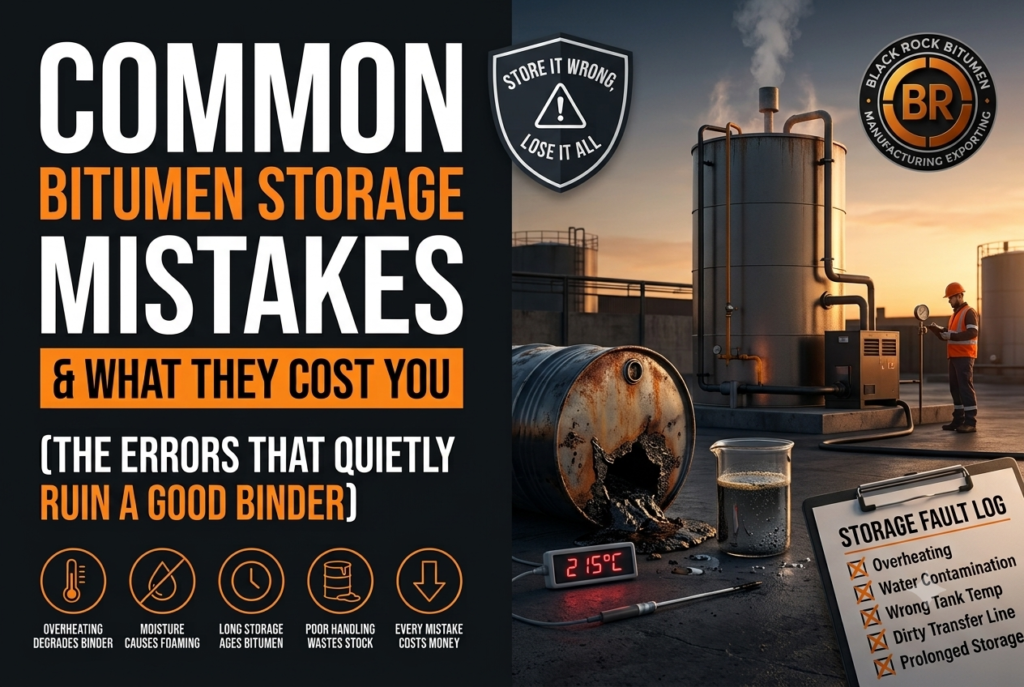
On a Saturday afternoon at a bitumen plant, a tank holding just a third of its capacity exploded. The blast tore off the tank’s upper section and a vent, destroyed every light in the workshop next door, and sent bitumen overflowing when firefighters hit it with water. The cause traced back to something almost mundane: heat building up inside a partially filled, badly monitored tank (BARPI/ARIA accident database). It’s the kind of failure that has a name and a fix, and it’s Mistake #2 below.
Nobody sets out to cause an incident like that. It happens because storage and handling get treated as the boring part of the bitumen supply chain — the part between “the shipment arrived” and “the crew started paving.” But more than half a million workers handle asphalt and bitumen fumes on a regular basis (OSHA), and the material sits at 140–180°C the entire time it’s in a tank (Gulf Petro). That combination — a hazardous temperature, high shipment volumes, and a habit of treating storage as an afterthought — is exactly where things go wrong.
This matters even more if you’re importing bitumen into Africa, South America, or Southeast Asia. Global demand is projected to climb from roughly 134 million tonnes in 2025 to over 173 million tonnes by 2030 (Mordor Intelligence), and a growing share of that volume is moving through trading hubs like Dubai before it ever reaches a paving crew. Long transit times, tropical humidity, and inconsistent power supply for tank heating all raise the odds that something goes wrong between the refinery and the road — which is exactly why Dubai has become a strategic hub for bitumen exports to Africa and Asia in the first place: shorter, more controlled logistics chains matter more than people think.
Here are the mistakes that cause the most damage — and what they actually cost you when they happen.
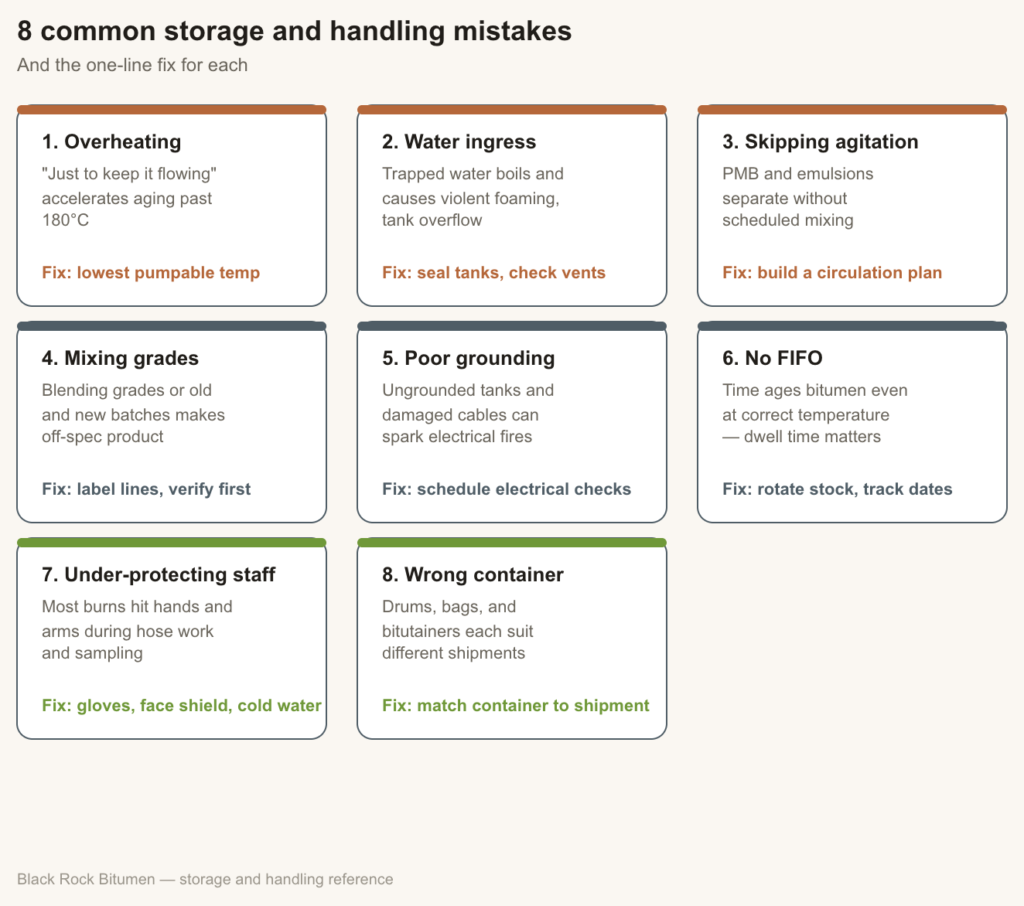
Mistake 1: Overheating the Tank “Just to Keep It Flowing”
The instinct makes sense. Bitumen gets harder to pump as it cools, so cranking the heat feels like the safe move. It isn’t. Storing bitumen at the lowest temperature that still allows safe pumping — typically 140–160°C for standard paving grades — slows oxidation significantly, while pushing past that range accelerates aging and can degrade the binder before it’s even used. The ceiling isn’t one number for every product, either: standard paving grades top out around 180–190°C, while oxidised and hard grades are formulated to run safely up to roughly 195°C (Energy Institute Model Code of Safe Practice, Part 11 — Bitumen Safety Code; Eurobitume and Asphalt Institute guidance; grade limits set out in EN 12591 / EN 14023). The rule that holds across every grade is simpler than a single number: never exceed the maximum for the specific grade you’re storing, and never let heating coils run exposed above the bitumen line.
Fix: store at the lowest pumpable temperature for the grade, check the ceiling against that grade’s own spec sheet rather than a blanket number, and treat any request to “just heat it more” as a red flag rather than a shortcut.
Mistake 2: Running Heating Coils Above the Bitumen Level
This is almost certainly what caused the explosion described at the top of this article. When the level in a tank drops below the heating coils — because the tank is only partly full, or because it’s been drawn down without anyone checking — the exposed sections of coil keep radiating heat into open air and vapour instead of into liquid bitumen. That localised overheating cokes the coil surface and builds up carbon deposits in the vapour space above the bitumen. Those deposits can self-ignite, and disturbing them — including hitting a hot tank with water, as happened in that incident — is exactly the kind of trigger that turns a maintenance oversight into a blast.
Fix: keep coils fully submerged at all times, know your tank’s minimum safe level before coils are exposed, and cut heating to any section of coil that’s coming out of the liquid rather than letting it run dry.
Mistake 3: Letting Water Get Into the Tank
This is the mistake that turns a storage problem into a safety incident. Water contamination is a serious problem specifically because when bitumen is heated for use, any trapped water boils and turns to steam almost instantly, and the resulting foam can overflow the tank entirely — creating a fire hazard, a mess, and a genuine danger to anyone standing nearby. Industry safety guidance is unambiguous on this point: water ingress must be avoided at all costs, because it’s the direct cause of violent foaming and “boil-over” events (ICHEME).
This risk is worse, not better, in humid, high-rainfall climates — exactly the conditions common across much of Africa, South America, and Southeast Asia. Rain pooling on a poorly sealed tank roof, condensation in a delivery truck’s tank, or a leaking gasket are all it takes.
Fix: seal tanks tightly, inspect vents and gaskets on the schedule set out in our storage standards guide, and never assume a truck or drum arriving from a humid port is bone dry.
Mistake 4: Skipping Agitation on PMB and Emulsions
Polymer Modified Bitumen (PMB) and bitumen emulsions aren’t just “bitumen that costs more.” They’re engineered products that need continuous or scheduled agitation to stay uniform. Without it, the polymer separates from the base bitumen and the material loses the very properties you paid extra for (Eurobitume guidance on modified binder storage). Left too long without mixing, heavier molecules also settle toward the bottom of the tank, creating an inconsistent product from top to bottom.
Fix: if you’re storing Polymer Modified Bitumen, build a circulation schedule into your storage plan from day one — don’t treat it as a nice-to-have.
Mistake 5: Mixing Grades or Batches in the Same Tank
This one sounds obvious until you’re managing a busy tank farm with multiple deliveries arriving in the same week. Combining different penetration grades, or topping off an old batch with a new one before the tank is empty, produces a blended product that doesn’t match any single specification anymore. It’s a common enough failure mode that it shows up repeatedly in industry design guidance as a labeling and process discipline issue, not just a technical one. And the cost isn’t proportional to the size of the mix-up: a cross-grade contamination event puts the whole tank off-spec, not just the portion that got mixed — every tonne in it needs re-testing, re-blending, or writing off.
Fix: label every line and manway clearly, and require a documented tank-cleaning or verification step before a new grade goes into a tank that held something different.
Mistake 6: Ignoring Tank Grounding and Electrical Maintenance
Bitumen storage incidents don’t only come from the material itself — sometimes the failure is electrical. In one documented case, a tank’s level sensor failed, bitumen overflowed, and the resulting heat damaged nearby cables. Because the tank wasn’t properly grounded, an electric arc formed and ignited a fire in the insulation (BARPI/ARIA accident database). The fire was put out, but the facility was shut down by regulators until it could prove the issue had been fixed — the kind of closure that costs weeks of production, not days.
Fix: grounding and cable integrity checks belong on the same maintenance schedule as temperature monitoring — not treated as a separate, lower-priority task. Our storage standards guide covers what a complete inspection schedule should include.
Mistake 7: No FIFO, No Limit on Dwell Time
Bitumen doesn’t sit still chemically just because it’s sitting still physically. Even under good temperature control, time itself degrades the material — the longer it sits hot in a tank, the more it ages and hardens (Energy Institute Model Code of Safe Practice, Part 11). A first-in-first-out system sounds like basic warehouse hygiene, but plenty of operators skip it because it’s easier to draw from whichever tank is closest to the pump.
Fix: track batch dates per tank, rotate stock on a FIFO basis, and set a maximum dwell time per grade rather than assuming “it’ll be fine, it’s just sitting there.”
Mistake 8: Under-Protecting the People Handling It
A study reviewing bitumen burns found that most injuries happened on worksites, involved workers averaging under 30 years old, and mainly affected the hands and upper extremities (ScienceDirect) — exactly the body parts exposed during hose connections, sampling, and drum handling. Separately, roughly 300,000 workers are employed at hot-mix asphalt facilities and paving sites in the US alone, with tens of thousands more in roofing operations (NIOSH) — and that’s before counting the workforce across every other bitumen-importing region.
Fix: heat-resistant gloves, face protection, and long sleeves aren’t optional extras for anyone connecting a hose or pulling a sample. For a burn, cool the area under cool running water for a full 20 minutes — never ice, never anything abrasive. Don’t try to peel off bitumen that’s stuck to skin, and don’t use solvents to remove it; both do more damage than the burn itself. Get medical attention for anything beyond a minor surface burn.
Mistake 9: Choosing the Wrong Container for the Job
Not every mistake happens inside a tank. Drums, bitutainers, and jumbo bags all handle differently, and picking the wrong one for your shipment size or storage duration creates its own set of problems — from excessive manual handling injuries with drums to unnecessary cost on jumbo bags for a small local job.
| Container type | Best for | Watch out for |
|---|---|---|
| Drums | Small volumes, remote or short-term sites | Higher manual handling risk, more surface area to lose heat |
| Jumbo Bags | Modified or solid-form bitumen, mid-size loads | Requires melting equipment on-site before use |
| Bitutainers | Bulk export, long-distance or intermodal shipping | Needs proper insulation checks before long transit |
| Bitubox | Packaged bulk handling with reduced spillage | Still needs the same temperature discipline as any container |
Fix: match the container to the shipment size and the distance it’s traveling, not just to what’s cheapest per tonne on paper.
Mistake 10: Skipping Checks on Transfer and Delivery
Storage gets most of the attention, but a lot of incidents happen during the handoff — not while the bitumen is sitting in the tank. Connecting a delivery hose to the wrong tank, a hose or coupling failing under pressure, or leaving an unloading operation unsupervised are all common enough that they belong on this list, not as footnotes to it.
Fix: verify the line and destination tank match before every transfer starts, use dedicated or clearly marked couplings per grade so a wrong connection is hard to make, and never leave a delivery or unloading operation unsupervised from start to finish.
Mistake 11: Entering a Confined-Space Tank Without a Permit
An “empty” tank isn’t empty of risk. Residual fumes, low oxygen, and heat retained in the tank shell make entering one of the most dangerous jobs on a bitumen site — and it’s also one of the jobs crews are least trained for, because it doesn’t come up often enough to feel routine.
Fix: treat every tank entry as a formal confined-space permit job, every time: atmospheric testing before entry, forced ventilation, a trained attendant stationed outside, and rescue equipment ready — regardless of how quick the job looks.
Mistake 12: Restarting a Solidified Tank Too Fast
If a tank has gone cold and the bitumen inside has solidified, the instinct is to get the heat back up as quickly as possible. That’s how coils get damaged and how trapped pockets form — pockets of moisture or vapour sealed inside the solid mass that can flash to steam or expand unevenly as the surrounding material softens.
Fix: bring a solidified tank back up slowly and evenly rather than blasting the heat, inspect coils for damage before re-energizing them, and watch for uneven softening that signals a trapped pocket rather than a uniformly reheated tank.
Quick-Reference: Storage Temperatures by Product Type
| Product type | Storage temperature | Key handling note |
|---|---|---|
| Standard paving grade (60/70, 80/100, etc.) | 140–160°C | Store at the lowest temperature that still allows pumping; treat ~180–190°C as the practical ceiling for this grade family |
| Hard or oxidised grades | 165–195°C | Higher viscosity needs more heat — but never past the maximum for that specific grade |
| Polymer Modified Bitumen | 170–180°C | Needs continuous or scheduled agitation to prevent separation |
| Bitumen emulsion | Above 0°C (never allow freezing), typically below 60°C | Heating too far breaks the emulsion prematurely; most grades should be used within 1–3 months and re-tested if stored longer |
| Cutback bitumen | Ambient to 50°C max | Contains flammable solvent — keep away from ignition sources |
Sources: Energy Institute Model Code of Safe Practice, Part 11 (Bitumen Safety Code); Eurobitume and Asphalt Institute guidance; EN 12591 / EN 14023.
A Note on Where Most Failures Actually Start
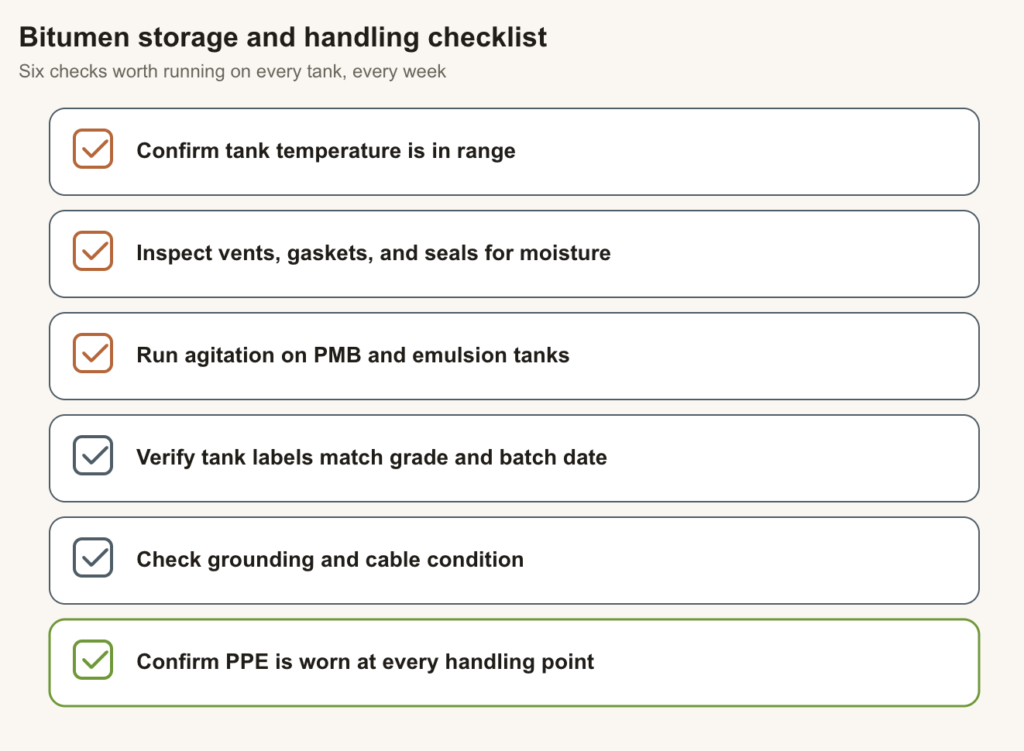
It’s worth saying plainly: the material usually isn’t the problem. It’s what happens to it after it leaves the refinery. If you want the fuller picture — tank design, heating systems, transport standards, and a complete safety framework — we’ve laid all of it out in our guide to bitumen storage, handling, and transport standards for safe project execution. This post is the shorter, mistake-focused version; that one is the full reference.
Frequently Asked Questions
What temperature should bitumen be stored at? Most standard paving grades should be stored at the lowest temperature that still allows safe pumping — typically 140 to 160°C. The maximum depends on the grade: standard paving grades top out around 180–190°C, while Polymer Modified Bitumen and harder, oxidised grades are formulated to run higher, up to roughly 195°C. Every grade has its own ceiling, and it shouldn’t be treated as a single number that applies across the board.
Can bitumen catch fire in storage? Yes. Bitumen itself has a flash point, but most storage fires and explosions trace back to secondary causes — water contamination triggering violent foaming, heating coils left exposed above the bitumen level and coking, electrical faults from poor grounding, or heating systems malfunctioning. The material is dangerous mainly because of the temperatures it’s stored at, not because it’s inherently explosive.
How long can bitumen sit in storage before it goes bad? Standard paving grade can typically be stored for weeks to months if temperature is controlled and dwell time is tracked. Polymer Modified Bitumen and other engineered grades are more time-sensitive and shouldn’t sit at high temperatures for extended periods without agitation. Emulsions are the most time-sensitive of all — most should be used within one to three months and re-tested if stored longer.
Is it safe to mix two batches of the same grade in one tank? Generally yes, if they’re genuinely the same grade and specification — but even then, label the tank clearly and document it. Mixing different grades or blending an old, aged batch with fresh material is what causes off-spec product, not mixing per se — and when it happens, it takes the entire tank off-spec, not just the mixed portion.
The Bottom Line
Storage and handling mistakes don’t usually announce themselves. There’s no dramatic moment where a supplier admits the tank was overheated or the water wasn’t checked for. What you get instead is bitumen that performs worse than its Certificate of Analysis promised, a shipment that gets rejected on arrival, or — in the worst cases — a fire that shuts a facility down for weeks.
None of these failures scale down neatly. A rejected tanker load doesn’t cost you the value of the off-spec portion — the whole shipment gets sent back or re-tested at your expense. A cross-grade contamination event takes the whole tank off-spec, not a fraction of it, and every tonne in it needs re-blending, re-certifying, or scrapping. A contaminated or badly grounded tank can mean days of downtime while it’s drained, cleaned, inspected, and requalified before anyone trusts it with product again. And a fire serious enough to bring in regulators, like the grounding failure above, doesn’t end when the flames are out — it can keep a facility shut for weeks while the cause is investigated and proven fixed.
Every mistake on this list has a fix that costs far less than the failure it prevents.