
Someone has been quoted cold mix for a job where hot mix was assumed, or the other way round, and the price difference is large enough to need an explanation.
The difference is not really temperature. It is how the mixture gains its strength. Hot mix asphalt is fluid because the binder is hot, so it has to be compacted before it cools, and it is at full strength as soon as it does. Cold mix is fluid because the binder is emulsified in water, cut back with solvent or foamed, so there is no cooling clock — but strength only arrives once the water or solvent has left and the binder has cured, which takes days to weeks rather than hours.
Black Rock Bitumen supplies the binders behind both: hot penetration and performance grades for hot mix plants, and emulsions and cutbacks for cold mix and surface treatments. Everything below — where each is used, what each costs, which weather each tolerates — follows from that one difference in how strength arrives.
Key takeaway: hot mix builds and rebuilds roads; cold mix keeps them serviceable in between and reaches places hot mix cannot. Choose hot mix where traffic is heavy, the layer is structural or the road must open quickly. Choose cold mix where the site is remote, the repair is small or scattered, the weather is marginal, or the material has to be stored.
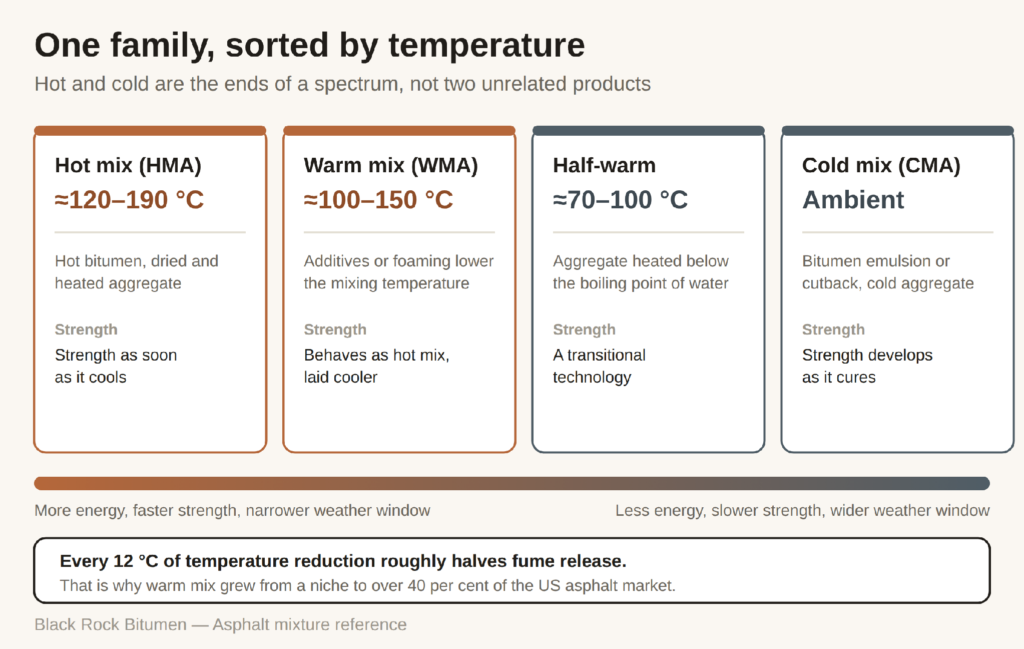
Figure 1. Hot and cold are the ends of a spectrum rather than two unrelated products. Temperature bands follow the European Asphalt Pavement Association’s definitions; more energy buys faster strength and a narrower weather window.
Alt text: Asphalt mixtures sorted by production temperature, from hot mix through warm and half-warm to cold mix.
Hot, Warm, Half-Warm and Cold: One Family
It helps to see these as a temperature spectrum rather than two opposing products. The European Asphalt Pavement Association sets out the bands: hot mix asphalt is produced at roughly 120 to 190 °C, warm mix at roughly 100 to 150 °C, half-warm asphalt at roughly 70 to 100 °C, and cold mixes are produced with unheated aggregate and bitumen emulsion or foamed bitumen.
| Mixture | Production temperature | Binder form | How strength arrives |
|---|---|---|---|
| Hot mix (HMA) | Roughly 120–190 °C | Hot bitumen; aggregate dried and heated | As the mat cools — usually trafficable within hours |
| Warm mix (WMA) | Roughly 100–150 °C | Hot bitumen with additives, wax or foaming | As for hot mix, but laid cooler |
| Half-warm | Roughly 70–100 °C | Aggregate heated below the boiling point of water | Transitional; between warm and cold behaviour |
| Cold mix (CMA) | Ambient | Bitumen emulsion, foamed bitumen or cutback; unheated aggregate | By curing — water or solvent leaves over days to weeks |
A Note on Cold Mix Binders
Cold mix is made with one of three binder forms, and they are not interchangeable. Bitumen emulsion — bitumen dispersed in water with an emulsifier — is the dominant form worldwide and the basis of most national cold mix guidance. Foamed bitumen, made by injecting a small amount of water into hot bitumen to expand it briefly, is widely used in cold in-place recycling and stabilised base work. Cutback bitumen, thinned with a petroleum solvent, is the oldest form and still in use, but it is restricted or discouraged in many markets because the solvent evaporates into the atmosphere and lowers the flash point of the material being handled. If a cold mix is quoted, it is worth asking which of the three it is built on.
Warm mix deserves a note too, because it is often misunderstood as a halfway house. It is not a compromise between hot and cold: it is hot mix made at a lower temperature, specified and used as hot mix. The environmental driver is straightforward — as a rule of thumb, fume release roughly halves for every 12 °C of temperature reduction — and the commercial result is that warm mix reached 40.2 per cent of the US asphalt market in 2024, at 178.3 million tons, according to NAPA’s annual industry survey (IS 138), published with FHWA.
The Real Difference: How Strength Arrives
Figure 2. The single most important difference. Hot mix cools into strength and carries traffic within hours; cold mix cures into it over days to weeks, which is why it is weakest exactly when it is newest.
Alt text: How hot mix and cold mix each gain strength, from mixing through to full strength.
Hot Mix Cools Into Strength
In a hot mix, the binder is fluid because it is hot. The mix has to be spread and compacted before it cools past the point where the rollers can still move the aggregate, and once it has cooled it is at working strength. That is why hot mix carries traffic almost immediately, and also why it is so weather-sensitive: surface temperature, wind and lift thickness all shorten the compaction window, and a mat that cooled too fast is permanently under-compacted. Our guide to seasonal scheduling covers that window in detail.
Cold Mix Cures Into Strength
In a cold mix, the binder is fluid because it is dispersed in water, foamed, or thinned with solvent. There is no cooling clock, so the material stays workable for months in a stockpile and can be laid in conditions that would stop a hot mix crew. The trade-off arrives afterwards: the emulsion has to break, the water or solvent has to leave, and strength builds gradually as it does.
That gap used to be very wide. In a 2025 review of cold mix research, Malik and colleagues record that early formulations reached Marshall stability of only 3.5 to 4.5 kN against 8 to 12 kN for typical hot mix, and took 28 to 90 days to reach full strength where hot mix is ready for traffic within 24 hours (Materials, 2025). The same review reports that modern cold mixes, using nano-modified binders, polymer and rubber additives and optimised recycled content, have narrowed that gap considerably — with rapid strength gain now achievable within 24 hours. But the principle still holds: cold mix is weakest exactly when it is newest.
Property by Property
| Property | Hot mix | Cold mix |
|---|---|---|
| Binder | Hot penetration, viscosity or PG grade | Bitumen emulsion, foamed bitumen or cutback |
| Production | Plant with dryer and heated storage | Ambient mixing; can be site-mixed |
| Strength on day one | Full — trafficable within hours | Low; builds over days to weeks |
| Weather tolerance | Narrow; needs warm, dry conditions | Wide; workable in cool and damp conditions |
| Storage | Hours — it must be used while hot | Months in a stockpile or bagged |
| Haul distance | Limited by heat loss | Effectively unlimited |
| Energy and emissions | Highest of the family | Lowest — the 2025 review puts the saving at 35–50 per cent energy and 40–60 per cent emissions |
| Structural capability | Suitable for all layers including base | Mostly surface, patching and low-volume use |
| Recycled content | High contents possible with design | Very high contents achievable |
| Typical cost per tonne | Lower at scale | Higher per tonne, but no plant, haul or heating cost |
The last row causes the most confusion. Cold mix is usually more expensive per tonne than hot mix, yet frequently cheaper for the job — because a pothole repair does not justify mobilising a paving crew, and a remote site may not have a hot mix plant within an economic haul at all.
Where Each One Is Used
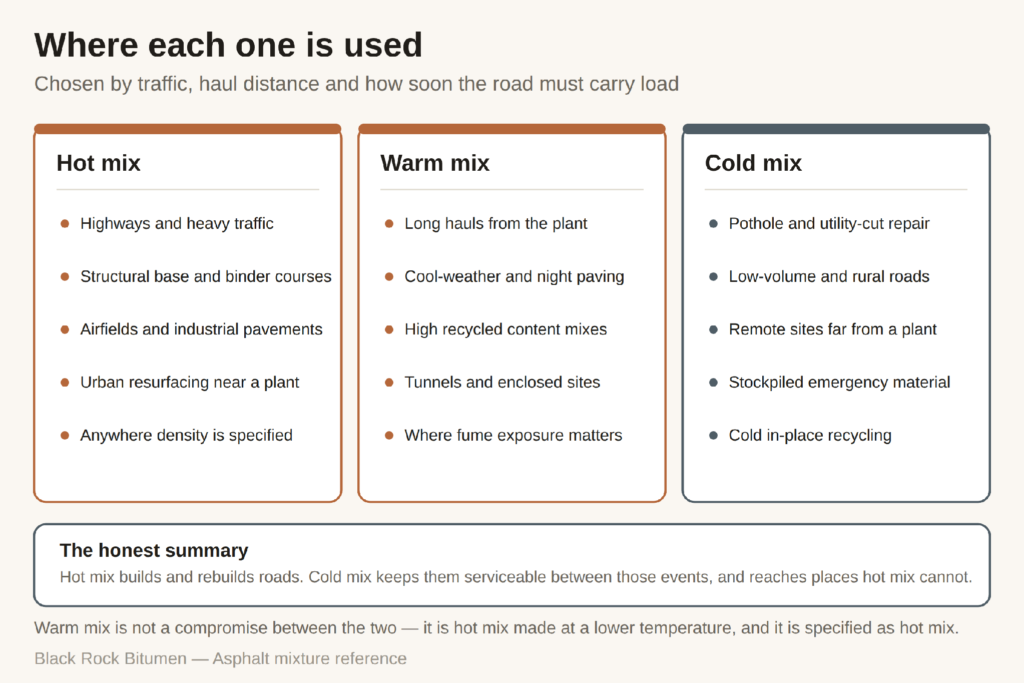
Figure 3. Hot mix builds and rebuilds roads. Cold mix keeps them serviceable between those events and reaches sites hot mix cannot. Warm mix is not a compromise between them — it is hot mix made cooler.
Alt text: Where hot mix, warm mix and cold mix are each used, by application type.
Hot Mix: Building and Rebuilding
Hot mix is the default wherever the pavement is being built or rebuilt: highways, structural base and binder courses, airfields, industrial pavements, and urban resurfacing within economic reach of a plant. If a specification sets a density requirement and a service life measured in decades, it is almost certainly a hot mix specification. Grade selection then follows the climate and traffic, as covered in our guides to bitumen grade selection and choosing a grade for your climate.
Warm Mix: Hot Mix With More Room
Warm mix earns its place where the constraint is the temperature rather than the material: long hauls from the plant, cool-weather or night paving where the compaction window is tight, high recycled contents where lower temperatures reduce binder ageing, tunnels and enclosed sites where fume matters, and anywhere worker exposure is a live concern.
Cold Mix: Maintaining and Reaching
Cold mix does two jobs hot mix cannot. It maintains — pothole repair, utility reinstatement, edge repairs, scattered patching where mobilising a hot plant makes no sense. And it reaches — low-volume and rural roads, hill and remote sites, places where the nearest hot mix plant is hours away or the road cannot take a delivery truck at temperature.
There is a third role worth naming: cold in-place recycling, where the existing pavement is milled and mixed on site with emulsion or foamed bitumen. That is a full structural treatment rather than a patch, and it is covered in our guide to reclaimed asphalt pavement.
Cold Mix Is a Standardised Technology, Not an Improvisation
It is worth correcting a common assumption. ASTM D4215, currently in its 2021 edition and active, specifies cold-mixed, cold-laid and recycled cold-mixed asphalt paving mixtures for base, binder, levelling and surface courses. It sits alongside companion test methods under the same ASTM subcommittee, including D6704 for the workability of cold mix patching material and D7196 for the raveling test on cold-mixed emulsified asphalt samples.
National guidance exists too. In India, IRC:SP:100-2014, “Use of Cold Mix Technology in Construction and Maintenance of Roads Using Bitumen Emulsion”, is a full manual covering emulsion chemistry, specification and testing, spray applications, surface treatments, cold mixes, half-warm mixes, maintenance mixtures and cold recycling. It is widely used in hill states and rural road programmes. Its companion, IRC:SP:101-2014, covers warm mix asphalt — so the Indian framework addresses the whole temperature spectrum, not just hot mix.
Choosing Between Them
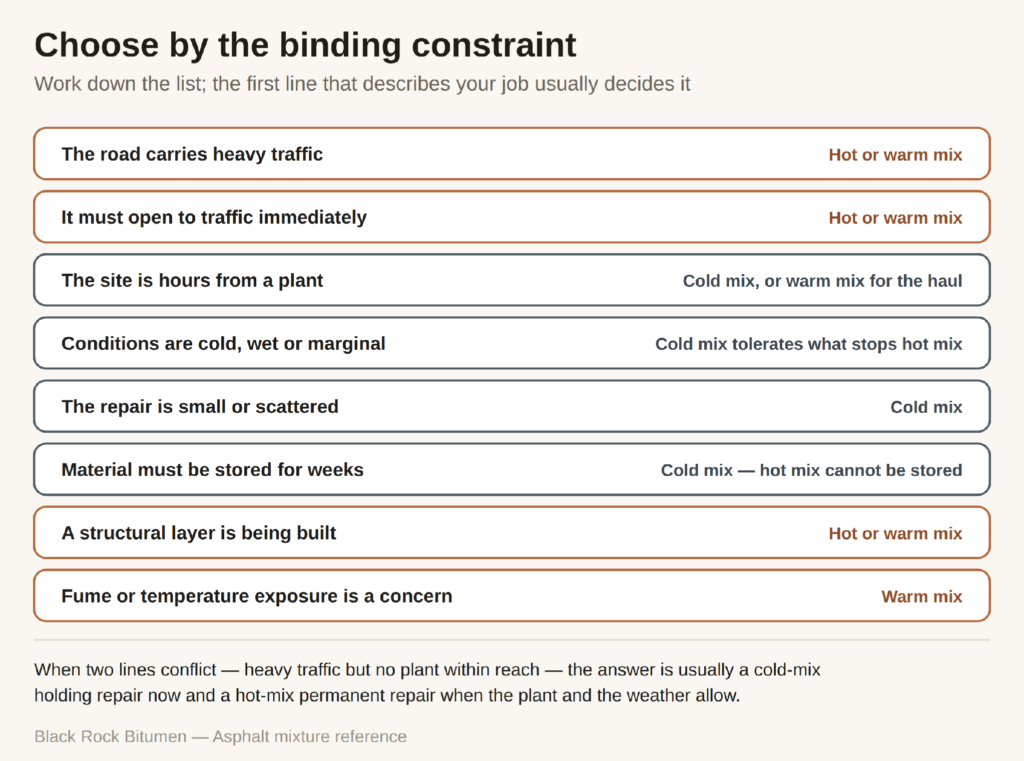
Figure 4. Work down the list; the first line that describes your job usually decides it. Where two lines conflict, the answer is normally sequencing rather than compromise.
Alt text: A decision guide matching eight common project constraints to hot, warm or cold mix.
In practice the decision is usually made by one binding constraint rather than by weighing everything:
| If this is true | The answer is usually |
|---|---|
| The road carries heavy or slow traffic | Hot mix, or warm mix |
| It must open to traffic immediately | Hot mix, or warm mix |
| A structural layer is being built | Hot mix, or warm mix |
| The site is hours from the nearest plant | Cold mix; warm mix if hot mix is still viable |
| Conditions are cool, damp or marginal | Cold mix, which tolerates what stops hot mix |
| The repair is small, scattered or urgent | Cold mix |
| Material must be stored for weeks | Cold mix — hot mix cannot be stored |
| Fume or heat exposure is a concern | Warm mix |
Where two constraints conflict — heavy traffic but no plant in reach, or a structural failure in the middle of a wet season — the usual answer is sequencing rather than compromise: a cold mix holding repair now, and a permanent hot mix repair when the plant and the weather allow.
Common Mistakes
Using cold mix as a permanent wearing course on a busy road. It will ravel and deform under traffic it was never designed to carry. Cold mix on a heavily trafficked road is a holding repair, and should be budgeted as one.
Judging cold mix by its cost per tonne. The comparison that matters is the cost of the job. Cold mix avoids plant mobilisation, heated haulage and a paving crew.
Expecting cold mix to be strong on day one. Strength develops as it cures. Traffic helps compact it, but the material is at its weakest immediately after placement.
Compacting cold mix too little. Poor compaction is the most common cause of early failure in cold mix repairs; the material needs real compactive effort, not just tamping.
Treating warm mix as a lesser product. It is hot mix made at a lower temperature and is specified, tested and accepted as hot mix.
Assuming all cold mix uses the same binder. Emulsion, foamed bitumen and cutback behave differently, cure differently, and are regulated differently. Ask which one is proposed.
Using cold patch and calling the pothole fixed. A patch addresses the symptom. If water is entering the pavement structure, the repair buys time rather than solving the problem.
Binder Supply for Both
Black Rock Bitumen supplies penetration grade, viscosity grade and performance grade binders and polymer-modified bitumen for hot and warm mix production, and bitumen emulsions and, on request, cutback grades for cold mix, patching and surface treatments — all from Dubai, with a batch certificate of analysis and safety data sheet.
If the same project needs both — a hot mix overlay and a stock of cold patch for the maintenance period afterwards — send us the two requirements together and we will plan the deliveries around the working season rather than shipping them separately. For how the binder is sprayed in surface treatments, see our guide to how a bitumen distributor works.
Frequently Asked Questions
What is the difference between hot mix and cold mix asphalt? Hot mix is produced with heated aggregate and hot bitumen at roughly 120 to 190 °C, and reaches full strength as it cools. Cold mix is produced at ambient temperature using bitumen emulsion, foamed bitumen or cutback, and gains strength as the water or solvent leaves and the binder cures over days to weeks.
Is cold mix asphalt permanent? It can be a permanent solution on low-volume roads and in properly designed cold-mixed layers — ASTM D4215 covers cold-laid mixtures for base through surface courses. As a pothole or utility-cut repair on a trafficked road it is normally a holding repair. The right expectation depends on the traffic and the design, not the material name.
When should I use cold mix instead of hot mix? When the site is far from a plant, the repair is small or scattered, the weather is too cool or damp for hot mix, the work is urgent, or the material has to be stored. Hot mix remains the choice for structural layers and heavily trafficked surfaces.
How long does cold mix take to cure? Days to weeks, depending on the mixture, the weather and the traffic. Research on earlier formulations records 28 to 90 days to full strength, while modern cold mixes can develop strength within 24 hours.
Is cold mix cheaper than hot mix? Usually more expensive per tonne, but often cheaper for the job. Cold mix avoids plant mobilisation, heated haulage and a full paving crew, which is why it wins on small, scattered or remote work.
What is warm mix asphalt? Hot mix produced at a lower temperature — roughly 100 to 150 °C — using additives, wax or foaming. It reduces energy use and fume exposure, extends haul distances and helps in cool-weather paving. It reached 40.2 per cent of the US asphalt market in 2024 according to NAPA’s annual survey.
Does cold mix use the same bitumen as hot mix? Not in the same form. Hot mix uses hot bitumen of a specified penetration, viscosity or performance grade. Cold mix uses that bitumen emulsified in water, foamed, or cut back with solvent so that it is fluid at ambient temperature.
Is cold mix better for the environment? It uses substantially less energy and produces fewer emissions than hot mix — a 2025 review puts the saving at 35 to 50 per cent energy and 40 to 60 per cent emissions. Whether that makes it the better choice overall depends on service life: a treatment that needs replacing repeatedly can erase the saving.
The Bottom Line
Hot mix and cold mix answer different questions. Hot mix gives full strength immediately and takes any traffic, at the cost of a plant, a haul limit and a narrow weather window. Cold mix goes anywhere, waits in a stockpile and tolerates conditions that stop a hot mix crew, at the cost of time before it reaches strength.
Warm mix sits alongside hot mix rather than between the two, offering the same performance at a lower temperature — which is why it now accounts for a large share of production in mature markets.
Match the mixture to the binding constraint, and budget the holding repairs as holding repairs.