
In northern Europe the question is “how late into autumn can we keep going?” In the Gulf it is “do we work nights?” In India it is “can we finish before the rains?”
Underneath those regional differences the physics is the same. Hot mix asphalt has to be placed and compacted before it cools below the temperature at which the rollers can still achieve density, and bituminous binders will not bond to a wet surface. Everything else — the paving season, the monsoon shutdown, the night shift — follows from those two facts.
Black Rock Bitumen supplies binders into all of those calendars at once, which is why this guide covers the principles first, then a region-by-region calendar, and finishes with how to plan a programme backwards from the window you actually have.
Key takeaway: there is no universal best month. The window is set by surface temperature, wind, lift thickness and rainfall, and it closes for opposite reasons in cold and hot climates. Work out the compaction window for your conditions, avoid wet surfaces entirely, and place the binder order before the season’s demand peak rather than during it.
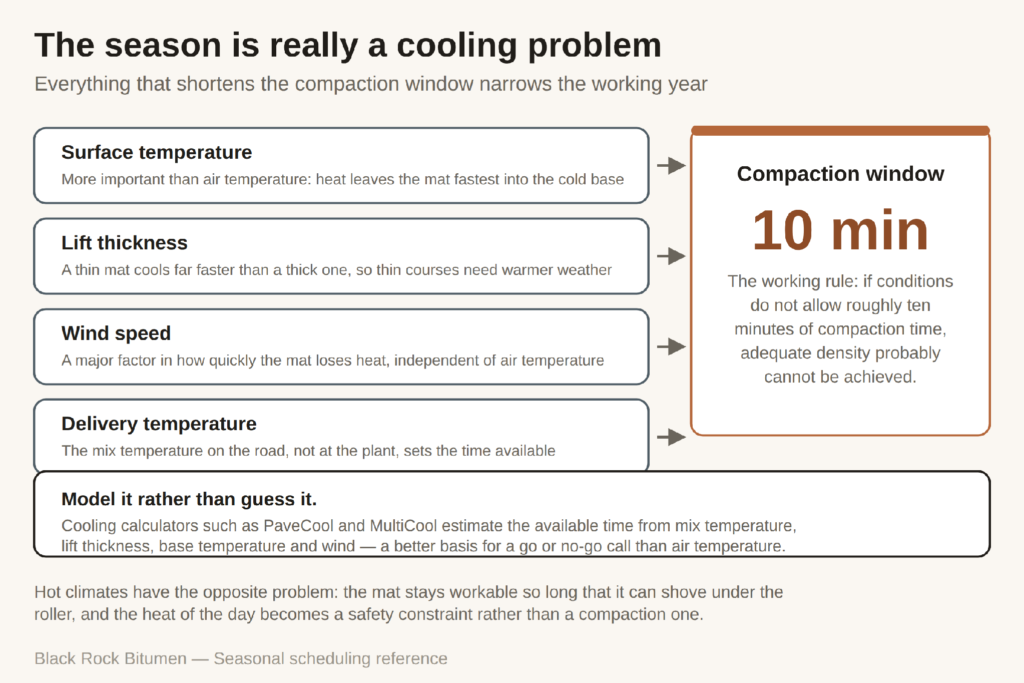
Figure 1. The paving season is really a cooling problem. Surface temperature, lift thickness, wind and delivery temperature all shorten the time available to compact — and in hot climates the constraint inverts entirely.
Alt text: The four factors that shorten the asphalt compaction window, and the ten-minute working rule.
Why the Season Exists at All
A paving crew is racing a cooling curve. The mix arrives at the paver hot, and compaction has to be finished before the mat drops below the temperature at which the rollers can still move the aggregate. The industry rule of thumb is blunt: if conditions do not allow roughly ten minutes of compaction time, adequate density probably cannot be achieved.
Four things control that window. In “Cold Weather Compaction”, Asphalt magazine makes the key point that both air and surface temperature matter but surface temperature matters more, because heat leaves the mat fastest into the material it is lying on. Wind speed is a major factor in its own right. Lift thickness is the other half of the equation — a thin mat cools far faster than a thick one, which is why a 40 mm surface course needs better conditions than a 100 mm binder course.
This is why experienced schedulers model the window rather than reading the forecast. Free tools such as PaveCool and MultiCool estimate the available compaction time from mix temperature, lift thickness, base temperature and wind speed, and give a far better basis for a go or no-go decision than air temperature alone.
Why Density Matters More Than Appearance
A mat that cooled too fast looks finished and is not. Low density means high air voids, water infiltration, ravelling and a surface that ages faster than the design assumed. The damage is invisible on the day and expensive three winters later, which is precisely why specifications set cessation temperatures rather than leaving it to judgement.
The Weather Limits That Stop Work
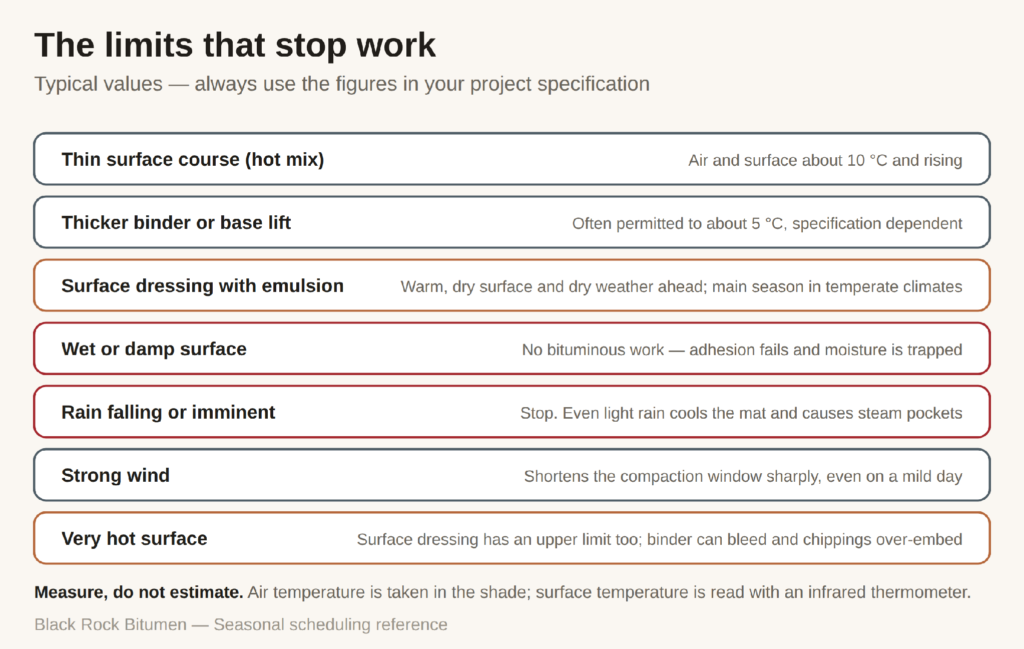
Figure 2. Typical values only: the project specification always governs. Note that the low-temperature limits at the top of the chart will never bind in a Gulf or equatorial summer — there, the upper limits and the night-work sections are the relevant ones.
Alt text: Typical weather limits for bituminous work, from minimum temperatures to rain and wind.
Specifications vary, but the shape of the rules is consistent worldwide:
| Condition | Typical rule | Why |
|---|---|---|
| Air and surface temperature | Around 10 °C and rising for thin surface courses; lower limits, often near 5 °C, for thicker lifts | Thin mats lose heat too fast to compact in cool conditions |
| Falling temperature | Many specifications require temperature to be rising, not falling | A falling reading means the window is closing during the shift |
| Wet or damp surface | No bituminous work at all | Moisture prevents bond and is trapped under the new layer |
| Rain falling or imminent | Stop work | Even light rain cools the mat and creates steam at the interface |
| Wind | Judgement, informed by a cooling model | Wind shortens the window sharply even on a mild day |
| Very hot surface | Upper limits apply to surface dressing | Binder can bleed and chippings over-embed |
If you work in a hot climate, the first two rows will never bind on you. A Gulf or equatorial crew will not meet a 10 °C limit in any month, and the constraints that matter are the upper ones: surface temperature limits for surface treatments, worker heat rules, and the shift to night work. Those are covered in the next section, and the wet-surface rule is the one line in this table that applies everywhere.
Two practical notes for everyone. Air temperature is measured in the shade; surface temperature is read with an infrared thermometer and is frequently very different. And the rule about wet surfaces is absolute rather than a preference — laying bitumen on a damp base is one of the most reliable ways to build a road that fails early.
Hot Climates Have the Opposite Problem
In the Gulf, North Africa and much of South Asia in summer, the constraint is not that the mat cools too fast. It is that it stays workable so long that it can shove and displace under the roller, that the crew is working in dangerous heat, and that the finished surface faces its worst rutting conditions immediately.
Regulation reflects this, and it is not confined to one country. In the UAE, the Ministry of Human Resources and Emiratisation’s Occupational Heat Stress Prevention Policy — the midday break — runs annually from 15 June to 15 September, banning work in direct sunlight between 12:30 and 15:00; the 2026 season was the twenty-second consecutive year. Asphalt laying is among the published exemptions where work cannot be interrupted or postponed for technical reasons, but sites still carry the duty to provide shade, water and cooling.
Neighbouring countries run their own versions, with different dates and hours, so a regional contractor cannot assume one rule covers the Gulf (comparative summary):
| Country | Typical period | Restricted hours |
|---|---|---|
| United Arab Emirates | 15 June – 15 September | 12:30 – 15:00 |
| Saudi Arabia | 15 June – 15 September | Generally 12:00 – 15:00 |
| Kuwait | 1 June – 31 August | 11:00 – 16:00 |
| Oman | 1 June – 31 August | 12:30 – 15:30 |
| Bahrain | Typically mid-June – late August or mid-September | 12:00 – 16:00 |
| Qatar | Summer period set annually | One of the region’s longest restricted windows |
Dates and hours are announced or confirmed annually by the responsible ministry in each country; check the current announcement before building a programme around them.
The practical effect across the region is the same: summer resurfacing moves to early mornings and night shifts. Night paving brings its own trade-offs. Temperatures are more workable and traffic disruption is lower, but lighting, supervision, compaction control and haul logistics all become harder, and the surface temperature drops through the shift rather than rising. The gain is real, but it is not free.
Grade selection matters more in these conditions than the calendar does. A binder chosen for the site’s actual pavement temperatures will tolerate a hot placement far better than one chosen for convenience — the subject of our guides to grade selection, choosing a grade for your climate and performance grading.
Rain, Monsoon and the Drying Rule
Where rainfall rather than temperature governs, scheduling becomes a matter of finding the dry window and protecting it.
Three rules apply almost everywhere. Bituminous layers go onto dry surfaces only. After rain, the surface needs time to dry through, not just at the surface — practitioners in monsoon regions commonly allow several days after heavy rain before bituminous work resumes. And an emulsion-based treatment needs the binder to break and cure before rain arrives, which makes the forecast for the following hours as important as the conditions at the moment of spraying.
This is why surface dressing and other emulsion treatments have tighter seasonal windows than hot mix. In the United Kingdom the surface dressing season runs April to September, with May to August as the main period. In monsoon climates the equivalent window is whatever falls outside the rains. For how the binder is applied and why the spray rate and timing are so sensitive, see our guide to how a bitumen distributor works.
A Region-by-Region Calendar
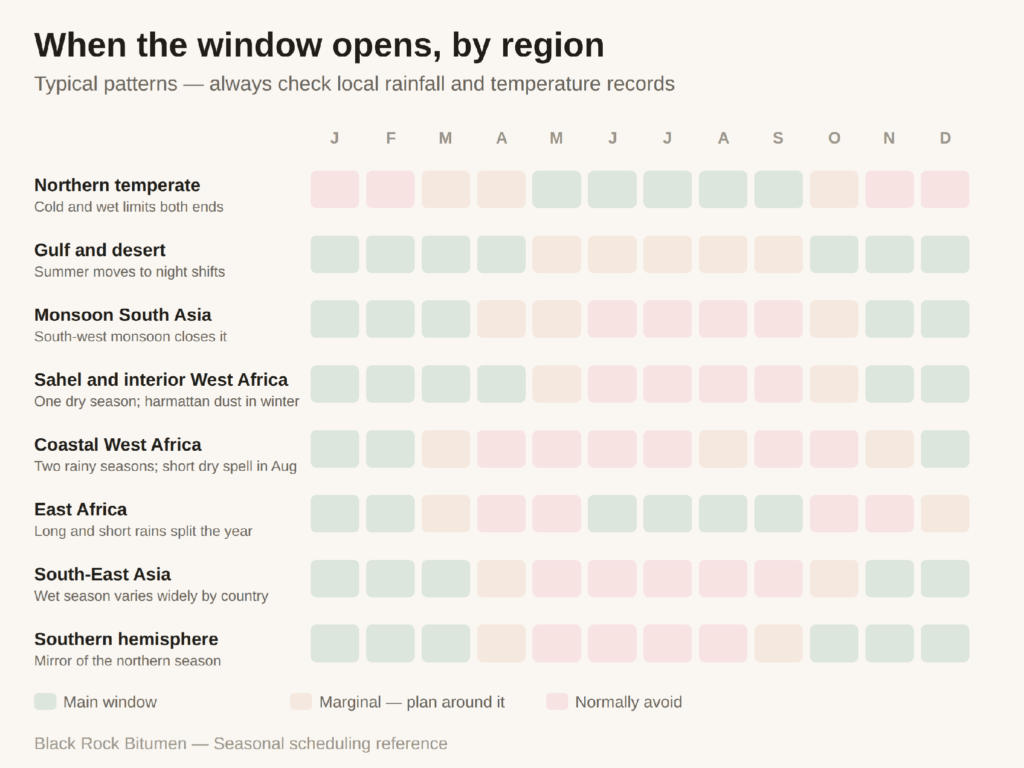
Figure 3. Typical patterns rather than a rule. Regions with a single dry season concentrate a year’s programme into a few months; those with two rainy seasons, such as East Africa and coastal West Africa, get two shorter windows instead.
Alt text: Regional resurfacing calendar showing main, marginal and avoid months for eight climate regions.
The table below gives typical patterns. They are a starting point for planning, not a substitute for local rainfall and temperature records — and in large countries the pattern varies by region as much as it does between countries.
| Region | Main window | Avoid | Notes |
|---|---|---|---|
| Northern temperate (UK, Europe, North America) | May to September | November to March | Shoulder months workable for thicker lifts; surface dressing April to September |
| Gulf and desert (UAE, Saudi Arabia, Qatar) | October to April | Midday, June to September | Summer work shifts to nights; midday outdoor work restricted by law |
| Monsoon South Asia (India, Bangladesh, Sri Lanka) | October to May | June to September | South-west monsoon; the north-east monsoon adds an October to December constraint in the south-east |
| Sahel and interior West Africa | October to May | June to September | A single dry season; harmattan dust affects surface cleanliness in winter |
| Coastal West Africa (Gulf of Guinea) | November to February, plus a short spell around August | April to July, and September to October | Two rainy seasons, with a “little dry season” between them — the single dry-season assumption does not hold here |
| East Africa | June to September, and January to February | Long rains around March to May; short rains around October to December | Two rainy seasons split the year into two working windows |
| South-East Asia | November to April in much of the region | The local wet season | Wet season timing varies widely — check by country and coast |
| Southern hemisphere temperate | October to April | June to August | Mirror of the northern season; summer rainfall areas need afternoon storm allowance |
Two patterns are worth noting. Regions with a single dry season concentrate an entire year’s programme into a few months, which pushes up demand for binder, plant and crews at exactly the same time each year. Regions with two rainy seasons — East Africa, and the Gulf of Guinea coast — get two shorter windows instead: harder to plan, but less exposed to a single wet spell wrecking the programme.
The Windows Are Moving
Scheduling assumptions built on twenty-year-old climate records are becoming less reliable, and the effect runs in both directions. In the United Kingdom, the Road Surface Treatments Association asked permitting authorities in 2026 for more flexibility on timing because road surface temperatures were exceeding the maxima set in TRL Road Note 39 for surface dressing. Its statement noted that surfaces in direct sunlight were understood to have exceeded 50 °C during a 35 °C heatwave, and asked authorities not to require contractors to work in the middle of the day.
The commercial effect showed up in the figures: the Road Emulsion Association reported that surface dressing volumes fell 6 per cent in the first half of 2026 against the same period the previous year, in what is normally the busiest quarter of the season. A treatment whose season traditionally existed because of cold is now being constrained by heat at its peak.
The practical response is not to redraw the calendar once, but to schedule against measured conditions rather than against the month. Two questions are worth asking of any programme: does it assume a window that recent seasons have actually delivered, and does it have contingency for the window closing earlier or opening later than planned?
Planning Backwards From the Window
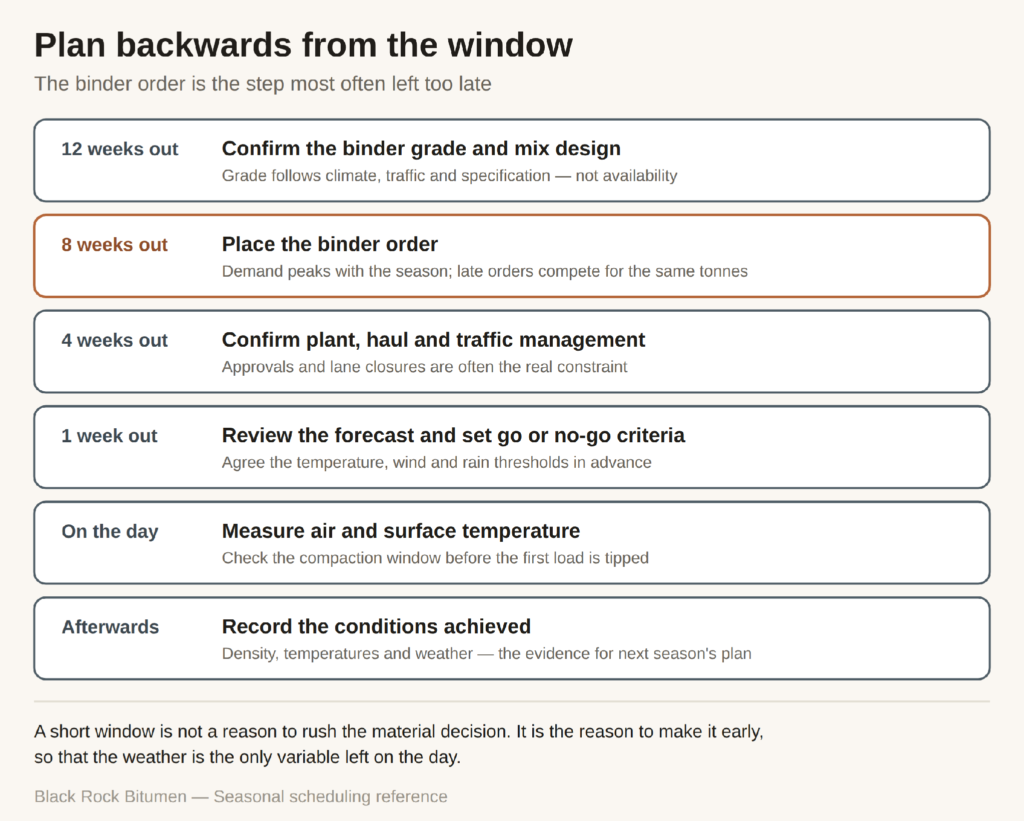
Figure 4. Plan backwards from the window. The binder order at eight weeks is the step most often left too late, because in a single-season market every contractor orders the same grades in the same weeks.
Alt text: A planning timeline working backwards from the paving window, from twelve weeks out to after the work.
Once the window is known, the programme should be built backwards from it. The step most often left too late is the binder order, because demand peaks with the season in every market.
- Twelve weeks out: confirm the grade and mix design against the project specification, climate and traffic. This is a technical decision, not a procurement one.
- Eight weeks out: place the binder order. In a single-season market, everyone is ordering the same grade in the same weeks.
- Four weeks out: confirm plant capacity, haul distance, traffic management approvals and lane closure permits.
- One week out: review the forecast and agree the go or no-go criteria in writing — temperature, wind and rain thresholds, and who makes the call.
- On the day: measure air and surface temperature, check the compaction window for the actual lift thickness, and confirm delivery temperature at the paver.
- Afterwards: record conditions, densities and temperatures achieved, so that next season’s plan is based on evidence rather than habit.
For the commercial side of that eight-week step, our guide to questions to ask a bitumen supplier covers lead times, quantity tolerance and what to agree before the order goes in. And if material arrives cold or has been held too long while a window slipped, our guide to why bitumen will not pour covers the diagnosis.
Different Treatments, Different Windows
| Treatment | Window | Governing constraint |
|---|---|---|
| Hot mix overlay and resurfacing | The broadest window of the common treatments | Compaction time before the mat cools |
| Thin surface course | Narrower than a thicker overlay | Cools fastest; needs the warmest conditions |
| Surface dressing and chip seals | Warm season only, with an upper temperature limit too | Emulsion must break and cure; chippings must embed before traffic |
| Slurry surfacing and microsurfacing | Warm, dry conditions with dry weather following | Curing before rain or traffic |
| Crack sealing | Cool but dry conditions are often preferred | Cracks are at their widest when the pavement is cold |
| Pothole repair with cold-mix | Year round | A holding repair, not a resurfacing treatment |
This ordering is useful for programme planning: when a window shortens unexpectedly, hot mix work is usually the last thing to become impossible and surface treatments the first. A programme that front-loads surface dressing into the reliable part of the season and keeps hot mix work for the shoulder months makes better use of the year than one that treats all work as equally weather-sensitive.
Planning Your Binder Supply Around the Season
Black Rock Bitumen supplies penetration grade, viscosity grade and performance grade binders, polymer-modified bitumen and bitumen emulsions from Dubai, in drums, jumbo bags, bitutainers and bulk, for projects across Africa, Asia and the Middle East.
Because our markets run on different calendars, we are used to programmes that need binder delivered ahead of a narrow dry window rather than spread evenly through the year. Send us your season’s grade, tonnage, destination port and the date the window opens, and we will work the shipping schedule backwards from it — start here.
Frequently Asked Questions
What is the best time of year to resurface a road? It depends on the climate. In northern temperate regions the main season runs roughly May to September. In the Gulf the best window is October to April, with summer work moved to nights. In monsoon regions it is the dry months, typically October to May in South Asia. The common requirement is a warm, dry surface and enough time to compact before the mat cools.
What is the minimum temperature for laying asphalt? Specifications vary, but around 10 °C and rising for air and surface temperature is a common limit for thin surface courses, with lower limits for thicker lifts. Surface temperature matters more than air temperature, and many specifications also require the temperature to be rising rather than falling.
Can you lay asphalt in the rain? No. Bituminous layers must go onto a dry surface. Rain cools the mat, creates steam at the interface, and traps moisture that prevents bond and causes early failure. Work should stop if rain is falling or imminent.
How long after rain can you resurface? Long enough for the surface to dry through rather than just at the top. In heavy-rainfall regions several days is commonly allowed after significant rain, and the decision should be based on the actual condition of the surface rather than the calendar.
Why do roads get resurfaced at night in hot countries? Because daytime surface temperatures and working conditions are extreme, and most Gulf countries restrict outdoor work in the middle of summer days — in the UAE, between 12:30 and 15:00 from 15 June to 15 September each year. Night work also gives more workable temperatures and less traffic disruption.
What is the compaction window? The time between placing the mat and it cooling below the temperature at which rollers can still achieve density. A widely used rule is that if conditions do not allow roughly ten minutes of compaction time, adequate density probably cannot be achieved.
Does lift thickness affect when you can pave? Considerably. A thin mat cools much faster than a thick one, so thin surface courses need warmer conditions. In marginal weather, increasing the lift thickness is one of the few adjustments that genuinely extends the window.
When should I order binder for a seasonal programme? Well before the window opens — around eight weeks ahead is a reasonable target in most markets. In regions with a single dry season, every contractor is ordering the same grades in the same weeks, and lead times stretch accordingly.
The Bottom Line
The best time of year to resurface is whenever the surface is dry, the temperature gives the crew enough time to compact, and the weather that follows will let the work cure or cool undisturbed. In cold climates that is summer. In hot climates it is the cooler half of the year, or the night. In monsoon climates it is whatever falls outside the rains.
What does not change is the sequence: work out the window from measured conditions rather than the calendar, decide the grade early, order the binder before the rush, and agree the go or no-go criteria before the crew is standing on site waiting for a decision.