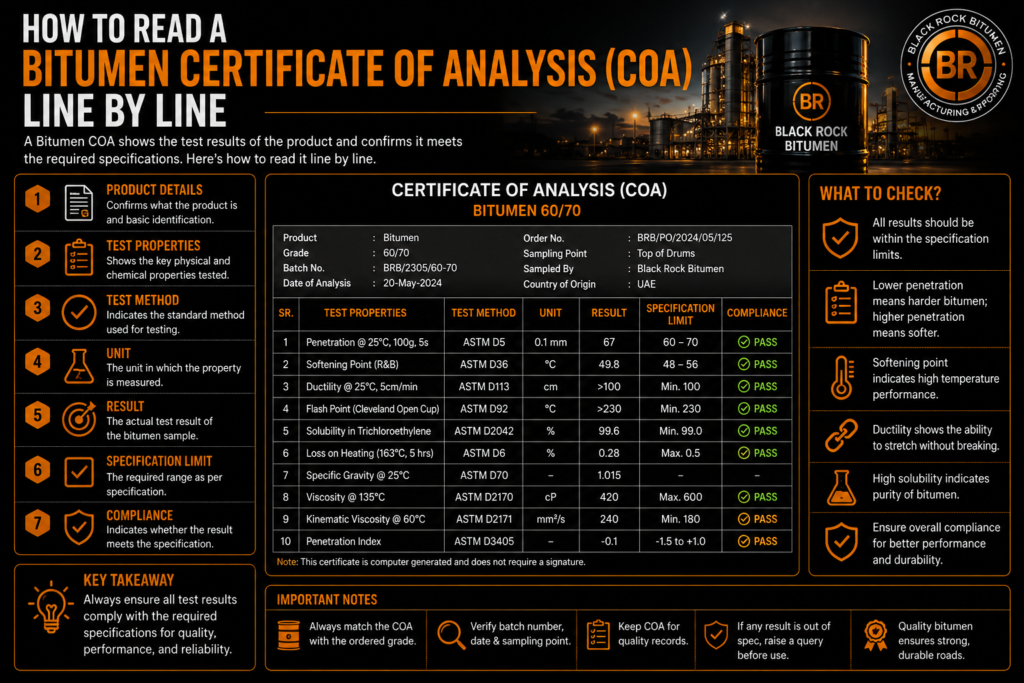
How to Read a Bitumen Certificate of Analysis (COA) Line by Line
A bitumen Certificate of Analysis can look reassuring at first glance: a product name, a grade, a few test results and a laboratory signature. But a number on a COA does not mean much by itself. To decide whether the certificate actually represents the cargo you are buying, you need to know what was tested, how it was tested, at what temperature, in what units, from which sample and against which specification.
That is the difference between reading a COA and simply looking at one. A reliable certificate connects the shipment to a defined batch, a documented sampling process, a competent laboratory and a recognised test method.
ISO/IEC 17025 is the international standard for the competence, impartiality and consistent operation of testing and calibration laboratories. ISO/IEC 17025:2017 For a buyer, the useful question is not merely whether a laboratory says it follows a quality system, but whether its accreditation scope covers the methods being reported.
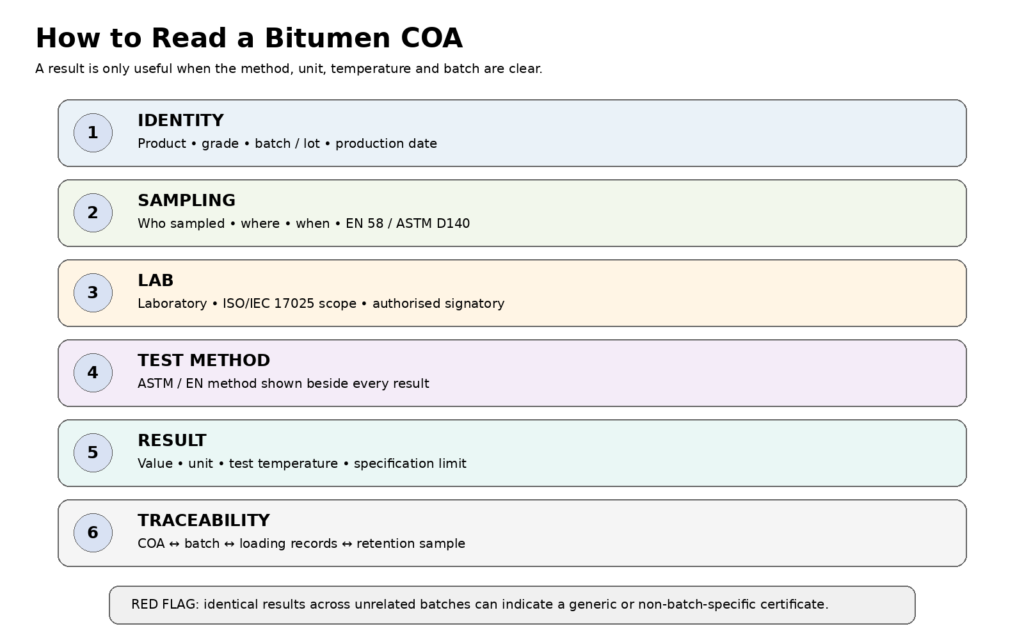
Alt text: Infographic showing six steps for reading a bitumen COA: identity, sampling, laboratory accreditation, test method, result interpretation and batch traceability, with a red flag for identical results across unrelated batches.
The 30-Second COA Check
| Check first | What to look for | Why it matters |
| Product identity | Product name, grade, batch / lot number | Confirms the certificate belongs to the material being purchased |
| Specification | Named governing standard and grade | Defines the limits the result must meet |
| Sampling | Sampling date, location, procedure and sampler | Shows whether the tested material represents the cargo |
| Laboratory | Laboratory identity and ISO/IEC 17025 scope | Adds confidence that the methods are performed competently |
| Methods | ASTM / EN method beside each property | Makes the result interpretable and comparable |
| Results | Value, unit, temperature and specification limit | Prevents misleading comparisons |
| Traceability | COA ↔ batch ↔ loading records | Connects the paper to the physical shipment |
| Retention sample | Sealed sample identified to the same batch | Provides a basis for re-testing in a dispute |
Line 1: Product Name and Grade
Start with the simplest question: what exactly does this COA claim to represent? The product description should be specific enough to identify the commercial material. A certificate that says only Bitumen is weak. A certificate that identifies the product as a penetration-graded paving bitumen, gives the grade designation and links that designation to the governing standard is much more useful.
Be careful with grade names because different standards use different designation systems. For example, ASTM D946 includes penetration grades such as 40–50 and 60–70, while
EN 12591 uses grades including 40/60, 50/70 and 70/100. EN 12591 These systems should not be treated as interchangeable naming systems.
This is why a COA should state the governing specification, not simply a number such as 60/70. In this article’s worked example, the certificate is deliberately built around ASTM D946 60–70 rather than presenting 60/70 as though it were an EN grade.
Line 2: Certificate Number, Batch Number and Dates
Next, establish traceability. Look for the COA number, batch or lot number, production date, sampling date and certificate issue date. These fields should make it possible to connect the certificate to the physical material.
If a tanker arrives with a batch reference that does not appear on the COA, stop and reconcile the documents before accepting the material. The same applies if the certificate predates the batch, uses a different grade or refers to a production lot that cannot be identified in the supplier’s loading records.
• COA number is unique or otherwise traceable.
• Batch / lot number matches the loading documentation.
• Production and sampling dates make chronological sense.
• Certificate issue date is consistent with the shipment timeline.
• The same batch reference appears on the retention sample, where one is held.
Line 3: Sampling — Where Did the Test Material Come From?
This is one of the most important checks on the entire certificate. A laboratory can perform a perfect test on the wrong sample and still produce a perfectly formatted COA.
ASTM D140/D140M states that sampling is as important as testing and covers sampling asphalt materials at points of manufacture, storage or delivery. ASTM D140/D140M The sampling record should therefore tell you who sampled, when the sample was taken, where it was taken and which procedure was used.
For European work, EN 58 is the relevant sampling standard for bituminous binders.
For an international bulk shipment, the practical questions are straightforward: Was the sample taken from the production batch, a storage tank, the loading line or the delivered cargo? Was it a representative sample? Was the buyer or an independent inspector present? If the COA does not answer these questions, ask for the sampling record or inspection report.
| Sampling check | What you want to see |
| Who | Named sampler, laboratory, supplier or independent inspector |
| When | Sampling date / time or documented sampling event |
| Where | Tank, production batch, loading point, drum or delivery point |
| How | ASTM D140/D140M, EN 58 or the procedure specified by the project |
| Traceability | Sample ID linked to batch / lot and retention sample |
Line 4: Laboratory and ISO/IEC 17025 Accreditation
A COA should identify the testing laboratory, not just carry a generic laboratory stamp. Then ask a more important question: is the laboratory accredited to ISO/IEC 17025 for the specific test methods reported?
ISO explains that ISO/IEC 17025 provides requirements for laboratory competence and helps establish confidence in testing and calibration results. ISO/IEC 17025.
The phrase specific methods matters. A laboratory can be accredited for some methods and not others. If a COA reports penetration, softening point, viscosity and flash point, the buyer should be able to verify that the laboratory’s accreditation scope covers the relevant methods, where accreditation is being relied upon.
• Laboratory name and address are identifiable.
• Accreditation body is identifiable where accreditation is claimed.
• ISO/IEC 17025 accreditation is current.
• The accreditation scope covers the reported methods, where applicable.
• Authorised signatory is identifiable and the certificate is verifiable.
Line 5: Penetration at 25°C
Penetration is one of the first numbers most buyers look for. It measures the depth a standardised needle penetrates the bitumen under specified conditions. For penetration-grade binders, it gives an indication of consistency at the test temperature.
The temperature matters. A penetration value without 25°C attached is incomplete for the common paving-grade test. The method matters too.
| Property | ASTM method | EN method | Typical reporting |
| Penetration | ASTM D5 | EN 1426 | 0.1 mm at 25°C |
| Softening point | ASTM D36 | EN 1427 | °C |
| Flash point | ASTM D92 | EN ISO 2592 | °C |
| Solubility | ASTM D2042 | EN 12592 | % |
Do not compare a result with a limit from another standard. The same property name does not guarantee identical test procedures, grading rules or acceptance limits.
Line 6: Softening Point
Softening point tells you the temperature at which the binder reaches the specified softening condition in the ring-and-ball test. It is useful because penetration and softening point describe different aspects of binder consistency.
EN 12591, for example, lists softening-point requirements alongside penetration grades and specifies EN 1427 as the test method. EN 12591 specification table
The useful buyer question is not Is 48°C good? It is Does 48°C comply with the softening-point requirement for this exact grade and governing standard?
Line 7: Viscosity — Check the Method and Temperature
Viscosity is where COA reading becomes especially easy to get wrong. Different viscosity methods describe different measurement conditions, and asphalt can behave differently depending on temperature and shear.
| Method | What it measures | Typical condition / reporting |
| ASTM D2170/D2170M | Kinematic viscosity | 60°C for liquid asphalts; 135°C for asphalt binders; mm²/s (cSt) |
| ASTM D2171/D2171M | Viscosity by vacuum capillary viscometer | 60°C; Pa·s or related units |
| ASTM D4402/D4402M | Apparent rotational viscosity | Elevated temperatures, with controlled temperature and shear conditions |
| EN 12595 | Kinematic viscosity of bituminous binders | 135°C; mm²/s |
| EN 12596 | Dynamic viscosity of bituminous binders | 60°C; Pa·s |
ASTM D2170 specifies kinematic-viscosity procedures at 60°C and 135°C depending on the material, while ASTM D2170/D2170M is used to characterise flow behaviour and shipment/source uniformity.
ASTM D2171 measures viscosity at 60°C using a vacuum capillary viscometer, while ASTM D2171/D2171M is particularly relevant to viscosity-graded binders and asphalt binder testing.
ASTM D4402 measures apparent viscosity at elevated temperatures using a rotational viscometer and notes that non-Newtonian results depend on conditions such as temperature and shear rate. ASTM D4402/D4402M.
This is why a certificate that simply says Viscosity: 250 is not enough. You need the method, temperature and unit.
Line 8: Flash Point
Flash point is a safety-related property rather than a direct measure of pavement performance. It helps establish the temperature at which vapours can ignite under the specified test conditions.
For a COA, check the test method, value, unit and specification limit. ASTM D92 and EN ISO 2592 are common methods in bitumen specifications. If the method is absent, do not assume that two flash-point numbers obtained by different procedures are directly interchangeable.
Line 9: Solubility
Solubility is used as an indication of the proportion of binder soluble in the specified solvent under the test procedure. It can help identify the presence of insoluble material or contamination when interpreted against the relevant specification.
EN 12591, for example, references EN 12592 for solubility. EN 12591
Line 10: Aging Results
A good COA may include results before and after short-term aging, depending on the governing specification. The purpose is to see how the binder’s properties change after simulated exposure to heat and air during production or handling.
For European paving-grade bitumen, EN 12591 uses EN 12607-1 for resistance to hardening at 163°C and reports properties such as retained penetration, change in softening point and mass change. EN 12591.
The important reading habit is to compare the aged result with the correct aged-material limit. Do not compare an unaged penetration requirement with a retained-penetration result.
A Worked Example: Read the COA Against One Named Specification
To avoid the most common COA-reading mistake, this example uses ASTM D946 60–70 penetration-grade asphalt cement. ASTM D946 identifies 60–70 as one of its penetration grades and includes requirements for penetration, ductility, flash point, solubility and other properties.
| COA line | Example result | What you check |
| Grade | 60–70 | ASTM D946; do not call this an EN 12591 grade |
| Penetration at 25°C | 64 × 0.1 mm | Within the ASTM D946 60–70 grade range |
| Ductility at 25°C | 110 cm | Compare with the governing ASTM D946 requirement |
| Flash point | ≥ 240°C | Check the reported method and ASTM limit |
| Solubility | ≥ 99.0% | Check the specified solvent/test method |
| Viscosity | Reported only if required | Confirm whether the COA uses D2170, D2171 or another specified method |
The lesson is more important than the example values: pick the governing specification first, then read each COA line against that specification. Do not create a hybrid limit table by combining ASTM, EN and other national standards.
What About Ductility?
Ductility is a useful example of why the governing standard matters. ASTM D946 includes ductility requirements, and the required value depends on the grade and test condition. A buyer should therefore read the exact D946 table rather than apply a generic 100 cm rule to every penetration-grade binder.
The same principle applies across other national and regional specifications: a property can be tested on the original binder in one system and on an aged residue in another, or the minimum can vary by grade. That is why the COA must be read with the named specification beside it.
Line 11: Performance Grade (PG) and PMB COAs Are Different
A Performance Grade binder certificate is not simply a penetration-grade COA with extra lines added. PG specifications use a performance-based framework and report properties tied to high-temperature, intermediate-temperature and low-temperature behaviour.
Depending on the specification and product, a PG COA can include dynamic shear rheometer results before and after aging, bending beam rheometer stiffness and m-value, and increasingly MSCR non-recoverable creep compliance. Polymer-modified binders can also require additional elastic-recovery or storage-stability information.
If the certificate is for PMB or PG binder, use the governing specification rather than the penetration-grade reading sequence above. Black Rock Bitumen’s Polymer Modified Bitumen range covers PMB products separately.
For the broader standards framework, see Black Rock Bitumen’s Regulatory Standards for Bitumen guide.
The Red Flags: When a COA Deserves a Second Look
| Red flag | Why it matters | What to do |
| No governing specification named | There is no clear acceptance basis | Ask for the exact standard and grade |
| No test method beside results | The value cannot be interpreted confidently | Request the method and test conditions |
| No sampling information | The certificate may not represent the cargo | Request sampling details and sample ID |
| Laboratory not identifiable | Testing cannot be independently traced | Request laboratory details and accreditation information |
| ISO/IEC 17025 claimed but scope not shown | Accreditation may not cover the reported methods | Check the accreditation scope |
| Identical results across unrelated batches | May indicate a generic document rather than batch testing | Ask for raw results, batch records and independent verification |
| Batch number does not match shipping documents | Breaks traceability | Hold acceptance until reconciled |
| Result is outside the specification | The product may be non-conforming | Do not approve solely because the supplier says it is normal |
| Retention sample not available | A later dispute becomes harder to resolve | Ask whether a sealed batch retention sample is held |
| Aged and unaged results are mixed | Limits may be applied to the wrong material | Separate original and aged-binder requirements |
Retention Samples: The Practical Answer When There Is a Dispute
A sealed retention sample linked to the same batch gives both sides something concrete to test if a quality dispute appears after delivery. The sample should be clearly identified, securely stored and traceable to the COA and shipment.
For a buyer, the question is simple: If we challenge this COA six months from now, is there a sealed sample of the same batch that can be independently re-tested? If the answer is no, the certificate provides less protection than it appears to.
How Black Rock Bitumen Should Support the COA Process
A strong supplier should not make the buyer chase basic traceability information after the shipment has arrived. For every batch, the documentation package should make it easy to connect the product, test results and shipment.
For Black Rock Bitumen, the commercial opportunity is straightforward: tell buyers which laboratory performs the testing, whether the laboratory’s relevant methods are within an ISO/IEC 17025 accreditation scope, how samples are identified, how batch traceability is maintained, and whether sealed retention samples are held.
Buyers can also compare the COA with Black Rock Bitumen’s COA vs. TDS vs. MSDS guide to understand which document answers which question.
For shipping and documentation checks, see HS Codes and Import Documentation for Bitumen Shipments before cargo is released.
For a supplier-level product comparison, visit the Bitumen Supply range and confirm the governing grade and specification before purchase.
The 10-Point COA Acceptance Checklist
Product name and grade match the purchase order.
Exact governing specification is named.
Batch / lot number matches the physical cargo and shipping documents.
Sampling date, location and procedure are documented.
Laboratory identity and authorised signatory are clear.
ISO/IEC 17025 accreditation is current and covers the relevant methods where accreditation is claimed.
Every reported result has a test method, unit and temperature where applicable.
Each result is compared with the correct limit for the same standard and grade.
Retention sample is identified and held where agreed.
COA, SDS, TDS, inspection and shipping documents tell the same story.
The Bottom Line
A bitumen COA is easiest to understand when you stop reading it as a list of numbers.
Read it as a chain:
**Product → Batch → Test Method → Result → Specification → Compliance.**
Start by confirming that the COA belongs to the product and shipment you ordered. Then work through each required property, check the method and conditions, compare the actual result with the governing specification, and finally cross-check the COA against the commercial and shipping documents.
For procurement teams, this approach turns the COA from a document you file away into a practical quality-control tool.
Before approving a shipment, review the COA vs. TDS vs. MSDS documentation, then compare the applicable Bitumen Grades & Standards for Infrastructure Tenders. If you are selecting the binder itself, review Penetration Grade Bitumen, Performance Grade Bitumen and Polymer Modified Bitumen where relevant. For shipment preparation, also review Bulk vs. Drum vs. Flexitank: How Bitumen Is Packaged and Shipped and the relevant HS Codes and Import Documentation for Bitumen Shipments so the technical, commercial and customs paperwork stays aligned.