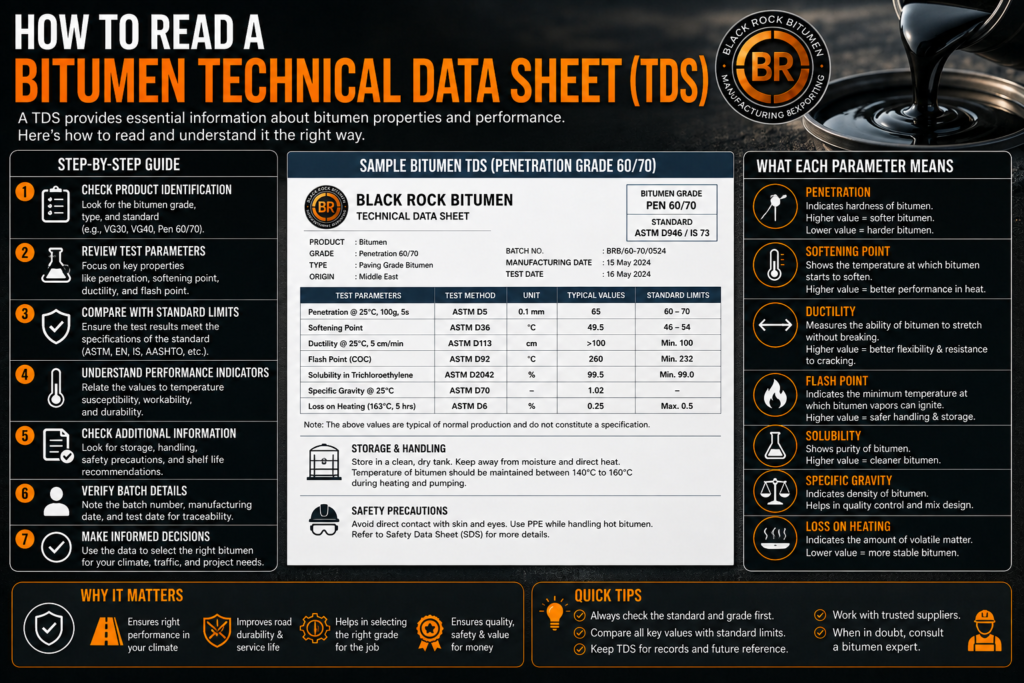
Black Rock Bitumen’s technical team regularly uses TDSs to help buyers verify grades, test methods, and specification limits. Open a bitumen TDS for the first time and it looks like a wall of codes: ASTM D5, AASHTO T315, dmm, kPa, a dozen rows of numbers next to test methods most buyers have never heard of. So most people do the same thing — they scroll straight to the penetration row, check it looks roughly right, and skip the rest.
That’s a mistake, and it’s a more expensive one than it used to be. The global bitumen market was valued at $57.31 billion in 2025 and is projected at $60.02 billion in 2026, according to The Business Research Company, August 2026. Market-size estimates vary between research houses because they can use different definitions, coverage, and methodologies. More volume moving through more supply chains means more TDS documents changing hands, and more chances for a buyer to sign off on a sheet they didn’t actually read.
That risk compounds for buyers importing into Africa, South America, or Southeast Asia specifically. A TDS from a supplier in one country, reviewed by a contractor in another, applied to a project in a third — that’s a normal supply chain for these markets, and it’s exactly the kind of chain where a misread specification table travels the furthest before anyone catches it. A mistake that would get flagged immediately by an in-house lab at a domestic refinery can sail straight through three sets of hands on an import order if nobody actually reads past the headline grade number.
A TDS isn’t decoration. It’s the single document that tells you what a product is supposed to be before you ever put it in a tank. Here’s how to actually read one.
TDS vs. COA — Know Which Document You’re Holding
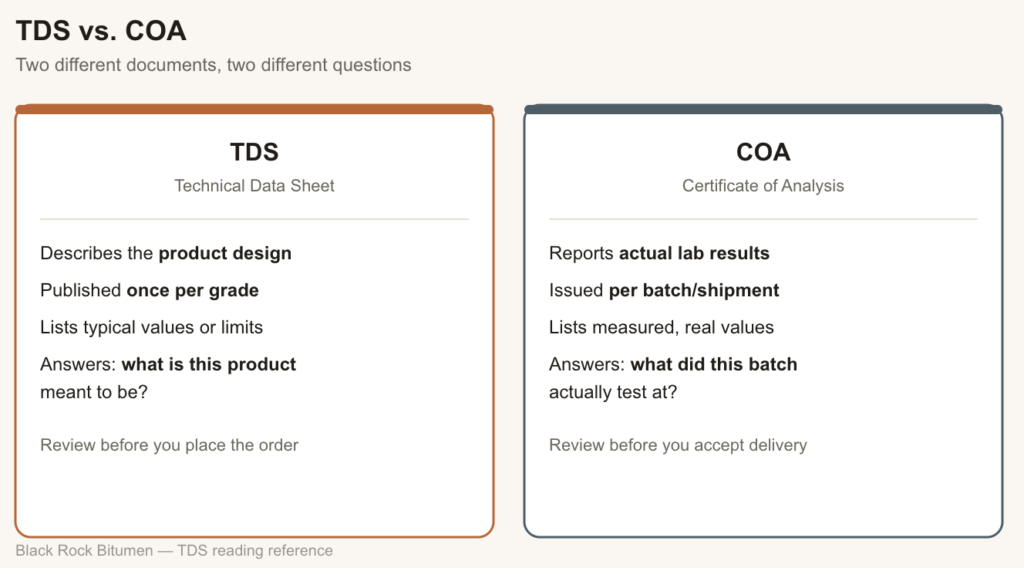
These two get confused constantly, and the difference matters.
A Technical Data Sheet (TDS) describes a product in general — the typical properties and specification limits for a grade, published once and used for every batch of that product a supplier makes. Think of it as the product’s design spec.
A Certificate of Analysis (COA) reports the actual lab results for one specific batch or shipment — the real numbers measured on the material you’re about to receive, not the general target for the grade.
A TDS tells you what the product is designed to be. A COA tells you what a specific batch actually is. Reviewing a TDS before you order and a COA before you accept delivery are two different checks, and skipping either one leaves a gap.
Think of it this way: if you were buying a car, the TDS is the manufacturer’s spec sheet — the engine size, the fuel economy rating, the safety features every unit of that model is designed to have. The COA is the inspection report on the actual car sitting in front of you, confirming it left the factory the way it was supposed to. Nobody would buy a used car off the spec sheet alone, and the same logic applies here — a strong TDS tells you the product is well-engineered, but only a COA tells you the specific batch in your tank matches it.
Alt text: Diagram showing the five sections of a bitumen TDS: product identification, specification table, typical applications, handling and storage guidance, and safety information.
The Anatomy of a Bitumen TDS
Most bitumen TDS documents follow a similar structure, whether they’re for a straight penetration grade or a Performance Grade binder. A typical example for a paving-grade product includes a product identification section, a specification table, notes on typical applications, and handling and storage guidance.
Alt text: Side-by-side comparison showing that a TDS describes product design and typical values or limits, while a COA reports measured results for a specific batch or shipment.
1. Product identification. Name, grade, and a short description — for example, a straight-run penetration grade product intended for road paving in moderate climates. This section tells you what the product is meant for before you even reach the numbers.
2. The specification table. This is the core of the document — a grid of properties, test methods, units, and values or limits. It’s also the section most people half-read.
3. Typical applications. A short list of where the product is normally used — hot mix asphalt layers, surface dressing, waterproofing, and so on. Worth cross-checking against your actual project before assuming a grade fits.
4. Handling and storage guidance. Storage and pumping temperature ranges, and warnings against overheating or extended storage at maximum temperature. Skipping this section is how storage mistakes happen in the first place.
5. Safety information. Burn risk, flash point handling notes, and basic PPE guidance.
Reading the Specification Table Properly
This is where the real information lives, and it’s built from four columns that each answer a different question: the property being measured, the test method used, the unit of measurement, and the value or acceptable range.
| Column | What it tells you |
| Property | What’s being measured — penetration, softening point, ductility, and so on |
| Test method | Which standard the result was measured against — ASTM, EN, or AASHTO |
| Unit | The measurement unit — dmm, °C, cm, Pa·s, kPa |
| Value / specification | The typical result, or the minimum/maximum limit the product must meet |
Worked Example: How to Read a TDS Specification Table
The table below is illustrative rather than a product certificate. The point is to show how a buyer should read the method, value, and specification status together.
| Property | Test method | Example value / limit | What to check |
| Penetration | ASTM D5 | 65 dmm | If the specification is 60–70 dmm, this is a result within the limit — not automatically a ‘typical’ value. |
| Softening point | ASTM D36 | 52°C | Check that the method matches the contract before comparing the number with another TDS. |
| Solubility | EN 12592 / ASTM D2042 | 99.5% min | The method matters: confirm whether your contract requires EN or ASTM. |
| Loss on heating | ASTM D6 / ASTM D1754 | 0.2% max | This is a specification limit, not a claim that every batch will test at exactly 0.2%. |
Key takeaway: “230°C” or “65 dmm” means very little on its own. The governing method, unit, and whether the figure is typical or a hard limit are what make the number meaningful.
A standard paving-grade TDS typically lists penetration, softening point, ductility, flash point, solubility, and loss on heating, each tied to its own test method and limit. Solubility is commonly tied to EN 12592 or ASTM D2042, while loss on heating may be measured under ASTM D6 or ASTM D1754. If you’ve already worked with these core properties, the table will look familiar — the difference on a TDS is that every value is tied explicitly to the exact test method used to get it, which matters because two labs using different standards can report numbers that look similar but aren’t directly comparable.
Read the test method column, not just the value. A “230°C” flash point measured under ASTM D92 and one measured under a different method aren’t automatically apples-to-apples. Always confirm the standard, not just the number.
Distinguish “typical value” from “specification limit.” Some TDS documents list a single expected value; others list a minimum or maximum the product must meet. A table that only shows “typical” numbers with no stated limits gives you less to hold a supplier accountable to.
Performance Grade TDS Documents Have Extra Columns — Here’s What They Mean
If you’re sourcing a Performance Grade (PG) binder rather than a standard penetration grade, the TDS will include several additional rows that don’t appear on a simpler sheet. A real example for a PG 76-22 binder illustrates the pattern well.
| Property | What it actually measures |
| Rotational viscosity | How easily the binder pumps and mixes at high temperature |
| Dynamic shear (original binder) | Resistance to rutting on fresh, unaged material |
| RTFO mass loss | How much the binder loses during simulated short-term aging (mixing and laying) |
| Dynamic shear (RTFO aged) | Rutting resistance after that short-term aging |
| Dynamic shear (PAV aged) | Fatigue cracking resistance after simulated long-term, in-service aging |
| Bending beam stiffness | Resistance to low-temperature cracking |
| Elastic recovery | How well a modified binder returns to shape after being stretched (AASHTO T 301 / ASTM D6084); relevant to modified PG binders |
These rows exist because the PG system tests the binder at multiple points in its life cycle — fresh, after mixing, and after years in service — rather than relying on a single-temperature snapshot the way a basic penetration test does. The governing PG specification should be named on the sheet: AASHTO M 320 for Performance-Graded asphalt binder, or AASHTO M 332 when the binder is specified using the Multiple Stress Creep Recovery (MSCR) system. Elastic recovery is specifically relevant to modified PG binders and is associated with AASHTO T 301 / ASTM D6084; it should not be assumed to be a required row on an unmodified PG sheet. If a PG TDS is missing most of the rows relevant to the governing specification, that’s worth asking the supplier about directly.
Common Mistakes When Reading a TDS
Treating every value as guaranteed for every batch. A TDS describes the product design, not a specific shipment. That’s what a COA is for — request one alongside the TDS, not instead of it.
Skipping the handling and storage section. Every TDS that includes storage temperature ranges is telling you something specific about that grade’s behavior — ignoring it is how avoidable storage mistakes happen.
Not checking which standard governs the whole sheet. A TDS built entirely around ASTM methods and one built around EN methods can describe genuinely different products even at similar-looking grade numbers.
Assuming a longer TDS means a better product. A PG-grade sheet has more rows because it tests more life-cycle stages, not because the binder is inherently superior to a well-specified penetration grade for a given project. Match the document — and the product — to what your project actually needs.
Filing the TDS away instead of comparing it to the COA on arrival. The TDS is your baseline. If a shipment’s COA doesn’t line up with what the TDS promised, that’s the conversation to have with your supplier before the material goes into the ground.
A Simple TDS Review Checklist
- Confirm the product identification matches what you ordered — grade, standard, and description.
- Read every row in the specification table, not just the penetration or PG number.
- Check the test method column for each property, and confirm it matches your contract’s required standard.
- Note whether values are listed as “typical” or as hard specification limits.
- Read the handling and storage section before the shipment arrives, not after.
- Request a matching COA for the actual batch, and compare it against the TDS on arrival.
Frequently Asked Questions
What’s the difference between a TDS and a COA? A TDS describes the general, typical properties and specification limits for a product or grade. A COA reports the actual lab results for one specific batch. Always request both — the TDS to know what you’re ordering, the COA to confirm what you received.
Why does a Performance Grade TDS have more rows than a penetration grade TDS? PG binders are tested at multiple stages of their service life — fresh, after simulated short-term aging, and after simulated long-term aging — which requires additional tests like dynamic shear and bending beam stiffness that a basic penetration grade sheet doesn’t include.
Can I trust a TDS without a corresponding COA? A TDS tells you what the product is designed to be, not what a specific shipment actually tested at. For any meaningful order, request a COA for the batch itself rather than relying on the TDS alone.
What’s the most commonly overlooked section on a bitumen TDS? The handling and storage guidance. Buyers tend to focus entirely on the specification table and skip the temperature ranges and storage warnings, which is exactly the section that prevents avoidable handling mistakes.
The Bottom Line
A bitumen TDS is a short document that contains almost everything you need to know before placing an order — but only if you read past the first row. Check the test methods, not just the values. Know whether you’re looking at a typical figure or a hard limit. And always pair the TDS with a batch-specific COA before the shipment goes into use.
Black Rock Bitumen provides full technical data sheets across our range — see our Penetration Grade Bitumen, Performance Grades, and Polymer Modified Bitumen lines for the specification tables relevant to each system.