Black Rock Bitumen supplies bitumen to contractors and procurement teams across Africa, Asia and the Middle East, and “send me your ISO certificates” is one of the first things a serious buyer asks. It is the right question. The trouble is that the answer usually arrives as a folder of PDFs, and a PDF proves very little on its own.
The ISO certifications relevant to bitumen manufacturing and supply fall into four groups, and they are not equally useful to a buyer. ISO/IEC 17025 accredits the laboratory that produced the numbers on your certificate of analysis. ISO 9001 covers the quality management system that produced the batch. A factory production control certificate covers the product itself where CE or UKCA marking applies. ISO 14001, ISO 45001 and ISO 50001 describe how the company operates rather than what it ships.
This guide is written for buyers. It sets out which certificate proves what, which ones matter most for bitumen specifically, and how to check in a few minutes whether the documents in front of you are real, current and relevant to the material you are actually buying.
Key takeaway: ISO certifies nobody. Certificates are issued by certification bodies, which should themselves be accredited by a national accreditation body. For bitumen, the certificate that most directly backs your product is ISO/IEC 17025 for the testing laboratory, not ISO 9001 for the company — and both are only meaningful if you check the scope, the sites and the accreditation behind them.
Alt text: Priority order of certifications for a bitumen buyer. First, ISO/IEC 17025 accreditation of the testing laboratory, which stands behind the numbers on the certificate of analysis. Second, ISO 9001 for the quality management system that produced the batch. Third, a factory production control certificate under EN product standards where CE or UKCA marking applies. Fourth, ISO 14001, ISO 45001 and ISO 50001, which describe how the company operates rather than the product. Separately, ISO/IEC 17020 covers the independent cargo inspector.
First, a Correction: ISO Does Not Certify Anyone
This is the single most common misunderstanding in supplier documentation, and it matters because it changes what you are looking at. ISO writes and publishes standards. It does not perform certification, does not issue certificates, and does not permit anyone to use the ISO logo in connection with certification. ISO also states that it takes complaints about misuse of its logo and about false certification claims seriously.
So a supplier is never “certified by ISO”. A supplier is certified to an ISO standard by a certification body. If a certificate carries an ISO logo, or a company says it is “ISO certified” without naming a standard, an edition year and a certification body, you are looking at a marketing claim rather than a certification.
Who Certifies Whom: The Chain Behind a Valid Certificate
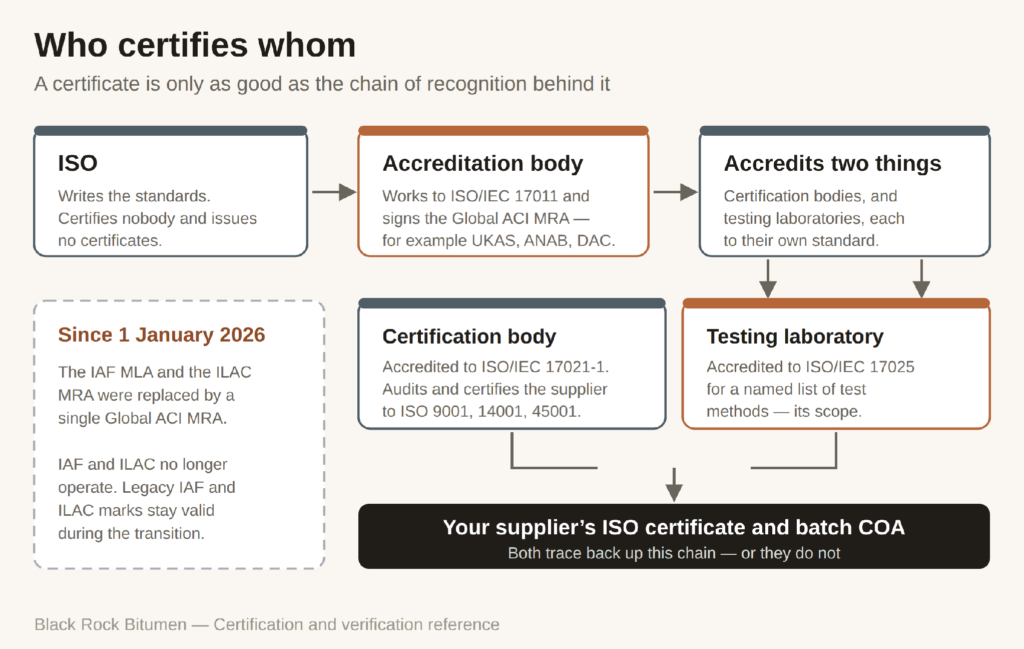
Every credible certificate sits on a chain, and the value of the certificate depends on how far up that chain it can be traced.
Alt text: Diagram of the certification chain. ISO writes the standards but certifies nobody. Accreditation bodies work to ISO/IEC 17011 and are signatories to the Global ACI multilateral recognition arrangement, which replaced the IAF MLA and ILAC MRA on 1 January 2026. Accreditation bodies accredit certification bodies under ISO/IEC 17021-1 and laboratories under ISO/IEC 17025. Those bodies then issue the supplier’s certificate or certificate of analysis.
| Link in the chain | What it is | Standard it works to |
|---|---|---|
| ISO | Publishes the standards | Not applicable — ISO does not certify |
| Accreditation body | National body that assesses and accredits certification bodies and laboratories, such as UKAS, ANAB or a Gulf accreditation body | ISO/IEC 17011 |
| Certification body | Audits your supplier and issues the ISO 9001, 14001 or 45001 certificate | ISO/IEC 17021-1 |
| Testing laboratory | Runs the tests that appear on the certificate of analysis | ISO/IEC 17025 |
| Inspection body | Independent cargo inspection, sampling and loading supervision | ISO/IEC 17020 |
One Change Most Articles Have Not Caught Up With
Until the end of 2025, international recognition ran through two bodies: the International Accreditation Forum (IAF) for management system certification, and the International Laboratory Accreditation Cooperation (ILAC) for laboratories and inspection. On 1 January 2026 both were replaced by a single organisation, Global Accreditation Cooperation Incorporated, known as Global ACI, which now operates one Multilateral Recognition Arrangement covering the scopes previously recognised under the ILAC MRA and the IAF MLA.
For a buyer this changes the vocabulary, not the principle. Legacy IAF MLA and ILAC MRA marks remain recognised as equivalent during the transition, so a certificate carrying an older mark is not automatically suspect. But if a supplier’s paperwork or a certification body’s website still describes IAF and ILAC as current operating bodies in late 2026, it is a sign the documentation has not been reviewed recently.
The Certifications That Matter, in Priority Order
1. ISO/IEC 17025 — The Certificate Behind Your COA
If you only check one thing, check this. ISO/IEC 17025:2017 sets general requirements for the competence of testing and calibration laboratories. A laboratory accredited to it has demonstrated both technical competence and a management system capable of delivering technically valid results — which is exactly what a certificate of analysis claims to be.
The detail that buyers miss is that ISO/IEC 17025 accreditation is never general. It is granted against a scope of accreditation: a named list of materials and test methods. A bitumen laboratory scope lists those methods individually — penetration to ASTM D5/D5M, softening point to ASTM D36/D36M, flash point to ASTM D92, ductility to ASTM D113/D113M, dynamic shear rheometer testing to AASHTO T 315, MSCR to ASTM D7405, and so on. Ask for the scope document itself and read it against the methods your specification names.
| What to check on a laboratory’s accreditation | Why it matters |
|---|---|
| The accreditation is to ISO/IEC 17025:2017 | The current edition; older editions have long been superseded |
| The scope lists the exact methods on your COA | Accreditation for penetration testing does not cover DSR or MSCR testing |
| The scope covers bitumen, not only aggregates or concrete | Many construction laboratories are accredited for materials other than binder |
| The laboratory named is the one that ran your tests | A supplier’s in-house laboratory and a third-party laboratory are different entities |
| The accreditation is current | Scopes are reissued; check the date on the scope document, not just the certificate |
An in-house laboratory can be accredited to ISO/IEC 17025 too, and many good ones are. The question is not whether the laboratory belongs to the supplier; it is whether it is accredited for the methods your specification names. For what to do with the results once you have them, see our guide to testing bitumen quality before purchase.
2. ISO 9001 — The Quality Management System
ISO 9001 is the world’s most widely held management system certification, and it is the one most bitumen suppliers lead with. It is genuinely useful: it means an accredited certification body has audited the supplier’s processes for document control, traceability, non-conforming product, corrective action and customer complaints, and found them to work.
What it does not do is tell you anything about the bitumen. ISO 9001 is process-based and product-neutral. A company can hold valid ISO 9001 certification and still ship a grade that does not meet your specification, because the standard governs how decisions are recorded and controlled, not what the penetration value is. Treat it as a floor, not a guarantee.
A timing point worth knowing right now. ISO 9001:2015 is being replaced. ISO scheduled publication of the sixth edition, ISO 9001:2026, for 16 September 2026, following approval of the Final Draft International Standard, and listed the edition at stage 60.00, under publication, in the run-up to that date. The changes are evolutionary rather than radical — clearer risk and opportunity requirements, a new emphasis on quality culture and ethical behaviour, and formal integration of climate change considerations — and certified organisations are expected to have a three-year transition period.
Transition periods are set by the accreditation community, which since 1 January 2026 means Global ACI rather than IAF, and the three-year period for ISO 9001:2026 remains subject to its formal confirmation. In practice this means that for the next few years you will see both ISO 9001:2015 and ISO 9001:2026 certificates in circulation, and both can be valid. A 2015 certificate is not out of date; a 2008 one is.
3. Factory Production Control Certificates and CE or UKCA Marking
This is the group most often missing from discussions of ISO certification, and for European projects it is the group that carries legal weight. Paving grade bitumen placed on the EU market is a construction product. The governing legislation is now Regulation (EU) 2024/3110, which applied from 8 January 2026 and repealed Regulation (EU) No 305/2011 — though extensive transitional arrangements keep much of the old framework running. Harmonised standards in force on that date, including EN 12591, remain valid until the Commission withdraws them, and some provisions of the 2011 regulation continue as late as 8 January 2040.
EN 12591 carries an Annex ZA setting out how conformity is assessed, and it is worth reading with the edition in mind: EN 12591:2009 predates the CPR, so its Annex ZA is written against the earlier Construction Products Directive 89/106/EEC and uses “declaration of conformity” language. The substance still holds. Bitumen falls under assessment and verification of constancy of performance (AVCP) system 2+, which means a notified body must certify the manufacturer’s factory production control, and the manufacturer must issue a declaration covering the product.
Published examples show certificates covering paving grade bitumens under EN 12591, hard and multigrade paving grade bitumens under EN 13924-1 and EN 13924-2, polymer-modified bitumens under EN 14023 and cationic emulsions under EN 13808, each naming the production plants covered.
One naming change to expect. Under Regulation (EU) 2024/3110 the declaration of performance (DoP) becomes a declaration of performance and conformity (DoPC) for products assessed against the new harmonised technical specifications. For now you are still asking for the same two documents — a notified body FPC certificate under system 2+, and a declaration — but both names will be in circulation for some years.
Great Britain operates a parallel UKCA route through UK Approved Bodies, but it is optional. Following the government statement of 2 September 2024 and the Construction Products (Amendment) Regulations 2025, CE marking is recognised for construction products in Great Britain indefinitely, with a minimum two-year transition promised before any future change. Northern Ireland continues to require CE marking. So for a GB project, EU documentation is normally sufficient: ask for the FPC certificate and the declaration, whichever mark the product carries, rather than insisting on a duplicate UK assessment your supplier does not need.
| Document | What it covers | When you need it |
|---|---|---|
| FPC certificate | The manufacturer’s factory production control at named plants | Any EN-standard binder placed on the EU, GB or Northern Ireland market |
| Declaration of performance (DoP), or declaration of performance and conformity (DoPC) under Regulation (EU) 2024/3110 | The declared performance of the specific product | Legally required to accompany a CE-marked construction product |
| CE or UKCA marking | The mark on the product documentation | CE for EU and Northern Ireland projects; Great Britain accepts either mark |
If you are buying to ASTM, AASHTO or a national standard such as IS 73, none of this applies and its absence is not a red flag. If you are buying EN-grade binder for a European project and the supplier cannot produce an FPC certificate and a declaration, that is a serious gap regardless of how many ISO certificates they hold.
4. ISO 14001, ISO 45001 and ISO 50001
These three describe how a company runs, and they matter increasingly for prequalification on public and donor-funded projects, ESG reporting and tender scoring. They tell you little about product quality directly, but a supplier handling material at 150 °C or more with no safety management system is telling you something about their operations.
| Standard | Covers | Current edition and status |
|---|---|---|
| ISO 14001 | Environmental management systems | ISO 14001:2026, published 15 April 2026, replacing the 2015 edition; 36-month transition running into 2029 |
| ISO 45001 | Occupational health and safety management | ISO 45001:2018 remains current; a revision reached draft stage in 2026 with publication expected in 2027 |
| ISO 50001 | Energy management systems | ISO 50001:2018; relevant to refineries and terminals with heated storage |
The ISO 14001 transition is worth a moment. ISO 14001:2026 was published on 15 April 2026, starting a 36-month transition, so certificates issued to the 2015 edition run to 2029. Certification bodies are currently publishing end dates in both April and May 2029, depending on how they count the 36 months, so confirm the exact date with yours rather than planning against the earliest one you read. Either way, a 2015-edition environmental certificate is currently normal, not lapsed.
5. ISO/IEC 17020 — The Independent Inspector
Not a certification your supplier holds, but one worth knowing. Independent cargo inspection — draught survey, sampling, sealing and loading supervision by a body such as SGS, Bureau Veritas or Intertek — is performed by inspection bodies accredited to ISO/IEC 17020. For an international bitumen shipment this is often the most valuable independent assurance available, because it is the only check performed on your actual cargo at the point of loading rather than on a batch in a supplier’s tank.
What Each Certificate Does Not Prove
This table is the one to keep. Most certification disputes come from assuming a certificate covers something it does not.
| Certificate | What it proves | What it does not prove |
|---|---|---|
| ISO 9001 | The company operates an audited quality management system | That any particular batch meets your specification |
| ISO/IEC 17025 | The laboratory is competent for the methods in its scope | That the product passed, or that untested methods were run competently |
| ISO 14001 / 45001 / 50001 | The company manages environment, safety or energy systematically | Anything about the binder’s properties |
| FPC certificate | Factory production control at the named plants is assessed as conforming | That your shipment came from one of those plants |
| A certificate of analysis | The results measured on a specific batch | That the batch tested is the batch loaded, unless traceability is documented |
| An inspection report | What the inspector observed on your cargo | The long-term properties of the binder after storage and handling |
How to Verify a Supplier’s Certificates in Five Minutes
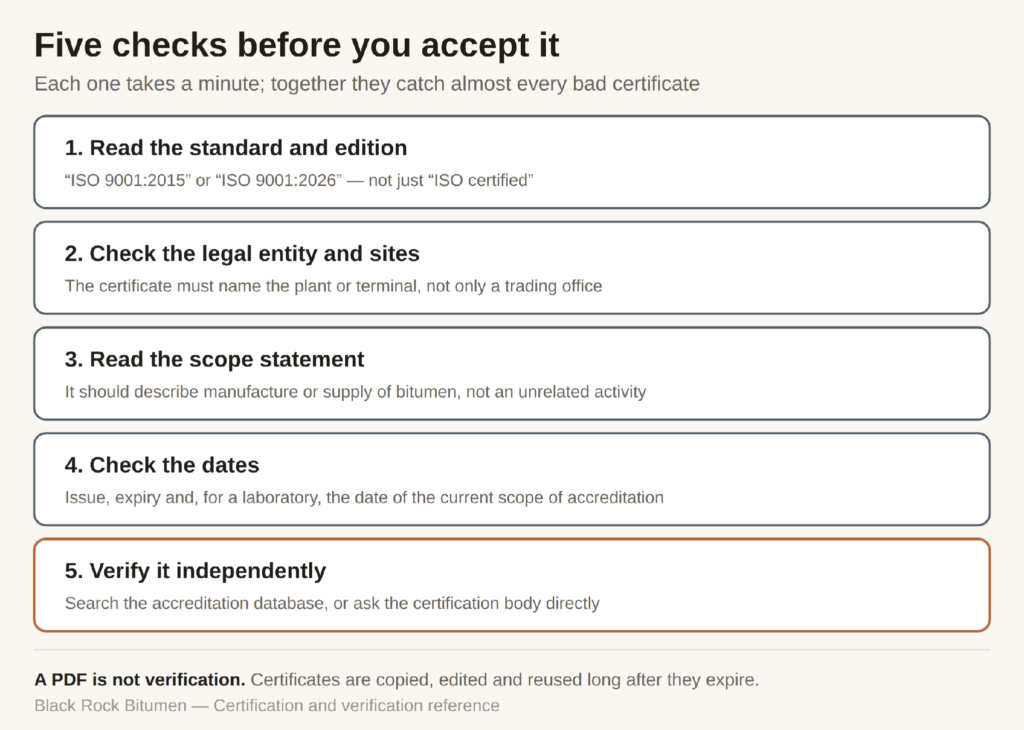
Alt text: Five checks for verifying a supplier’s ISO certificate: read the standard and its edition, check the certified legal entity and the sites listed, read the scope statement against what you are buying, check the issue and expiry dates, and verify the certificate independently in the accreditation database or with the certification body.
- Read the standard and its edition. “ISO 9001:2015” is a claim you can check. “ISO certified” is not.
- Check the certified legal entity against the company that will invoice you, and check the site addresses listed — a certificate covering a trading office does not cover a refinery.
- Read the scope statement. It should describe manufacture, blending, storage or supply of bitumen and bituminous products. A scope reading “general trading” tells you the audit never looked at bitumen.
- Check the issue and expiry dates, and for a laboratory the date of the current scope of accreditation.
- Verify independently: search the certificate number in the accreditation database, or contact the certification body directly.
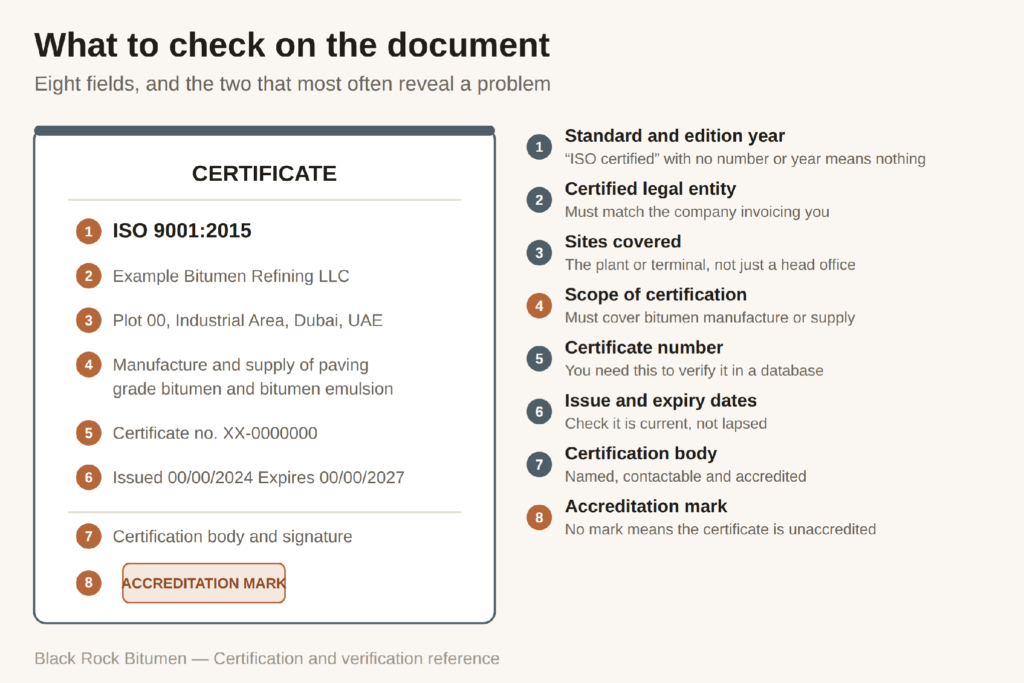
Alt text: Annotated layout of an ISO certificate showing the eight things a buyer should check: the standard and its edition year, the certified legal entity, the site addresses covered, the scope of certification, the unique certificate number, the issue and expiry dates, the name of the certification body, and the accreditation body mark with its accreditation number.
Where to Verify
| What you are verifying | Where to check |
|---|---|
| An ISO 9001, 14001 or 45001 certificate | The certification body’s own online register, or a global accredited-certificate database — the former IAF CertSearch, whose ownership transferred to Global ACI at the end of 2025 and which is being rebranded accordingly |
| Whether the certification body is accredited | The accreditation body’s directory, and whether that accreditation body signs the Global ACI MRA |
| A laboratory’s ISO/IEC 17025 accreditation | The accreditation body’s public register, which publishes the scope document |
| An FPC certificate | The notified body’s register; the certificate carries a notified body number |
| An inspection report | Directly with the inspection company, using the report reference |
Two practical notes. First, a global database will not hold every valid certificate: participation is voluntary, so absence from a database is a reason to ask the certification body, not an automatic rejection. ISO itself notes that accreditation is not compulsory and that non-accreditation does not necessarily mean a certification body is disreputable — but for a buyer, accredited certification is a much easier thing to verify. Second, always verify with the issuing body rather than with the supplier who sent you the PDF.
Red Flags on Bitumen Supplier Certificates
- “ISO certified” with no standard or year. There is no such thing. Ask which standard, which edition and which certification body.
- An ISO logo on the certificate. ISO does not permit its logo to be used in connection with certification.
- No certification body named, or no accreditation mark. An unaccredited certificate cannot be traced up the chain and is worth very little in a tender.
- Scope that never mentions bitumen. A scope covering “general trading” or an unrelated product line means the audit did not examine bitumen operations.
- Certificate names a trading company, product comes from a refinery. Ask for the certificate covering the production site, not only the seller.
- A laboratory scope that does not list your test methods. Accreditation is method-by-method; an unlisted method is not accredited work.
- Expired dates, or a scope document years older than the certificate. Both are common and both are easy to check.
- A COA on certification body letterhead. Certification bodies certify systems; laboratories issue test results. Confusing the two is a sign the documentation was assembled rather than produced.
- Refusal to give the certificate number. The number is what makes independent verification possible, which is usually the point of withholding it.
What to Write Into a Tender or Prequalification
Vague requirements produce vague evidence. These clauses ask for things that can actually be checked:
- Valid ISO 9001 certification covering the production or blending site, issued by a certification body accredited by a recognised accreditation body, with the certificate number stated.
- ISO/IEC 17025 accreditation for the testing laboratory, with the scope of accreditation attached and covering every test method named in this specification.
- A batch-specific certificate of analysis for each consignment, traceable to the shipment documents.
- Where EN-standard product is supplied: a factory production control certificate and a declaration of performance — or, under Regulation (EU) 2024/3110, a declaration of performance and conformity — for the plant of origin.
- Where required: independent inspection at loading by a body accredited to ISO/IEC 17020, with the report issued to the buyer.
- Confirmation of the edition of each management system standard, and of transition plans where the certificate is to a superseded edition.
For what the technical documents themselves should contain, see our guide to bitumen grade selection and, for performance-graded binder, the Superpave PG grading guide.
How This Works at Black Rock Bitumen
Black Rock Bitumen supplies penetration grade, viscosity grade, performance grade, polymer-modified and emulsion products from Dubai, tested against ASTM, EN and AASHTO specifications before shipment, with a certificate of analysis, safety data sheet and export documentation supplied with every order.
If you are running a supplier comparison, the checklist above applies to us as much as to anyone else: ask for the certificate numbers, the laboratory scope and the batch COA, and verify them with the issuing bodies. For an overview of how suppliers in the region document quality, see our guide to bitumen suppliers in the UAE, and to discuss documentation for a specific tender, contact us.
Frequently Asked Questions
Which ISO certifications are relevant to bitumen manufacturing and supply? Four groups: ISO/IEC 17025 for the testing laboratory behind the certificate of analysis, ISO 9001 for the quality management system, ISO 14001, ISO 45001 and ISO 50001 for environment, safety and energy management, and ISO/IEC 17020 for independent cargo inspection bodies. Where EN-standard product is sold in the EU or UK, a factory production control certificate also applies.
Does ISO certify bitumen suppliers? No. ISO publishes standards but does not perform certification, issue certificates or allow its logo to be used in connection with certification. Certificates are issued by certification bodies, which should be accredited by a national accreditation body.
Is ISO 9001 enough to prove bitumen quality? No. ISO 9001 shows that the supplier operates an audited quality management system. It is product-neutral and says nothing about whether a particular batch meets your specification. The batch COA, and the accreditation of the laboratory that produced it, do that.
What is ISO/IEC 17025 and why does it matter for bitumen? It is the international standard for the competence of testing and calibration laboratories. It matters because the numbers on a bitumen COA are only as reliable as the laboratory that produced them, and accreditation is granted for a specific scope of test methods such as ASTM D5 and ASTM D36.
How do I check whether a supplier’s ISO certificate is genuine? Read the standard and edition, check the legal entity and site addresses, read the scope, check the dates, then verify the certificate number with the certification body or in an accredited-certificate database. Never rely on the PDF alone.
What replaced IAF and ILAC? Global Accreditation Cooperation Incorporated, known as Global ACI, began operations on 1 January 2026 and replaced both bodies with a single Multilateral Recognition Arrangement. Legacy IAF and ILAC marks remain recognised during the transition period, and Global ACI now sets the transition rules for revised management system standards.
Is an ISO 9001:2015 certificate still valid in 2026? Yes. ISO 9001:2026 was scheduled for publication on 16 September 2026, and certified organisations are expected to have a three-year transition, to be confirmed formally by Global ACI. Both editions will be in circulation for some time. Similarly, ISO 14001:2015 certificates run to 2029 — certification bodies are publishing end dates in both April and May 2029, so confirm the date with yours.
Does bitumen need CE marking? Paving grade bitumen placed on the EU market under EN 12591 is a construction product requiring CE marking, with factory production control certified by a notified body under system 2+ and a declaration of performance. The governing legislation is now Regulation (EU) 2024/3110, which applied from 8 January 2026 and repealed Regulation (EU) No 305/2011, subject to long transitional arrangements. In Great Britain the UKCA route through UK Approved Bodies remains available but is optional, because CE marking is recognised there indefinitely; Northern Ireland still requires CE marking. None of this applies to ASTM or AASHTO purchases outside those markets.
What is the difference between certification and accreditation? Certification is what a certification body gives your supplier after auditing it against a standard. Accreditation is what a national accreditation body gives the certification body or laboratory after assessing its competence. Accreditation is what makes a certificate traceable and comparable across borders.
Can an in-house laboratory be ISO/IEC 17025 accredited? Yes, and many refinery and terminal laboratories are. What matters is not ownership but whether the accreditation scope covers the specific test methods your specification requires.
The Bottom Line
Certificates are evidence, not decoration. For bitumen, the useful order is: the laboratory accreditation that backs the numbers, the quality system that produced the batch, the product conformity documents where the market requires them, and the management system certificates that describe how the company operates.
Everything above can be checked in a few minutes with a certificate number and the issuing body’s register. Suppliers who are used to serious buyers will expect you to do it, and the ones who object are telling you something useful.
To discuss documentation requirements for a specific tender or shipment, contact Black Rock Bitumen.