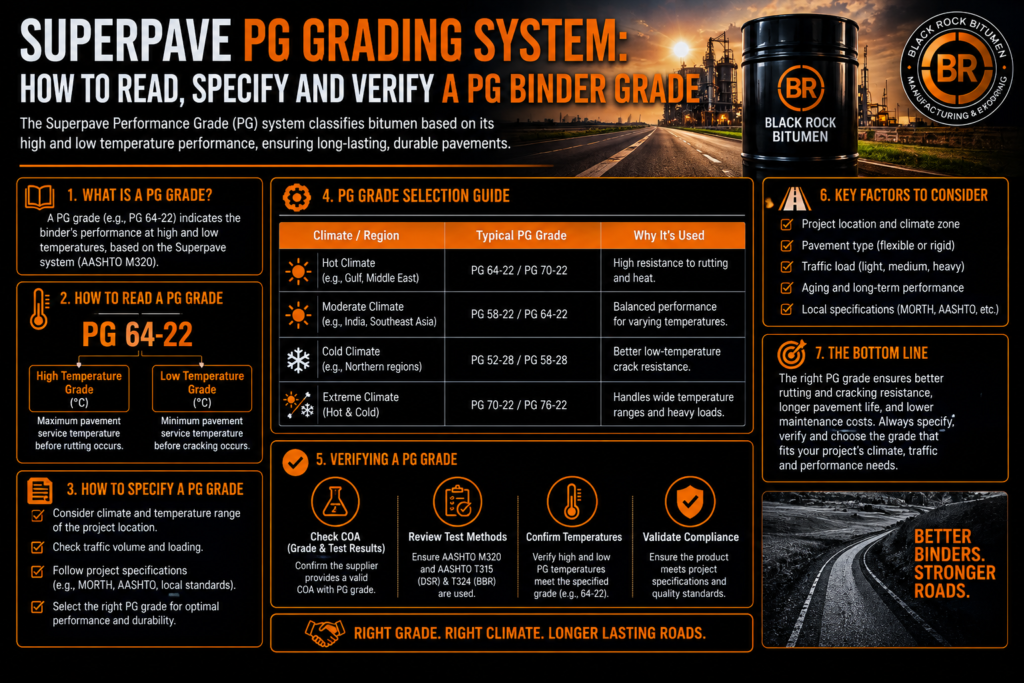
Black Rock Bitumen’s technical team works with PG specifications and certificates of analysis to help buyers match tender requirements to the grade that is actually supplied. If you have ever looked at a bitumen specification and wondered what PG 70-10, PG 76-10 or PG 82-10 actually means, you are not alone. The Superpave PG grading system looks technical on paper, but the idea behind it is practical. Instead of classifying a binder by how hard it is at a single test temperature, it matches the binder to the pavement temperatures it will face and, under newer specifications, to the traffic it will carry.
This guide is written for procurement teams, contractors and consultants who have to turn a tender requirement into a correct purchase order, and then check the certificate that arrives with the shipment. It covers how to read a grade, how traffic changes it, which of the four governing specifications applies, and which numbers a compliant Certificate of Analysis (COA) should show.
Key takeaway: PG 76 is not a complete grade. PG 76-10 is. In the Superpave PG grading system, the first number is the high pavement design temperature (the average seven-day maximum, in °C) and the second is the minimum pavement design temperature. Under an MSCR specification (AASHTO M 332 or ASTM D8239), a traffic letter sits inside the designation, as in PG 76H-10. That letter replaces grade bumping, so never specify both.
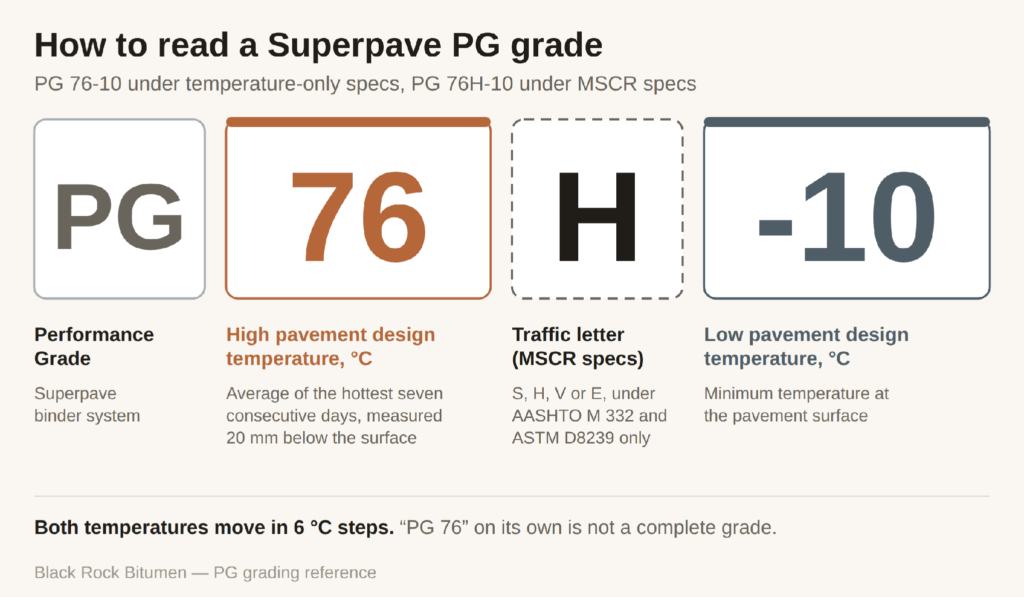
Alt text: Diagram of a Superpave PG grade designation: in PG 76H-10, 76 is the high pavement design temperature in °C, H is the MSCR traffic letter used only under AASHTO M 332 or ASTM D8239, and -10 is the low pavement design temperature in °C.
What Is the Superpave PG Grading System?
The Superpave performance grading (PG) system specifies asphalt binder by the range of pavement temperatures over which it is expected to perform, rather than by a single empirical measurement such as needle penetration. Superpave stands for Superior Performing Asphalt Pavements. The system came out of the Strategic Highway Research Program (SHRP), a United States research programme of the late 1980s and early 1990s. Its binder tests were designed to relate directly to the three main binder-related pavement distresses: rutting, fatigue cracking and thermal cracking.
The current ASTM specification, ASTM D6373-23, Standard Specification for Performance-Graded Asphalt Binder, relates each grade designation to the maximum and minimum pavement design temperatures calculated with LTPPBind Online, the binder-selection tool published by the US Federal Highway Administration (FHWA). It is a separate specification from those used for penetration-graded and viscosity-graded bitumen.
The principle is simple. Choose the binder for the temperatures and loading it has to survive, not because a harder or higher-numbered grade sounds safer.
How Do You Read a PG Grade Such as PG 76-10?
A PG designation has two temperature numbers, both in degrees Celsius, and under an MSCR specification a traffic letter between them. Take PG 76-10:
| Part of the designation | What it represents | In PG 76-10 |
|---|---|---|
| High-temperature grade | Average seven-day maximum pavement design temperature, 20 mm below the surface | 76 °C |
| Low-temperature grade | Minimum pavement design temperature, at the surface | −10 °C |
| Traffic letter | S, H, V or E traffic loading, used only under AASHTO M 332 and ASTM D8239 | Not present. PG 76H-10 would carry one. |
| Complete designation | The full performance window the binder is graded for | PG 76-10 |
Three facts follow from this. First, the high-temperature number is not the hottest the road will ever get. It is the average of the hottest seven consecutive days, at the depth where rutting develops. Second, both numbers move in fixed 6 °C steps (64, 70, 76 and 82 on the high side; −10, −16, −22 and −28 on the low side), so a design temperature of 73 °C rounds up to a PG 76 high grade. Third, a purchase order that says only “PG 76” is incomplete, because PG 76-10 and PG 76-16 are different products tested at different temperatures.
Why Does Pavement Temperature, Not Air Temperature, Set the Grade?
One of the most common specification errors is taking a city’s maximum air temperature and treating it as the PG requirement. Superpave works with pavement temperature. A dark asphalt surface in direct sun runs far hotter than the air above it, and the design value is an average over the hottest week at 20 mm depth, not a single afternoon reading.
In the United States and Canada, engineers calculate these values with LTPPBind Online, which converts long-term weather-station records into pavement design temperatures at a chosen reliability level. Both ASTM D6373 and ASTM D8239 refer to it. The project’s own calculation should control the grade, not a generic climate label such as “hot” or “desert”.
What About Projects in Africa, Asia and the Middle East?
LTPPBind is built on North American weather and pavement data, and its weather stations do not cover most project sites in Africa, Asia or the Middle East. For those projects, pavement design temperatures should come from the local road agency’s own PG climate map or temperature model, or from the SHRP and LTPP pavement-temperature equations applied to local weather-station records. Researchers in Ghana, for example, evaluated several of these models against 42 years of local air-temperature data before recommending binder grades. If a tender quotes a PG grade without stating how the design temperatures were derived, it is worth asking.
How Does PG Grading Compare With Penetration and Viscosity Grading?
| System | Primary basis | What it tells you | Example |
|---|---|---|---|
| Penetration grade | Depth a standard needle penetrates at 25 °C | Consistency at one temperature | 60/70 |
| Viscosity grade | Viscosity at 60 °C | Resistance to flow at one high temperature | VG-30 |
| Performance grade | Rheology across the pavement temperature range, before and after ageing | Expected behaviour across the design temperature window | PG 76-10 |
These are different classification systems, not a ranking. The tender specification decides which one applies, and a binder should not be accepted against one system when the contract calls for another. For the older systems, see our bitumen penetration grade chart and our viscosity grade bitumen range. For a side-by-side on the two most exported penetration grades, read Bitumen 60/70 vs 80/100.
Which Pavement Distresses Does Each PG Test Target?
| Temperature range | Pavement distress | Test and binder condition |
|---|---|---|
| High | Rutting (permanent deformation) | Dynamic Shear Rheometer (DSR) on original and RTFO-aged binder; Multiple Stress Creep Recovery (MSCR) on RTFO-aged binder under M 332 or D8239 |
| Intermediate | Fatigue cracking | DSR on PAV-aged binder |
| Low | Thermal cracking | Bending Beam Rheometer (BBR) on PAV-aged binder; Direct Tension Test (DTT) where the specification allows it |
The Dynamic Shear Rheometer measures how stiff the binder is and how much of its response is elastic rather than viscous. The Bending Beam Rheometer measures how stiff the binder becomes at low temperature, and how quickly it relaxes the stress that builds up as a pavement cools. The FHWA’s accelerated pavement testing programme, published as Performance Testing for Superpave and Structural Validation (FHWA-HRT-11-045), evaluated the Superpave rutting and fatigue parameters against full-scale pavement performance.
Why Is the Binder Tested After Ageing?
Bitumen changes during production and service, so PG specifications test it in three conditions:
Original binder. The binder as supplied, before any ageing.
RTFO residue. After the Rolling Thin-Film Oven (RTFO) test, ASTM D2872 / AASHTO T 240, which simulates the short-term ageing that happens in the asphalt plant and during laying.
PAV residue. After RTFO ageing followed by the Pressure Aging Vessel (PAV), ASTM D6521 / AASHTO R 28, which simulates years of in-service oxidation. The PAV normally runs at 100 °C, and AASHTO M 320 allows 110 °C for PG 70 and higher grades in desert climates.
A binder that performs well when fresh can behave very differently once it has oxidised. For procurement teams, this means a compliant PG certificate always contains results from all three conditions, not just the fresh binder.
PG 70 vs PG 76 vs PG 82: What Does the High-Temperature Number Change?
The first number sets the temperature at which the high-temperature DSR tests are run. Moving from PG 70 to PG 76 means the binder must meet the same stiffness criteria at a temperature 6 °C higher. That is a genuine step up in rutting resistance, and usually in cost.
| Grade family | High-temperature test | Where it may be considered | What still needs checking |
|---|---|---|---|
| PG 70 | 70 °C | Hot climates and demanding pavement conditions | Design temperatures, reliability and traffic |
| PG 76 | 76 °C | Higher pavement temperatures and/or heavy loading | Temperature model, traffic, reliability and specification |
| PG 82 | 82 °C | Very high pavement temperatures or exceptionally severe conditions | Whether the project actually requires it, and modification |
Does PG 82 Need Modification?
Usually, yes. At the top of the range the grade is difficult to meet with unmodified bitumen. A widely used rule of thumb is that once the gap between the high and low grade numbers reaches about 90 °C, the binder will generally need modification (Pavement Interactive). PG 82-10 spans 92 °C, and so does PG 76-16. In practice, PG 82 binders for road projects are typically polymer-modified.
That makes PG 82 a cost decision as well as a technical one, and it is the clearest illustration of why higher is not automatically better. If a pavement is properly designed for PG 70, buying PG 82 because it is the largest number available adds modifier cost without addressing any requirement the project actually has.
Black Rock Bitumen supplies PG 70, PG 76 and PG 82 performance-grade bitumen from Dubai, with complete designations from PG 70-10 to PG 82-34. Explore the full performance-grade range.
What Does the Low-Temperature Number Mean?
The second number is the minimum pavement design temperature the binder is graded for. It controls the Bending Beam Rheometer test, which is run 10 °C warmer than the grade temperature. This surprises many first-time COA readers: a PG 76-10 binder is BBR-tested at 0 °C, not at −10 °C. The offset reflects the time-temperature behaviour of bitumen, which lets a short laboratory test at the warmer temperature represent the much slower build-up of thermal stress in a cooling pavement.
| Grade | High-temperature tests | PAV DSR (intermediate) | BBR test temperature |
|---|---|---|---|
| PG 70-10 | 70 °C | 34 °C | 0 °C |
| PG 70-16 | 70 °C | 31 °C | −6 °C |
| PG 76-10 | 76 °C | 37 °C | 0 °C |
| PG 76-16 | 76 °C | 34 °C | −6 °C |
| PG 82-10 | 82 °C | 40 °C | 0 °C |
Test temperatures follow Table 1 of AASHTO M 320 and ASTM D6373. Always confirm them against the edition named in the tender.
PG 76-10 and PG 76-16 are not interchangeable. A −16 grade is tested 6 °C colder on the BBR and at a lower intermediate temperature, and it is the right choice only where the project’s calculated minimum pavement design temperature requires it. Specifying a colder low grade than the site needs narrows the supply options without improving performance.
How Does Traffic Change the Grade? MSCR and the S, H, V and E Letters
Two roads in the same climate can put very different demands on a binder. A port access road and a residential street may share pavement temperatures, but slow, heavy, channelled truck traffic loads the binder for longer on every pass, and that longer loading is what drives rutting. Newer PG specifications capture this with the Multiple Stress Creep Recovery test.
What Is MSCR?
Multiple Stress Creep Recovery (MSCR), ASTM D7405 / AASHTO T 350, is a DSR test on RTFO-aged binder. It applies repeated one-second loads, first at 0.1 kPa and then at 3.2 kPa, each followed by a nine-second rest, and measures how much of the resulting strain the binder fails to recover. The key result is the non-recoverable creep compliance at 3.2 kPa, written Jnr3.2 and reported in kPa−1. The lower the Jnr3.2, the more rut-resistant the binder. The test is run at the project’s high pavement design temperature.
How Is the Traffic Letter Written?
Under AASHTO M 332 and its ASTM equivalent, ASTM D8239-23, an S, H, V or E designation must be specified for standard, heavy, very heavy or extremely heavy traffic loading respectively. The letter sits inside the designation, between the two temperatures:
| Designation | Traffic loading | Written as | Maximum Jnr3.2 (kPa−1) | Typical application |
|---|---|---|---|---|
| S | Standard | PG 76S-10 | 4.5 | Under 10 million ESALs, traffic faster than 70 km/h |
| H | Heavy | PG 76H-10 | 2.0 | 10 to 30 million ESALs, or slow traffic (20 to 70 km/h) |
| V | Very heavy | PG 76V-10 | 1.0 | Over 30 million ESALs, or standing traffic (under 20 km/h) |
| E | Extremely heavy | PG 76E-10 | 0.5 | The most severe cases, such as toll plazas and port facilities |
ESAL means equivalent single axle load, the standard way of expressing cumulative design traffic. Typical applications follow the AASHTO M 332 guidance summarised by the Minnesota Department of Transportation. Road agencies set their own thresholds.
Grade Bumping or a Traffic Letter: Why You Should Never Pay Twice
This is the most commercially important point in PG procurement.
Under AASHTO M 320 and ASTM D6373, the traditional response to heavy, slow-moving traffic is grade bumping. The engineer specifies a high-temperature grade one or two steps (6 °C or 12 °C) above the climate grade. A road with a PG 76-10 climate requirement and slow trucks might therefore be specified as PG 82-10.
Under AASHTO M 332 and ASTM D8239, you do not bump. The traffic letter performs that function. The same road is specified as PG 76H-10 or PG 76V-10, and the MSCR test is run at 76 °C against a tighter Jnr3.2 limit.
A buyer who bumps the grade and also specifies a traffic letter is paying twice for the same requirement. Ordering PG 82H-10 or PG 82E-10 for a site whose climate grade is PG 76 buys a higher test temperature and a stricter MSCR limit to answer one traffic condition. Both requirements push the supplier toward heavier modification, so the combination adds cost without adding performance the pavement design asked for.
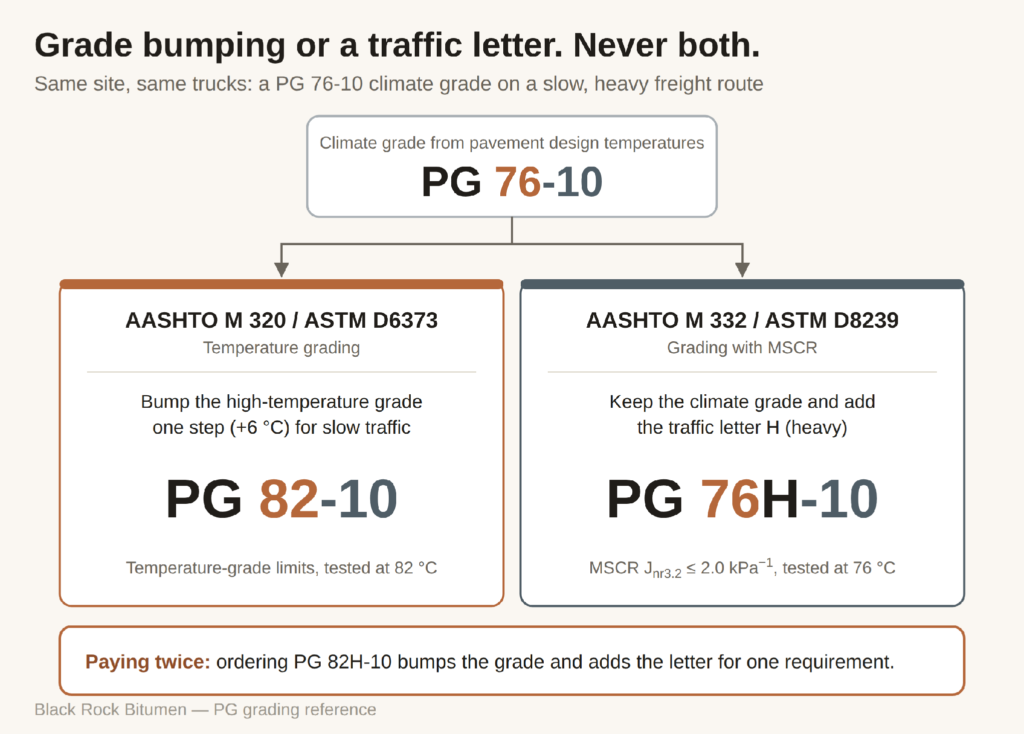
Alt text: Flowchart comparing grade bumping with the MSCR traffic letter for a PG 76-10 climate grade on a slow, heavy freight route: AASHTO M 320 or ASTM D6373 bumps the grade to PG 82-10, AASHTO M 332 or ASTM D8239 adds the letter to give PG 76H-10, and ordering PG 82H-10 does both and pays twice for one requirement.
Which Specification Governs: AASHTO M 320, AASHTO M 332, ASTM D6373 or ASTM D8239?
Four specifications cover performance-graded asphalt binder, and they come in pairs. ASTM D6373 is the ASTM counterpart of AASHTO M 320 and grades by temperature only. ASTM D8239 is the ASTM counterpart of AASHTO M 332 and adds the MSCR traffic letter. The Asphalt Institute’s binder specification database shows road agencies using M 320, M 332, or M 320 for some grades and M 332 for others.
| Specification | Framework | Grade written as | Traffic handled by | Buyer check |
|---|---|---|---|---|
| AASHTO M 320 | Temperature-based performance grading | PG 76-10 | Grade bumping | Complete grade, table used (1 or 2) and all aged-binder tests |
| ASTM D6373-23 | ASTM equivalent of M 320 | PG 76-10 | Grade bumping | As for M 320 |
| AASHTO M 332 | Performance grading with MSCR | PG 76H-10 | S, H, V or E letter | Letter present, Jnr3.2 on the COA, no grade bump |
| ASTM D8239-23 | ASTM equivalent of M 332 | PG 76H-10 | S, H, V or E letter | As for M 332 |
Not every project uses an MSCR specification. If the tender cites M 320 or D6373, a traffic letter has no meaning on the purchase order. If it cites M 332 or D8239, a grade without a letter is incomplete.
How Do You Select the Right PG Binder in Six Steps?
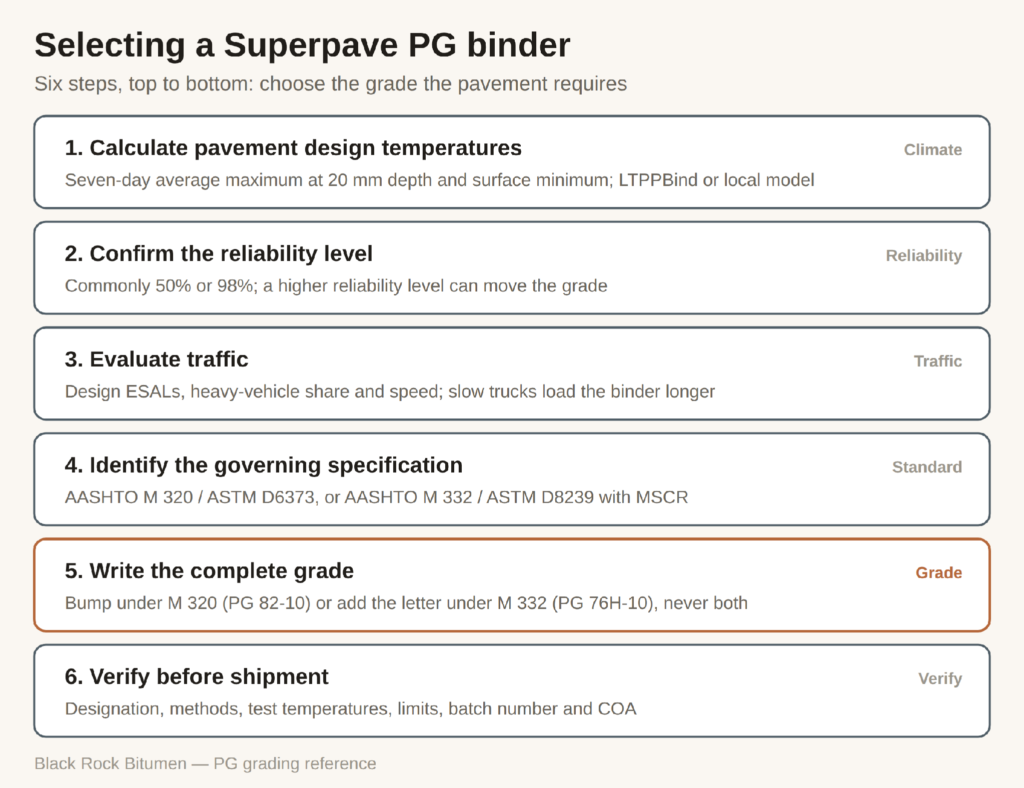
Alt text: Six-step Superpave PG binder selection process: calculate pavement design temperatures, confirm reliability, evaluate traffic, identify the governing specification, write the complete grade using a grade bump or a traffic letter but not both, and verify the COA before shipment.
- Calculate the maximum (seven-day average, 20 mm depth) and minimum pavement design temperatures, using LTPPBind Online in North America or the local agency model elsewhere.
- Confirm the reliability level the project requires.
- Evaluate design traffic in ESALs, heavy-vehicle loading and operating speed.
- Identify the governing specification: AASHTO M 320 or ASTM D6373, AASHTO M 332 or ASTM D8239, or a project-specific requirement.
- Write the complete grade. Under M 320 or D6373, apply any grade bump to the high-temperature number. Under M 332 or D8239, add the traffic letter instead. Never do both.
- Verify the product designation, test methods, test temperatures, acceptance limits, batch number and COA before shipment.
Why Can the Same Location Have Different Requirements?
PG selection is not a matter of finding one temperature number. Reliability is the statistical confidence that the actual pavement temperature will stay within the design value, and design temperatures are commonly calculated at 50% or 98% reliability. A major highway may require the higher figure while a low-volume road accepts less, and the difference can move the grade by a full 6 °C step.
Two projects in the same city can therefore have different binder requirements if their design assumptions, road classifications, reliability targets or traffic conditions differ. For a supplier, the useful question is not “What grade do you normally use here?” It is “What grade does this project specification require, and how was it calculated?”
Worked Example: A Hot Freight Road With Slow Trucks
Suppose a project’s temperature analysis gives a maximum pavement design temperature of 73 °C and a minimum of −7 °C at the required reliability. Rounding each outward to the next standard grade gives a climate grade of PG 76-10.
Now add traffic. The road is a freight route carrying around 25 million ESALs over its design life, with loaded trucks slowing to between 30 and 50 km/h on the approach to a port. That is heavy, slow-moving traffic, and the correct purchase requirement depends on which specification the tender cites:
| Route | Governing specification | Purchase requirement | What the COA must show |
|---|---|---|---|
| Temperature grading with a bump | AASHTO M 320 / ASTM D6373 | PG 82-10 | M 320 Table 1 limits at 82 °C, 40 °C and 0 °C |
| MSCR grading | AASHTO M 332 / ASTM D8239 | PG 76H-10 | Jnr3.2 no more than 2.0 kPa−1 at 76 °C |
| Paying twice (avoid) | Mixed | PG 82H-10 | A bump and a letter for one traffic condition |
Only after these checks should the final purchase requirement be written. This is why “PG 76” on its own is never enough.
How Do You Read a PG Bitumen Certificate of Analysis?
A certificate can contain impressive-looking numbers and still be the wrong certificate if the grade, test method, test temperature or governing specification does not match the tender. Check three things for every line: that the property was tested by the correct method, that it was measured at the correct temperature for the grade, and that the result meets the acceptance limit.
Which Test Methods Should a PG COA Cite?
| Property | ASTM method | AASHTO method |
|---|---|---|
| Dynamic Shear Rheometer (DSR) | D7175 (current edition D7175-25) | T 315 |
| Rolling Thin-Film Oven (RTFO) | D2872 | T 240 |
| Pressure Aging Vessel (PAV) | D6521 | R 28 |
| Bending Beam Rheometer (BBR) | D6648 (current edition D6648-25a) | T 313 |
| Direct Tension Test (DTT) | D6723 (withdrawn by ASTM in 2021) | T 314 |
| Multiple Stress Creep Recovery (MSCR) | D7405 (current edition D7405-24) | T 350 |
| Rotational viscosity | D4402 | T 316 |
| Flash point (Cleveland open cup) | D92 | T 48 |
An older edition on a COA is not automatically a non-compliance, but it should match the edition the contract calls for. ASTM D6373 still refers to direct tension testing for its alternative low-temperature table, so if a tender asks for DTT results, confirm with the specifier which method they expect.
What Acceptance Criteria Should the Results Meet?
These are the standard limits from Table 1 of AASHTO M 320 and ASTM D6373, with the test temperature that applies to a PG 76-10 binder:
| Stage | Test | Criterion | Test temperature for PG 76-10 |
|---|---|---|---|
| Original binder | Flash point | ≥ 230 °C | Not applicable |
| Original binder | Rotational viscosity | ≤ 3 Pa·s | 135 °C |
| Original binder | DSR, G*/sin δ | ≥ 1.00 kPa | 76 °C |
| RTFO residue | Mass change | ≤ 1.00 % | Not applicable |
| RTFO residue | DSR, G*/sin δ (M 320 and D6373) | ≥ 2.20 kPa | 76 °C |
| RTFO residue | MSCR Jnr3.2 (M 332 and D8239, replacing the line above) | ≤ 4.5 / 2.0 / 1.0 / 0.5 kPa−1 for S / H / V / E | 76 °C |
| PAV residue | DSR, G*·sin δ | ≤ 5000 kPa | 37 °C |
| PAV residue | BBR creep stiffness | ≤ 300 MPa | 0 °C |
| PAV residue | BBR m-value | ≥ 0.300 | 0 °C |
| PAV residue | Direct tension failure strain (where used) | ≥ 1.0 % | 0 °C |
Direct tension is used when BBR creep stiffness falls between 300 and 600 MPa; the m-value must still pass. AASHTO M 332 relaxes the PAV DSR limit for H, V and E grades subject to a phase-angle condition, so check the table in the edition the tender cites.
Two facts catch many first-time COA readers. PG grades move in 6 °C increments on both the high and low sides, and the BBR is run at the low-temperature grade plus 10 °C.
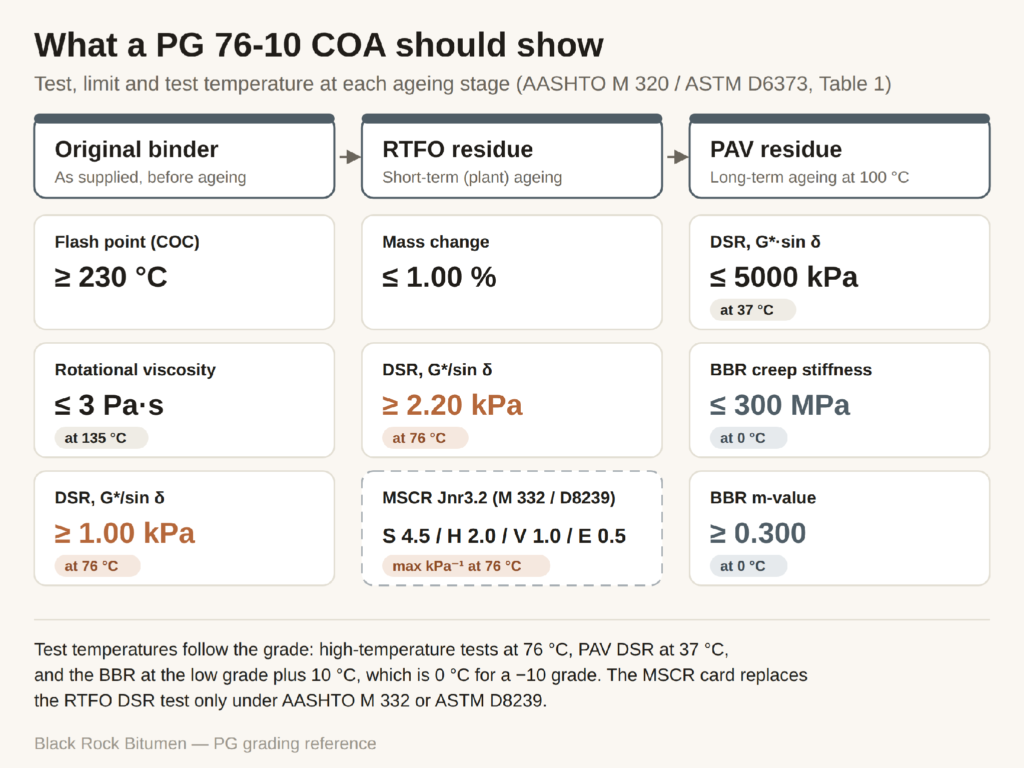
Alt text: Chart of the tests, acceptance limits and test temperatures a PG 76-10 certificate of analysis should show for original binder, RTFO residue and PAV residue, with high-temperature tests at 76 °C, the PAV DSR test at 37 °C and the BBR test at 0 °C.
Which Document and Traceability Checks Matter?
| COA item | What to check |
|---|---|
| Product designation | Complete PG grade, including the traffic letter where M 332 or D8239 applies |
| Governing specification | Named AASHTO or ASTM standard and edition, matching the tender |
| PAV ageing temperature | 100 °C, or 110 °C where the tender specifies the desert-climate condition |
| Batch number | Matches the bill of lading, packing list and drum or bitutainer markings |
| Laboratory and traceability | Named laboratory, test dates, and clear responsibility for the results |
| Technical Data Sheet (TDS) | Shows typical values only; it is not a substitute for the batch-specific COA |
For a wider pre-shipment checklist, see How to Test Bitumen Quality Before Purchase.
Is PG Bitumen the Same as Polymer-Modified Bitumen (PMB)?
No. PG is a grading system. Polymer-modified bitumen (PMB) is a type of binder: bitumen modified with polymers such as SBS. A PMB can be manufactured to meet a PG grade, and most PG 82 binders are polymer-modified, but PMB sold under European designations such as PMB 25/55-65 is classified by an entirely different system.
If a tender requires both a PG grade and polymer modification, both requirements must be met. Some agencies also add “PG-plus” tests, such as MSCR percent recovery, to confirm that a polymer is present and working. See our polymer-modified bitumen range, and note that PMB needs agitation in storage to stay uniform, as covered in Common Bitumen Storage and Handling Mistakes.
How Should PG Grades Be Selected for Hot-Climate Projects?
For buyers across Africa, Asia and the Middle East, regional climate is a starting point, not a grade. A hot location often needs a higher high-temperature grade, but the final choice still depends on pavement design temperatures from a model that is valid for the region, the reliability level, traffic and the governing specification.
Two checks matter more in hot regions than elsewhere. First, confirm whether the tender calls for the 110 °C desert PAV condition, because it changes the long-term ageing test. Second, confirm whether the design handles heavy traffic with a grade bump or an MSCR letter, and make sure the purchase order uses only one of them.
Black Rock Bitumen supplies PG 70, PG 76 and PG 82 families from Dubai for infrastructure projects across Africa, Asia and the Middle East. For a broader view of matching grades to climate, read How to Choose the Right Bitumen Grade for Your Climate.
What Are the Most Common Superpave PG Mistakes?
Writing PG 76 without the low-temperature component. PG 76-10 and PG 76-16 are different products tested at different temperatures, so an order for “PG 76” leaves the supplier to guess.
Leaving out the traffic letter under an MSCR specification. If the tender cites AASHTO M 332 or ASTM D8239, PG 76-10 is incomplete. The order needs an S, H, V or E designation.
Bumping the grade and adding a traffic letter. Both answer the same traffic requirement. Use the bump under M 320 or D6373, or the letter under M 332 or D8239, never both.
Using air temperature instead of pavement design temperature. The grade is based on pavement temperatures, which run well above air temperature in direct sun.
Applying LTPPBind outputs outside North America. Its data does not cover most sites in Africa, Asia or the Middle East. Use the local agency model or local weather records instead.
Choosing the highest grade available. A higher grade only adds value if the design temperature, reliability or traffic requires it, and PG 82 usually means paying for modification.
Accepting a COA without checking test temperatures. A result can look compliant and still be wrong if it was measured at the temperature for a different grade.
Assuming PG selection alone guarantees durability. Mixture design, pavement structure, construction quality, and storage and handling all matter alongside the binder grade.
Copying another project’s grade. Two sites in the same city can need different grades if their reliability targets or traffic differ.
Does a Correct PG Grade Guarantee Pavement Performance?
No. Even a correctly selected binder cannot compensate for every pavement problem. Mixture design, aggregate quality, pavement structure and construction quality all influence whether a road ruts or cracks, and binder quality can be lost between the refinery and the paver through poor storage and handling. The PG grade is one essential part of a performing pavement, not the whole of it.
Buyer Checklist Before Ordering PG Bitumen
- Write the complete designation on the purchase order: PG 76-10, or PG 76H-10 under an MSCR specification.
- Confirm the maximum and minimum pavement design temperatures, and how they were calculated.
- Confirm the required reliability level.
- Review design traffic, heavy-vehicle loading and speed assumptions.
- Identify the governing specification and its edition.
- Check that traffic is handled by a grade bump or by a traffic letter, not both.
- Confirm the required PAV ageing temperature (100 °C or 110 °C).
- Request the current TDS and the batch-specific COA.
- Check every COA result against the correct method, test temperature and limit for the grade.
- Check batch traceability across the COA and shipping documents, and confirm the supplied grade before loading.
Frequently Asked Questions
What does PG 76-10 mean? PG 76-10 is a Superpave performance grade for asphalt binder designed for an average seven-day maximum pavement temperature of up to 76 °C and a minimum pavement temperature of −10 °C. Both numbers are pavement design temperatures, not air temperatures.
What does the letter in PG 76H-10 mean? The H stands for heavy traffic loading under AASHTO M 332 or ASTM D8239. It means the binder’s MSCR Jnr3.2 at 76 °C must not exceed 2.0 kPa−1. The other letters are S for standard (4.5), V for very heavy (1.0) and E for extremely heavy (0.5).
Should I bump the PG grade and also add a traffic letter? No. Under AASHTO M 320 or ASTM D6373, heavy or slow traffic is handled by raising the high-temperature grade. Under AASHTO M 332 or ASTM D8239, it is handled by the S, H, V or E letter instead. Doing both specifies the same requirement twice and adds cost.
What is the difference between AASHTO M 332 and ASTM D8239? They describe the same framework: performance-graded binder with an MSCR-based traffic designation. AASHTO M 332 is published by AASHTO and ASTM D8239 is the ASTM version. In the same way, ASTM D6373 is the ASTM counterpart of AASHTO M 320.
At what temperature is the BBR test run for PG 76-10? At 0 °C. The Bending Beam Rheometer test is run 10 °C above the low-temperature grade, so a −10 grade is tested at 0 °C and a −16 grade at −6 °C.
Is PG 76 better than PG 70? Not automatically. PG 76 must meet its stiffness criteria at a temperature 6 °C higher, so it resists rutting at hotter pavement temperatures. It only adds value when the project’s design temperature, reliability level or traffic requires it.
Does PG 82 bitumen need polymer modification? Usually. Grades whose high and low numbers are about 90 °C or more apart generally need modification to pass, and PG 82-10 spans 92 °C. PG 82 binders for road projects are typically polymer-modified.
Can LTPPBind be used for a project in Africa, Asia or the Middle East? Not directly. LTPPBind Online is based on North American climate data. Outside that region, pavement design temperatures should come from the local road agency’s model, or from SHRP or LTPP temperature equations applied to local weather records.
Does PG mean polymer modified? No. PG is a grading system and polymer-modified bitumen (PMB) is a type of binder. A PMB can be manufactured to meet a PG grade, and a tender may require both.
The Bottom Line
The Superpave PG system makes bitumen selection more precise because it connects the binder to the conditions the pavement will actually face. The first number is the high pavement design temperature, the second is the low pavement design temperature, and under an MSCR specification a traffic letter between them handles heavy loading.
The best approach is not to choose the biggest number. Start with pavement design temperatures from a model valid for the site, confirm reliability, evaluate traffic, identify the governing specification, and then write the complete grade with either a grade bump or a traffic letter, never both. Finally, check every COA result against the right method, temperature and limit.
For international buyers sourcing from Dubai, that process keeps the tender, purchase order, laboratory results and delivered product aligned. To discuss current performance-grade supply for your project, contact Black Rock Bitumen.