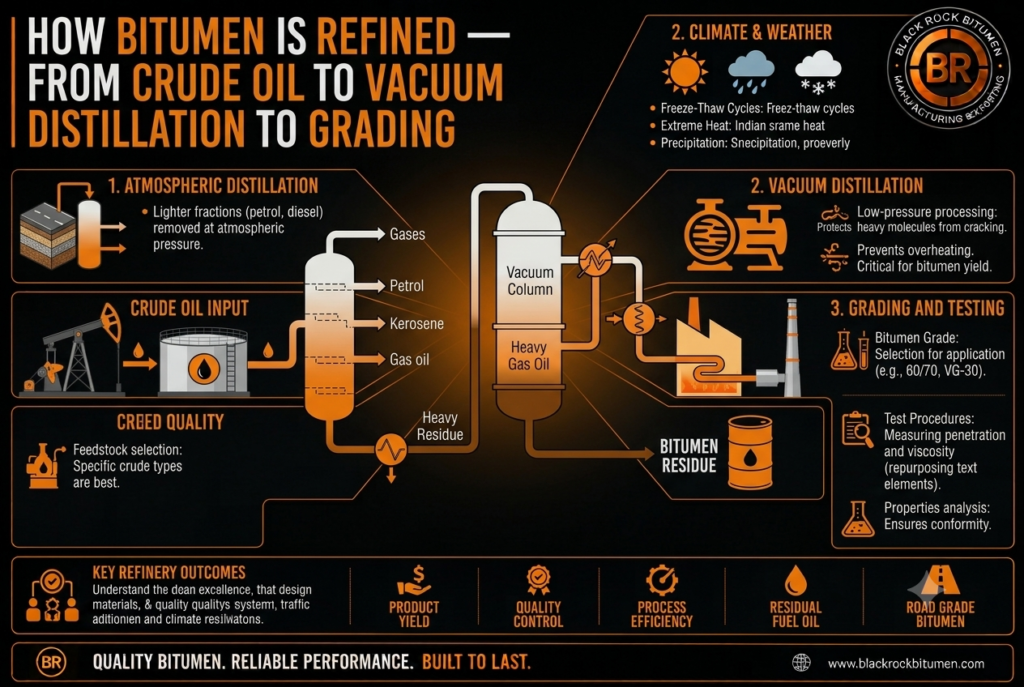
Bitumen does not simply appear at the end of an oil refinery. It is the result of separating, processing and testing one of the heaviest parts of crude oil.
That journey starts with crude oil — a complex mixture containing hydrocarbons with very different boiling ranges. Refineries first separate these components, and the heavier material left behind can then be processed further to produce vacuum residue and, where the refinery configuration and crude quality are suitable, bitumen feedstock.
The final product is then tested against a specification. Depending on the market and project requirement, that can mean penetration grade, viscosity grade or performance grade. For buyers, this distinction matters: vacuum residue is a refinery stream, while finished bitumen is a specified product that must meet defined test limits.
So instead of asking only “What grade is this?”, procurement teams should ask: **What specification does it meet? What are the test results? Is the batch traceable? Is the grade consistent with the intended climate and traffic? How has the product been stored and transported?** Those questions turn a refining story into a practical quality-assurance tool.
Here is the journey from crude oil to the paving-grade binder used in roads, airports and other infrastructure.
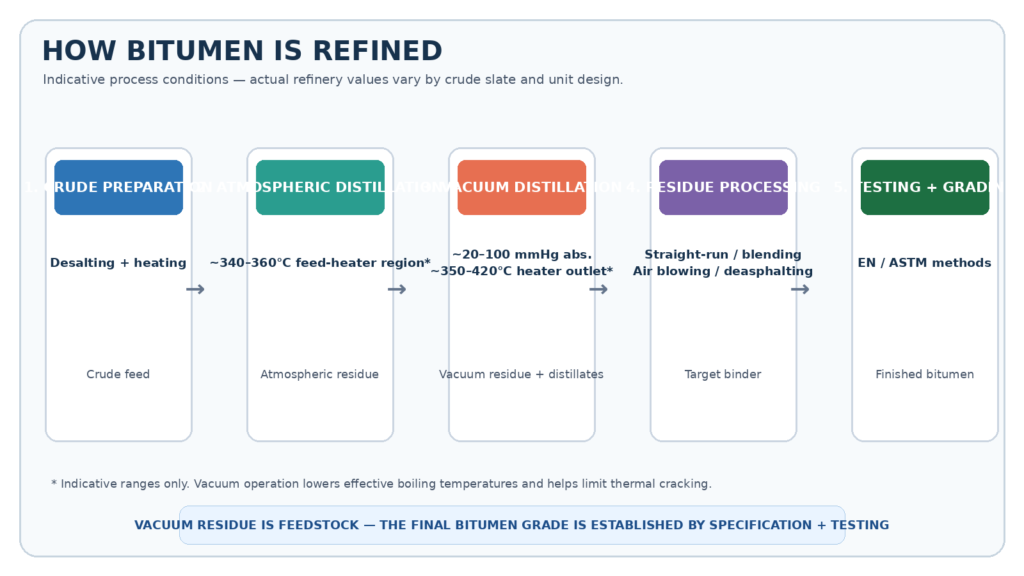
Alt text: Labelled bitumen refining process diagram showing crude preparation, atmospheric distillation, vacuum distillation at indicative reduced pressure and temperature ranges, residue processing through straight-run, air blowing or deasphalting, and final testing and grading.
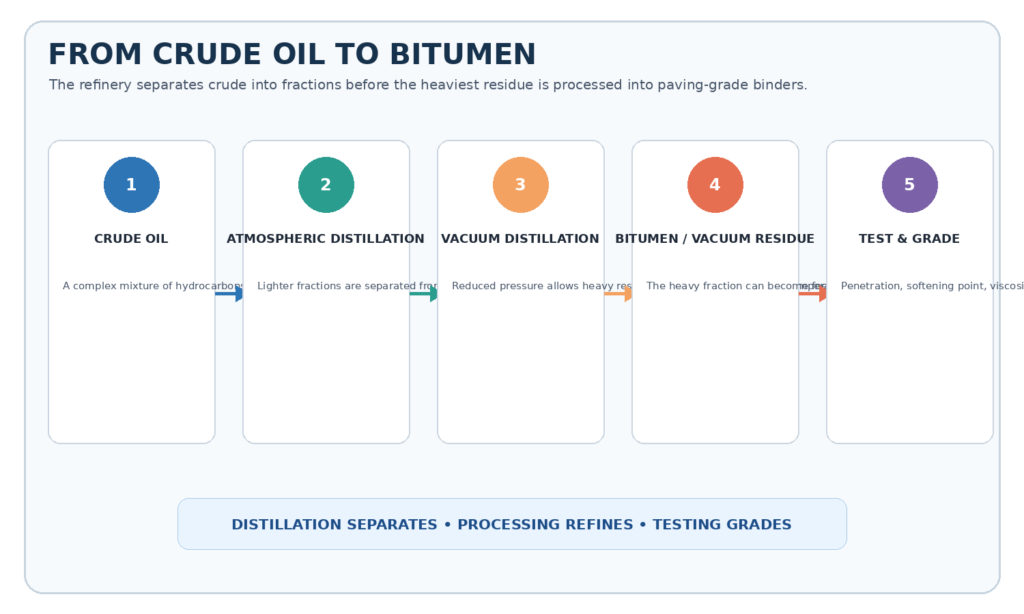
Alt text: Colour infographic showing the bitumen refining journey from crude oil through atmospheric distillation, vacuum distillation, bitumen or vacuum residue and final testing and grading.
What Is Bitumen Made From?
Bitumen is a highly viscous, dark hydrocarbon material containing complex high-molecular-weight compounds. In conventional refinery production, it is associated with the heaviest fractions of crude oil.
Crude oil is not a single substance. Its composition varies significantly by source, including the relative amounts of lighter hydrocarbons, middle distillates and heavy residue. That means two refineries processing different crude slates can have very different yields and feedstocks available for bitumen production.
The refining route matters too. Some refineries are configured to maximise fuels and other products, while others have equipment that allows deeper processing of heavy fractions.
For a broader explanation of the material itself, see Black Rock Bitumen’s What Is Bitumen? Uses, Types & Benefits for Road Construction.
Step 1: Crude Oil Enters the Refinery
The first stage is preparation. Crude oil is typically desalted and heated before entering the primary distillation unit.
The objective is to separate the crude into fractions according to differences in boiling behaviour. Lighter components can be recovered as gases and light products, while heavier fractions remain toward the bottom of the atmospheric distillation column.
This is not yet “bitumen production.” It is the first separation step that concentrates the heavy material needed for further processing.
Step 2: Atmospheric Distillation Separates the Main Fractions
In atmospheric distillation, heated crude enters a fractionation column operating near atmospheric pressure. Vapours rise through the column and condense at different levels according to their boiling ranges.
| Fraction / stream | General character | Role in refinery |
| Light gases / naphtha-range material | Lower-boiling hydrocarbons | Feeds fuel and petrochemical streams |
| Middle distillates | Intermediate boiling range | Can feed diesel, jet and other refinery streams |
| Gas oil / heavier distillates | Higher-boiling material | Can be further processed or used as refinery feed |
| Atmospheric residue | Very heavy material | Feeds vacuum distillation and other residue-processing routes |
| Air blowing / oxidation | Hot bitumen is contacted with air to alter penetration and softening point | Confirm oxidized grade, ratio designation and application |
The atmospheric residue is particularly important for bitumen production because it contains material that would require extremely high temperatures to distil at atmospheric pressure.
Step 3: Vacuum Distillation Does the Heavy-Lifting
This is where the process becomes especially relevant to bitumen.
Vacuum distillation operates at a pressure significantly below atmospheric pressure. Lowering the pressure lowers the boiling temperatures of heavy hydrocarbons, allowing further separation without requiring the extreme temperatures that would otherwise be needed.
The result is a separation of the atmospheric residue into additional distillate streams and a very heavy bottom stream commonly referred to as vacuum residue.
That vacuum residue can be an important feedstock for paving-grade bitumen, depending on refinery configuration, crude source and the properties required for the finished product.
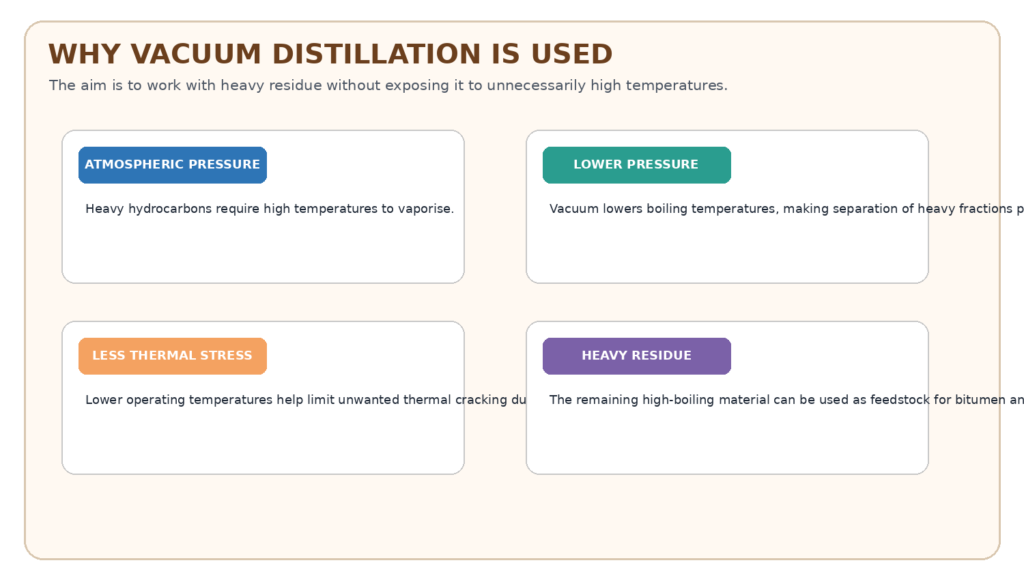
Alt text: Colour infographic explaining why vacuum distillation is used in bitumen production: reduced pressure lowers boiling temperatures, helps separate heavy fractions and produces heavy residue suitable as bitumen feedstock.
Why Can’t Heavy Residue Simply Be Distilled at Atmospheric Pressure?
The problem is temperature.
Heavy hydrocarbon molecules have very high boiling points. Raising the temperature enough to vaporise them at atmospheric pressure can cause unwanted thermal cracking or degradation before clean separation is achieved.
Vacuum distillation changes the pressure rather than relying only on higher temperature. This allows the refinery to separate useful heavy distillates from the residue under less severe thermal conditions.
There is no single refinery setting, but typical vacuum distillation systems operate at only a small fraction of atmospheric pressure, often around **20–100 mmHg absolute** depending on the unit and operating point. Heavy feed temperatures are commonly kept roughly in the **350–420°C range at the heater outlet**, with the vacuum allowing further separation without requiring atmospheric-pressure boiling temperatures. Thermal cracking of heavy hydrocarbons becomes a concern as temperatures move into roughly the **340–360°C+ region**, which is one reason vacuum operation is used. These are indicative ranges, not universal operating specifications; actual refinery conditions depend on crude slate, unit design, vacuum level and target products.
Step 4: From Vacuum Residue to Bitumen
Vacuum residue is not automatically a finished road-grade bitumen.
Depending on the refinery, the residue may be used directly as a feedstock, blended with other refinery streams, or processed further to achieve the required properties.
The target is a binder with a controlled combination of consistency, temperature behaviour, durability and other characteristics required by the intended specification.
This is where refinery process control and laboratory testing become critical.
Straight-Run, Air-Blown and Deasphalted Bitumen: Three Production Routes
A conventional paving binder can be produced through refinery separation and controlled processing without polymer modification. This is often described as **straight-run bitumen** when the material is produced primarily from refinery residue and brought to the required properties through the refinery route and, where applicable, blending.
A second route is **air blowing (oxidation)**. Hot bitumen is contacted with air, causing controlled oxidation that generally raises the softening point and lowers penetration. This route is used to manufacture oxidized grades for roofing, waterproofing, insulation and industrial applications. Black Rock Bitumen supplies oxidized grades including **75/25, 85/25 and 115/15**, making air blowing directly relevant to the company’s product range.
A third route is **solvent deasphalting**, in which a light hydrocarbon solvent such as propane is used to separate heavy asphaltic material from vacuum residue. The process can recover or adjust heavy fractions and is one of the refinery routes used to manage residue quality and product properties.
Polymer modification is different again: a polymer is incorporated into a base bitumen to change selected performance properties. In other words, polymer modification is a downstream formulation step, while air blowing and solvent deasphalting are processing routes that can change the character of the refinery-derived material.
Step 5: Testing Turns Refined Material Into a Grade
Once the refinery has produced a candidate paving binder, laboratory testing determines whether it meets the required specification.
The tests used depend on the grading system. Under the EN framework, penetration is measured using **EN 1426**, softening point using **EN 1427**, and resistance to hardening using **EN 12607-1 (RTFOT)**. Viscosity may be specified using methods such as **EN 12595** for kinematic viscosity at 135°C and **EN 12596** for dynamic viscosity at 60°C. Under ASTM systems, common references include **ASTM D5** for penetration, **ASTM D36** for softening point, **ASTM D2170/D2171** for viscosity and **ASTM D2872** for RTFOT.
That is why “refined bitumen” and “specified bitumen” are not necessarily the same thing. Refining creates the material; testing and specification define whether it is suitable for a particular grade and application.
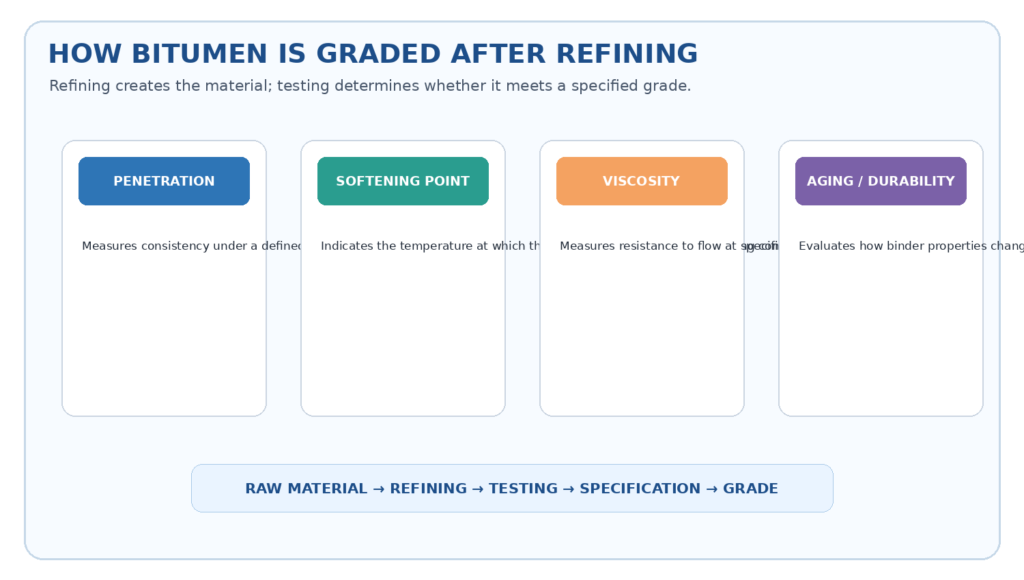
Alt text: Colour infographic showing four common bitumen grading checks after refining: penetration, softening point, viscosity, and aging or durability.
Penetration: One of the Traditional Ways to Grade Bitumen
Penetration measures how far a standard needle enters the bitumen under specified conditions of load, time and temperature.
Penetration measures how far a standard needle enters the bitumen under specified conditions of load, time and temperature, using **EN 1426** or **ASTM D5** depending on the specification. If the project uses EN 12591, common paving grades include **40/60, 50/70 and 70/100** — not 40/50, 60/70 and 80/100. Similar-looking designations can belong to different grading systems, so the governing standard should always be written into the purchase specification.
Penetration is useful because it gives a standardised measure of binder consistency at a defined temperature. But it should not be treated as a complete description of pavement performance.
For conventional paving grades, see Black Rock Bitumen’s Penetration Grade Bitumen.
Softening Point: Understanding Elevated-Temperature Behaviour
The softening point test, **EN 1427** or **ASTM D36**, gives an indication of the temperature at which a binder reaches a defined softening condition. It is often considered alongside penetration rather than used alone. Two binders can have similar penetration values but different elevated-temperature behaviour.
It is often considered alongside penetration rather than used alone. Two binders can have similar penetration values but different temperature behaviour, which is why a complete specification includes multiple properties.
For road projects in hot climates or under heavy traffic, elevated-temperature behaviour becomes particularly important.
Viscosity: Measuring Flow Behaviour
Viscosity describes resistance to flow at a specified temperature. Under EN specifications, **EN 12595** covers kinematic viscosity at 135°C and **EN 12596** covers dynamic viscosity at 60°C. ASTM specifications use methods such as **ASTM D2170** and **ASTM D2171**. Viscosity grading is therefore not just a generic “thickness” label; it is a measured property tied to a defined test method and temperature.
Viscosity grading systems classify binders according to measured viscosity ranges. The exact test temperature and limits depend on the applicable standard.
For projects using performance-based specifications, review Performance Grade Bitumen and the required testing framework.
Aging Tests: What Happens After Heat and Air Exposure?
Bitumen changes during refinery processing, asphalt production and pavement service. Heat and oxygen can alter binder properties, which is why specifications use controlled aging procedures. **RTFOT — ASTM D2872 / EN 12607-1 — simulates short-term aging associated with hot mixing and laydown. PAV — ASTM D6521 / EN 14769 — is then used to simulate longer-term oxidative aging during service.** These tests do not predict an exact road lifespan; they provide controlled measurements for comparing binder behaviour after simulated aging.
Laboratory aging procedures are therefore used to simulate selected stages of this exposure and measure how properties change.
The purpose is not to predict an exact road lifespan from one laboratory result. Instead, the tests provide controlled information about the binder’s resistance to changes under defined conditions.
How Refinery Origin Can Affect Bitumen Quality
Crude source matters because crude oils have different chemical compositions, yields and residue characteristics. A useful framework for explaining those differences is **SARA: Saturates, Aromatics, Resins and Asphaltenes**. FHWA describes these four operationally defined fractions in asphalt binders; asphaltenes act as viscosity builders, while resins help disperse and peptize the asphaltenes. The balance between resins and asphaltenes contributes to whether an asphalt system behaves more like a sol or a gel. citeturn0search7
This is why not every crude slate is equally suitable for paving-grade bitumen. Heavy, residue-rich crudes — including many heavier and naphthenic crudes and some higher-sulphur crudes — have historically been important sources of asphaltic residue. Very light, sweet crudes generally yield a much larger share of light products and may provide less suitable residue for conventional paving bitumen. The refinery configuration still matters: the crude alone does not determine the finished product.
But origin alone does not tell a buyer whether a shipment meets specification. The practical quality question is whether the finished batch consistently meets the agreed standard, test methods and acceptance limits. That is why the COA matters more than a refinery-origin claim by itself.
For procurement guidance, see Black Rock Bitumen’s Bitumen Grades & Standards for Infrastructure Tenders.
What Happens to the Other Products in the Refinery?
Bitumen production is part of a much larger refinery system.
Crude oil can produce gases, naphtha, kerosene-range streams, gas oils, residue and other intermediate products. Refineries then process or blend these streams depending on their configuration and commercial objectives.
This is one reason the availability of bitumen can vary between regions and over time. A refinery’s crude slate, processing configuration, maintenance schedule and overall product economics can all affect how much suitable residue is available.
For infrastructure buyers in Africa, South America and Southeast Asia, this also makes supply planning important. Bitumen supplied from Dubai can move through a multi-stage international logistics chain, so refinery source, production route, batch traceability, storage and transport conditions all matter when the material is finally delivered to a project.
How Bitumen Moves From Refinery to Road Project
| Stage | What happens | What the buyer should care about |
| Crude sourcing | Refinery receives a particular crude slate | Source consistency and refinery capability |
| Primary distillation | Crude is separated into broad fractions | Heavy residue availability |
| Vacuum distillation | Heavy residue is further separated under reduced pressure | Vacuum residue properties |
| Bitumen processing / blending | Material is adjusted toward target properties where required | Consistency of finished binder |
| Laboratory testing | Properties are measured against the specification | Conformity and batch results |
| Storage / transport | Finished binder is kept within appropriate handling conditions | Temperature, contamination and traceability |
| Project delivery | Material reaches asphalt plant or construction site | Correct grade, documentation and acceptance testing |
Why Storage and Handling Still Matter After Refining
A bitumen product can meet specification when it leaves the refinery and still be mishandled later in the supply chain.
Excessive heating, contamination, poor tank management or unsuitable transport practices can affect product quality and create operational problems.
For international shipments, the supply chain should therefore be considered part of quality assurance rather than a separate logistics issue.
See Black Rock Bitumen’s Bitumen Storage, Handling & Transport Standards for practical handling considerations.
Why Buyers Should Understand the Refining Route
You do not need to operate a refinery to buy bitumen intelligently. Understanding the production route helps you ask better questions before the purchase order is issued.
Instead of asking only “What grade is this?”, procurement teams should ask: **What specification does it meet? What are the test results? Is the batch traceable? What production route was used? Is the grade consistent with the intended climate and traffic? How has the product been stored and transported?**
That distinction is especially useful for international buyers. A material can come from a reputable refinery and still need to be checked against the exact contractual specification. Likewise, a vacuum residue stream is not automatically a finished paving binder.
A Simple Bitumen Refining Checklist
1. Know the crude-to-residue pathway. Bitumen begins with heavy refinery fractions, so the refinery configuration matters.
2. Understand vacuum distillation. Reduced pressure enables further separation of heavy material at lower temperatures.
3. Separate feedstock from finished product. Vacuum residue may be a bitumen feedstock; it is not automatically a road-grade product.
4. Check the grading system. Penetration, viscosity and performance grading use different approaches.
5. Review the test results. Confirm the actual batch results against the required specification.
6. Verify traceability. The COA and batch information should connect the test results to the supplied material.
7. Protect quality in transit. Storage, heating and transport should preserve the product until use.
Frequently Asked Questions
Is bitumen made directly from crude oil? Conventional petroleum-derived bitumen is associated with the heaviest fractions of crude oil. Refineries separate crude through distillation, including vacuum distillation of heavy residue, and the resulting material can be processed or blended to meet a paving specification.
What is vacuum residue? It is the very heavy bottom stream produced after vacuum distillation of atmospheric residue. Depending on refinery configuration and properties, it can serve as feedstock for bitumen and other heavy products.
Why is vacuum distillation used in bitumen production? Lower pressure reduces the boiling temperatures of heavy hydrocarbons, allowing further separation without relying on the extremely high temperatures that atmospheric-pressure separation would require.
Is vacuum residue the same as bitumen? Not necessarily. Vacuum residue can be a feedstock for bitumen production, but the finished binder must meet the required specification and test limits.
How is bitumen graded? Common systems use penetration, viscosity or performance-based properties. Under EN 12591, examples include 40/60, 50/70 and 70/100, with penetration tested by EN 1426 and softening point by EN 1427. ASTM uses different grading frameworks, so the governing standard must be identified.
What is straight-run bitumen? It generally refers to paving bitumen produced primarily through refinery processing without polymer modification. It should be distinguished from air-blown oxidized bitumen, solvent-deasphalted material and polymer-modified bitumen.
Does crude oil source affect bitumen? Yes. Crude composition and SARA balance affect the characteristics and yield of heavy residue, but finished-product conformity must still be established through testing against the applicable specification.
Why do buyers need a Certificate of Analysis? A COA provides batch-specific test results that can be compared with the agreed product specification and acceptance limits. For a deeper guide, see Black Rock Bitumen’s How to Read a Bitumen Certificate of Analysis (COA) Line by Line.
The Bottom Line
The journey from crude oil to road-grade bitumen is a chain of controlled steps: crude preparation, atmospheric distillation, vacuum distillation, residue processing or blending, laboratory testing and final grading.
Vacuum distillation is particularly important because it allows heavy refinery material to be separated under reduced pressure, producing vacuum residue that can serve as feedstock for bitumen. But the residue itself is not automatically a finished paving binder.
The final grade is established through testing. Penetration, softening point, viscosity, aging behaviour and, for performance-based systems, rheological properties all help determine whether the binder meets its specification.
For infrastructure buyers, the next step is to connect the refining story with the material you are actually purchasing. Review Black Rock Bitumen’s Penetration Grade Bitumen, Performance Grade Bitumen, Polymer Modified Bitumen and Bitumen Emulsion based on the application. For procurement, use the Bitumen Grades & Standards for Infrastructure Tenders guidance, and protect the finished material through the supply chain with Bitumen Storage, Handling & Transport Standards. Together, these steps help ensure the bitumen specified on paper is the bitumen that reaches the road project.