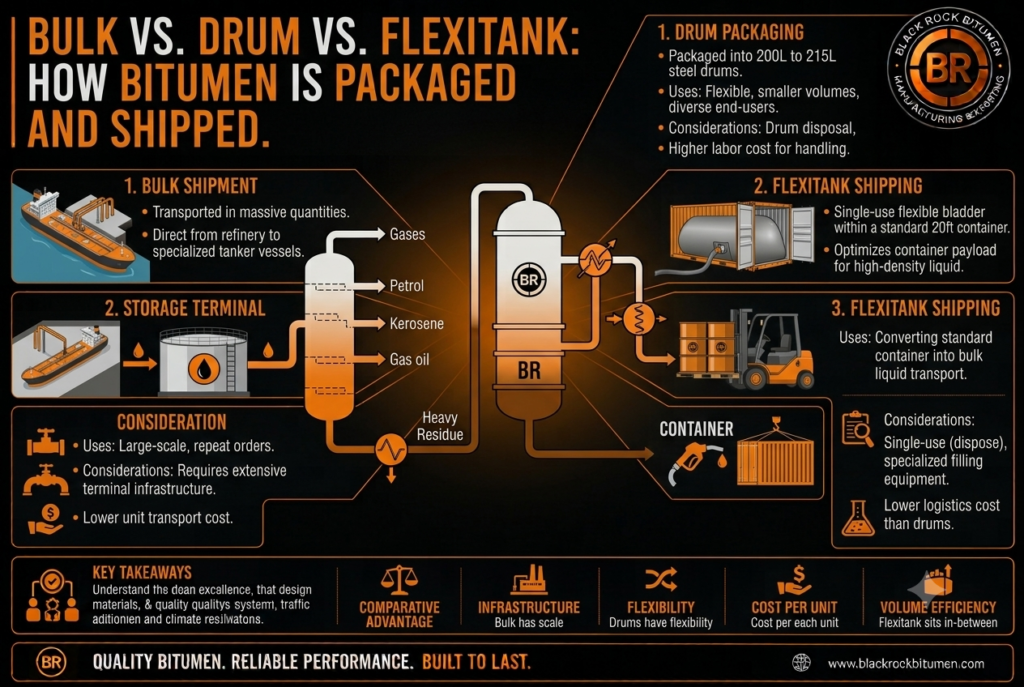
For international bitumen buyers, packaging is not a cosmetic choice. It changes how much product fits into a shipment, what infrastructure is needed at destination, how the cargo is classified for transport, how it is heated or discharged, and what the final landed cost looks like.
The common options include bulk delivery, steel drums, flexitank systems, heated tank containers and meltable bitumen bags. They are not interchangeable. The right format depends on the product, shipment size, destination infrastructure, route, carrier acceptance and receiving site’s ability to store and discharge the binder.
For buyers across Africa, South America and Southeast Asia, the decision is especially important because a shipment leaving Dubai may travel through several handling environments before reaching the road project. The cheapest package at origin can become the most expensive option if the receiving site cannot unload it efficiently.
The practical rule is simple: **choose the shipping format around the destination, not just the supplier’s quotation.**
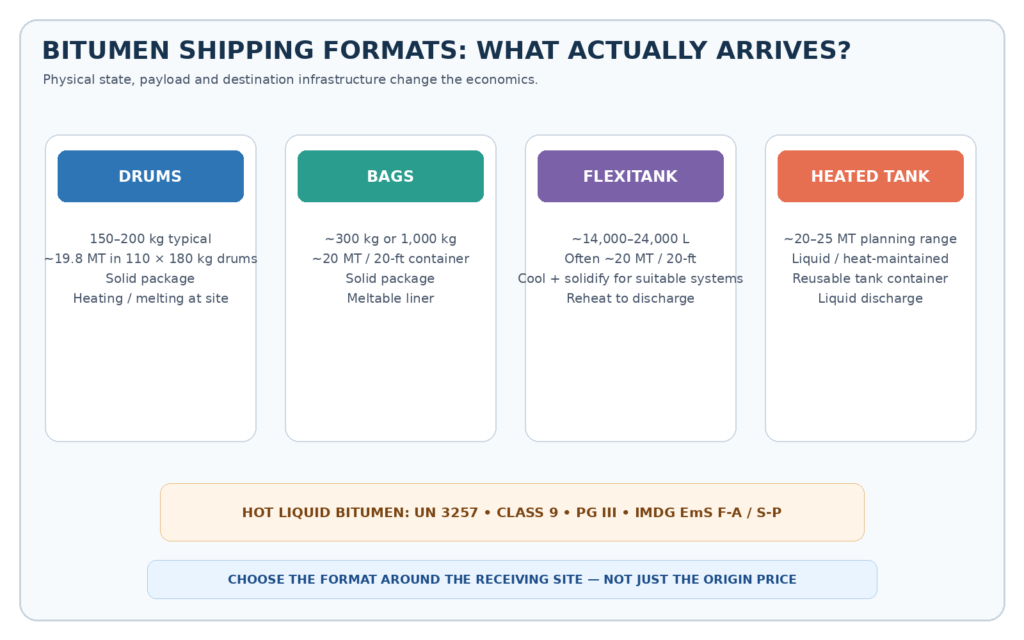
Alt text: Bitumen shipping format infographic comparing steel drums, meltable bags, bitumen-specific flexitanks and heated tank containers by typical payload, physical state and destination requirements, with UN 3257 Class 9 transport classification for hot liquid bitumen.
So before comparing prices per tonne, compare the complete delivery system.
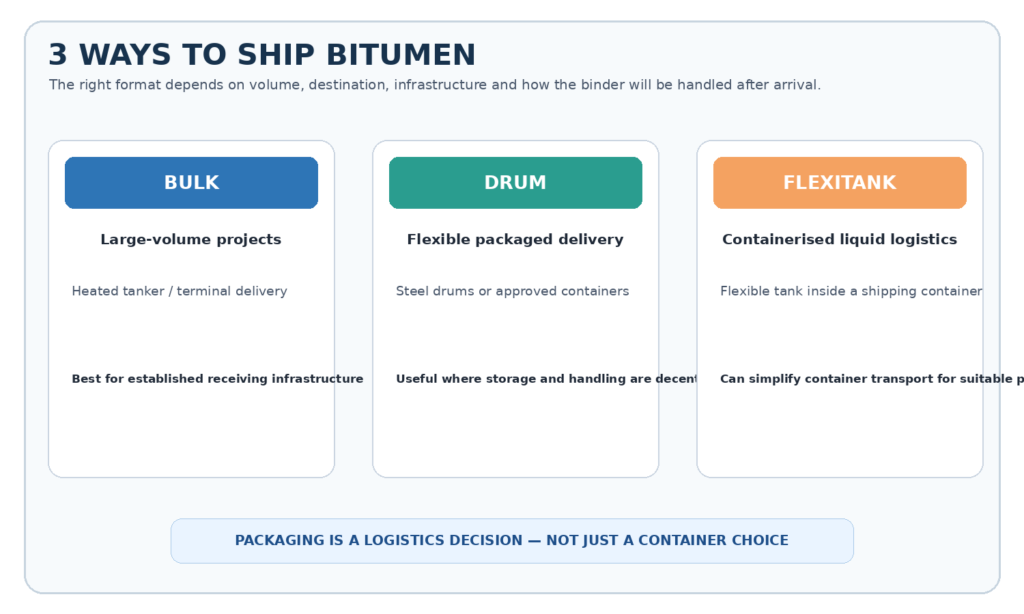
Alt text: Colour infographic comparing three common ways to ship bitumen: bulk delivery, steel drums and flexitanks, with typical use cases and logistics considerations.
What Are the Three Main Ways Bitumen Is Shipped?
Bitumen is commonly transported in bulk heated tankers, packaged in drums, or transported in suitable flexitank systems. The exact packaging method depends on the product and shipping arrangement.
1. Bulk Bitumen
Bulk bitumen is transported as a liquid in heated tanker trucks, rail tank cars or marine tankers, depending on the route and infrastructure available.
Because paving-grade bitumen is highly viscous at ambient temperatures, bulk shipments normally require controlled heating during loading, transport and discharge. The receiving facility needs suitable tanks, pumps and heating arrangements.
Bulk delivery is generally attractive for large, regular projects because it reduces the need to handle individual packages.
2. Drummed Bitumen
Drummed bitumen is filled into approved drums and transported as packaged cargo. Drums can make sense when the destination does not have the infrastructure required to receive and store a large bulk liquid shipment.
They can also be useful when the customer needs to distribute material across multiple work locations or consume it progressively rather than receiving one large bulk quantity.
The trade-off is more handling. Drums require loading, unloading, storage, movement and eventually empty-drum management.
3. Flexitank Bitumen
A flexitank is a flexible tank installed inside a standard shipping container for transporting suitable liquid products. For bitumen, suitability depends on the product formulation, temperature requirements, flexitank specification and the shipping operator’s acceptance conditions.
Flexitanks can provide a containerised logistics option without the handling pattern of individual drums. But they are not a universal replacement for bulk delivery. The product and the complete loading, transit and discharge procedure must be approved for the selected system.
Flexitank Bitumen: A Specialised Containerised Option
There is an important misconception to clear up first: a standard flexitank designed for ordinary ambient-temperature liquids should not be assumed to be suitable for hot bitumen. Bitumen-specific flexitank systems have their own temperature limits and loading procedures.
| Format | Typical planning capacity | Physical state in transit | Destination requirement | Best fit |
| Bulk heated delivery | ~25–30 MT road tanker; sea bulk varies | Hot liquid | Heated tank + pumps | Large recurring projects |
| 180 kg steel drums | ~19.8 MT / 20-ft at 110 drums | Solid/cooled package | Drum handling + heating/melting | Flexible or staged consumption |
| 1,000 kg meltable bags | ~20 MT / 20-ft | Solid/cooled package | Melting/heating system | Medium projects with fewer units |
| Bitumen flexitank | ~14,000–24,000 L; often ~20 MT | Cooled/solidified for suitable systems | Approved flexitank + destination reheating | Containerised shipments |
| Heated tank container | ~20–25 MT typical planning range | Hot liquid / temperature-controlled | Heating + liquid discharge | Containerised liquid delivery |
For the solidifying-bitumen systems used in this market, the material is loaded at a controlled reduced temperature within the liner manufacturer’s limit, then allowed to cool and solidify before the container moves. A commonly cited operating practice is to allow roughly **24 hours for cooling/solidification** before onward transport. At destination, the bitumen is reheated so it can be discharged; the meltable liner is designed to soften/melt into the bitumen during the reheating process. The exact loading temperature, cooling time and discharge procedure must come from the approved flexitank supplier and the product SDS/technical instructions.
This changes the infrastructure question completely. A flexitank shipment may reduce individual drum handling and use standard container logistics, but the receiving site still needs a safe and practical method to heat and discharge the solidified binder.
Typical bitumen flexitank capacities are roughly **14,000–24,000 litres in a 20-foot container**, with actual usable payload governed by the product density, container limits, liner design and loading plan. Industry packing examples commonly target around **20 metric tonnes per 20-foot container**. citeturn0search0turn0search1
Drummed Bitumen: Why Use It?
Heated Tank Containers: When Liquid Delivery Matters
A heated ISO tank container is the generic term for a tank container equipped for temperature-controlled handling of products that need to remain pumpable. It is different from a flexitank: the tank itself is a reusable pressure-rated transport unit with its own heating arrangements and operating requirements.
For buyers that need the material to arrive in a liquid, heat-maintained state and have the appropriate receiving system, a heated tank container can be attractive. Typical tank-container payloads for bitumen are often in the **20–25 tonne** range, but the actual payload depends on tank capacity, density, route and legal weight limits.
However, drums take more physical space per tonne than bulk delivery and involve additional loading and unloading operations.
Bitumen Bags: The Middle Ground Between Drums and Bulk
Meltable bitumen bags or jumbo bags are another established option. Common export formats include **300 kg** and **1,000 kg** units, with around **20 tonnes per 20-foot container** being a common planning figure for 1-tonne bags. The outer packaging supports handling, while the inner liner can be melted with the bitumen during the heating process. Actual bag design, liner melting temperature and container loading should be confirmed for the specific supplier and product. citeturn0search3turn0search12
Bags can be useful where a project wants more manageable units than bulk but fewer individual packages than drums. They still require a suitable melting/heating arrangement at destination, so the receiving setup should be confirmed before booking the shipment.
Flexitanks sit between the two logistics approaches: the product is transported as a liquid, but the transport unit is a shipping container rather than a conventional tanker.
For suitable bitumen products and approved flexitank systems, this can make containerised ocean transport practical. It may also simplify inland movement where container infrastructure is more accessible than bulk tanker infrastructure.
Temperature: The Number That Can Make or Break the Shipment
Bitumen is not shipped at one universal temperature. The required range depends on grade, viscosity, pumping equipment, storage system and transport method. For many paving-grade operations, handling and pumping are commonly carried out at roughly **140–180°C**, while some export loading operations use higher temperatures depending on the product and equipment.
| Question | Why it matters |
| Is the product approved for the flexitank? | Material compatibility and temperature requirements vary. |
| What is the loading temperature? | The packaging system must tolerate the specified loading conditions. |
| What happens during transit? | Temperature changes can affect viscosity and handling. |
| How will it be discharged? | The destination needs a practical unloading method. |
| Who accepts the container? | Carrier, terminal and destination requirements must align. |
As a practical safety principle, storage temperature should be kept only as high as necessary for the product and system. Prolonged high-temperature exposure can accelerate ageing, and the product should never be heated above the supplier’s specified maximum safe temperature. The exact maximum is product-specific rather than one universal number.
For pumping, the critical issue is viscosity: once the bitumen cools sufficiently, it may become too viscous or solid to move through the receiving system. That threshold varies by grade and equipment, so the receiving terminal must work from the product’s viscosity-temperature data and the agreed discharge procedure rather than a generic temperature promise.
For containerised solidified flexitank or bag shipments, the destination must plan the reheating stage before the cargo arrives. This is one of the biggest practical differences between these formats and a conventional heated bulk delivery.
Bulk vs Drum vs Flexitank: Side-by-Side Comparison
| Factor | Bulk | Drum | Flexitank |
| Typical project scale | Large | Small to medium / distributed | Medium to large, containerised |
| Handling at destination | Pumping / transfer | Manual or mechanical package handling | Liquid discharge system |
| Heating requirements | High importance | Depends on product and use | Critical to product and system suitability |
| Storage | Heated tanks | Packaged storage area | Container / approved discharge arrangement |
| Packaging handling | Low | High | Low individual-unit handling |
| Containerisation | No | Can be containerised | Yes |
| Best advantage | Efficient at scale | Flexible physical handling | Container-based liquid logistics |
| Main challenge | Requires receiving infrastructure | More handling and package management | Product and system compatibility |
Bitumen Transport Classification: UN 3257
When transported as a hot elevated-temperature liquid at or above 100°C and below its flash point, bitumen is commonly classified as **UN 3257, ELEVATED TEMPERATURE LIQUID, N.O.S. (Bitumen), Class 9, Packing Group III**. Under IMDG, the emergency schedules are **F-A and S-P**. The classification is driven by the elevated temperature condition; bitumen is not correctly described simply as a Class 3 flammable liquid. citeturn1search1turn1search46
The exact transport classification depends on the cargo’s physical state and temperature at the time it is offered for transport, so the shipment should always be checked against the current SDS, applicable IMDG/ADR requirements and carrier instructions. For ADR road transport, UN 3257 carries hazard identification number **99**, indicating a miscellaneous dangerous substance carried at an elevated temperature. citeturn1search2turn1search5
For bulk shipments, the supplier and carrier need to manage loading, transport and discharge temperatures within the product’s handling requirements. The receiving facility must also be ready to accept the material without unnecessary delays.
With drums, the product is packaged before transport, but the customer still needs to consider how the material will be heated or otherwise prepared for use.
With flexitanks, the temperature profile becomes even more important because the packaging system, product and transport conditions must be considered together.
For more on safe handling, see Bitumen Storage, Handling & Transport Standards.
How Shipping Distance Affects the Decision
The further the bitumen travels, the more important the logistics chain becomes.
A shipment moving from a refinery to a nearby asphalt plant may have a relatively simple bulk route. An international shipment involving ocean freight, port clearance and inland transportation requires more planning.
Buyers should consider the full route rather than comparing only the ocean freight component. Port handling, container availability, heating, inland haulage, storage and final discharge can all change the landed cost.
How Packaging Affects Landed Cost: A Worked Planning Example
Suppose a buyer needs approximately **20 metric tonnes** delivered to a destination port. The product price is identical in this illustration; only the logistics model changes. The figures below are planning examples, not market quotations.
A port with liquid bulk terminals and heated storage may make bulk delivery attractive. A destination with strong container infrastructure but limited liquid-bulk facilities may favour packaged or containerised solutions.
The question is therefore not simply “Which packaging is cheapest?” It is “Which format can move from supplier to final point of use with the fewest avoidable handling problems?”
Before booking a shipment, confirm what the port, carrier, terminal and receiving site will accept.
What Documents Should Accompany a Bitumen Shipment?
Documentation is part of the shipment, not an afterthought.
| Document | Purpose |
| Commercial invoice | Commercial transaction and customs information |
| Packing list | Package and shipment details |
| Certificate of Analysis (COA) | Batch-specific product test results |
| Safety Data Sheet (SDS) | Handling, hazard and emergency information |
| Bill of Lading / transport document | Evidence and details of carriage |
| Certificate of Origin, where required | Origin documentation for customs or contractual requirements |
| Inspection / conformity documents, where required | Evidence of compliance with the purchase specification |
The exact document set depends on the destination, contract, carrier and product. Buyers should agree the required documentation before dispatch rather than trying to correct missing paperwork after the cargo arrives.
The document pack should tell one consistent story. For a detailed explanation of COA, TDS and SDS, see Black Rock Bitumen’s **COA vs. TDS vs. MSDS: Which Document Tells You What**. For shipment-specific import paperwork, also review **HS Codes and Import Documentation for Bitumen Shipments**.
The lowest quoted price per tonne is not always the lowest delivered cost.
Bulk can reduce package handling, but may require heated storage tanks and specialised discharge equipment. Drums can reduce infrastructure requirements but add packaging, handling and storage costs. Flexitanks can simplify containerised movement but introduce their own equipment and compatibility requirements.
A useful procurement comparison should therefore include:
Product cost. The actual bitumen price.
Packaging cost. Drums, flexitank system or bulk loading arrangement.
Ocean freight. Container, tanker or other transport cost.
Empty drums are not a free disposal item. After the binder has been removed, the steel packaging still has to be collected, stored, recycled or disposed of according to the destination’s waste rules. In markets tightening packaging and industrial-waste requirements, that can add labour, transport and compliance costs. It can also turn what looked like a low-infrastructure packaging choice into a recurring waste-management obligation.
Inland transport. Movement from port to the project or storage facility.
Heating and discharge. Energy, equipment and operational costs.
Storage. Tanks, drums storage or container handling requirements.
Loss and handling. Potential product loss, package damage or additional labour.
What Bitumen Grades Are Commonly Shipped?
Packaging does not determine the bitumen grade. The product specification comes first, and the shipping format is then selected around the product and logistics requirements.
Black Rock Bitumen: Choosing the Format From Dubai
Black Rock Bitumen can help buyers compare the product, shipment format and destination requirements before dispatch from Dubai. The useful question is not simply “bulk or drums?” It is “What combination of grade, quantity, packaging, transport classification, destination infrastructure and discharge method gives this project the lowest practical landed cost?”
For buyers across Africa, South America and Southeast Asia, Dubai can function as a strategic export point because the shipment plan can be built around the destination port, container availability, inland route and receiving infrastructure. The exact ports and services available should be confirmed for the specific order rather than assumed from a generic packing list.
Bulk vs Drum vs Flexitank: Which Should You Choose?
Use **bulk** when the project has large volumes and reliable heated storage and discharge infrastructure.
Consider **drums** when flexibility, staged consumption, decentralised storage or limited liquid-handling infrastructure is more important than maximum handling efficiency.
Consider a **flexitank** when containerised liquid transport is attractive and the exact bitumen product, temperature profile, packaging system and receiving process have all been confirmed as compatible.
And if the destination is uncertain, do not choose the packaging format in isolation. Ask the receiving terminal and project team how the material will actually be unloaded and prepared for use.
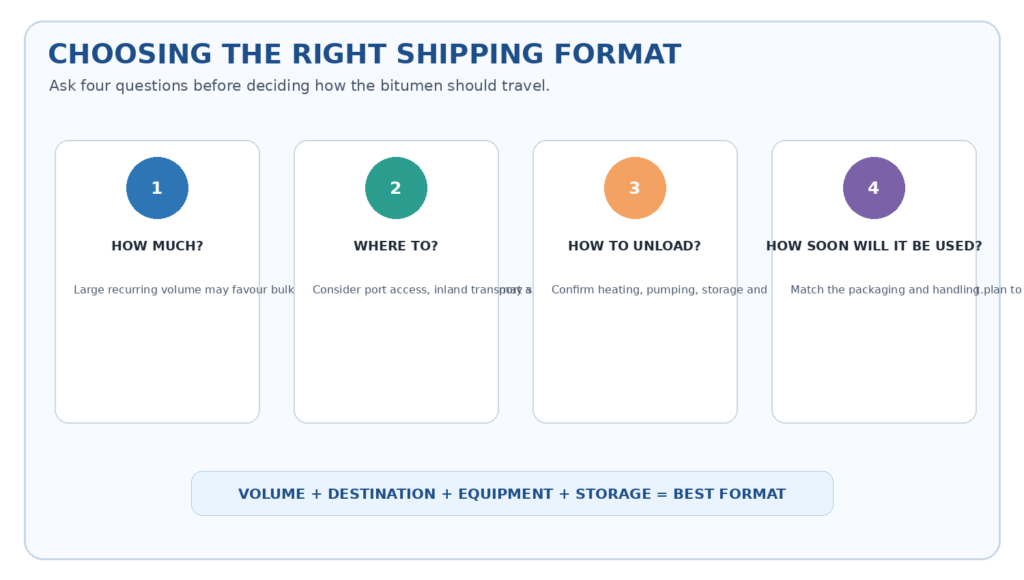
Alt text: Colour infographic showing four questions for choosing a bitumen shipping format: shipment volume, destination, unloading equipment and storage or consumption timing.
A Pre-Shipment Checklist for Bitumen Buyers
1. Confirm the exact grade. Make sure the product designation and specification match the purchase order.
2. Confirm the packaging format. Bulk, drums or flexitank should be selected around the destination and product.
Before approving a shipment, buyers should connect the technical and logistics decisions. Start with Black Rock Bitumen’s Bitumen Grades & Standards for Infrastructure Tenders, then verify the batch using the COA vs. TDS vs. MSDS guide and How to Read a Bitumen Certificate of Analysis (COA) Line by Line. For customs and import preparation, review HS Codes and Import Documentation for Bitumen Shipments. For the physical shipment itself, compare Bulk vs. Drum vs. Flexitank with Bitumen Storage, Handling & Transport Standards, and choose Penetration Grade Bitumen, Performance Grade Bitumen or Polymer Modified Bitumen according to the project specification.
4. Check the receiving infrastructure. Verify tanks, pumps, heating and unloading arrangements.
5. Check carrier acceptance. Confirm that the selected carrier and route accept the cargo and packaging.
6. Prepare documents early. COA, SDS, commercial and transport documentation should be ready before dispatch.
7. Plan inland transport. The port is not the final destination; check the complete route.
8. Protect traceability. Batch numbers and documentation should remain linked to the delivered material.
Frequently Asked Questions
Is bulk bitumen cheaper than drums? It can be more efficient for large-volume projects because it reduces individual package handling, but the total delivered cost depends on heating, storage, discharge equipment, transport, port charges and project volume.
Can bitumen be shipped in drums? Yes. Drummed bitumen is used where packaged handling is suitable. The drum specification and filling, transport and storage conditions need to be appropriate for the product.
Can bitumen flexitanks transport hot liquid bitumen? Do not assume so. Standard flexitanks are not automatically suitable for hot bitumen. Approved bitumen-specific systems have defined loading-temperature limits and procedures; some systems use controlled loading followed by cooling and solidification, then reheating at destination.
Does bitumen travel as a liquid in a flexitank? For the solidifying flexitank systems described here, the binder cools and solidifies before onward container transport and is reheated at destination for discharge. Confirm the exact procedure with the liner supplier.
What is UN 3257 for bitumen? UN 3257 is the transport entry for elevated-temperature liquid, N.O.S. (Bitumen), Class 9, Packing Group III when the applicable temperature conditions are met. Under IMDG, the EmS codes are F-A and S-P. citeturn1search1
How much bitumen fits in a 20-foot container? It depends on the format. Planning examples include about 19.8 MT in 110 × 180 kg drums, around 20 MT in 20 × 1-tonne bags, roughly 20 MT in many bitumen flexitank configurations, and about 20–25 MT in some heated tank containers. Actual payload is controlled by container, packaging, density, route and legal weight limits. citeturn0search3turn0search12
Why are empty drums a concern? They create a physical waste stream that may require collection, storage, recycling or disposal. Destination waste rules and local disposal costs should be included in the landed-cost comparison.
Which format is cheapest? There is no universal winner. Bulk is often efficient at scale, drums can win where infrastructure is limited, and containerised bags, flexitanks or heated tank containers can be attractive when the route and receiving system suit them.
The Bottom Line
Bulk, drums and flexitanks are not simply three different ways of putting the same product on a ship. They create different handling, storage, heating and receiving requirements.
For large infrastructure projects with heated storage and pumping facilities, bulk delivery can be the most efficient route. Drums can provide flexibility where packaged handling is more practical. Flexitanks can offer a containerised liquid option for suitable bitumen products when the system and temperature requirements are properly managed.
The smartest choice is the one that works across the **entire logistics chain** — from supplier loading through ocean transport, port handling, inland delivery, storage and final use.
If you are planning an international bitumen shipment, start by confirming the required Bitumen Grades & Standards for Infrastructure Tenders. Then compare the appropriate Penetration Grade Bitumen, Performance Grade Bitumen or Polymer Modified Bitumen against your project’s requirements. For liquid applications, Bitumen Emulsion may also be relevant. Finally, review Bitumen Storage, Handling & Transport Standards before deciding whether bulk, drums or flexitank delivery makes the most sense for the destination.
| Format | Approx. net payload | Package units | Main added cost drivers | What can make it cheaper |
| 180 kg drums | ~19.8 MT | 110 drums | Drum manufacture, handling, storage, disposal | Low receiving infrastructure |
| 1-tonne bags | ~20 MT | 20 bags | Bag cost, melting equipment, handling | Fewer individual packages |
| Flexitank | ~20 MT | 1 liner / 20-ft container | Approved liner, container freight, reheating/discharge | Containerised route + low unit handling |
| Heated tank container | ~20–25 MT | 1 tank container | Tank hire, heating, terminal handling | Liquid discharge with suitable infrastructure |
| Bulk | Project/terminal dependent | Tanker / bulk vessel | Heated storage, pumping, terminal equipment | Large recurring volumes |