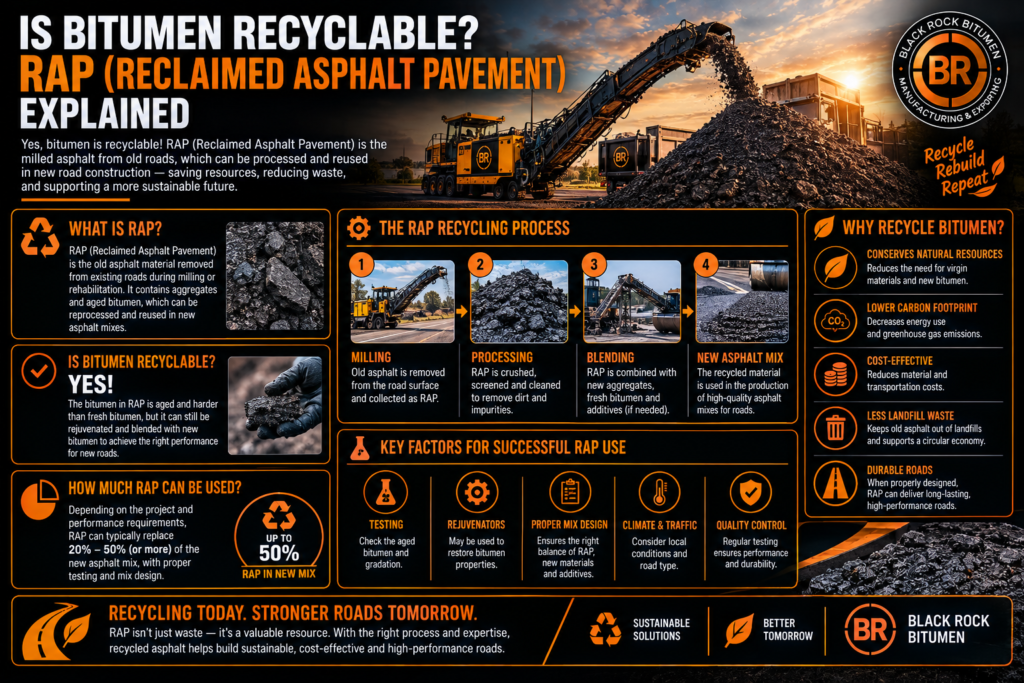
Black Rock Bitumen supplies paving binders to road contractors across Africa, Asia and the Middle East, and choosing the right virgin binder matters just as much when a mixture contains recycled material. If you have ever watched an old asphalt road being milled away, it is easy to assume the material is simply waste. It isn’t. Much of that removed pavement can become a useful feedstock for new asphalt — and the key material inside it is the same asphalt binder that originally helped hold the pavement together. That reclaimed material is known as reclaimed asphalt pavement, or RAP.
So, is bitumen recyclable? Yes — but RAP recycling is not the same thing as simply melting old bitumen and using it again. RAP contains aggregate coated with aged asphalt binder, and both components have to be characterised, processed and incorporated into a new mixture in a controlled way.
One definition matters from the start. The reclaimed binder ratio (RBR) is the share of a mixture’s total binder that comes from RAP. It is not the same number as the RAP percentage by weight of the mixture, and much of the confusion around “high-RAP” asphalt comes from mixing the two up. AASHTO M 323 defines this binder replacement as the ratio of reclaimed binder to the total binder in the mixture, and FHWA’s RAP guidance uses it when it reports that mixtures with a 30 to 50 percent reclaimed binder ratio can perform well and be practically and responsibly produced.
For buyers and contractors working across international supply chains, the practical question is therefore not just “Is bitumen recyclable?” It is: how do you recover its value without losing control over grade, binder behaviour, mixture performance and quality?
Key takeaway: Yes, bitumen is recyclable, and asphalt pavement is recycled at enormous scale — US producers used 101.4 million US short tons of RAP in asphalt mixtures in 2024, and the average mixture contained 22.9 percent RAP. For design, the number that matters is the reclaimed binder ratio, not the RAP percentage, because the share of binder coming from RAP is what decides whether the virgin binder grade has to change.
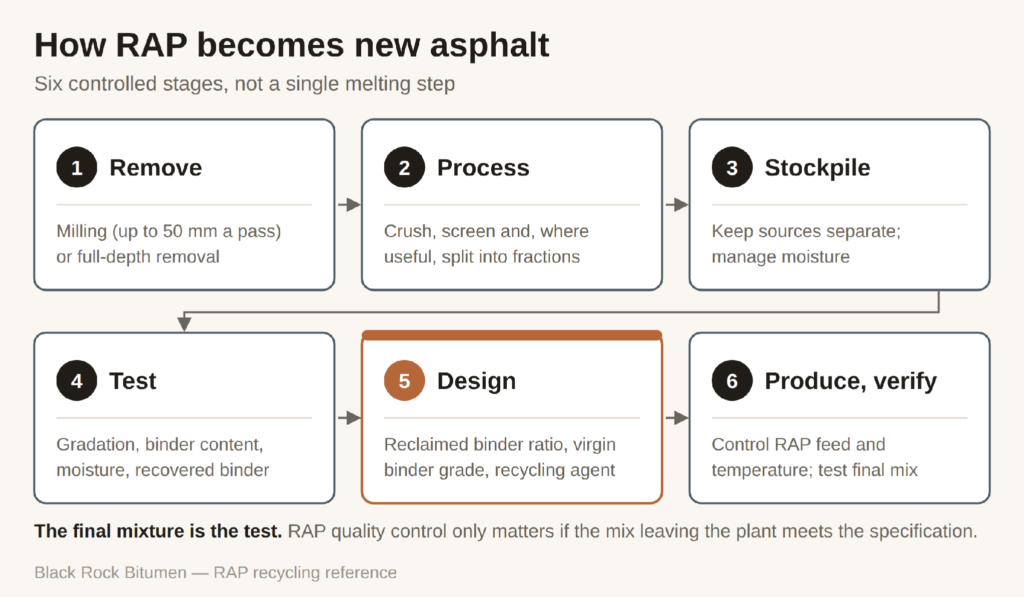
Alt text: Six-stage flow showing how reclaimed asphalt pavement becomes new asphalt: remove the old pavement by milling or full-depth removal, process it by crushing and screening, stockpile it with sources kept separate, test gradation, binder content, moisture and recovered binder, design the mixture including the reclaimed binder ratio and virgin binder grade, then produce the mixture and verify the final asphalt.
What Exactly Is RAP?
RAP stands for reclaimed asphalt pavement — removed or reprocessed pavement material containing asphalt binder and aggregate. FHWA’s material description notes that RAP is generated when asphalt pavements are removed for reconstruction, resurfacing or access to buried utilities, and that properly crushed and screened RAP consists of well-graded aggregate coated with asphalt binder.
That definition matters because RAP is not a single chemical product. It is a recovered pavement material with a history. Its properties depend on the original aggregate and binder, pavement age, traffic, climate, maintenance history, milling method and how the material was processed and stored. FHWA puts typical figures on that variability: the binder content of RAP usually ranges from 3 to 7 percent by weight (4.5 to 6 percent for most surface-course RAP), and stockpiled RAP can hold 5 percent moisture or more, rising to 7 or 8 percent after prolonged rain.
| RAP component | What it contains | Why it matters |
|---|---|---|
| Recovered aggregate | Stone, sand and mineral particles from the old asphalt — typically 93 to 97 percent of RAP by weight | Influences gradation, structure and the mixture skeleton |
| Aged asphalt binder | Binder remaining on the recovered aggregate — typically 3 to 7 percent of RAP by weight | Contributes to the total binder and is usually substantially stiffer than virgin binder |
| Fines, moisture and possible contaminants | Material introduced during milling, processing or storage | Can change plant handling, gradation, binder estimates and consistency |
RAP Is Not the Same as Recycled Bitumen
The terms are often used interchangeably in casual conversation, but technically they describe different things. RAP is the reclaimed pavement material. Recycled asphalt binder is the binder contribution within that material.
Imagine a road surface being milled. The machine does not separate the binder from the stone into two clean streams. Instead, it produces reclaimed particles in which aggregate is coated with aged binder. That combined material is then processed and used in a new application — which is why RAP recycling is best understood as materials engineering rather than a simple “reuse the old bitumen” process.
RAP Percentage vs Reclaimed Binder Ratio: Why the Difference Matters
RAP percentage and reclaimed binder ratio describe the same mixture in two different ways. RAP percentage is the share of RAP by weight of the whole mixture. The reclaimed binder ratio is the share of the mixture’s total binder that comes from that RAP. Because RAP contains only a few percent binder, the two numbers are rarely the same.
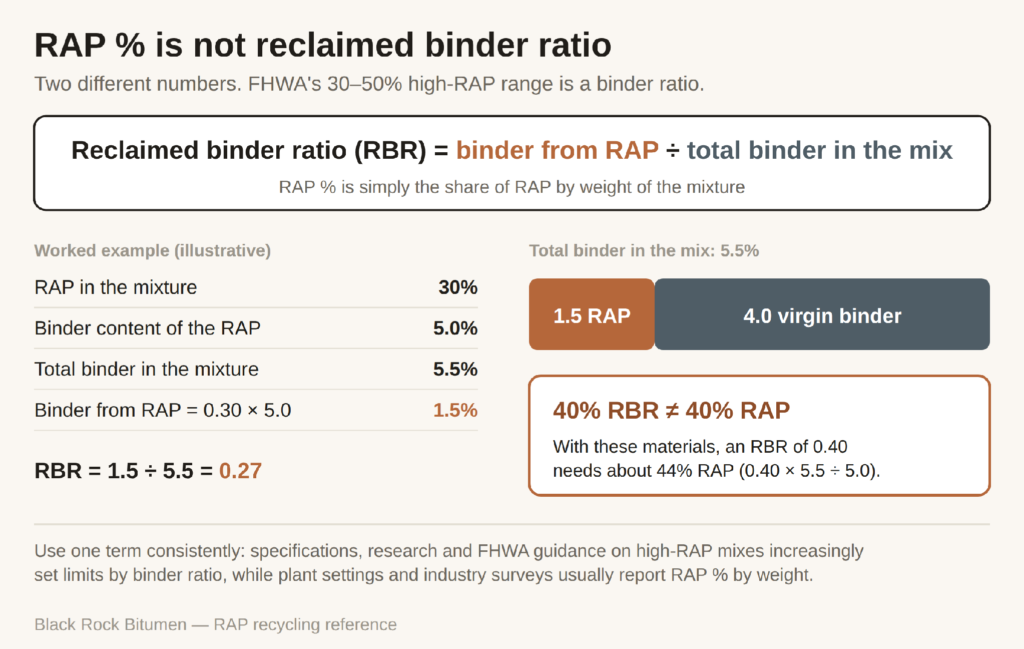
Alt text: Diagram explaining that RAP percentage and reclaimed binder ratio are different numbers. In a worked example, a mixture with 30 percent RAP, 5.0 percent binder in the RAP and 5.5 percent total binder has 1.5 percent binder from RAP, giving a reclaimed binder ratio of 0.27. With the same materials, a reclaimed binder ratio of 0.40 would need about 44 percent RAP.
| Step | Worked example (illustrative) |
|---|---|
| RAP content, by weight of mixture | 30% |
| Binder content of the RAP | 5.0% (within FHWA’s typical 4.5–6% range for surface-course RAP) |
| Total binder content of the mixture | 5.5% |
| Binder contributed by RAP (0.30 × 5.0) | 1.5% of the mixture |
| Reclaimed binder ratio (1.5 ÷ 5.5) | 0.27, or 27% |
With these materials, a 40 percent RBR would need about 44 percent RAP, not 40. A mixture described as “40% RAP” and one described as “40% RBR” are therefore different mixtures, and a specification limit written in one term cannot be checked against a mix design reported in the other. This article uses RAP percentage for plant proportions and industry statistics, and reclaimed binder ratio for binder design and FHWA’s high-RAP guidance — and says which is which each time.
How Is Asphalt Pavement Recycled?
The exact recycling route depends on the project, available equipment, RAP quality and specification. The most familiar route is central-plant hot recycling, but cold recycling and in-place processes are also established technologies, all covered in FHWA’s pavement recycling programme.
1. Milling or full-depth removal. Existing asphalt pavement is removed by milling or by full-depth removal. FHWA notes that a milling machine can remove up to 50 mm (2 in) in a single pass, while full-depth removal involves ripping and breaking the pavement. The removal method affects the size and consistency of the reclaimed material; milled RAP is generally finer than crushed RAP.
2. Crushing and screening. Raw RAP is not automatically ready to feed into a new mixture. Processing may include crushing, screening, conveying and stockpiling. FHWA’s hot-recycling guidance treats processed RAP as a granular aggregate substitute, and splitting it into coarse and fine fractions is a common way to improve control over plant input and mix design.
3. Stockpiling and material management. Stockpiling sounds simple, but it is one of the less glamorous parts of RAP quality control. Different sources can have different binder histories and gradations; if they are combined without control, that variability goes straight into the plant. Moisture matters too, because wet RAP increases heating demand and complicates production.
4. Testing the RAP. Before a significant amount of RAP goes into a mixture, its gradation, binder content, moisture and — at higher binder ratios — recovered binder properties need to be understood. The next section sets out the methods.
5. Mix design. The designer decides how much RAP can be incorporated while still meeting target mixture properties. This is where the reclaimed binder ratio becomes the key number, because the aged binder’s influence on stiffness grows with it.
6. Plant production and paving. Production then has to reproduce the design consistently. RAP feed rates, moisture, temperature, aggregate proportions and virgin binder addition all need to stay within the production controls set for the project.
How Is RAP Tested?
| Test or characteristic | Typical method | Why it matters |
|---|---|---|
| Asphalt binder content | Ignition oven, ASTM D6307 / AASHTO T 308; or solvent extraction, ASTM D2172 / AASHTO T 164 | Sets how much binder the RAP contributes, and therefore the reclaimed binder ratio |
| Gradation of recovered aggregate | AASHTO T 30 on aggregate recovered by ignition or extraction | Affects aggregate structure and final mixture gradation |
| Moisture content | Oven-drying of stockpile samples, as set by the specification | Affects heating, production rate and handling |
| Recovered binder properties | Extraction and recovery (AASHTO T 319), then PG testing of the recovered binder | Needed for blending charts and virgin binder selection at higher binder ratios |
The binder content result deserves particular care. The ignition oven burns the binder off at a high temperature (typically around 538 °C), but some aggregate also loses mass in the process. Without a correction factor, the method over-predicts binder content (Pavement Interactive). The correction factor is typically between 0 and 0.5 percentage points and is generally higher for abrasion-susceptible aggregates such as limestone, so it must be established for each mixture and each oven. An uncorrected result overstates the RAP binder contribution, inflates the calculated reclaimed binder ratio, and can lead to too little virgin binder being added.
The choice of method also depends on what happens next. FHWA’s state-of-the-practice report recommends extracting and recovering the binder when RAP binder properties need testing, and notes that the ignition oven can change the physical characteristics of some aggregates. Solvent extraction is therefore the usual route when the recovered binder itself is going to be graded.
What Happens to the Old Bitumen Inside RAP?
The binder in RAP is not “frozen in time”. Asphalt binder changes during service: oxidation and environmental exposure generally increase stiffness and viscosity, so aged RAP binder behaves differently from the virgin binder supplied for a new project. FHWA reports that binder recovered from RAP typically has a penetration of 10 to 80 at 25 °C and an absolute viscosity of 4,000 to 25,000 poise at 60 °C — far stiffer than common paving grades.
This is the central technical issue in RAP recycling: the final mixture contains binders with different histories. The design has to account for the aged binder already present in the RAP and the properties of the virgin binder being added, and to decide how much the two actually blend.
RAP and the “Right Grade” Question: How Should the Virgin Binder Change?
RAP changes the starting point of the mixture. With a virgin-only mix, the designer starts with new aggregate and new binder. With RAP, part of the aggregate and binder system already exists, and that existing binder is stiffer. A grade that worked for a virgin mixture should not automatically be assumed to be the best choice for a RAP mixture.
AASHTO M 323, the Superpave volumetric mix design specification, gives the long-standing answer as a three-tier guideline:
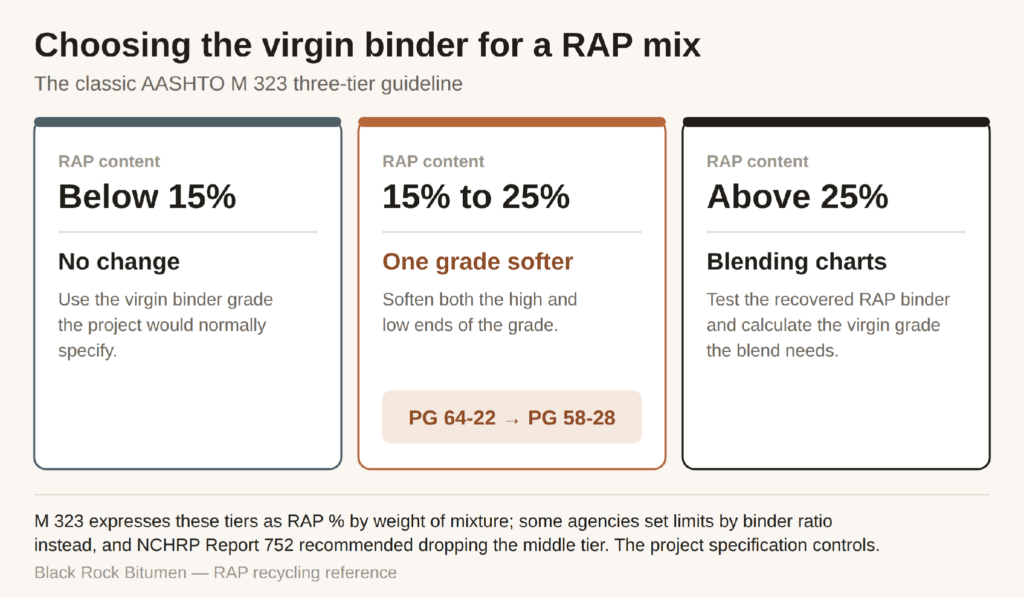
Alt text: Three-tier guideline for choosing the virgin binder in a RAP mixture from the classic AASHTO M 323 table: below 15 percent RAP make no change to the virgin binder grade; from 15 to 25 percent select a virgin binder one grade softer on both the high and low ends, for example PG 58-28 instead of PG 64-22; above 25 percent use blending charts to determine the virgin grade. The governing project specification controls.
| RAP content (classic AASHTO M 323 guideline) | Virgin binder selection |
|---|---|
| Below about 15% | No change to the virgin binder grade |
| About 15% to 25% | Select a virgin binder one grade softer on both the high and low ends — for example, PG 58-28 where PG 64-22 would normally be used |
| Above about 25% | Use blending charts, based on tests of the recovered RAP binder, to determine the virgin grade |
Two caveats make this rule more useful, not less. First, M 323 expresses these tiers as RAP percentage by dry weight of the mixture. The same standard also allows agencies to work by percent binder replacement instead, and some state agencies have moved the tiers onto the binder ratio; research for NCHRP Report 752 recommended removing the middle tier altogether and using blending calculations once the binder ratio reaches 0.25. Second, the governing project specification controls. Check which edition of M 323 — or which agency table — the contract cites, and whether its limits are written as RAP percentage or binder ratio.
How a Blending Chart Sets the Virgin Grade
Blending charts treat the final binder as a weighted blend of the recovered RAP binder and the virgin binder. Using the blending equation in AASHTO M 323 Appendix X1, with the RAP binder supplying 30 percent of the total binder, the calculation looks like this:
| Blending step | High-temperature side | Low-temperature side |
|---|---|---|
| Target grade of the blended binder | PG 64 (critical temperature ≥ 64 °C) | −22 (critical temperature ≤ −22 °C) |
| Measured critical temperature of the recovered RAP binder | 88.0 °C | −12.0 °C |
| Virgin binder needed: (target − 0.30 × RAP) ÷ 0.70 | At least 53.7 °C | −26.3 °C or colder |
| Standard virgin grade that satisfies it | PG 58 | −28 |
In this illustrative case, the blending calculation points to a PG 58-28 virgin binder — the same one-grade-softer result as the middle tier. With a stiffer RAP binder or a higher binder ratio, the answer would move further. Blending charts assume the RAP and virgin binders blend fully, which may not happen in practice, so mixture performance testing remains the final check. For how PG grades are defined and tested, see our Superpave PG Grading System guide; for choosing between PG, penetration and viscosity grades, see bitumen grade selection.
Can RAP Make Asphalt Too Stiff?
It can, particularly as the reclaimed binder ratio rises. Greater stiffness can improve resistance to rutting, but excessive stiffness can reduce cracking resistance, depending on the pavement, climate and mixture.
FHWA has documented this trade-off. In 2014 it issued a memorandum after a number of state agencies reported premature cracking in relatively new asphalt pavements, many of which shared a high percentage of recycled binder; the memorandum is summarised in FHWA’s later tech brief on resource-responsible RAP use. The lesson is not “avoid high RAP”. It is “design the final mixture”: high binder ratios need more attention to material characterisation, binder selection and performance verification.
How Much RAP Can Be Used?
There is no universal percentage that can be stamped onto every asphalt project. The limit depends on material quality, mixture design, plant capability, specification and performance requirements. In practice, however, usage has grown steadily: NAPA’s survey shows the average RAP content of US asphalt mixtures rose from 15.6 percent in 2009 to 22.9 percent in 2024 (NAPA IS 138).
At the high end, FHWA’s RAP guidance — drawing on NCHRP Report 927 and field reviews of practice — reports that mixtures with a 30 to 50 percent reclaimed binder ratio can perform well and be practically and responsibly produced, and may be a promising short-term route to agency sustainability goals. NCHRP Report 927 was scoped at binder ratios between 0.3 and 0.5 precisely because current practice generally limits the reclaimed binder ratio to 0.3 or less.
| Reclaimed binder ratio | What changes | Main engineering focus | Typical priority |
|---|---|---|---|
| Up to about 0.30 | The range most current agency limits allow | Routine gradation, binder content and binder accounting | Consistent feed and quality control |
| About 0.30 to 0.50 | Aged binder strongly influences the final blend — the range FHWA and NCHRP Report 927 address | Recovered binder testing, blending, recycling agents and mixture performance tests | Characterisation and verification |
| Above 0.50 | Specialised mixtures and processes | Project-specific design and trials | Detailed testing and production control |
High RAP Does Not Automatically Mean High Risk
The strongest field evidence comes from FHWA’s Long-Term Pavement Performance (LTPP) programme. Its SPS-5 experiment compared overlays built with virgin mixtures and with recycled mixtures containing about 30 percent RAP by weight at 18 test sites across the United States and Canada, monitored for 8 to 17 years. FHWA concluded that pavements containing up to 30 percent RAP performed similarly to pavements built from virgin materials with no RAP; the LTPP tech brief found no significant performance difference at the majority of sites.
FHWA’s earlier high-RAP programme material defined high-RAP mixtures as more than 25 percent RAP by weight of mixture; its current guidance discusses reclaimed binder ratios of 30 to 50 percent. The number is therefore a design variable, not a quality score. A well-characterised mixture with a high binder ratio is not automatically inferior to a low-RAP mixture, just as a low-RAP mixture is not automatically well designed.
Recycling Agents and Rejuvenators: What Do They Do?
A recycling agent is an additive intended to restore some of the properties the RAP binder lost through ageing, so that more of it can be used without making the mixture too stiff. Products range from petroleum-based oils to bio-based materials, and they are commonly called rejuvenators or softening agents.
ASTM D4552/D4552M classifies hot-mix recycling agents by their viscosity at 60 °C; it does not cover emulsified agents. The standard itself cautions that meeting the classification does not necessarily indicate how a binder blend or mixture containing the agent will perform. That is why performance testing matters: NCHRP Report 927 evaluated commercially available recycling agents in mixtures with reclaimed binder ratios between 0.3 and 0.5, and produced a draft AASHTO standard practice.
Dosage is a balance. Too little agent leaves the blend stiff and crack-prone; too much can soften it enough to raise rutting risk. One laboratory study found that a 0.4 percent rejuvenator dose doubled a binder’s rutting potential as measured by the MSCR test (laboratory study, 2024). Buyers should ask what agent is proposed, what it is classified as, how the dose was set, and which mixture tests verified it.
Warm-Mix Asphalt: A Route to Higher RAP Contents
Warm-mix asphalt (WMA) technologies allow asphalt mixtures to be produced and placed at lower temperatures than conventional hot mix. They are no longer niche: WMA reached 178.3 million US short tons (about 161.7 million tonnes) in 2024, or 40.2 percent of the US asphalt mixture market.
Lower production temperatures reduce ageing of the virgin binder in the plant, and many practitioners see that as headroom for incorporating more RAP, which is stiffer and more brittle. WMA is not an automatic licence for high RAP, though. A Pennsylvania DOT study found that mixtures with 15 percent RAP met volumetric requirements at warm production temperatures, but at 30 percent RAP hot production temperatures were needed to reach the same compaction. Combining WMA with high RAP is a mix design decision to verify, not an assumption.
Hot Recycling vs Cold Recycling vs In-Place Recycling
| Approach | Basic process | Main control points |
|---|---|---|
| Hot central-plant recycling | RAP is combined with virgin aggregate and new binder in a plant to produce hot-mix or warm-mix asphalt | Temperature, moisture, gradation, binder contribution and plant control |
| Cold central-plant recycling | RAP is processed and combined with emulsified or foamed asphalt, often with other additives, at a stationary plant | Moisture, curing, binder system and mixture design |
| Hot in-place recycling | Existing pavement is heated, scarified, treated and replaced on site | Heating, scarification, rejuvenation and placement |
| Cold in-place recycling | Existing pavement is milled and processed on site, then combined with asphalt emulsion or foamed asphalt | Depth, moisture, processing, curing and compaction |
FHWA’s RAP guidelines describe cold in-place recycling as milling the existing surface to a depth of up to 150 mm and mixing it with asphalt emulsion or foamed asphalt, with in-place processes adding rejuvenating agents where needed. Black Rock Bitumen supplies bitumen emulsions used in cold recycling systems. The best approach depends on pavement condition, project objectives, available equipment and the governing specification, so RAP recycling is a family of technologies rather than one single process.
In-place processes also answer a question buyers often ask: can 100 percent RAP be used? In cold in-place recycling, the answer is effectively yes — NCAT describes the process as recycling 100 percent of the existing asphalt pavement, with an emulsion or foamed asphalt added and a new surface course placed on top. In plant-produced hot mix, FHWA’s 1997 user guidelines noted that technology had made 90 to 100 percent RAP hot mix possible, but such mixtures remain specialised; the 2024 US average was 22.9 percent.
Can RAP Be Used Outside New Asphalt?
Yes. RAP can also be used in granular base and subbase applications and, in some circumstances, as embankment or fill. Those uses still divert reclaimed pavement from disposal, although they do not recover the value of the aged binder in the way asphalt-mixture recycling does.
US practice reflects that hierarchy. According to NAPA’s 2024 survey, more than 99 percent of RAP was put back to use — more than 96 percent in new asphalt pavements and the remaining 4 percent in other civil engineering applications such as unbound aggregate bases. For a pavement owner trying to maximise material value, the preferred use is not simply “any reuse”; it is the highest-value application that the material quality, project requirements and economics can responsibly support.
Why RAP Quality Matters More Than the Headline Percentage
Source: Know where the RAP came from and whether different sources were kept separate.
Gradation: Processing should create a predictable particle-size distribution suitable for the target mixture.
Binder content: The existing binder has to be measured accurately, including the ignition oven correction factor.
Recovered binder: The aged binder’s properties influence virgin binder selection and final mixture behaviour.
Moisture: Excess moisture affects heating and production consistency.
Contamination: Soil, debris or unsuitable material can compromise the recycled feedstock.
Stockpile management: Consistent handling reduces variability before the RAP reaches the plant.
RAP Quality-Control Checklist
- Identify the RAP source and pavement layer where practical.
- Control the combining of materially different RAP sources.
- Check gradation after processing.
- Measure binder content by ignition oven (ASTM D6307 / AASHTO T 308) with a mixture-specific correction factor, or by solvent extraction (ASTM D2172 / AASHTO T 164).
- Calculate and report the reclaimed binder ratio, not just the RAP percentage.
- Characterise the recovered binder when the binder ratio or the specification requires it.
- Monitor moisture before and during production.
- Keep stockpile management consistent.
- Verify that the final mixture — not only the RAP — meets the specification.
What Are the Environmental Benefits of RAP?
The sustainability case for RAP is straightforward: if useful material can be recovered from an existing road, less new aggregate and virgin binder is needed, and less reclaimed pavement goes to disposal. Those benefits are the reason RAP sits at the centre of FHWA’s pavement recycling work.
The scale is substantial. The figures below come from NAPA’s IS 138, Asphalt Pavement Industry Survey on Recycled Materials and Warm-Mix Asphalt Usage: 2024, the 15th annual survey, released with FHWA (summary record). All tonnages are US short tons; approximate metric equivalents are given for international readers.
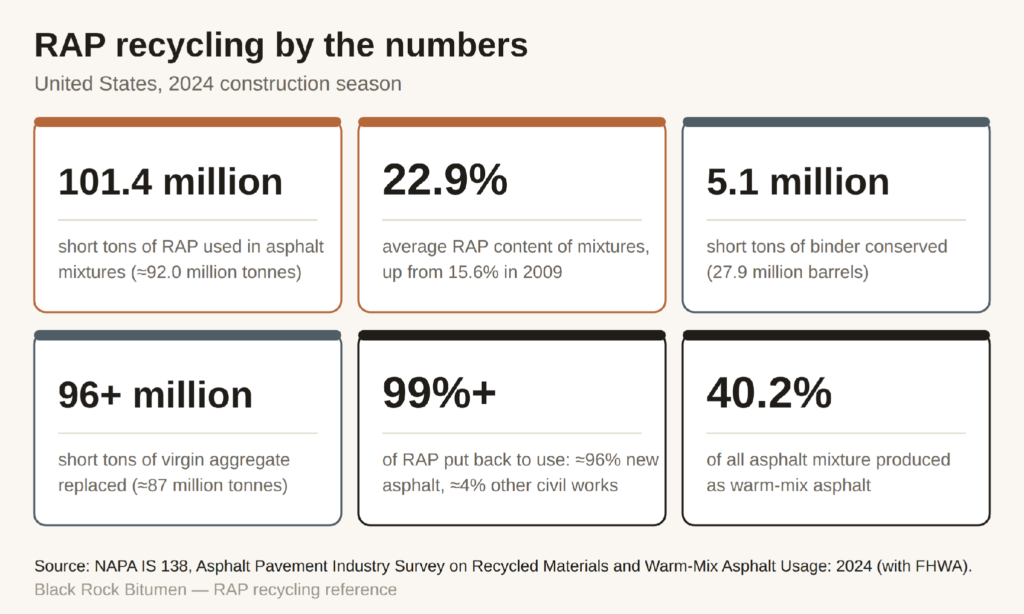
Alt text: Statistics from NAPA’s 2024 US industry survey: 101.4 million short tons of RAP used in asphalt mixtures, about 92.0 million tonnes; average RAP content of 22.9 percent, up from 15.6 percent in 2009; 5.1 million short tons, or 27.9 million barrels, of asphalt binder conserved; more than 96 million short tons of virgin aggregate replaced; more than 99 percent of RAP put back to use, about 96 percent in new asphalt and 4 percent in other civil engineering uses; and 40.2 percent of asphalt mixture produced as warm-mix asphalt.
| 2024 US figure | Value | Scope and notes |
|---|---|---|
| RAP used in asphalt mixtures | 101.4 million short tons (≈92.0 million tonnes) | RAP only |
| Average RAP content of asphalt mixtures | 22.9% (up from 15.6% in 2009) | RAP percentage by weight of mixture |
| Asphalt binder conserved | 5.1 million short tons (≈4.6 million tonnes), or 27.9 million barrels | RAP only |
| Virgin aggregate replaced | More than 96 million short tons (≈87 million tonnes) | RAP only |
| RAP put back to use | More than 99% | More than 96% into new asphalt pavements; about 4% into other civil engineering uses |
| Material cost savings | $4.7 billion | RAP and reclaimed asphalt shingles (RAS) combined |
| Landfill space saved | About 72.5 million cubic yards (≈55.4 million m³) | RAP and RAS combined |
These are US industry survey estimates and should be read as a snapshot of one mature market rather than a global benchmark. RAP availability, specifications and recycling rates vary widely across Africa, Asia and the Middle East.
Does RAP Actually Reduce Costs?
It can, but the answer is more complicated than “RAP is cheaper”. RAP has value because it contains aggregate and binder that would otherwise have to be supplied as virgin materials. That value has to be balanced against milling, hauling, crushing, screening, stockpiling, testing, moisture management and plant requirements.
| Cost factor | Potential RAP advantage | Potential added cost |
|---|---|---|
| Aggregate | Replaces part of virgin aggregate demand | Processing and gradation control |
| Asphalt binder | Reuses binder already present in RAP | Testing, binder management and possibly recycling agents |
| Transport | A local RAP source can reduce virgin material movement | Additional hauling if RAP sources are distant |
| Plant operation | Reduces virgin material demand | Higher binder ratios may need tighter feed, moisture and temperature control |
| Quality control | An established RAP programme creates predictable supply | More characterisation as the binder ratio rises |
RAP and Virgin Bitumen Procurement
When a recycled mixture still needs virgin binder — and most do — procurement becomes more technical, not less. A common misconception is that sustainability means using as little new binder as possible. In reality, the goal is the right amount and type of virgin binder for the final blend, and a poorly selected virgin binder can undermine an otherwise well-managed RAP programme.
The buyer needs to know which grade is being supplied, which standard governs it, and how it is expected to work with the aged binder in the RAP. On PG projects, that may mean a softer grade than the virgin-only design called for; see our Superpave PG Grading System guide and performance-grade range. On projects specified by penetration or viscosity grade, the same logic applies to the choice between grades such as those in our penetration grade and viscosity grade ranges — and to checking that a proposed grade matches the tender’s standard, as covered in bitumen grade selection.
For export projects, review the product’s technical documentation, grade, standard and batch-specific certificate of analysis before dispatch or acceptance. Our guide to testing bitumen quality before purchase sets out the checks.
Is Recycled Asphalt as Good as New Asphalt?
It can be. RAP in hot mix has long been standard asphalt paving practice in the United States, and the LTPP SPS-5 comparison found that recycled overlays with about 30 percent RAP performed statistically equivalently to virgin overlays in the majority of cases across 18 sites. The key qualifier is design and production: RAP should not be judged simply by whether it is recycled.
The better question is whether the final mixture has been designed and produced to deliver the required rutting resistance, cracking resistance, moisture resistance, durability and workability for the project.
Common Mistakes in RAP Projects
Confusing RAP percentage with reclaimed binder ratio: A 40 percent RBR mixture is not a 40 percent RAP mixture, and limits written in one term cannot be checked against the other.
Treating all RAP as identical: Different sources have different gradations, binder properties and ageing histories.
Focusing only on the headline number: A high percentage is not automatically a high-quality or economical outcome.
Ignoring the ignition oven correction factor: An uncorrected binder content overstates the RAP binder and can leave the mixture short of virgin binder.
Choosing virgin binder by habit: The virgin grade should be selected for the final blend, using the M 323 tiers, blending charts or the agency’s own rules.
Adding a recycling agent without verification: Classification under ASTM D4552 does not predict mixture performance; dose and effect need testing.
Ignoring moisture: Wet RAP affects heating, production and consistency.
Mixing stockpiles without control: Uncontrolled blending increases variability in the plant feed.
Assuming all recycling is hot recycling: Cold and in-place recycling may suit some projects better.
Skipping final mixture testing: The final asphalt mixture is what has to meet the project requirements.
What Should Buyers and Contractors Ask?
- Where did the RAP originate, and were different sources kept separate?
- Was the RAP processed and stored under controlled conditions?
- What are the RAP gradation, binder content and moisture results — and which binder content method and correction factor were used?
- Has the recovered binder been characterised?
- What RAP percentage and what reclaimed binder ratio are proposed?
- Which virgin binder grade is being used, and how was it selected?
- Is a recycling agent proposed? If so, how is it classified, and how was the dose verified?
- Is the mixture produced as hot mix or warm mix, and at what temperature?
- Which mix design procedure, performance tests and project specification govern acceptance?
- How will RAP feed consistency be monitored during production?
FAQ: Is Bitumen Recyclable?
Can bitumen be recycled? Yes. Asphalt pavement can be reclaimed and reused, with its aged binder becoming part of a new asphalt mixture through controlled RAP processing and mix design. In the United States, more than 99 percent of reclaimed asphalt pavement was put back to use in 2024.
Is RAP the same as recycled bitumen? No. RAP is reclaimed pavement containing aggregate and asphalt binder, typically 3 to 7 percent binder by weight. The binder is one component of the RAP.
What is the difference between RAP percentage and reclaimed binder ratio? RAP percentage is the share of RAP by weight of the mixture. The reclaimed binder ratio is the share of the mixture’s total binder that comes from RAP. For example, 30 percent RAP with 5 percent binder in a mixture with 5.5 percent total binder gives a reclaimed binder ratio of about 0.27.
How much RAP can normally be used? There is no universal limit. The average US asphalt mixture contained 22.9 percent RAP by weight in 2024, and FHWA reports that mixtures with a 30 to 50 percent reclaimed binder ratio can perform well when responsibly designed and produced.
Can 100% RAP be used? In cold in-place recycling, effectively yes: the process recycles all of the existing asphalt layer, with an emulsion or foamed asphalt added and a new surface placed on top. In plant-produced hot mix, 90 to 100 percent RAP has been shown to be technically possible but remains specialised.
Does RAP change which virgin binder grade I need? Often. Under the classic AASHTO M 323 guideline, below about 15 percent RAP needs no change, 15 to 25 percent calls for a virgin binder one grade softer on both ends, and above 25 percent calls for blending charts. The governing project specification controls.
What does a recycling agent or rejuvenator do? It is added to restore some of the properties lost by the aged RAP binder so that more RAP can be used without making the mixture too stiff. ASTM D4552 classifies hot-mix recycling agents by viscosity, but the dose and effect still need to be verified by testing.
Does RAP reduce pavement quality? Not inherently. FHWA’s LTPP evaluation found that pavements containing up to 30 percent RAP performed similarly to pavements built with virgin materials. Quality depends on material control and final mixture design.
Can RAP be used for base or subbase? Yes. RAP can be used in granular base and subbase, although this does not recover the value of the aged binder. In the United States, about 4 percent of reused RAP goes to such civil engineering applications.
Is RAP always cheaper? No. It can reduce virgin material demand, but processing, transport, testing, storage and plant requirements all affect the total economics.
The Bottom Line
Yes, bitumen is recyclable — but RAP is the more accurate way to describe what actually happens in pavement recycling. Existing asphalt pavement can be reclaimed, processed and incorporated into new pavement, recovering both aggregate and aged binder.
The most important point is that recycling does not mean lowering the engineering standard. RAP needs source control, processing, testing, sensible stockpile management, a clear reclaimed binder ratio, appropriate virgin binder selection and verification of the final mixture.
When those controls are in place, RAP turns material that would otherwise be removed from a road into a valuable input for the next pavement — while reducing demand for virgin resources. To discuss the virgin binder for a recycled mixture, contact Black Rock Bitumen.