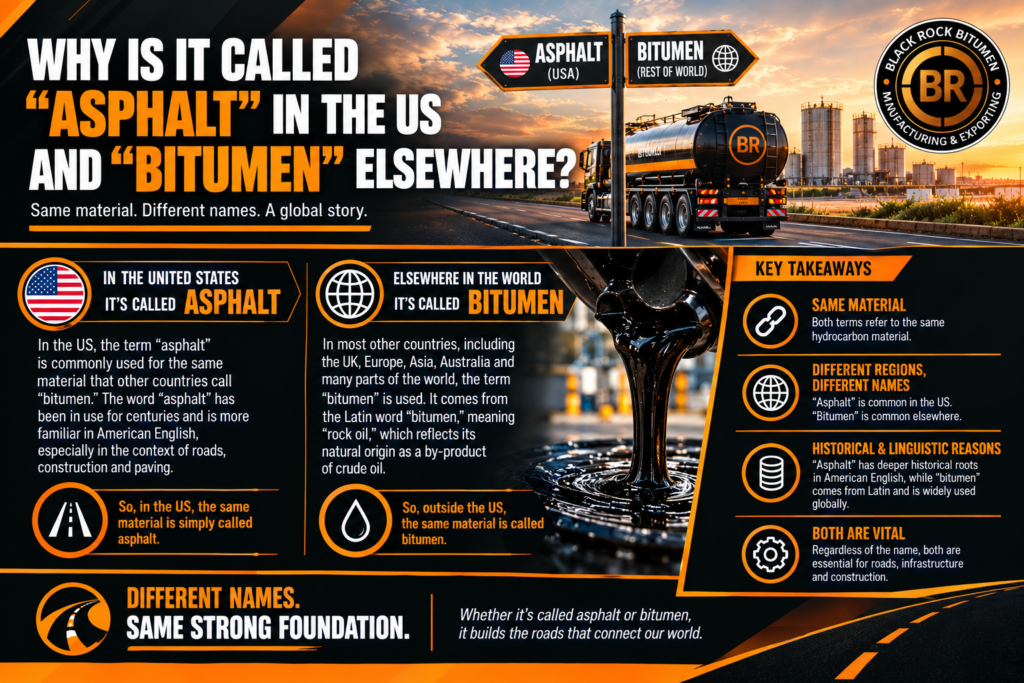
An American engineer and a European engineer can discuss the same road for ten minutes before realising they are describing different things. One means the black binder; the other means the mixture of binder and stone. Both are saying “asphalt”.
The split is not a matter of one side being imprecise. It is a historical accident with two causes: the two languages that gave us the words, and the very different ways the paving industry started in America and in Britain. Once you know how it happened, the terminology stops being confusing and becomes predictable.
Black Rock Bitumen ships to markets that use all of these conventions — ASTM in some, EN in others, Indian Standards in others again — so this is a practical matter for us, not a linguistic curiosity. This guide covers where the words came from, what each one means now, and how to write an order that cannot be misread.
Key takeaway: in US usage “asphalt” means the binder and often the mixture too; in European and Commonwealth usage the binder is bitumen and “asphalt” means the mixture. Tar is a different material altogether. The fix on a purchase order is to name the grade and the standard — “60/70 to ASTM D946” or “VG-30 to IS 73” — which no market can misread.
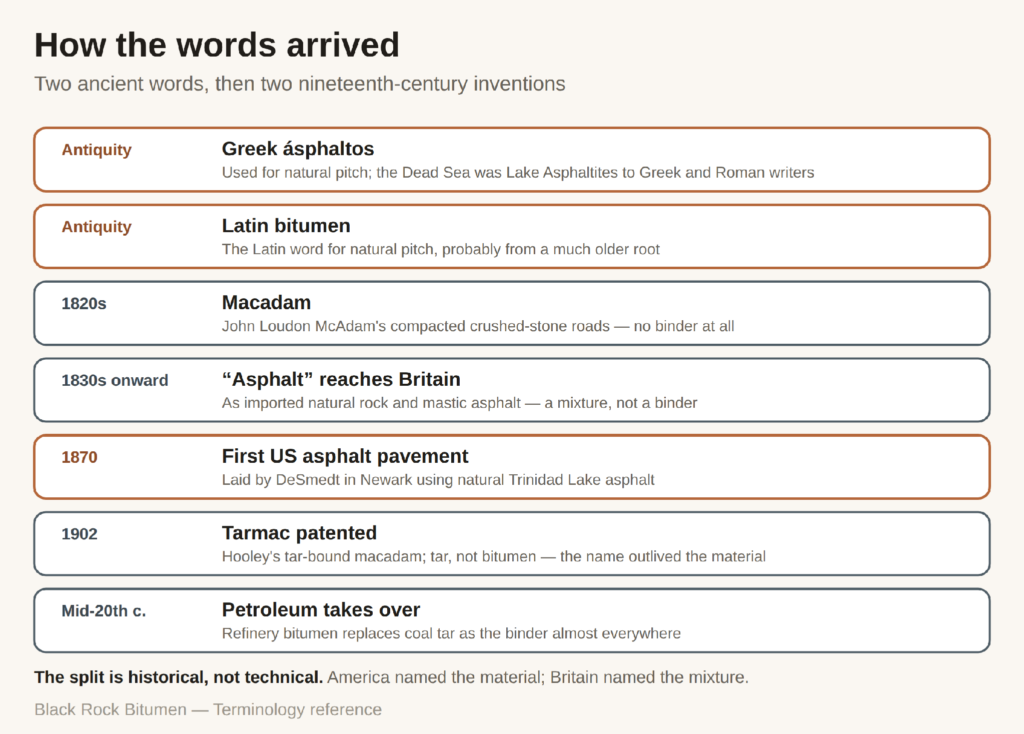
Figure 1. Two ancient words for the same natural material, then two nineteenth-century inventions that attached them to different things.
Alt text: Timeline of the words asphalt, bitumen, macadam and tarmac, from ancient Mesopotamia to the twentieth century.
Where the Words Came From
Asphalt: Greek, and Older Than That
“Asphalt” reached English through Late Latin *asphaltum* from the Greek ἄσφαλτος (*ásphaltos*), the word for the natural pitch that seeps from the ground. The popular explanation is that it combines the negative prefix with a verb meaning “to cause to fall”, giving a sense of “secure” or “not liable to fall down” — a name supposedly earned because the material was used as a cement that held things together.
It is a good story, and it may not be true. The etymologist Robert Beekes considers that derivation weak and suggests a Semitic or other non-Greek origin, which would fit the archaeology: Mesopotamian builders were using natural bitumen for mortar and waterproofing long before Greek was written down (etymological summary). What is certain is that the word travelled with the material. Greek and Roman writers called the Dead Sea *Lacus Asphaltites* — Asphalt Lake — because lumps of bitumen floated to its surface and were traded across the ancient world.
Bitumen: Latin, and Probably Older Still
“Bitumen” is simply the Latin word for the same natural substance. Its own origins are disputed, with proposed roots in Sanskrit and in Celtic languages. For most of recorded history the two words were synonyms in different languages, describing a material nobody yet manufactured.
So the divergence is not ancient. Both words meant natural pitch for two thousand years. They only came to mean different things when people started building roads with the stuff.
How the Two Words Split: Two Different Industries
Between roughly 1820 and 1910, road building changed completely — and it changed differently on each side of the Atlantic.
Britain: the Word Arrived Attached to a Mixture
In Britain and Europe, the first paving material called “asphalt” was natural rock asphalt: limestone naturally impregnated with bitumen, quarried at places such as Val de Travers in Switzerland and Seyssel in France, and imported to be laid as mastic asphalt. It arrived as a mixture — stone and binder together, from the ground, ready to heat and lay.
So in British and European usage the word attached to the product laid on the road, not to the black liquid. When refineries later began supplying the binder separately, a different word was needed for it, and the Latin one was available: bitumen.
America: the Word Arrived Attached to the Material
American practice took a different route. The first true asphalt pavement in the United States was laid by the Belgian chemist Edmund DeSmedt in Newark, New Jersey in 1870, and he went on to pave Pennsylvania Avenue in Washington using sheet asphalt made with binder from Trinidad Lake (Asphalt Paving Association of Iowa). The defining ingredient was a shipped-in natural binder, and “asphalt” was what everyone called it.
The word therefore stuck to the binder. When refined petroleum binder replaced the lake product, it inherited the name — asphalt cement, later asphalt binder — and the mixture became “asphalt concrete”. In everyday American use the single word now stretches across both.
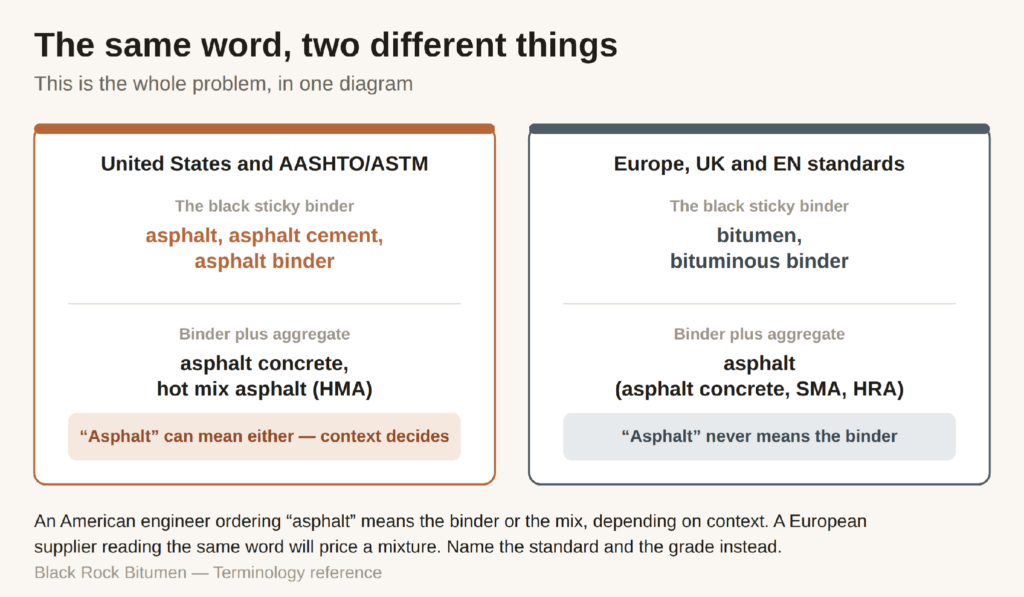
Figure 2. The core of the problem. In US usage “asphalt” covers both the binder and the mixture; in European usage the binder is bitumen and “asphalt” is reserved for the mixture.
Alt text: Diagram showing that in US usage asphalt means both the binder and the mixture, while in European usage bitumen is the binder and asphalt is the mixture.
And Then There Was Tar
A third strand confuses things further. Macadam roads — John Loudon McAdam’s compacted crushed stone from the 1820s — had no binder at all, and the motor car turned them to dust and ruts. In 1901 the Nottinghamshire surveyor Edgar Purnell Hooley noticed a stretch of road near an ironworks that had been accidentally surfaced when a barrel of tar burst and workers covered it with furnace slag. He patented the process in 1902 as tar macadam and formed a company to sell it (Grace’s Guide); Radcliffe Road in Nottingham became the first tarmac road.
Tar is not bitumen. It comes from the destructive distillation of coal, not from crude oil, and it was largely phased out of road work through the second half of the twentieth century as town gas production ended and its polycyclic aromatic hydrocarbon content became a recognised health concern. The name outlived the material: “tarmac” is still used across the Commonwealth for surfaces that contain no tar whatever.
The Terms, Sorted
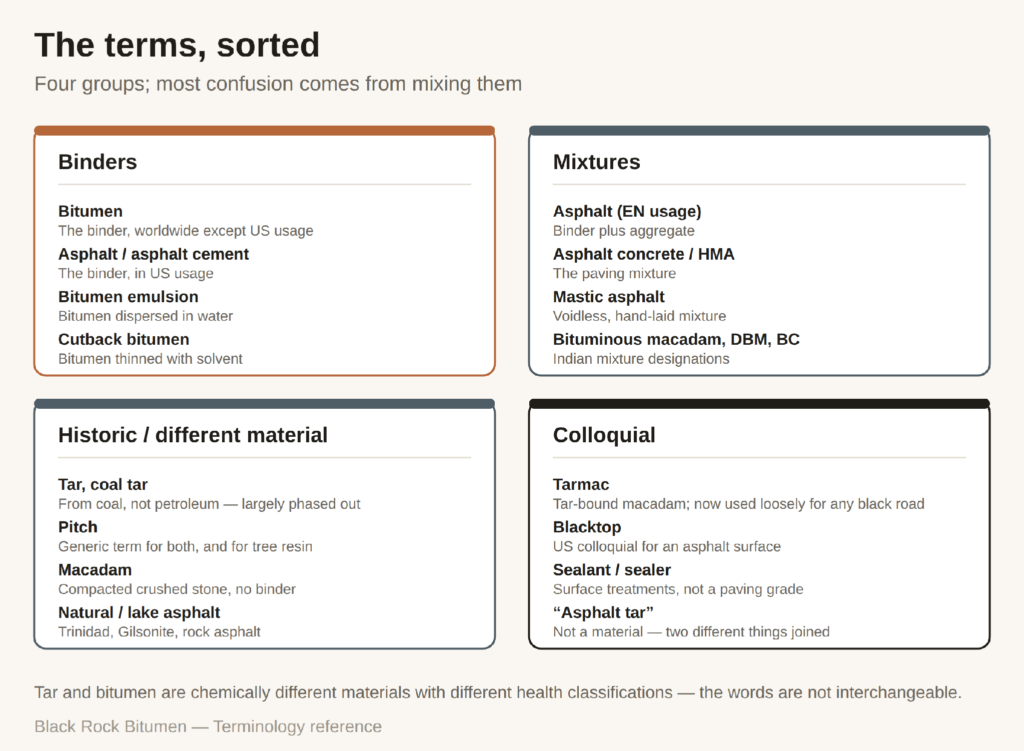
Figure 3. Four groups of terms. Most confusion comes from treating a word in one group as though it belonged to another — particularly tar.
Alt text: Glossary grouping the terms into binders, mixtures, historic materials and colloquial names, with what each actually means.
| Term | What it actually means | Where you will hear it |
|---|---|---|
| Bitumen | The binder: the black, viscous petroleum product | Europe, UK, Commonwealth, Asia, Middle East, Africa |
| Asphalt (US sense) | The binder — also called asphalt cement or asphalt binder | United States, Canada, ASTM and AASHTO standards |
| Asphalt (EN sense) | The mixture of binder and aggregate | Europe and the UK, and EN standards |
| Asphalt concrete / HMA | The paving mixture | United States; also used internationally |
| Mastic asphalt | A voidless, hand-laid mixture | UK and Europe, especially roofing and flooring |
| Bituminous macadam, DBM, BC | Indian mixture designations | India and South Asia |
| Tar / coal tar | A different material, from coal | Historic road work; now largely withdrawn |
| Pitch | Loose term for both, and for tree resin | Historic and colloquial |
| Macadam | Compacted crushed stone, no binder | Historic; survives inside other words |
| Tarmac | Tar-bound macadam | Colloquial, for any black road surface or airport apron |
| Blacktop | An asphalt surface | United States, colloquial |
Two of these are worth flagging for anyone writing a specification. Tar is not a synonym for bitumen — the materials differ chemically and are classified differently for health purposes, so “tar” in a modern specification is either an error or a very unusual requirement. And “asphalt” alone is ambiguous, which matters most when the reader is in a different market from the writer.
Why This Matters Commercially
The naming split is not only a curiosity; it creates four practical risks in international trade.
| Risk | How it happens | How to avoid it |
|---|---|---|
| Pricing the wrong thing | A buyer asks for “asphalt” meaning binder; a supplier quotes a mixture, or the reverse | Specify the grade and standard, not the material name alone |
| Comparing incomparable quotations | One quotation is per tonne of binder, another per tonne of mix | State the unit and the product explicitly on the enquiry |
| Specification mismatch | “Asphalt concrete” assumed to be a binder specification | Name the standard: EN 12591 and EN 13108 govern different things |
| Customs and documentation errors | Mixtures and binders sit under different tariff headings | Declare petroleum bitumen under its own heading, and mixtures under theirs |
The customs point is worth a sentence of its own. Straight petroleum bitumen is normally classified under HS heading 2713, while bituminous mixtures such as mastics and cutbacks fall under 2715 — so a shipment described loosely as “asphalt” can end up declared under the wrong heading. Our guide to questions to ask a bitumen supplier covers the wider documentation set.
What the Standards Themselves Say
Figure 4. How the main standards families name each thing, and the wording that removes the ambiguity from a purchase order.
Alt text: Table of how the main standards families name the binder and the mixture, and what to write on a purchase order.
The standards bodies are consistent internally, even though they disagree with each other. ASTM D946 is titled for *penetration-graded asphalt binder*; AASHTO M 320 covers *performance-graded asphalt binder*. The European binder standards are titled *Bitumen and bituminous binders* — EN 12591, EN 1426, EN 1427 — while the EN 13108 series covers *bituminous mixtures*, with mix groups named Asphalt Concrete, Stone Mastic Asphalt and Hot Rolled Asphalt. In India, IS 73 is titled *Paving bitumen*, and the mixtures carry their own names such as bituminous macadam and bituminous concrete.
Read that way, a pattern appears. Wherever a standard is about the binder, the American family says asphalt and everyone else says bitumen. Wherever a standard is about the mixture, both families are comfortable saying asphalt. That single observation resolves most of the confusion you will meet in tender documents.
What to Write on a Purchase Order
The practical fix takes one line. Never order a material by its common name alone; order a grade against a standard.
- Name the product and grade: 60/70, 50/70, VG-30, PG 76-10.
- Name the standard and, where it matters, the edition: ASTM D946/D946M, EN 12591, IS 73, AASHTO M 320.
- State whether you are buying binder or mixture, and the unit — per tonne of binder is not per tonne of mix.
- For imports, state the tariff heading you expect, and confirm it with your broker.
- Avoid “asphalt”, “tarmac” and “blacktop” in contractual text entirely; keep them for conversation.
“Bitumen 60/70 to ASTM D946/D946M, 20 MT in new 180 kg drums” cannot be misread in any market on earth. “Asphalt, 20 tonnes” can be read at least three ways. For choosing the grade in the first place, see our bitumen grade selection guide; for the difference between the mixture types the word “asphalt” may be hiding, see hot mix versus cold mix asphalt.
How We Use the Words
We use “bitumen” for the binder throughout our documentation, because that is what the EN, Indian and most Asian, African and Middle Eastern specifications use, and because it is unambiguous: bitumen is never the mixture. Where a customer works to ASTM or AASHTO, our certificates state the ASTM grade and method regardless of which word appears in the enquiry.
Black Rock Bitumen supplies penetration grade bitumen, viscosity grades to IS 73, performance grades, polymer-modified bitumen and bitumen emulsions from Dubai. If you are working from a specification in one convention and buying in another, send us the specification as written and we will tell you which grade it maps to — get in touch here.
Frequently Asked Questions
Why is it called asphalt in the US and bitumen elsewhere? Because the two industries started with different materials. American paving began with imported natural lake asphalt, so the word attached to the binder. British and European paving began with natural rock asphalt laid as a mixture, so the word attached to the mixture, leaving the Latin word bitumen free to describe the binder.
Are asphalt and bitumen the same thing? In American usage, asphalt is the binder, so yes — asphalt and bitumen describe the same material. In European usage, asphalt is the mixture of binder and aggregate, so no. The words are only interchangeable when both speakers mean the binder.
Is tar the same as bitumen? No. Tar is produced by the destructive distillation of coal; bitumen comes from crude oil. They are chemically different, classified differently for health purposes, and tar has largely been withdrawn from road work. The word survives in “tarmac”, which today contains no tar.
What does asphalt mean in European standards? The mixture. EN 12591 and the other binder standards are titled “Bitumen and bituminous binders”, while the EN 13108 series covers bituminous mixtures with names such as Asphalt Concrete, Stone Mastic Asphalt and Hot Rolled Asphalt.
Where does the word asphalt come from? From Greek ásphaltos through Late Latin asphaltum. It is often explained as meaning “secure”, from a root suggesting something that does not fall down, though etymologists regard that derivation as uncertain and a Semitic origin has been proposed.
Why is a road surface called tarmac if it contains no tar? Because the name comes from Edgar Hooley’s 1902 tar macadam patent, when the binder really was coal tar. Petroleum bitumen replaced tar during the twentieth century, but the name stayed in everyday use across the UK and Commonwealth.
What is blacktop? An American colloquial term for an asphalt-surfaced road. It is not a technical designation and should not appear in a specification.
What should I write on a purchase order? A grade against a standard — for example “bitumen 60/70 to ASTM D946/D946M” or “VG-30 to IS 73” — plus whether you are buying binder or mixture and in what unit. Avoid ordering by common name alone.
The Bottom Line
Two ancient words meant the same natural material for two thousand years. They only diverged when road building industrialised — and they diverged because America imported a binder while Britain imported a mixture. Tarmac and macadam arrived from a third direction entirely, carrying a material that has since been withdrawn.
None of it is worth arguing about, and all of it is worth being precise about in writing. Name the grade, name the standard, and the two-hundred-year-old ambiguity stops being your problem.