Bulk bitumen orders rarely go wrong because of the price. They go wrong because something was assumed rather than agreed: which grade exactly, tested against which standard, shipped in what packaging, with which documents, and with whose name on the risk once the cargo leaves the terminal.
A bulk order is a technical purchase wrapped in a shipping contract. Both halves can fail independently, and both are far easier to fix in an email before the order than in a claim afterwards.
Black Rock Bitumen ships bulk and packed bitumen to buyers across Africa, Asia and the Middle East, and the questions below are the ones that separate a smooth shipment from a disputed one. They are grouped into six themes, and they work for a first-time importer and for an experienced procurement team alike; the difference is usually how quickly you get through them.
Key takeaway: settle six things before you place a bulk order — the exact grade and standard, the quality evidence for your batch, who actually produces the material, the commercial terms including the Incoterm and quantity tolerance, the packaging your site can receive, and the document pack. A supplier who answers all six clearly is usually the one to buy from.
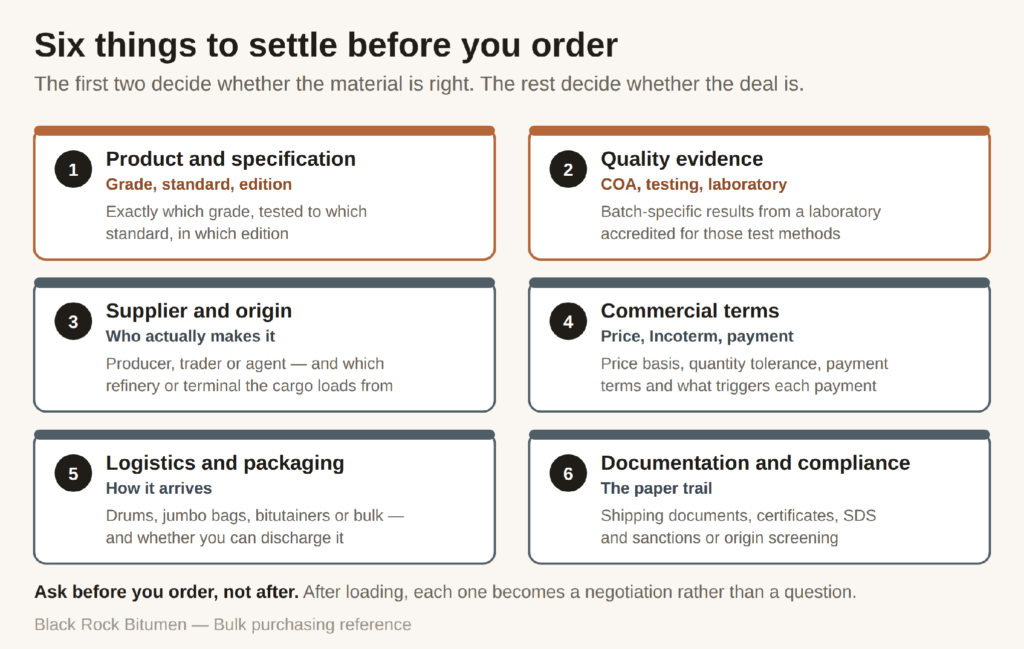
Figure 1. The six themes, in the order they are worth working through. The first two decide whether the material is right; the remaining four decide whether the deal is.
Alt text: Six themes to settle before a bulk bitumen order, from specification to documentation.
1. Product and Specification
Everything downstream depends on this being unambiguous. “60/70” is a label, not a specification.
- Which exact grade are you quoting, and against which standard and edition — for example 60/70 to ASTM D946/D946M, 50/70 to EN 12591, VG-30 to IS 73, or PG 76-10 to AASHTO M 320?
- If the tender names a standard you do not normally supply against, can you meet it, and will the certificate be issued against that standard?
- If the project uses an MSCR specification, can you supply a traffic-designated grade such as PG 76H-10 under AASHTO M 332 or ASTM D8239?
- For polymer-modified bitumen, which polymer and dosage, and which specification does it meet?
- Which base grades can be substituted if my first choice is unavailable, and what would change?
- What are the recommended storage, pumping and application temperatures for this grade?
The third question is worth separating out, because the two specifications are not interchangeable. A conventional performance grade — PG 76-10 — is specified under AASHTO M 320 or ASTM D6373. The S, H, V and E traffic letters come from MSCR grading under AASHTO M 332 and its ASTM equivalent D8239, so a grade written as PG 76H-10 belongs to that framework rather than to M 320. Asking for “PG 76H-10 to M 320” is a contradiction a good supplier will query and a careless one will simply accept. Our Superpave PG grading guide covers what a complete designation has to include under each.
The first question catches most of the remaining mismatches. Commercial labels do not map neatly onto standards: ASTM D946/D946M-25a, the current edition, covers 40–50, 60–70, 85–100, 120–150 and 200–300, so there is no 80/100 grade in it at all — the nearest ASTM grade, and the one buyers usually mean, is 85–100. Under EN 12591 the closest is 70/100. Our bitumen grade selection guide sets out the crosswalk between the penetration, viscosity and performance systems.
If the grade itself is still open — because the climate or traffic conditions have not been settled — resolve that before you ask for prices. Our guide to choosing a grade for your climate covers the inputs.
2. Quality Evidence
A supplier can describe a product accurately and still ship something else. What separates the two is documentary evidence tied to your cargo.
- Will I receive a batch-specific certificate of analysis, or only a technical data sheet of typical values?
- Which laboratory performs the testing, is it accredited to ISO/IEC 17025, and does its scope of accreditation cover the test methods on my certificate?
- Which test methods will be reported, and do they match the standard named in my purchase order?
- How is the sample taken, and does the sampling follow a recognised practice?
- Are retained samples kept, for how long, and can I have one?
- Can I appoint an independent inspector at the load port, at my cost, to sample and witness loading?
- How is the batch number on the COA linked to the drums, containers or tank I receive?
The TDS-versus-COA distinction is the most common gap. A data sheet describes what the product is designed to be; a certificate of analysis reports what was measured on the material being shipped. If only a data sheet is offered, nothing has been tested on your cargo.
Sampling deserves more attention than it usually gets. ASTM D140/D140M, the sampling practice for asphalt materials, makes the point that sampling matters as much as testing, because a sample that does not represent the bulk makes the test results meaningless however good the laboratory is. For the full pre-shipment sequence, see our guide to testing bitumen quality before purchase, and for how to check the laboratory’s accreditation, our guide to ISO certifications in bitumen supply.
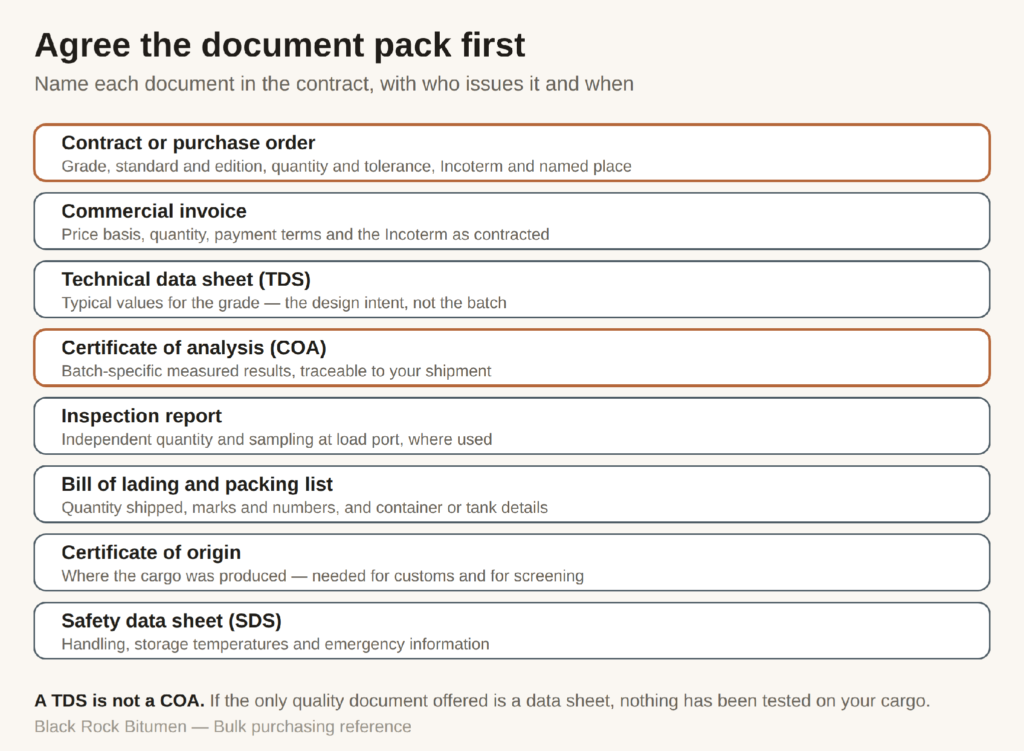
Figure 2. Agree who issues each document and when, in the contract. The two highlighted in rust are the ones that define what you are buying and prove what you received.
Alt text: The document pack for a bulk bitumen order, from contract to safety data sheet.
3. The Supplier and the Origin
You are buying from a company, but the material comes from a refinery. Those are often not the same entity, and that is not inherently a problem — traders provide real value in this market. What matters is that you know which is which.
- Are you the producer, a term supplier with allocated volume, or a trader buying on the spot market for this cargo?
- Which refinery or terminal will this cargo load from, and in which country was the bitumen produced?
- Will the certificate of origin state that country, and can it be legalised if my customs authority requires it?
- Do you have your own storage at the load port, or are you dependent on third-party tankage?
- What is your typical monthly volume of this grade, and can you support repeat orders at this specification?
- Can you provide references from buyers in my region, or details of comparable shipments?
- Which sanctions and compliance screening do you apply to the cargo, the vessel and the counterparties?
The origin question is not bureaucratic. It determines your customs treatment, your insurance, your bank’s willingness to handle the transaction, and in some jurisdictions your legal exposure. A supplier who is vague about which refinery the cargo loads from is telling you something, and it is worth pressing politely until the answer is specific.
4. Commercial Terms
This is where technically competent buyers most often lose money, because the terms look standard until something goes wrong.
- Which Incoterms 2020 rule applies, and what is the named place or port — for example “CFR Mombasa (Incoterms 2020)”?
- Is the price fixed, or linked to a published index, and if linked, which assessment and which pricing period?
- What quantity tolerance applies, at whose option, and how is the invoiced quantity determined?
- Is quantity based on shore tank figures, ship’s figures, or the bill of lading, and who resolves a discrepancy?
- What are the payment terms, and what triggers each payment — advance, letter of credit, cash against documents?
- How long is the quotation valid, and what happens to the price if loading is delayed?
- What is the lead time from order to loading, and what is the laytime and demurrage position?
- What happens if the material fails specification on arrival — rejection, discount, replacement, or arbitration?
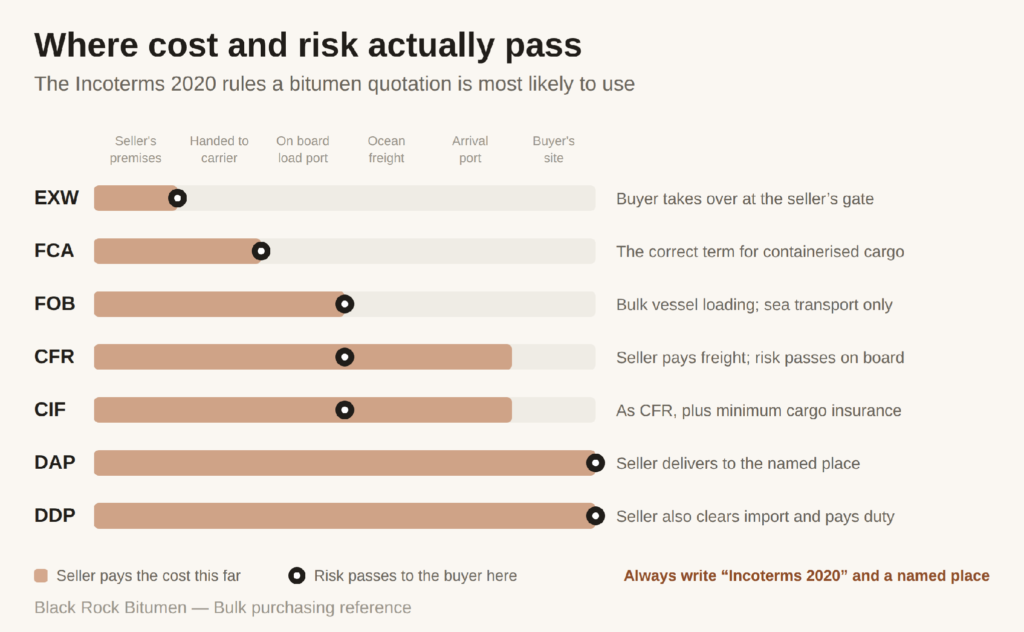
Figure 3. Cost and risk do not move at the same point under every rule — under CFR and CIF the seller pays freight to the arrival port while risk passes at the load port. Incoterms 2020 remains the current edition; the ICC has not announced a date for the next one.
Alt text: Where cost and risk pass to the buyer under the Incoterms 2020 rules used for bitumen.
The Incoterm Is Not a Formality
The Incoterms 2020 rules published by the International Chamber of Commerce remain the current edition in 2026. The ICC has not announced a date for the next revision; because the rules have been revised roughly once a decade — 2000, 2010, 2020 — it is generally expected around 2030. There is no “Incoterms 2026” edition, despite the phrase appearing on quotations, so always write the rule, the named place and the year together.
There is a specific trap in this trade. FAS, FOB, CFR and CIF are written for bulk and break-bulk cargo loaded directly onto a vessel. For containerised cargo — which is how most drummed bitumen, jumbo bags and bitutainers move — FCA is the correct term, because the seller hands the containers over at an inland depot or terminal rather than placing them on board. This has been the ICC’s standing recommendation since Incoterms 2010, and quotations for containerised drums still routinely say FOB. It is worth asking where risk actually passes rather than assuming the label describes it.
Quantity Tolerance and How It Is Measured
Bulk liquid cargoes are rarely loaded to the exact contract quantity, so contracts carry a tolerance, often expressed as a percentage at the seller’s or the vessel’s option. Two questions follow: what is the tolerance, and which measurement governs the invoice. Shore tank figures and ship’s figures routinely differ, and a contract that does not say which prevails has left a gap that only appears when the numbers do.
5. Logistics and Packaging
The cheapest packaging per tonne is not the cheapest option if your site cannot receive it.
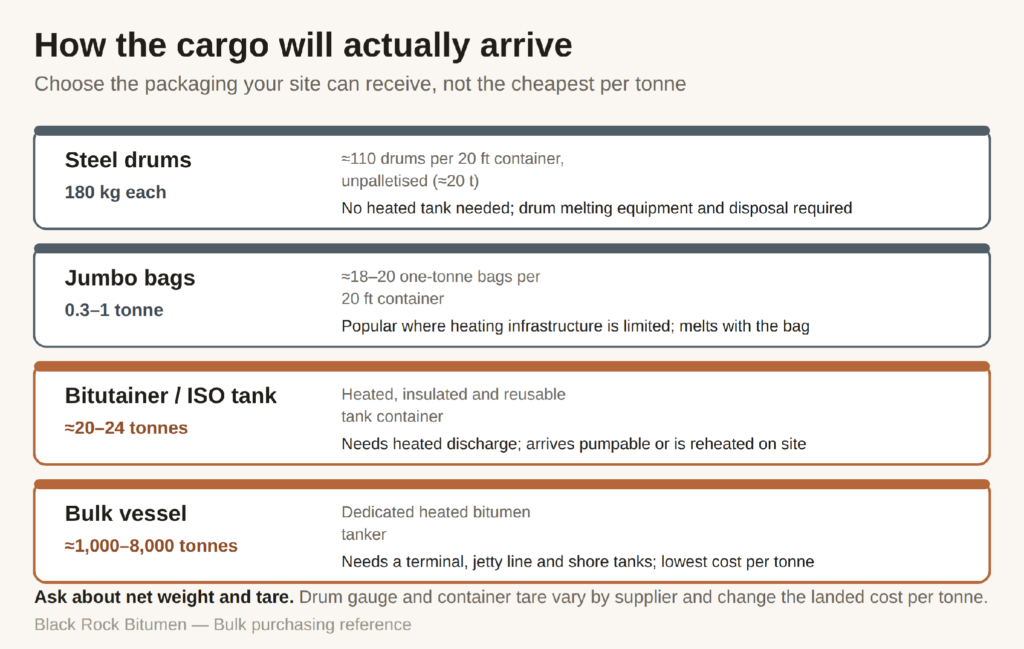
Figure 4. Loading quantities are indicative and vary with drum gauge, bag type and container tare — confirm the actual figures with your supplier before comparing landed cost per tonne.
Alt text: Packaging options for bulk bitumen: drums, jumbo bags, bitutainers and bulk vessels.
Which packaging options are available for this grade, and what is the net weight and tare of each?
For drums: what gauge of steel, are they new drums, and how many per container palletised and unpalletised?
For bitutainers or bulk: what temperature will the cargo arrive at, and what discharge facilities do I need?
Who pays for and arranges reheating if the cargo arrives below pumping temperature?
Which port will the cargo discharge at, and are there restrictions on heated cargo or on container weight?
What is the container free time at destination, and who bears detention and demurrage?
Is the cargo insured, to what value, and under which clauses?
For repeat supply: can you hold stock at a regional terminal, and what call-off arrangements are available?
Arrival temperature is the question most first-time bulk importers forget. A bitutainer or vessel that arrives pumpable saves a reheating cycle; one that arrives cold turns into a slow, expensive problem on the quayside. Our guide to why bitumen will not pour covers what that reheating involves, and our storage and handling guide covers what happens to the material afterwards.
6. Documentation and Compliance
Agree the document pack in the contract, not in an email after loading. Every document should have a named issuer and a deadline.
Which documents will accompany the shipment, and which are issued by third parties?
Will the certificate of analysis be batch-specific and issued before or after loading?
Is a safety data sheet provided in the language my receiving country requires?
Which HS classification will be declared, and does it match what my broker expects?
Are pre-shipment inspection or conformity certificates required for my destination, and who arranges them?
Can documents be couriered in advance, and can scanned copies be released for customs pre-clearance?
Who is the named contact for a quality or quantity claim, and what is the notification deadline?
The HS Headings You Are Likely to See
Classification is your broker’s call, but knowing the usual headings helps you spot a declaration that looks wrong before it causes a delay. Under the Harmonized System, straight petroleum bitumen sits under heading 2713, at subheading 2713.20. Natural bitumen and asphalt fall under 2714. Bituminous mixtures — including mastics and cutbacks — fall under heading 2715, which is also where emulsions are commonly classified.
| Product | Usual HS heading | Note |
|---|---|---|
| Penetration, viscosity or performance grade bitumen | 2713.20 — petroleum bitumen | The bulk of paving binder trade |
| Natural bitumen and asphalt | 2714 | Natural rather than refinery product |
| Cutback bitumen, bituminous mastics | 2715 | Mixtures rather than straight bitumen |
| Bitumen emulsion | Commonly 2715 | Confirm with your broker; treatment varies by country |
Duty rates and national subheadings differ widely — the same heading is duty-free in some markets and carries a 5 per cent rate plus local taxes in others — so confirm the final code and the landed duty with your customs broker before you compare offers.
One more question is worth asking early, precisely because nobody wants to discuss it during a negotiation: the claims window. Most supply contracts set a short period for notifying quality or quantity claims after discharge. If you do not know the deadline, you can lose a valid claim simply by testing too late.
Answers That Should Slow You Down
“We supply all grades from all origins.” Ask which refinery this cargo loads from. A supplier who cannot name it at the point of quotation may not have secured the material.
“The COA will be sent after loading.” That is normal for a batch certificate, but ask what happens if the result is off-specification once the cargo is already at sea.
“Our product meets all international standards.” No product meets all of them. ASTM, EN and IS grade the same material differently. Ask which standard and which edition.
“Here is our test report” — on a data sheet. Typical values are not batch results. Ask for the certificate of analysis with the batch number.
A price far below the market. Ask what packaging, origin, quantity tolerance and payment terms sit behind it before assuming it is comparable.
Reluctance to allow independent inspection. Third-party inspection at loading is routine in this trade. Resistance to it is unusual enough to be worth a second look.
“FOB” on a containerised drum quotation. Ask where risk actually passes. It may be an honest habit, or it may mean the term was never thought about.
A One-Page Pre-Order Checklist
| Theme | Confirmed before ordering |
|---|---|
| Product | Exact grade, standard and edition, in writing on the purchase order |
| Quality | Batch COA promised; laboratory accreditation and test methods confirmed |
| Sampling | Sampling practice agreed; retained samples and inspection rights settled |
| Supplier | Producer or trader identified; loading refinery or terminal named |
| Origin | Country of production confirmed and certificate of origin available |
| Price | Fixed or index-linked, with pricing period and validity stated |
| Incoterm | Rule, named place and “Incoterms 2020” written in full |
| Quantity | Tolerance, option and governing measurement agreed |
| Payment | Instrument and payment triggers agreed with your bank |
| Packaging | Format, net weight and tare confirmed against your discharge capability |
| Logistics | Arrival temperature, free time, demurrage and insurance settled |
| Documents | Full pack listed, with issuers and deadlines; HS classification confirmed |
| Claims | Notification window and process agreed in advance |
Buying From Black Rock Bitumen
Black Rock Bitumen supplies penetration grade, viscosity grade, performance grade, polymer-modified and emulsion products from Dubai, in drums, jumbo bags, bitutainers and bulk, with a batch certificate of analysis, safety data sheet and export documentation supplied with every order.
If you are preparing an enquiry, sending the grade, standard, quantity, destination port, packaging preference and required delivery window in the first message will get you a comparable quotation faster than a request for a price alone. Send us those details and we will come back with a quotation you can put side by side with any other.
Frequently Asked Questions
What should I ask a bitumen supplier before placing a bulk order? Cover six themes: the exact grade and standard, the quality evidence for your batch, who produces the material and where, the commercial terms including the Incoterm and quantity tolerance, the packaging and logistics your site can handle, and the document pack with issuers and deadlines.
What is the difference between a TDS and a COA? A technical data sheet gives typical values for a grade and describes the product in general. A certificate of analysis reports measured results for a specific batch. Only the COA tells you anything about the material being shipped to you.
Which Incoterm should I use for bulk bitumen? For bulk cargo loaded directly onto a vessel, FOB, CFR or CIF are the usual choices. For containerised drums, jumbo bags or bitutainers, FCA is the correct rule because the seller hands over the containers before they are loaded on board. Always state the rule, the named place and “Incoterms 2020”.
Is there an Incoterms 2026? No. Incoterms 2020 is still the current edition, and the ICC has not announced a date for the next revision, which is generally expected around 2030. A contract citing “Incoterms 2026” refers to a rulebook that does not exist.
Is 80/100 an ASTM grade? No. ASTM D946/D946M covers 40–50, 60–70, 85–100, 120–150 and 200–300. The nearest ASTM grade to 80/100 — and the one most buyers mean — is 85–100. Under EN 12591 the closest is 70/100.
What quantity tolerance is normal on a bulk bitumen shipment? Bulk liquid cargoes are usually contracted with a percentage tolerance at the seller’s or the vessel’s option, because exact loading is impractical. The important part is that the contract states the tolerance and which measurement — shore tank, ship’s figures or bill of lading — governs the invoice.
Which HS code applies to bitumen? Straight petroleum bitumen is usually declared under 2713.20, natural bitumen and asphalt under 2714, and bituminous mixtures such as cutbacks and mastics under 2715, which is also where emulsions are commonly classified. Confirm the final code and duty with your customs broker.
What documents should come with a bulk bitumen shipment? Typically the commercial invoice, bill of lading, packing list, batch certificate of analysis, certificate of origin and safety data sheet, plus an inspection report where independent inspection is used, and any pre-shipment conformity certificate your destination requires.
The Bottom Line
Most bulk bitumen disputes trace back to a question nobody asked. The grade was assumed, the standard was never named, the Incoterm was copied from a previous deal, or the only quality document was a data sheet.
None of these questions are adversarial. A competent supplier answers them quickly, because they have the answers to hand, and the way they answer tells you as much as the answers themselves.