Two drums of 60/70 arrive from different suppliers. Both certificates are in order, both meet the same standard, and someone asks the obvious question: can we put them in the same tank?
Usually yes. Occasionally no — and when the answer is no, the consequences do not appear on the certificate. They appear a week later as sludge in the tank bottom, a blocked filter screen, or material that tests harder than either of the two binders that went into it. What separates those two outcomes is compatibility.
Black Rock Bitumen ships binders that end up in tanks alongside other people’s material, so this is a question we field regularly. This guide explains what compatibility means chemically, which blends carry real risk, what incompatibility looks like, and how to check before committing a tank.
Key takeaway: bitumen is a colloid — asphaltene clusters dispersed in an oily maltene phase and held apart by resins. Compatibility is how well that dispersion survives when two bitumens are mixed. Blending like with like is routine; blending across crude sources, across product families or with polymer-modified binder is where blends go wrong. A laboratory blend held hot, then tested top and bottom, answers the question before the tank does.
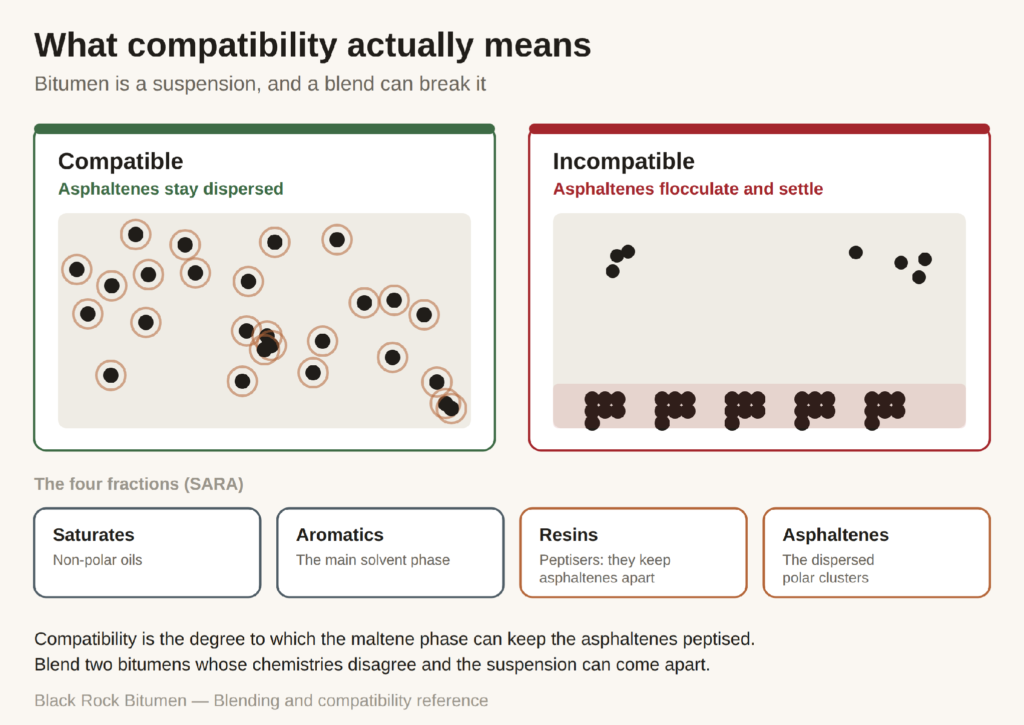
Figure 1. Bitumen behaves as a colloid: asphaltene clusters dispersed in a maltene phase and kept apart by resins. Compatibility is the degree to which that dispersion holds.
Alt text: Diagram of bitumen as a colloid: asphaltene clusters held apart by resins in a maltene medium when compatible, and flocculated and settling when not.
The Chemistry, Once
Bitumen is not a single compound. It is a mixture of thousands of hydrocarbon molecules, conventionally separated into four fractions — saturates, aromatics, resins and asphaltenes, known together as SARA and separated in the laboratory under methods such as ASTM D4124.
| Fraction | What it is | Role in the colloid |
|---|---|---|
| Saturates | Non-polar, oily, low molecular weight | Part of the solvent phase, but a poor solvent for asphaltenes |
| Aromatics | The largest fraction in most bitumens | The main dispersing medium |
| Resins | Polar, intermediate molecular weight | Peptisers — they coat asphaltene clusters and keep them apart |
| Asphaltenes | Polar, high molecular weight, heptane-insoluble | The dispersed phase; they give stiffness and structure |
The classical model treats bitumen as a colloidal suspension: asphaltene clusters dispersed through the maltene phase — that is, everything that is not asphaltene — and kept from flocculating by the resins that surround them. Whether the system behaves as a free-flowing *sol*, an elastic *gel*, or something between the two depends on that balance.
Compatibility is simply the degree to which that dispersion holds. A compatible binder keeps its asphaltenes peptised. An incompatible one lets them flocculate, cluster and eventually settle — at which point the material is no longer homogeneous and no longer behaves as the certificate says it should.
Why Blending Can Break It
When two bitumens are mixed, the asphaltenes of each find themselves in a combined maltene phase that neither was designed for. If the resulting medium is a poorer solvent for either set of asphaltenes than its own was, they begin to flocculate. This is the same phenomenon refiners manage when blending crude oils, where the risk of asphaltene destabilisation on blending is well documented.
Bitumen chemists quantify the balance with indices calculated from the SARA fractions — most commonly the colloidal instability index, the ratio of saturates plus asphaltenes to aromatics plus resins. A higher value indicates a less stable colloidal structure, and the index rises as a binder oxidises, because ageing consumes aromatics and creates asphaltenes. Published pass–fail thresholds for the index come from crude oil practice rather than paving specifications, so it is best used comparatively — one binder against another, or a blend against its components — rather than as an absolute limit.
Which Blends Actually Carry Risk
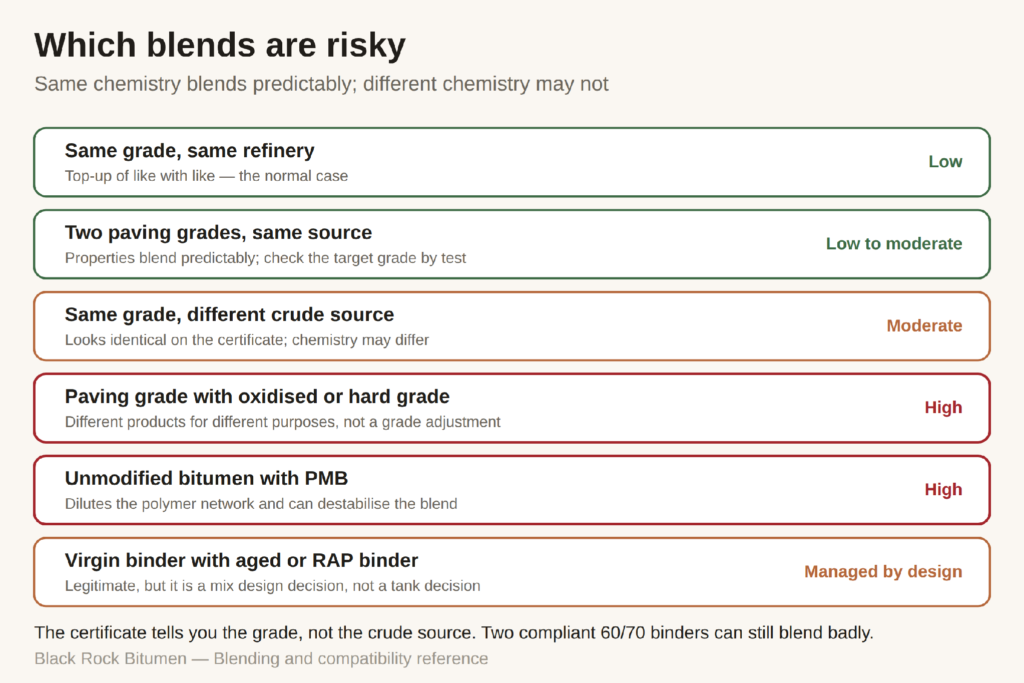
Figure 2. Blending like with like is routine. The risk rises as the chemistries diverge — and the highest-risk blends are the ones that look most like a simple grade adjustment.
Alt text: Risk rating for five kinds of bitumen blending, from same grade and source at low risk to unmodified with polymer-modified bitumen at high risk.
Not all blending is equal. The risk rises as the chemistry of the two materials diverges.
| Blend | Risk | Why |
|---|---|---|
| Same grade, same refinery | Low | Chemically the same material; this is a routine top-up |
| Two paving grades from the same source | Low to moderate | Similar chemistry, different consistency — properties blend predictably |
| Same grade, different crude source | Moderate | The certificates match but the SARA balance may not; this is the classic trap |
| Paving grade with oxidised or hard grade | High | Different products made for different purposes; heavily oxidised binder has a very different asphaltene balance |
| Unmodified bitumen with PMB | High | Dilutes the polymer network and can destabilise both the polymer and the colloid |
| Virgin binder with aged or RAP binder | Managed by design | Legitimate and routine in recycling, but a mix design decision rather than a tank decision |
The Different-Source Case Is the One to Watch
A certificate tells you the grade; it does not tell you the crude source. Two binders can both be compliant 60/70 and still have materially different SARA balances, because the crude slate and the refining route differ. Research on polymer modification has shown how far this goes: in a study across six bitumens meeting similar specifications, the base chemistry governed how the material behaved and how stable the resulting blends were (Wieser and colleagues, Materials, 2021). Earlier work reached the same conclusion for compatibility generally — higher aromatic content favours stability, while a higher asphaltene content works against it (Lu and Isacsson, Materials and Structures, 1997).
The practical consequence is that “it is the same grade” is not a compatibility argument. It is a specification argument, and the two are different questions.
Why Oxidised and Paving Grades Should Not Meet
Oxidised or blown grades have been deliberately processed to convert maltenes into asphaltenes, which is what raises their softening point. Blending them into a paving binder does not produce an intermediate grade; it produces a binder with a distorted fraction balance and often an unpredictable one. Our guide to bitumen grade selection sets out why an oxidised grade written as 85/25 is a different product family from a paving grade written as 60/70, not simply a harder version of it.
And Why PMB Should Not Be Diluted
Adding unmodified binder to a PMB does two things at once: it dilutes the polymer below the concentration at which it forms a continuous network, and it changes the maltene phase the polymer swelled in. The result is usually a binder that no longer has the elastic recovery it was bought for, and which may separate in storage. Our guide to how SBS and EVA are blended into bitumen explains why that network is the product.
What an Incompatible Blend Looks Like
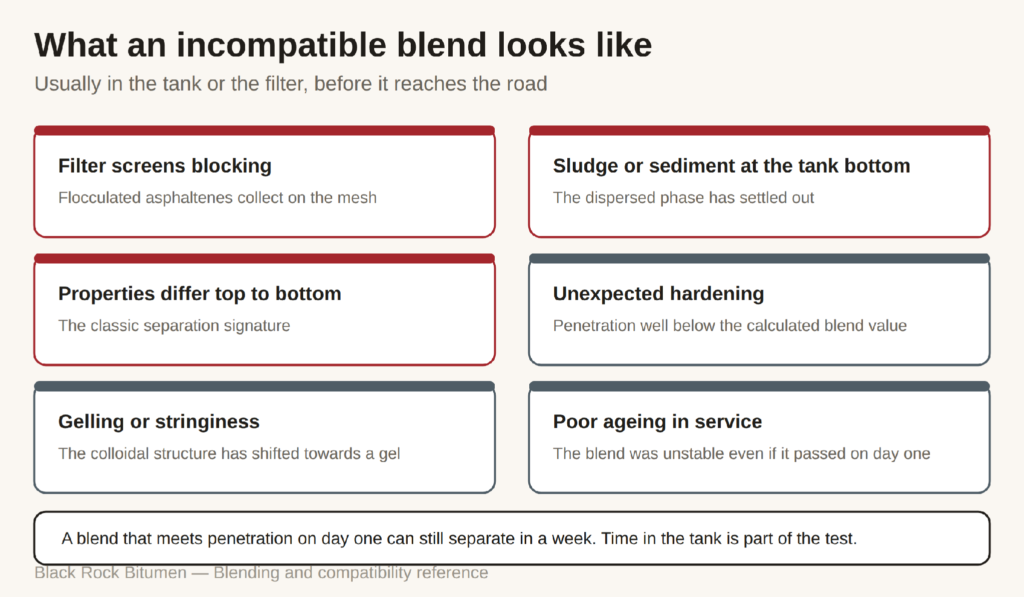
Figure 3. Incompatibility usually shows up in the tank or the filter rather than on the certificate. The last two signs can appear weeks after a blend passed its initial tests.
Alt text: Six warning signs of an incompatible blend, from filter blocking and sludge to properties that differ between the top and bottom of the tank.
Incompatibility rarely announces itself at the moment of mixing. It shows up over hours or days, usually in the tank rather than on the road.
| Sign | What is happening | When you see it |
|---|---|---|
| Filter screens blocking repeatedly | Flocculated asphaltenes collecting on the mesh | Hours to days after blending |
| Sludge or sediment in the tank bottom | The dispersed phase settling out | Days, and on tank cleaning |
| Properties differ top to bottom | Separation; the classic signature | After static storage |
| Penetration lower than the calculated blend | The colloid has shifted towards a gel structure | On the first test of the blend |
| Gelling, stringiness or poor pumping | Structural change rather than simple hardening | During transfer |
| Poor ageing in service | An unstable blend that passed on day one | Weeks to months later |
The last one is the reason a single passing test is not proof. A blend can meet penetration and softening point on the day it is made and still separate in the tank a week later, which is exactly why the storage stability tube test exists for modified binders — the conditioning procedure in ASTM D7173 and EN 13399 is designed to find separation that day-one testing misses.
How to Check a Blend Before You Commit a Tank
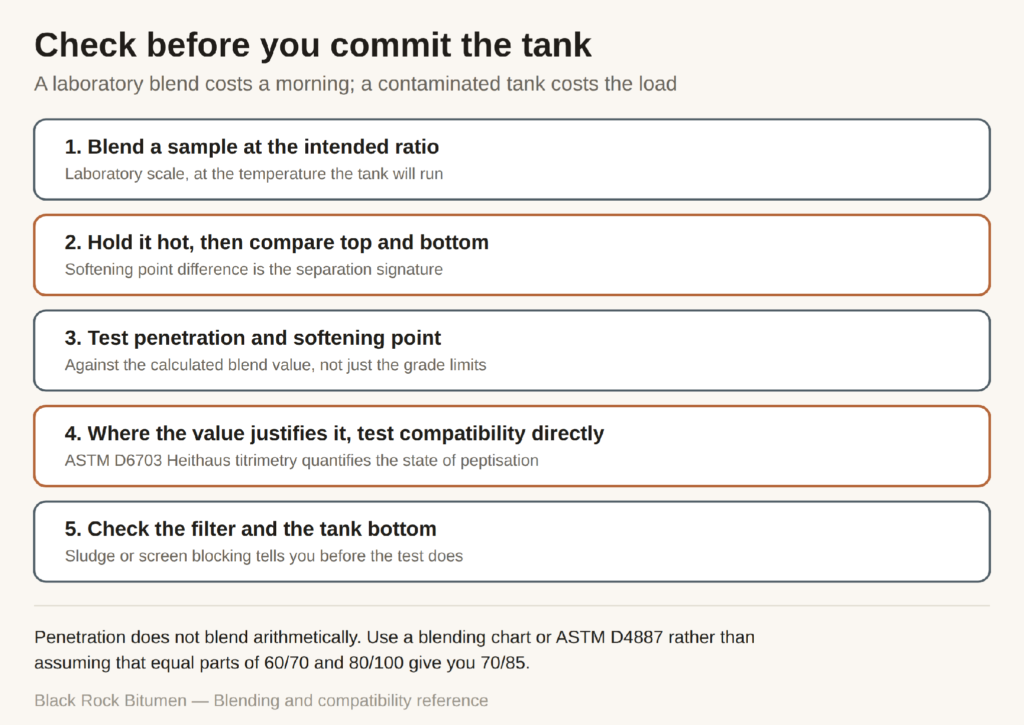
Figure 4. A laboratory blend held hot answers the question before a tank is committed. Step four is worth the cost only on large or repeated blends.
Alt text: How to check a blend before committing a tank: make a small-scale blend, hold it hot, then compare top and bottom properties and run compatibility tests.
- Blend a laboratory sample at the ratio you intend to use, at the temperature the tank will actually run.
- Hold it hot — conditioning it as the storage stability procedure does — then compare the softening point of the top and bottom portions. A difference is the separation signature.
- Test penetration and softening point on the blend, and compare against the calculated blend value, not merely against the grade limits.
- Where the value or the repetition justifies it, test compatibility directly. ASTM D6703 quantifies the state of peptisation and is written for exactly this purpose.
- Inspect the filter and the tank bottom after the first transfers; screen blocking and sediment often appear before a test result does.
The Named Methods
| Method | What it gives you | When to use it |
|---|---|---|
| ASTM D6703, automated Heithaus titrimetry | Heithaus parameters describing the state of peptisation; low values indicate incompatibility | Large or repeated blends, and cross-source blending where the stakes justify it |
| ASTM D4124, separation into four fractions | The SARA balance of each component | Understanding why two binders differ |
| ASTM D3279, n-heptane insolubles | Asphaltene content | A quicker proxy than full SARA analysis |
| ASTM D7173 / EN 13399 conditioning | Top-to-bottom difference after hot storage | Detecting separation that day-one tests miss |
| ASTM D4887, viscosity blends | A proper basis for calculating blend proportions | Whenever you need to hit a target consistency |
That last entry addresses a common arithmetic error. Penetration and viscosity do not blend linearly. Equal parts of 60/70 and 80/100 do not give a binder in the middle of the two ranges, and assuming they do produces a blend that misses its target. Use a blending chart or the preparation practice in ASTM D4887 rather than averaging the numbers.
For the wider set of incoming checks, see our guide to testing bitumen quality before purchase.
Practical Rules for the Tank
- Do not load a new grade onto the residue of a different one. Clean the tank, or dedicate tanks to products.
- Prefer blending within a source. Same refinery, same crude slate, predictable result.
- Treat cross-source blending as a decision requiring evidence, not a convenience.
- Never blend paving grades with oxidised or hard industrial grades to adjust consistency.
- Never dilute PMB with unmodified binder to stretch a load.
- Blend hot and circulate, so the two materials genuinely mix rather than layering.
- Record what went into every tank, and in what proportion — an unrecorded blend cannot be diagnosed later.
- Retest the blend, and treat the result as the new specification for that tank.
The recording rule earns its place. Most compatibility problems we hear about are diagnosed retrospectively, and the investigation usually stalls at the same point: nobody can say with confidence what was in the tank. Our guides to storage and handling mistakes and reheating after cooling cover the neighbouring disciplines of temperature and thermal history.
A Note on RAP and Rejuvenators
Blending virgin binder with the aged binder in reclaimed asphalt is a compatibility question too, but it is a designed one. The aged binder is stiffer and has a higher asphaltene content, and the mix design accounts for that by selecting a softer virgin grade or using a recycling agent. That is not the same as combining two unrelated binders in a tank, and it is governed by the mix design rather than by tank-side judgement. Our guide to reclaimed asphalt pavement covers how the virgin grade is selected.
Recycling agents raise their own compatibility question: an agent that restores the maltene balance of one aged binder may not suit another, which is why dosage is established by testing rather than by a supplier’s default rate.
Getting Material That Blends Predictably
Black Rock Bitumen supplies penetration grade bitumen, viscosity grades to IS 73, performance grades, polymer-modified bitumen and bitumen emulsions from Dubai, each with a batch certificate of analysis stating the grade, the governing standard and the test methods used.
If you need to blend a delivery with stock you already hold, tell us the grade and source of the existing material before the order rather than after it. We would rather match a repeat supply to what is already in your tank than have you discover the difference afterwards — send us the details here.
Frequently Asked Questions
What does bitumen compatibility mean? It describes how well the colloidal structure of a bitumen holds together — specifically, how well the maltene phase keeps the asphaltene clusters dispersed. In blending, it means whether two bitumens can be mixed without the asphaltenes flocculating and separating.
Can you mix two different grades of bitumen? Usually yes if they come from the same source, and properties then blend predictably. Mixing grades from different crude sources carries more risk, and mixing paving grades with oxidised grades, or unmodified binder with PMB, should be avoided.
Can I mix 60/70 and 80/100 bitumen? From the same refinery, generally yes — but the result is not simply the average of the two. Penetration does not blend linearly, so use a blending chart or ASTM D4887 to calculate the proportions, and test the blend rather than assuming the target.
What happens if two bitumens are incompatible? The asphaltenes flocculate and can settle. You see blocked filter screens, sludge in the tank bottom, properties that differ between the top and bottom of the tank, unexpected hardening, and poor ageing in service.
How do you test bitumen compatibility? Blend a laboratory sample at the intended ratio, hold it hot, and compare the softening point of the top and bottom portions. For a direct measurement, ASTM D6703 automated Heithaus titrimetry quantifies the state of peptisation of a binder or a blend.
Why does crude source matter if the grade is the same? Because the grade describes consistency, not chemistry. Two compliant binders from different crude slates can have different saturate, aromatic, resin and asphaltene balances, and it is that balance which determines whether a blend stays stable.
Can I add unmodified bitumen to polymer-modified bitumen? It is not advisable. Doing so dilutes the polymer below the concentration needed to form a continuous network and changes the phase the polymer swelled in, so the blend loses the elastic recovery the PMB was bought for and may separate in storage.
Is blending virgin binder with RAP binder a compatibility problem? It is a compatibility question, but a designed one. The mix design accounts for the stiffer aged binder by choosing a softer virgin grade or a recycling agent, which is quite different from combining two unrelated binders in a tank.
The Bottom Line
Compatibility is the quiet variable in bitumen supply. Grade, standard and certificate all describe what a binder is; compatibility describes whether it will stay that way when it meets another one.
The working rules are short. Blend like with like wherever you can. Treat a different crude source as a question rather than an assumption. Keep paving grades away from oxidised grades and unmodified binder away from PMB. And when a blend matters, make it in the laboratory first, hold it hot, and look at the top and the bottom — because that is where an incompatible blend tells you what it is going to do.