


No products in the cart.
- Blog
- Storage & shipping
- Cold Patch Bitumen Mixtures: Specifications, Storage and Pothole Repair Best Practices
Cold Patch Bitumen Mixtures: Specifications, Storage and Pothole Repair Best Practices
Storage & shipping

Saniya MirzaBlack Rock Bitumen · Dubai, UAE
4 min read
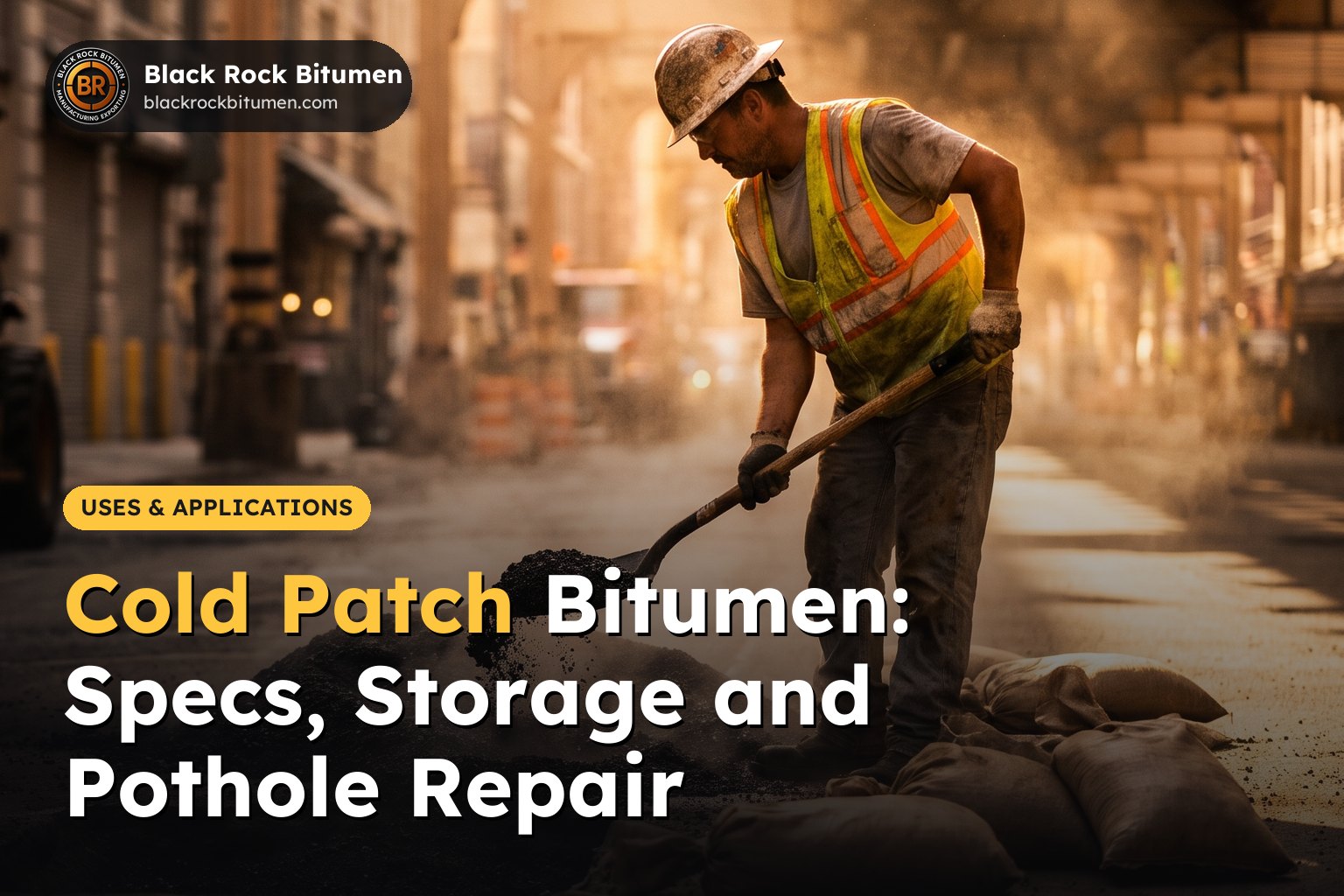
Table of contents
Potholes and localized surface failures demand immediate maintenance. While Hot Mix Asphalt (HMA) remains the gold standard for permanent structural repairs, deploying hot-mix plants for minor utility cuts, isolated potholes or emergency repairs during winter rains is logistically impractical and economically inefficient.
This is where Cold Patch Bitumen Mixtures (also known as cold-mix patching compounds) become indispensable. Formulated to stay pliable in storage for months and workable at sub-zero or ambient temperatures, cold-patch mixtures let road crews restore pavement serviceability quickly without specialized heating equipment.
The Chemistry Behind Workability and Curing
Standard paving bitumen hardens into a rigid solid as it cools below 100°C. Cold patch mixtures bypass this limitation by using modified binder systems that stay workable at ambient temperatures (0°C to 40°C) and cure only after mechanical compaction.
Two Binder Systems
| Binder System | Composition | Storage Phase | Application Phase |
| Medium-curing cutbacks / fluxed bitumens | Bitumen + volatile solvents (kerosene or diesel) + anti-strip additives | Solvent keeps the binder fluid in stockpiles or bags | Evaporation and air expulsion during compaction trigger the binder set |
| Cationic bitumen emulsions | Specialized slow- or medium-setting cationic emulsions (CMS-2 / CSS-1h) | The water phase keeps binder droplets suspended | Mechanical rolling forces water out, causing the droplets to coalesce |
Three Primary Binder Components
To balance long storage life with rapid strength gain after placement, cold patch binders rely on three components:
- Base bitumen matrix: typically a soft penetration grade (Pen 80/100 or Pen 100/150) or VG-10 base binder that provides inherent low-temperature ductility.
- Volatile cutters or fluxing oils: petroleum distillates (for example kerosene, diesel or bio-based soybean oil esters) that temporarily reduce binder viscosity to allow cold mixing and placement.
- Chemical anti-stripping agents: amine-based surfactants added at 0.5% to 2.0% by weight of binder. These agents modify the aggregate surface charge so the binder bonds directly to wet or damp pothole surfaces without stripping.
Aggregate Gradation: Ensuring Stability and Workability
Unlike dense-graded hot mixes that rely on tight particle packing, cold patch formulations use an open-graded or semi-open-graded aggregate matrix.
An open gradation creates interconnected voids (10% to 18% air void content in the loose mix), which serve two vital functions:
- Solvent evaporation: allows volatile fluxing agents or water vapor to escape efficiently after placement.
- Workability preservation: prevents the stockpile from consolidating into an unworkable block during storage.
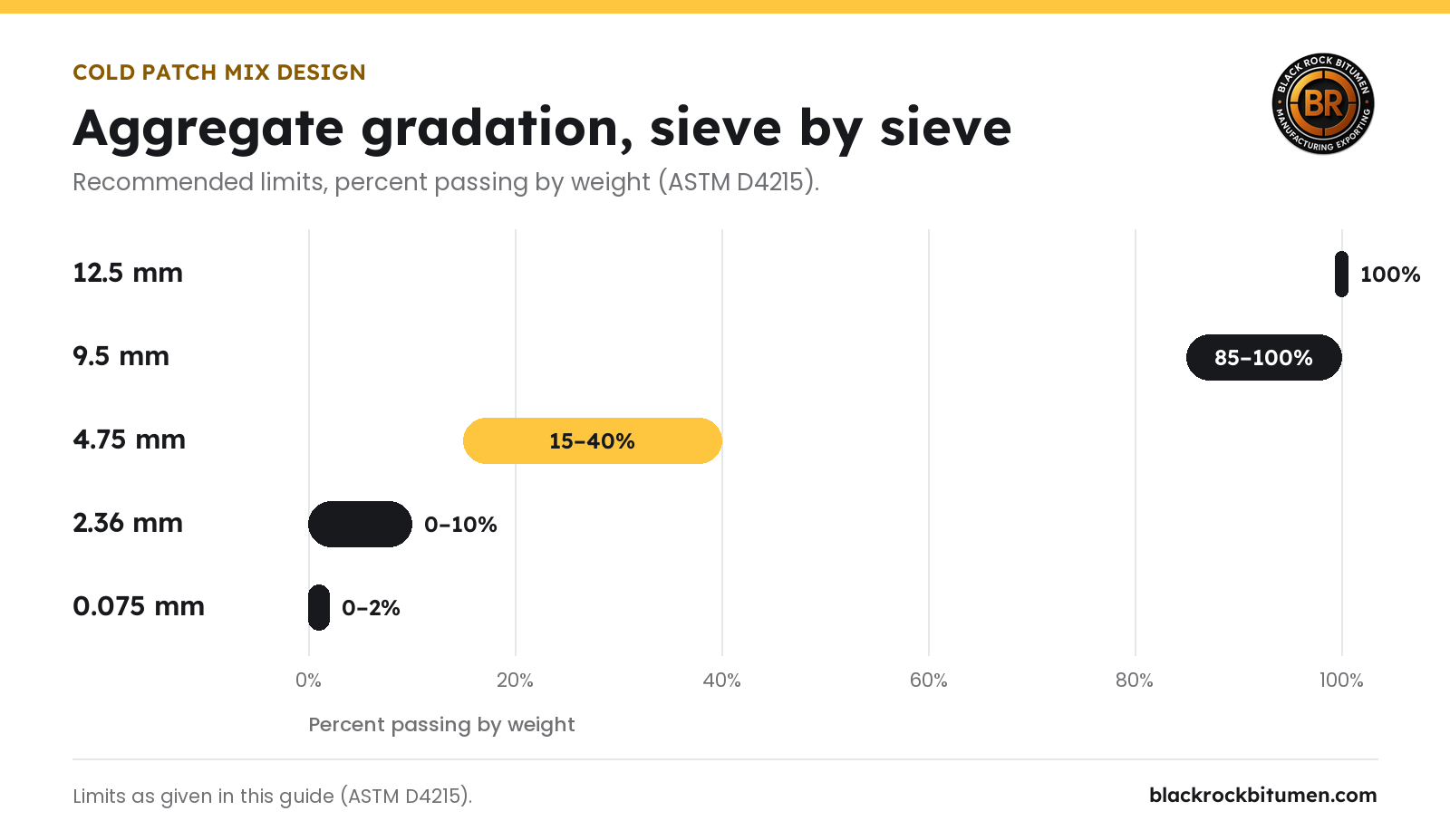
Recommended Cold Patch Aggregate Gradation (ASTM D4215)
| Sieve Size | Percent Passing by Weight (%) | Technical Function |
| 12.5 mm (1/2 in) | 100 | Maximum aggregate size constraint |
| 9.5 mm (3/8 in) | 85-100 | Primary structural stone skeleton |
| 4.75 mm (No. 4) | 15-40 | Interlocking matrix; prevents rutting |
| 2.36 mm (No. 8) | 0-10 | Limits fine fraction to maintain void channels |
| 0.075 mm (No. 200) | 0-2.0 | Must be strictly controlled; excess dust causes binder clumping |
Manufacturing and Storage Specifications
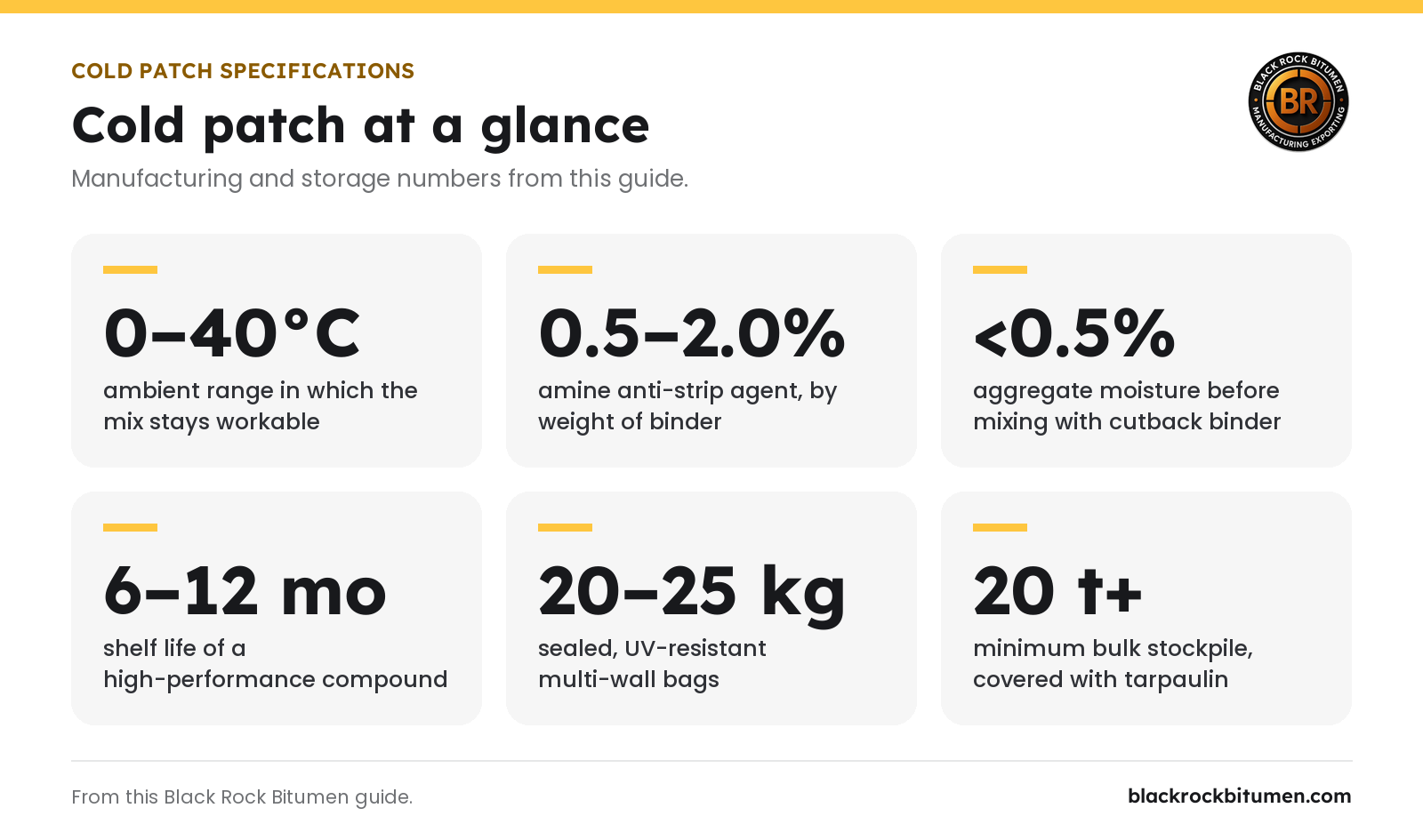
High-performance cold patch compounds can be stored for 6 to 12 months without losing workability or binder adhesion. Achieving this shelf life requires strict manufacturing controls.
Production and Packaging Flow
- Mixing: dry aggregate (20°C to 50°C) is combined with the fluxed or emulsified binder and anti-strip agent in a pugmill.
- Curing / aeration: the mix is allowed to cure and aerate.
- Storage: the finished mix goes either to bulk stockpiles or into sealed UV-resistant bags.
Moisture Elimination
Aggregates must be dried to below 0.5% moisture content before mixing with cutback binders. Residual aggregate moisture prevents full binder wetting and causes early stockpile stripping.
Packaging Alternatives
- Bulk stockpiles: formed in large conical piles (minimum 20 tons) and covered with heavy canvas or tarpaulins. The outer 50 mm layer forms a protective skin that shields the inner core from premature oxidation.
- 25 kg sealed bags: UV-resistant, heavy-duty polyethylene (multi-wall) bags, typically 20 kg to 25 kg, preserve solvent balance through the shelf life and let road crews transport exact quantities in standard utility vehicles.
Emergency Road Repair Best Practices: Standard Method vs “Throw-and-Roll”
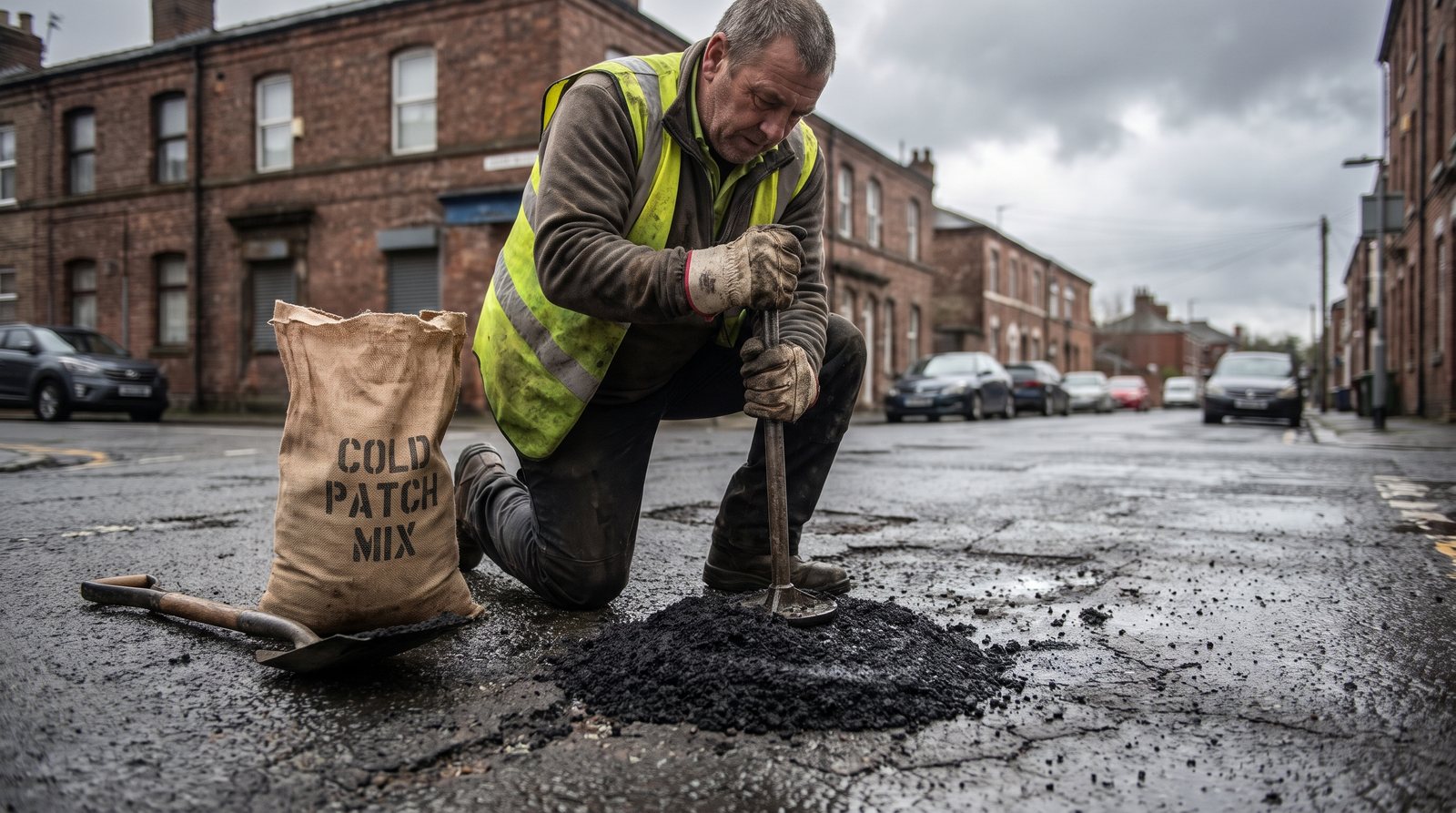
Field performance depends as much on installation technique as on material quality. Road maintenance teams generally use one of two installation methods:
| Method | Steps | Best For |
| Standard repair (permanent fix) | Mark and square edges, clean debris and water, apply tack coat, fill in lifts, compact mechanically | Longer service life |
| Throw-and-roll (rapid emergency response) | Dump cold patch directly into the pothole, compact with truck tires (3 to 8 passes) | Emergencies and minimizing worker exposure |
The Standard Repair Protocol (Recommended for Longer Service Life)
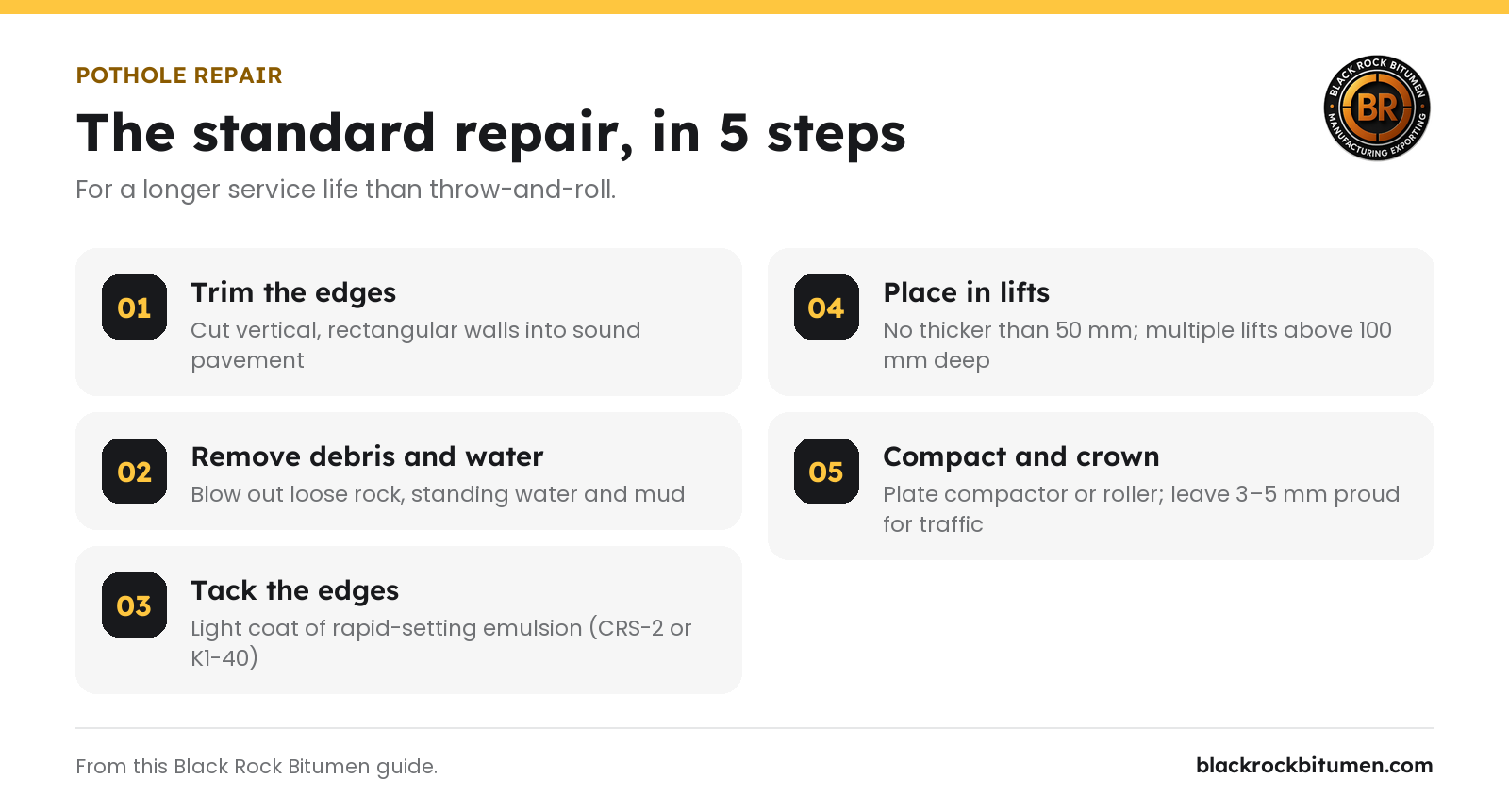
- Edge trimming: cut the pothole boundaries vertically using a pavement saw or jackhammer to form rectangular edges into sound pavement. Vertical walls provide lateral confinement for the patch.
- Debris removal: sweep or blow out all loose rock, standing water and mud using compressed air.
- Tack application: spray a light coat of rapid-setting emulsion (CRS-2 or K1-40) on the vertical edges to seal the interface against water ingress.
- Layered placement: place the cold patch mixture in lifts no thicker than 50 mm (2 inches). For deeper potholes (over 100 mm), compact in multiple lifts.
- Compaction: compact each lift thoroughly using a vibratory plate compactor, single-drum roller or hand tamper. Leave the patch slightly crowned (3 mm to 5 mm above the adjacent pavement) to allow for secondary compaction under traffic.
The “Throw-and-Roll” Protocol (Emergency High-Speed Response)
During severe winter storms or high-speed highway emergencies where worker exposure must be minimized, the Strategic Highway Research Program (SHRP) validated the throw-and-roll method:
- Cold patch material is shoveled directly into the un-cleaned pothole (even if wet).
- The maintenance truck backs over the patch 4 to 8 times to achieve compaction.
- High-quality cold patches containing active anti-stripping additives perform well under this method, achieving a 70% to 80% survival rate over 12 months.
Key Technical Takeaway for Procurement and Maintenance Teams
Cold patch bitumen mixtures are a crucial bridge between emergency repair and permanent road restoration. By specifying open-graded aggregates with tightly controlled fines, cutback or emulsion binders containing anti-strip additives, and sealed UV-stable packaging, procurement teams give their field crews an immediate, weather-independent response capability for emergency pavement repairs.
About the author:
Saniya Mirza
Content Writer, Black Rock Bitumen
Saniya Mirza writes the Black Rock Bitumen guides on bitumen grades, testing, storage, shipping and supply, in plain language for buyers, contractors and engineers.