



No products in the cart.
- Blog
- Supply & procurement
- What Happens to Bitumen Supply and Prices When Hormuz Reopens?
What Happens to Bitumen Supply and Prices When Hormuz Reopens?
Sources checked 9 Nov 2026 Supply & procurement

Saniya MirzaBlack Rock Bitumen · Dubai, UAE
14 min read

Table of contents
- Where the Strait of Hormuz stands today
- Why bitumen is so exposed
- What “reopening” will actually mean
- Supply: what recovers first, and what lags
- Prices: what falls fast, what falls slowly
- Three scenarios compared
- What reopening means for Africa, Asia and South America
- The UAE’s bypass routes will outlast the crisis
- What buyers should do now
- Signals that a reopening is real
- Frequently asked questions
- Need a supply plan for your project?
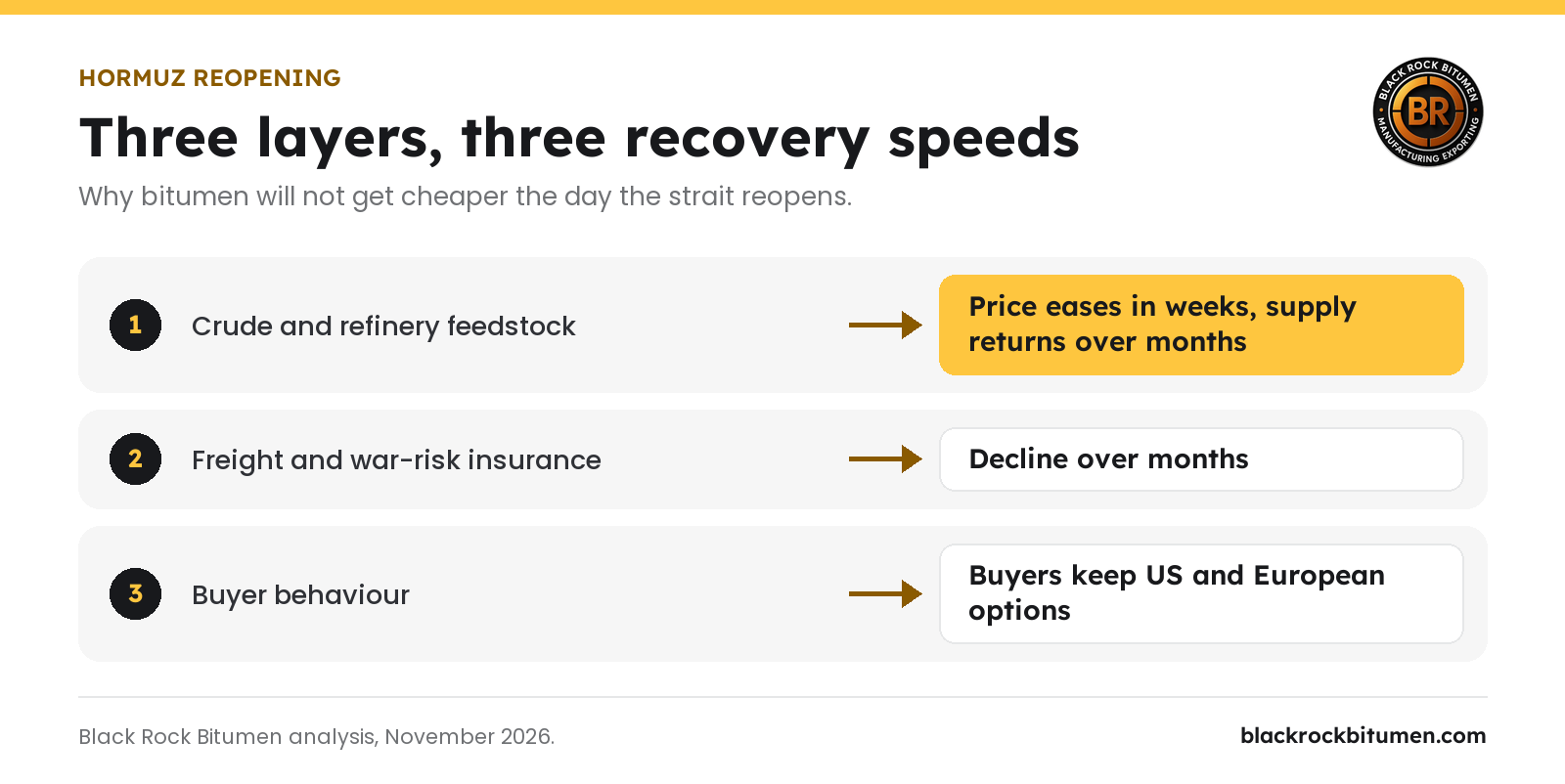
Short answer: reopening will not bring a quick drop in bitumen prices. When the Strait of Hormuz reopens, bitumen supply and prices will improve gradually, not overnight, because the 2026 shock sits in three layers that heal at different speeds: crude and refinery feedstock, freight and war-risk insurance, and buyer behaviour. Argus Bitumen Analytics’ outlook, as reported by Discovery Alert, is for gradual Hormuz normalisation in the first half of 2027.
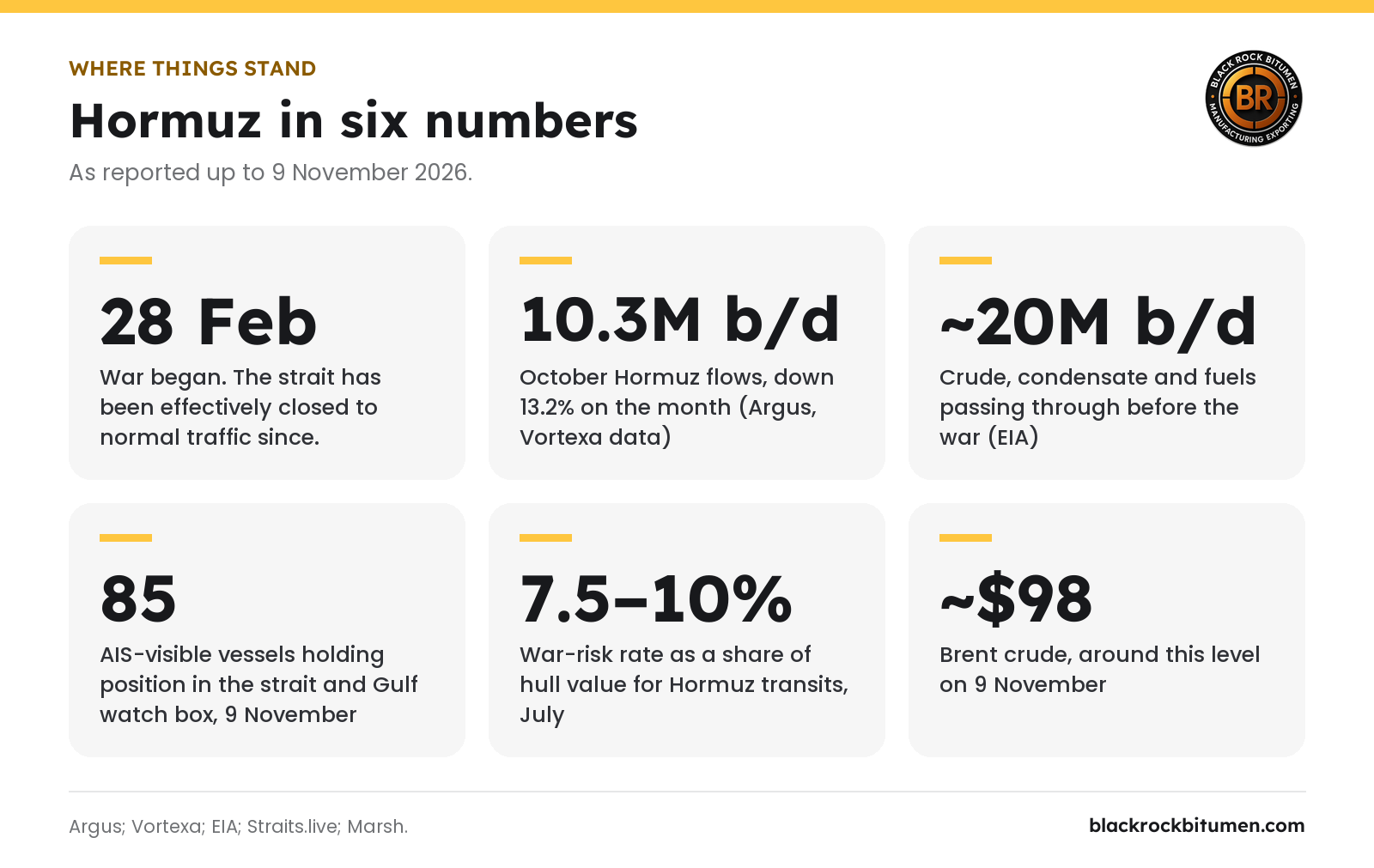
- Reopening is a process, not a date. The strait has been effectively closed to normal commercial traffic since the war began on 28 February 2026, and even the April ceasefire did not restore normal trade.
- Freight and insurance lag crude. War-risk rates for Hormuz transits reached 7.5% to 10% of hull value in July, and analysts expect premiums to stay high even after reopening.
- Non-Iranian Gulf supply should regain share first. Iranian bitumen faces US sanctions and a US naval blockade whether or not the strait reopens.
- Buyers will not fully go back. Argus expects buyers to keep US and European options as risk management.
- The practical move is to plan for a slow, uneven recovery: diversify origins, separate freight from product price in contracts, and watch a short list of signals (see Signals that a reopening is real).
Where the Strait of Hormuz stands today
As of 9 November 2026, the strait is still under acute pressure, with traffic a fraction of normal and attacks continuing. One tracker, Straits.live, counted 9 November as day 253 of the closure. Another logged at least 16 crossings between 5 and 6 November, with a US blockade still active. On 9 November, Reuters reported that Iran said navigation aids in the south of the strait were destroyed and no unauthorised vessels transited overnight.
The scale of the gap is visible in energy flows. Argus, citing preliminary Vortexa data, put October Hormuz flows at about 10.3 million barrels a day, down 13.2% on the month. Before the war, about 20 million barrels a day of crude, condensate and fuels passed through. Brent was around $98 on 9 November.
Why bitumen is so exposed
Bitumen is made from the heaviest part of the barrel, and many bitumen refiners depend on heavy, sour crude from the Gulf. Three exposures stand out:
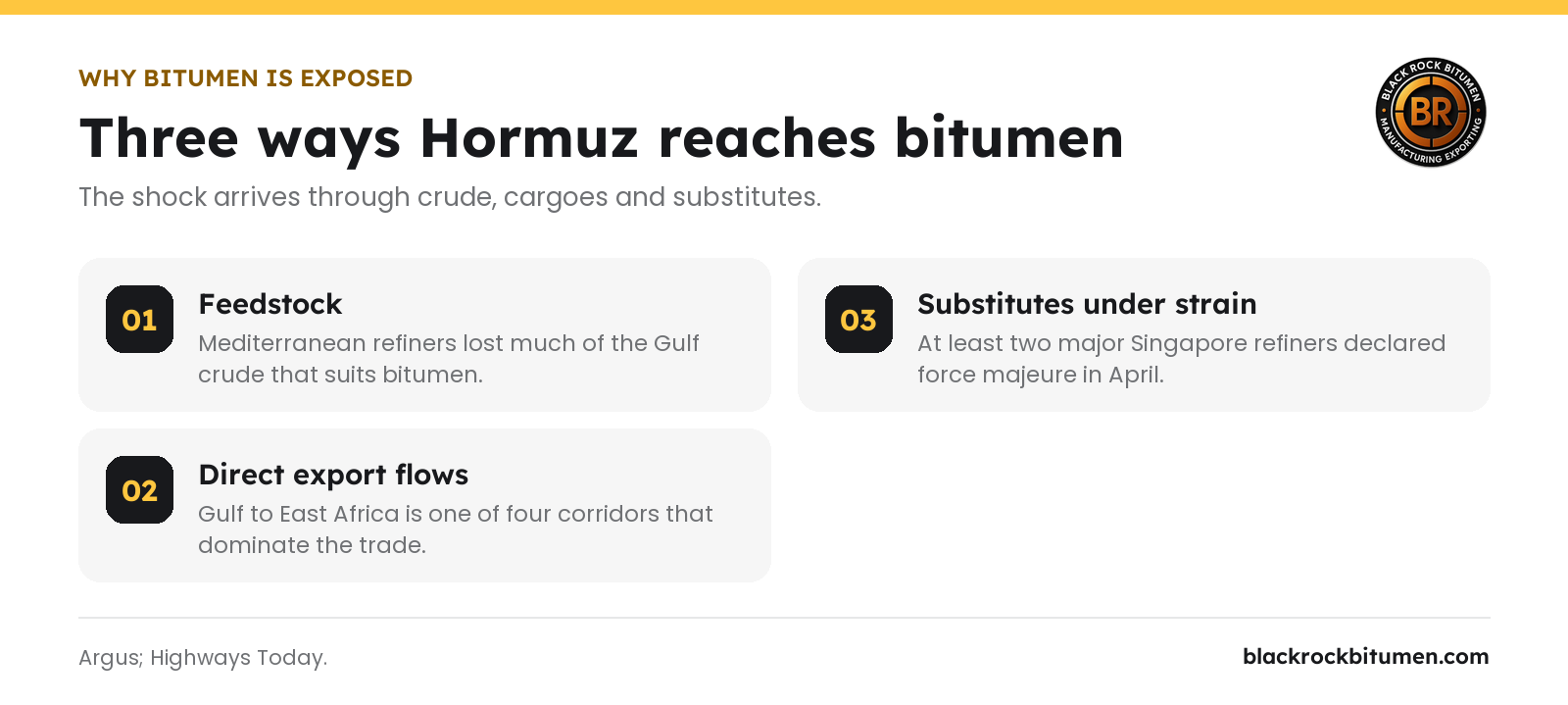
- Feedstock. Mediterranean refiners lost much of the Gulf crude that suits bitumen production, tightening supply in the region that normally feeds North and West Africa.
- Direct export flows. Analysis in Highways Today names the Gulf-to-East-Africa route as one of four corridors that dominate the trade, and calls Hormuz the single most important pinch point for East and Southern Africa’s supply.
- Substitutes under strain. In April, Argus reported that at least two major Singapore refiners declared force majeure on bitumen exports, and prices spiked to historic highs, as the same Highways Today piece records.
Argus also found the Asian impact was milder than the disruption implied, because the shock was mainly a feedstock and refinery-utilisation problem rather than a measured loss of bitumen output. That matters for recovery: bitumen supply comes back as crude and refinery runs come back, not the moment a ship can sail.
What “reopening” will actually mean
There is no single reopening event, so the first step is to separate three scenarios. They are our analysis, not forecasts, and the path can shift within days.
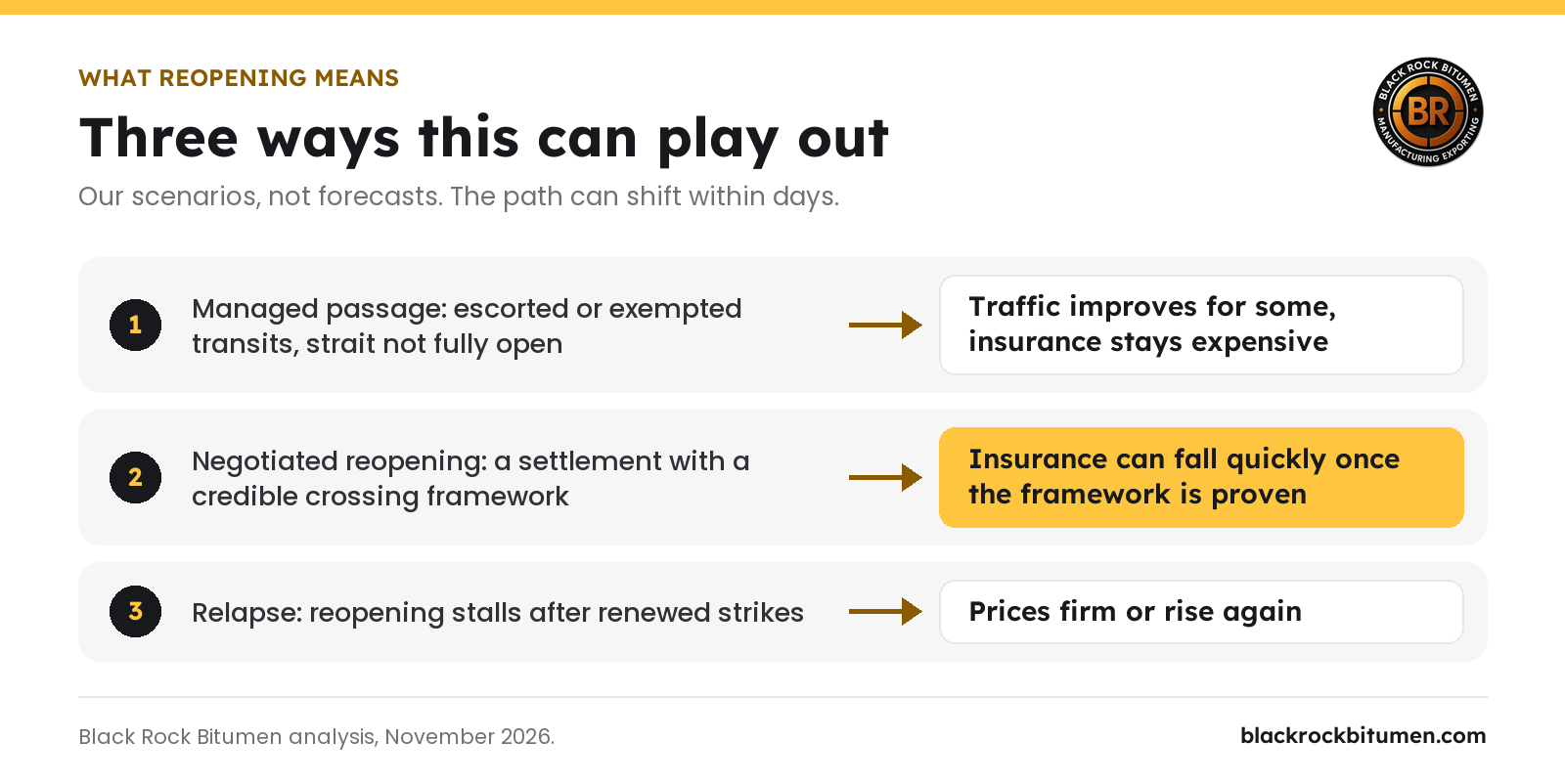
- Managed passage. Escorted, exempted or selectively cleared transits rise, but the strait is not fully open. Iran announced on 4 November that Indian ships were granted an exemption, which shows how selective passage can look. Traffic improves for some, insurance stays expensive.
- Negotiated reopening. A ceasefire or settlement with a credible crossing framework and military protection. Insurers have said that if such a framework is agreed and proven effective, rates would fall very quickly.
- Relapse. Reopening stalls or reverses after renewed strikes. This week’s tanker attacks and US strikes show the risk is live.
The April precedent is a warning. After the US-Iran ceasefire on 8 April, insurers said it eased tension but brought no immediate trade normalisation, and Iranian bitumen export activity stayed weak because markets remained cautious over sanctions risk and Hormuz security. A diplomatic announcement is therefore a starting signal, not the end of the shortage.
Supply: what recovers first, and what lags
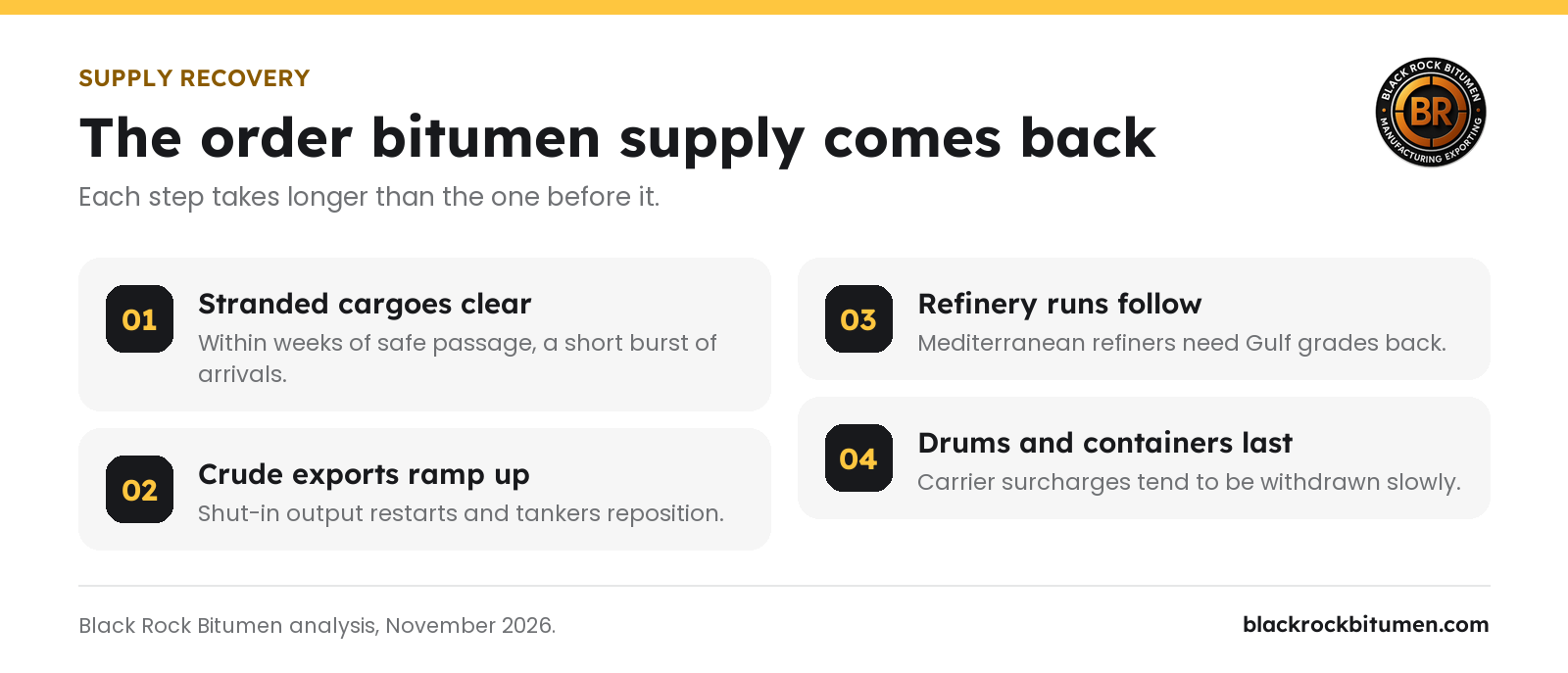
Bitumen supply will return in a predictable order, and each step takes longer than the one before it. The sequence below is our analysis, built on the market data cited in this post.
- Stranded cargoes and vessels clear first. About 85 AIS-visible vessels were holding position in the strait and Gulf watch box on 9 November, down from 147 two days earlier, though the tracker notes reduced AIS reception, and Indian importers reported bitumen vessels stranded inside the Gulf. A backlog like this releases within weeks of safe passage, which can cause a short burst of arrivals.
- Crude exports ramp up next, but not instantly. The IEA put Gulf crude exports at 13.9 million barrels a day in September, more than 75% of pre-war levels, and said 8.3 million barrels a day of Gulf output was still shut in during July. Shut-in output has to be restarted, stored crude moved and tankers repositioned.
- Refinery runs and crude slate follow. Bitumen yield depends on the crude, and Mediterranean refiners need Gulf grades back before their bitumen output recovers. Argus also notes that European bitumen is priced against high-sulphur fuel oil, so refiners choose between the two based on margin.
- Container and drum logistics normalise last. Carriers added war-risk surcharges on all cargoes exported from the Jebel Ali and Abu Dhabi hubs to west, east and south Africa, and surcharges tend to be withdrawn slowly once risk falls.
Iranian bitumen is a separate track
Iran is a major bitumen exporter, with Bandar Abbas as its key export point. Its trade runs on a different clock. US sanctions have made it significantly more difficult and far riskier, sanctions increasingly target vessels and shipping companies, and the US blockade of Iranian ports is still in force. A reopened strait does not by itself bring Iranian barrels back to compliant buyers.
Buyers will not simply return to old habits
Buyers who were forced to switch to Mediterranean, Singapore, Korean, US and European cargoes now have working relationships and qualified supply. Argus’s outlook says Middle Eastern and regional supply should regain share if access normalises, but buyers are likely to keep US and European options as risk management.
Prices: what falls fast, what falls slowly
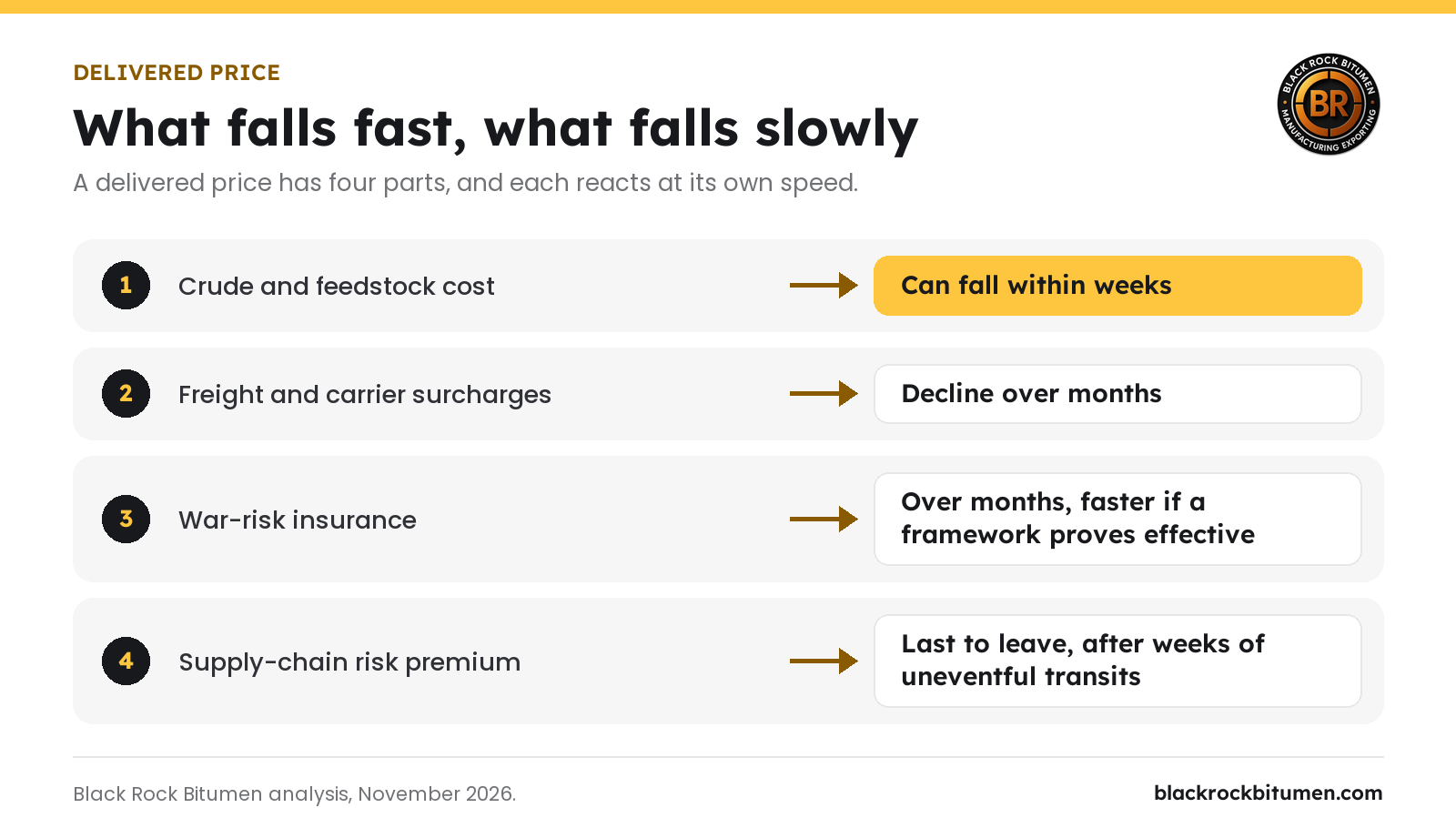
Bitumen prices will fall in stages, because a delivered price is made of four parts that react to a reopening at different speeds. We found no credible public forecast of an exact post-reopening price, so this section gives direction and drivers rather than a target.
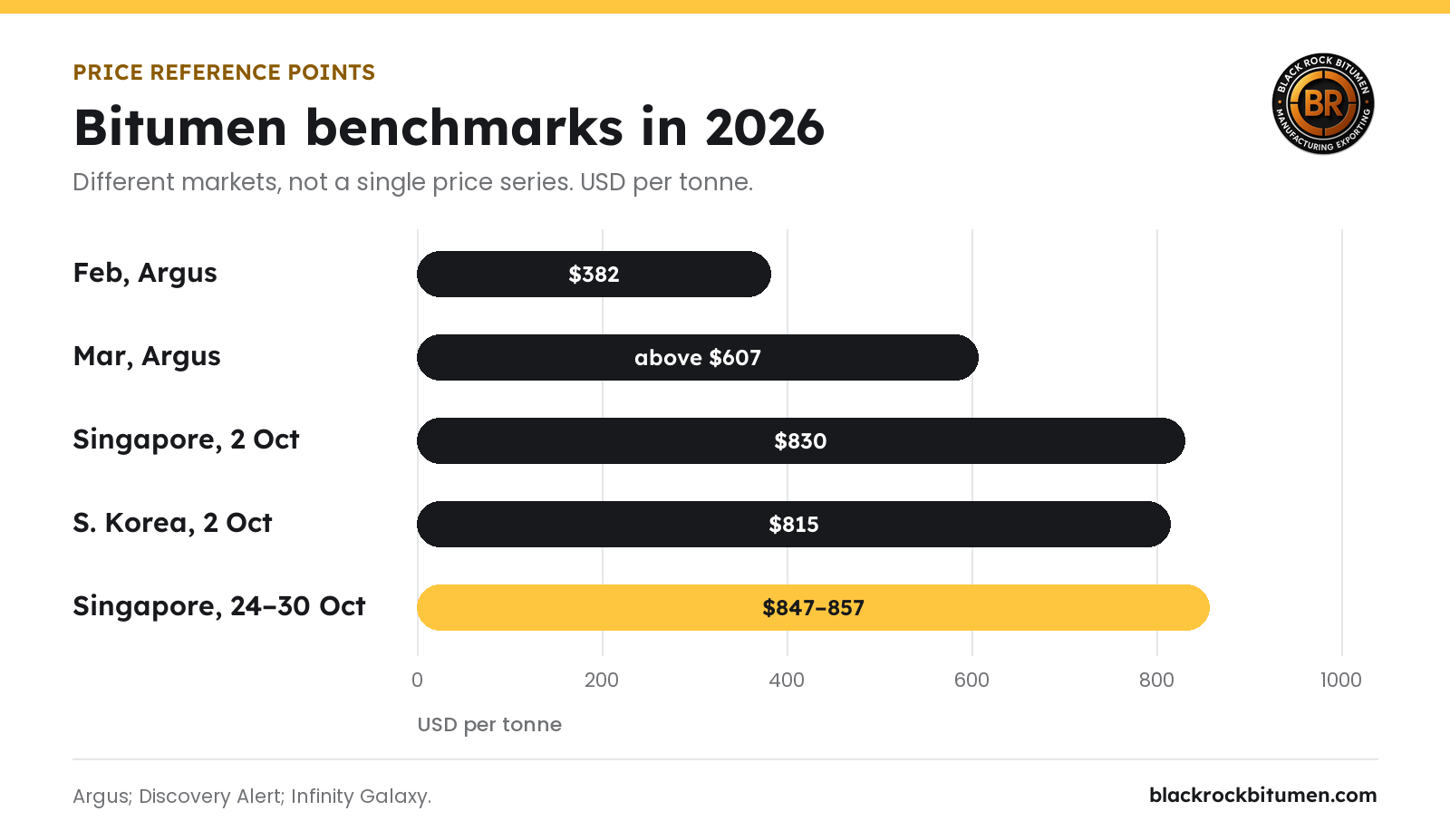
Reference points from 2026
| Date | Benchmark | Price (USD/t) | Source |
|---|---|---|---|
| Feb 2026 | Argus bitumen price, Europe and Africa discussion | 382 | Argus |
| Mar 2026 | Same | above 607 | Argus |
| 2 Oct 2026 | Singapore FOB | 830 | Argus via Discovery Alert |
| 2 Oct 2026 | South Korea FOB | 815 | Argus via Discovery Alert |
| 24 to 30 Oct 2026 | Singapore FOB range | 847 to 857 | Infinity Galaxy, citing Argus |
These benchmarks measure different markets and are not a single price series. Read them as evidence that prices rose sharply in March and were still high through October.
The four components of a delivered price
- Crude and feedstock cost. This should ease first if Gulf crude flows return, but it depends on the oil market as a whole. Brent was around $98 on 9 November.
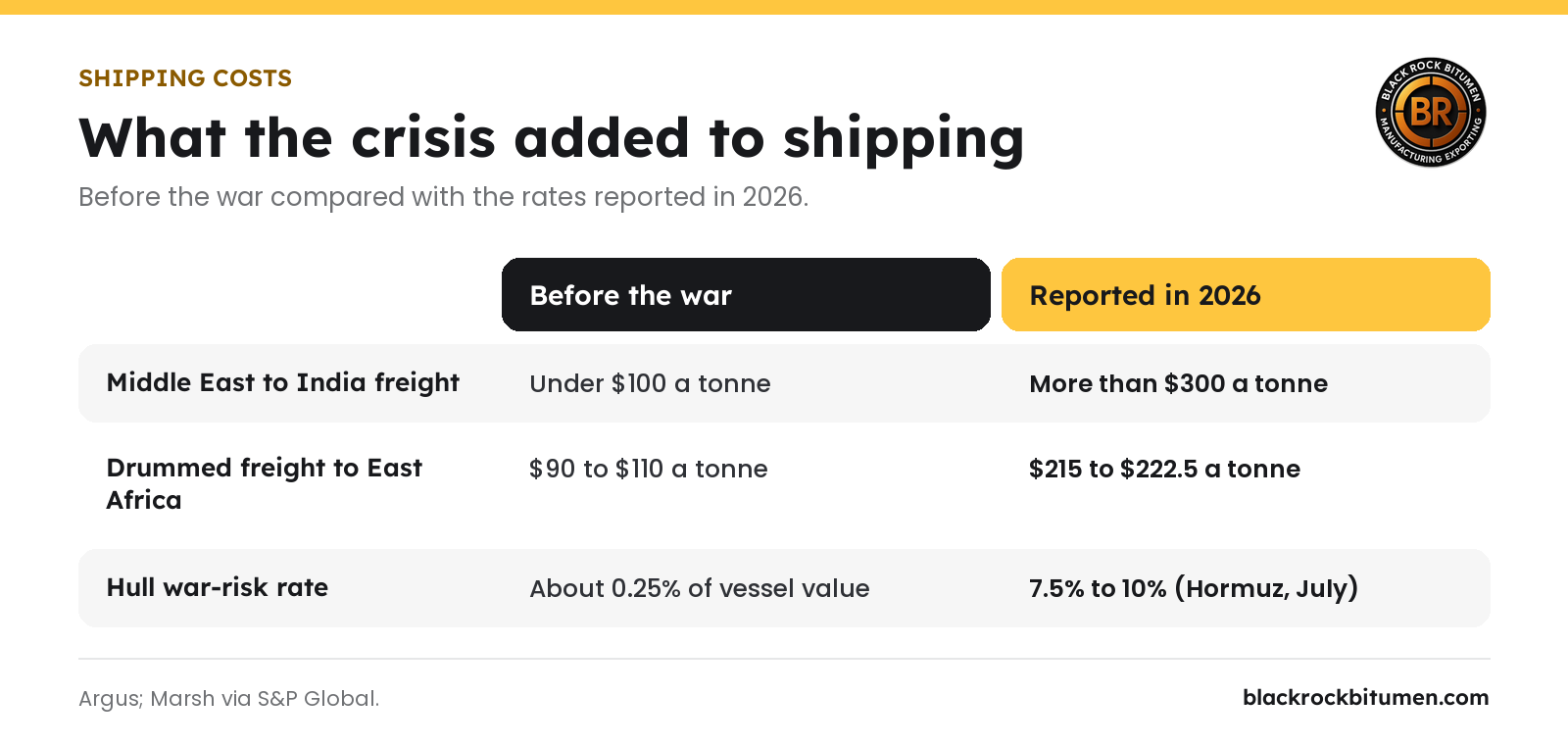
- Freight. Middle East to India freight rose from under $100 a tonne to more than $300. For Africa, Argus reported in March that surcharges would nearly double shipping costs for Iranian drummed product repackaged in the UAE, pushing drummed freight to East Africa to $215 to $222.5 a tonne. Before the war, drummed container freight to Mombasa and Dar es Salaam was assessed at $90 to $110 a tonne.
- War-risk insurance. Pre-war hull war-risk rates were about 0.25% of vessel value. Marsh reported Hormuz rates of 7.5% to 10% of hull value in July. Our read is that smaller product tankers, the type that carries bitumen, are deterred by these costs more than crude carriers are.
- Supply-chain risk premium. Suppliers and traders price in the chance of relapse. This premium is the last part to leave, and it only shrinks after weeks of uneventful transits.
What this implies
Our read is that the crude-linked part of the price can fall within weeks of a credible reopening, while freight, insurance and the risk premium decline over months. Two forces can slow the fall. Buyers who held back during the crisis are likely to restock once prices ease, which supports demand. And refiners that have been maximising other products may take time to shift output back toward bitumen. Both points are our judgement, not published forecasts.
Three scenarios compared
The table sets out what each scenario means for supply, price direction and shipping costs. It is qualitative on purpose: it shows direction and relative speed, not price targets.
| Scenario | What triggers it | Supply | Price direction | Freight and insurance | What buyers should do |
|---|---|---|---|---|---|
| Managed passage | Escorted or exempted transits, no full settlement | Partial relief, uneven by origin and flag | Small, patchy easing | Stay close to current highs | Keep diversified sourcing, avoid assuming a trend |
| Negotiated reopening | Ceasefire or settlement with a crossing framework | Backlog clears in weeks, crude and refinery runs recover over months | Crude-linked part eases first, delivered prices ease gradually | Insurance can fall quickly once the framework proves effective, surcharges lag | Stagger purchases, add price-review clauses |
| Relapse | Reopening stalls after new strikes or attacks | Renewed tightness, more stranded cargoes | Prices firm or rise again | Premiums and surcharges stay high or rise | Hold buffer stock, favour origins outside the Gulf where needed |
Argus Bitumen Analytics’ base view of gradual normalisation in the first half of 2027 sits between the first two rows. Whether you are planning purchases or contracts, the safest planning case is a slow recovery with a real chance of setbacks.
What reopening means for Africa, Asia and South America
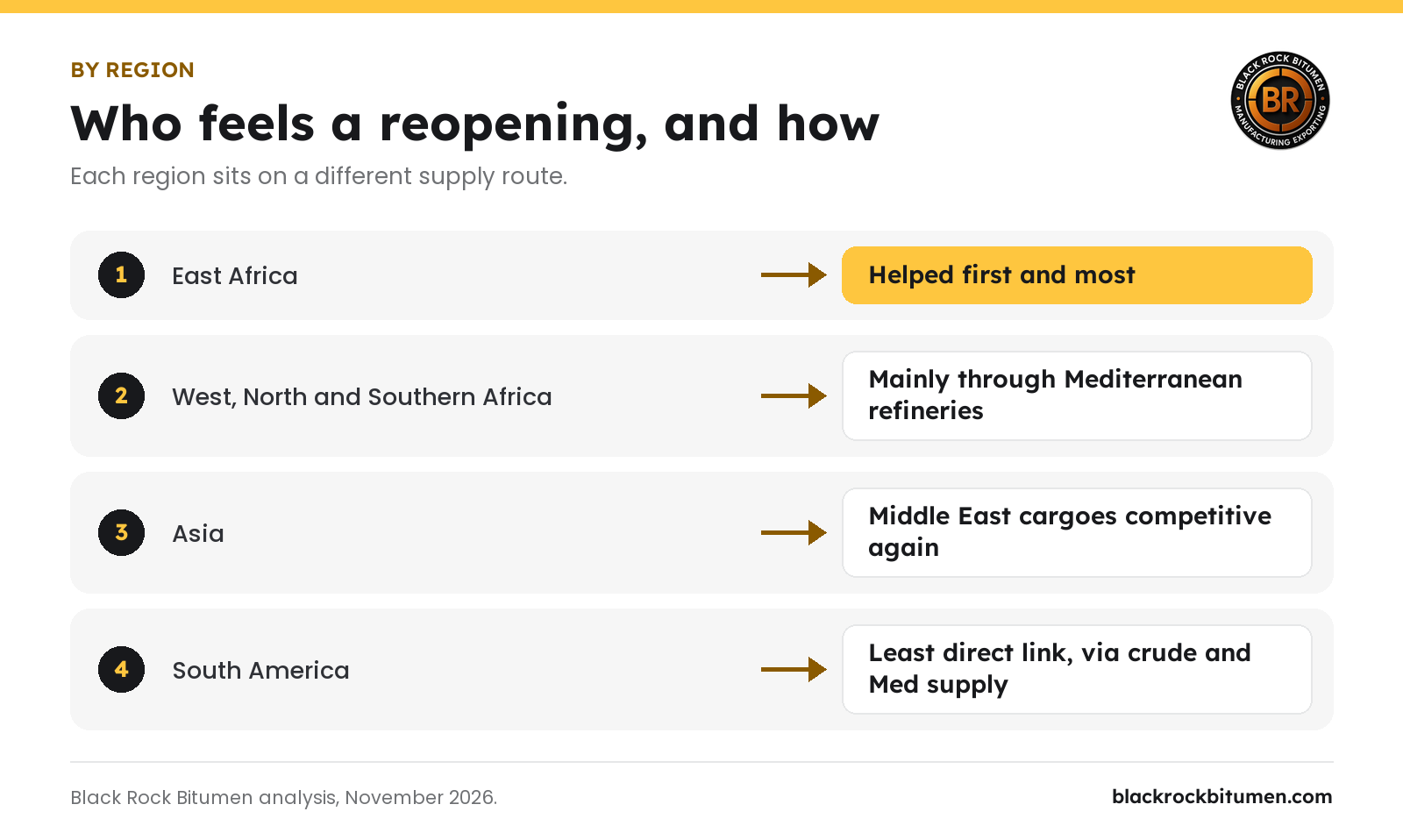
Each region reacts differently, because each sits on a different supply route. East Africa has the most to gain from a reopening, and South America the least direct link.
East Africa
East Africa depends most on Gulf drummed and some bulk supply, so it feels both the shortage and the freight shock. Gulf Petro’s market reports described supply as constrained by limited Gulf flows, with container freight rates to the region rising. A reopening would help this region first and most, but drum freight and carrier surcharges are likely to ease more slowly than product availability.
West Africa, North Africa and Southern Africa
These markets lean more on Mediterranean and other non-Gulf sources, and they have already shifted. Argus reported that North African imports of Greek bitumen slid to 65,000 tonnes in Q1 from 164,000 a year earlier as buyers moved to Spanish and Italian barrels. Argus forecasts Africa’s 2026 bitumen imports at 2.7 million tonnes, and says South Africa is growing more reliant on imports and more exposed to disrupted Middle East flows. Reopening matters here mainly through Mediterranean refineries getting Gulf crude back.
Asia
Asian buyers faced a double squeeze: the Singapore force majeure in April, and Gulf supply that was restricted by sanctions, shipping limits and vessel-risk concerns. Prices were $830 a tonne FOB Singapore and $815 FOB South Korea on 2 October. When Gulf and regional supply returns, Middle East cargoes become competitive again on price. Buyers in Asia are the most likely to keep multiple sources afterwards.
South America
South America has a less direct link to Hormuz. Historically, importers have drawn on the Mediterranean and the US: Argus reported that Mediterranean bitumen exports to South America tripled in 2022. Our analysis is that the effect reaches this region through crude prices and Mediterranean refinery strain, so a reopening should help most by easing Mediterranean availability and, over time, freight costs from the UAE. We found no current public volume data for South America.
The UAE’s bypass routes will outlast the crisis
Even after a reopening, the map of UAE exports will not return to exactly what it was, because the bypass routes built and expanded during the crisis stay in place. This matters for any supplier or buyer that moves cargo from the UAE.
- Jebel Ali sits inside the Gulf; Fujairah and Khor Fakkan sit outside it. The eastern ports on the Gulf of Oman coast avoid the strait entirely.
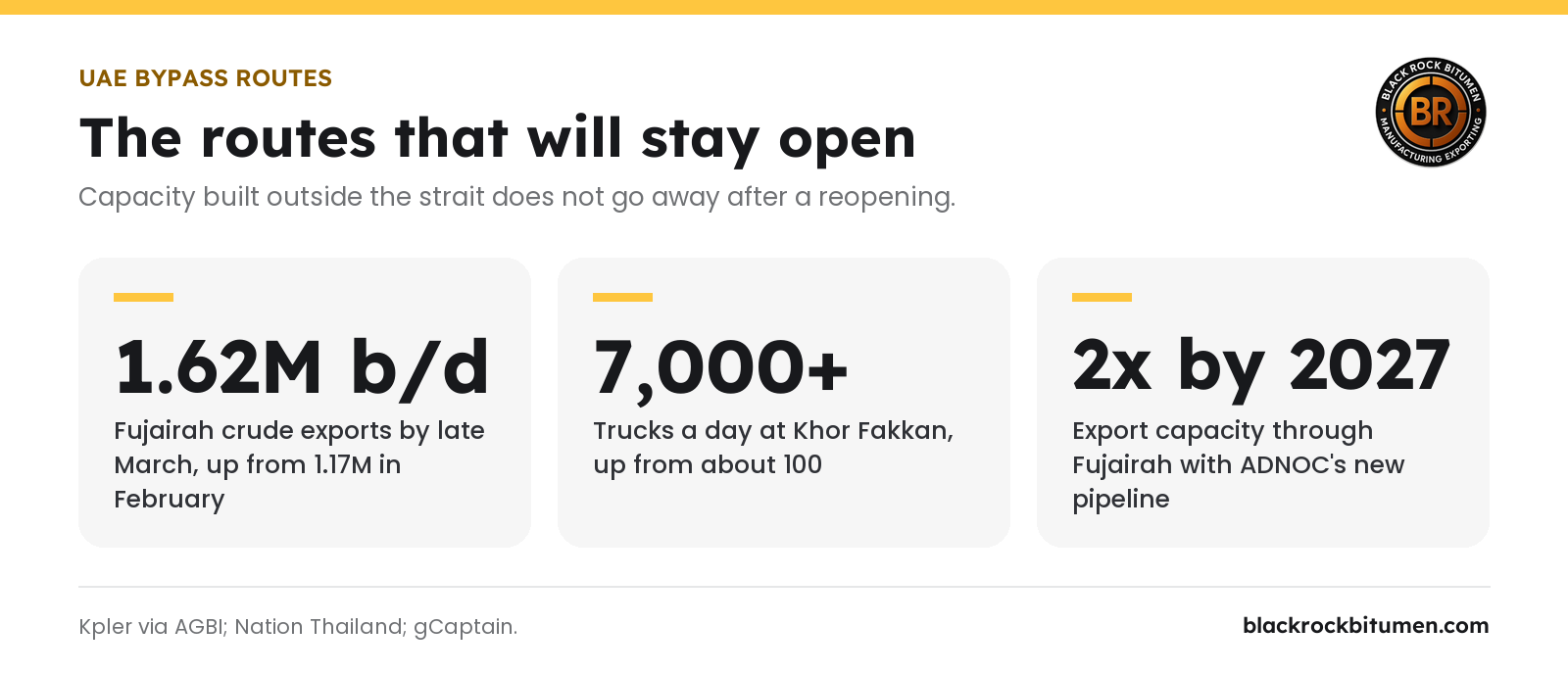
- Fujairah crude exports rose to an average of 1.62 million barrels a day by late March, up from 1.17 million in February, according to Kpler data cited by AGBI, using the Habshan-Fujairah pipeline that carries up to 1.8 million barrels a day.
- Khor Fakkan became an emergency gateway. Truck movements jumped from about 100 vehicles a day to more than 7,000.
- More capacity is coming. ADNOC is accelerating a new pipeline to Fujairah that will double export capacity through the port by 2027, giving the UAE options even after Hormuz reopens. The UAE’s stated aim is “zero Hormuz dependency”.
What this means for bitumen
Crude and containers moved to the east coast far more easily than bitumen has. BitumenMag noted that the UAE’s bypass corridors still need dedicated logistics for bitumen: heated storage, loading arms, drumming and container-packing capacity. Suppliers able to load on both sides of the strait will keep an advantage over those tied to one route, because the east coast is not risk-free either. Fujairah was hit by Iranian drone strikes in March before loading capacity was restored.
The practical conclusion is that resilience has become part of the product. After reopening, buyers will ask not only “what is your price?” but “how many ways can you ship it?”
What buyers should do now
The best preparation is to make your purchasing robust to both a slow recovery and a relapse. This is general commercial guidance, not financial advice, and the right mix depends on your project schedule and cash position.

- Split volumes across origins and loading ports. Avoid a single route. Keep at least one non-Gulf option qualified and approved on your project specification, even if it costs more today.
- Separate product price from freight and insurance in quotes. When these are itemised, you can see which part falls after a reopening and negotiate the rest. Compare FOB and CFR on the same basis.
- Add price-review and surcharge clauses. Link war-risk surcharges and freight to a published reference, so the cost comes down automatically when conditions improve.
- Stagger purchases rather than betting on one date. Because recovery is expected to be gradual, buying in tranches reduces the risk of locking in at a peak or waiting through a relapse.
- Protect your schedule with buffer stock. If a project cannot stop for a shipping delay, hold more inventory than usual, or agree delivery windows with a supplier who has loading options on both coasts.
- Check force majeure and delay terms. Make sure the contract says what happens if a vessel is stranded, rerouted or refused cover, and who bears the extra cost.
- Verify origin and vessel compliance. Sanctions risk is separate from the strait. Confirm origin certificates, vessel history and documents before you pay, especially for Gulf-origin cargo.
- Plan for the restocking wave. If many buyers who delayed purchases return together, availability can tighten briefly even as prices ease. Book early for your key season.
Signals that a reopening is real
Track a short list of indicators and wait for several to move together before assuming conditions have changed. A single headline is not enough.
| Signal | Where to see it | What a real reopening looks like |
|---|---|---|
| Daily strait crossings | Windward, Straits.live | A sustained climb from today’s low double digits a day, over many days, with fewer dark transits |
| War-risk premium | Broker and insurer notes, S&P Global | Hormuz rates falling well below the 7.5% to 10% of hull value reported in July |
| Carrier surcharges | Shipping line notices (for example MSC, Hapag-Lloyd) | War-risk surcharges on Jebel Ali and Gulf cargo withdrawn or cut |
| Vessels held in the Gulf | Straits.live daily brief | The count of vessels holding position (85 to 147 in the three days to 9 November) falling and staying low |
| US blockade and sanctions | Official notices, trade press | Blockade lifted or relaxed, vessel-sanction guidance clarified |
| Singapore and Korea FOB prices | Argus, Infinity Galaxy | Easing from the $815 to $857 a tonne range seen in October |
| Gulf-to-Africa and Gulf-to-India freight | Freight reports, your forwarder | Rates falling back from the $230 a tonne Argus assessed in mid-April (drums to East Africa) and above $300 (India) |
| Fujairah and Khor Fakkan congestion | Port and terminal updates | Eastern ports stop handling emergency volume, western loading resumes |
If only the first row moves, treat it as managed passage. If insurance and surcharges also move, the negotiated-reopening scenario is under way.
Frequently asked questions
Will bitumen prices fall immediately when the Strait of Hormuz reopens?
No. The crude-linked part of the price can ease within weeks, but freight, war-risk insurance and the supply-risk premium decline over months. Argus Bitumen Analytics expects gradual normalisation in the first half of 2027.
How long will it take for bitumen supply to normalise after reopening?
Expect weeks for stranded cargoes to clear and months for crude exports, refinery runs and container logistics to recover. The IEA put Gulf crude exports at a little over 75% of pre-war levels in September, so there is still a large gap to close.
Why is bitumen so affected by Hormuz?
Bitumen is made from heavy crude, and many refiners rely on Gulf grades. Gulf-origin bitumen also travels to East Africa and Asia through or near the strait, and Mediterranean refiners that supply North and West Africa lost much of the Gulf crude that suits bitumen production.
Will Iranian bitumen return to the market once the strait reopens?
Not automatically. US sanctions, sanctions on vessels and shipping companies, and the US blockade of Iranian ports apply separately from the strait, and compliant buyers should verify origin and vessel before buying.
Does shipping from Fujairah or Khor Fakkan avoid the risk?
It avoids the strait itself, which is why these ports carried so much traffic during the crisis. They are not risk-free: Fujairah was hit by Iranian drone strikes in March. Bitumen also needs dedicated loading, storage and packing capacity, so it is not a simple switch from Jebel Ali.
Should I buy now or wait for prices to fall?
That depends on your project schedule and risk tolerance, and this post is not financial advice. A common approach is to buy in tranches, keep a non-Gulf option qualified, and itemise freight and insurance so you can see the part that should fall after reopening.
Which regions are affected most?
East Africa feels it most because it relies on Gulf drummed and some bulk supply. Asia has been squeezed by the Singapore force majeure and restricted Gulf flows. West and North Africa are affected mainly through Mediterranean refinery supply, and South America has the least direct link.
Need a supply plan for your project?
If you want a supply plan built around your project calendar, destination port and grade (for example 60/70, 80/100 or VG30), Black Rock Bitumen can set out origin and loading-port options for you.
About the author:
Saniya Mirza
Content Writer, Black Rock Bitumen
Saniya Mirza writes the Black Rock Bitumen guides on bitumen grades, testing, storage, shipping and supply, in plain language for buyers, contractors and engineers.