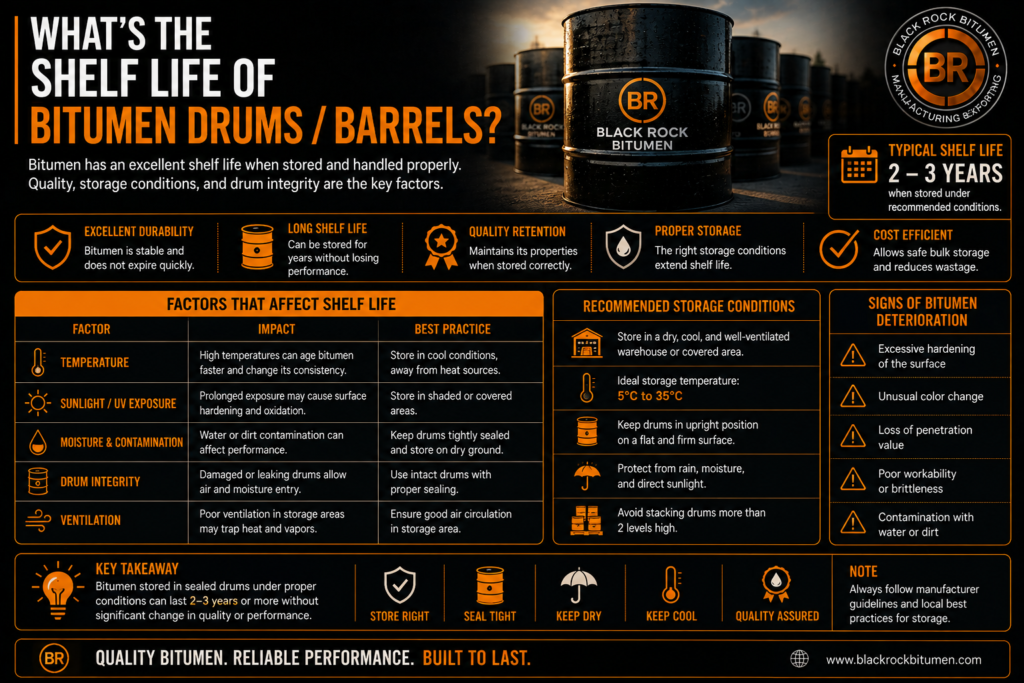
Bitumen doesn’t have an expiration date printed on the drum the way food or paint does. That does not mean a stored drum remains unchanged indefinitely. Bitumen can age chemically during storage, and the practical usable window depends on the grade, seal integrity, temperature, moisture exposure, and storage conditions.
SAFETY CALLOUT — Never reheat a drum suspected of containing trapped water. Moisture can flash to steam and cause violent foaming or ejection of hot bitumen. If a drum pops, hisses, or foams during reheating, stop heating immediately and isolate the drum.
Why Drums Behave Differently Than Tank Storage
Most conversations about bitumen aging focus on hot tank storage — bitumen kept liquid for extended periods and exposed to sustained heat and air. Drums are a different storage condition: bitumen is normally hot-filled, then cooled and solidified before shipping or storage. A standard steel bitumen drum is commonly supplied at about 180 kg net in a 200-litre-class drum, although packaging weights vary by supplier and drum design.
That solidification helps compared with continuously heated bulk storage. A sealed, cooled drum is not being held at tank-storage temperatures, so the rate of heat-driven ageing is much lower. It is still not an indefinite-storage condition: seal integrity, sunlight, temperature cycling, moisture ingress, and the product formulation all affect usable life.
Does Any Standard Define Bitumen Shelf Life?
No. ASTM and EN product specifications define properties and test methods for particular bitumen grades, but they do not set a universal 12-, 18-, or 24-month shelf-life limit for drummed bitumen. The time ranges quoted by suppliers are therefore commercial guidance based on product formulation, packaging, storage conditions, and experience — not a specification requirement.
But “more stable than a hot tank” doesn’t mean “stable indefinitely.” The seal, the grade, and the storage environment still determine how long that stability actually holds.
Shelf Life by Grade Type
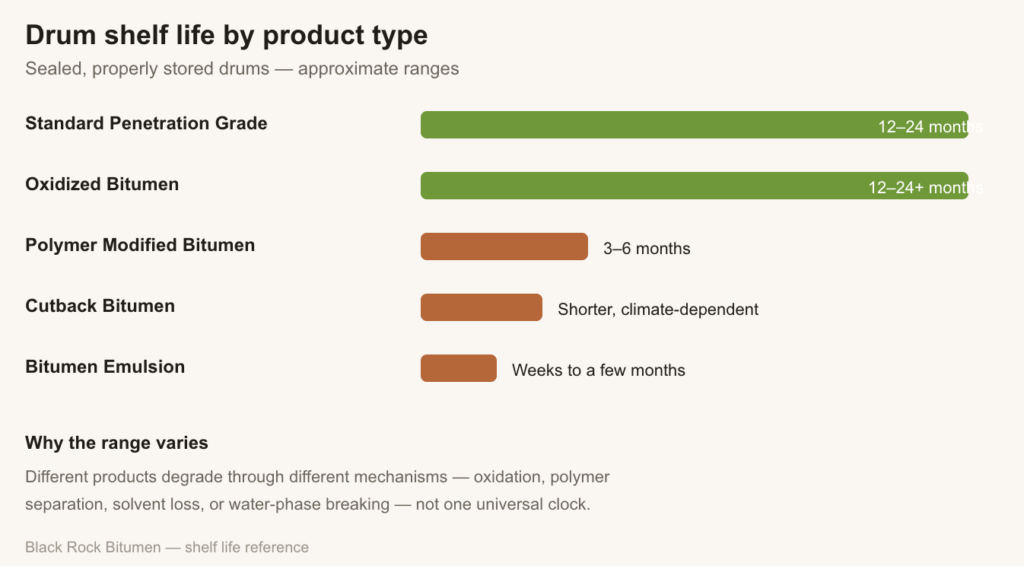
Different bitumen products age through different mechanisms, which is why one blanket shelf-life number does not work across the board.
Standard penetration grade bitumen (60/70, 80/100, and similar refinery-produced grades) is generally the most stable common drummed paving product. For planning purposes, Black Rock Bitumen uses 12 to 24 months as commercial guidance when drums are properly sealed and stored in dry, shaded conditions. The principal long-term change is gradual oxidative hardening, which can raise softening point and reduce penetration.
Oxidized bitumen (the roofing, waterproofing, and industrial grades) can also be stable in drum storage. Its higher initial softening point does not make it immune to ageing, so the actual product specification, formulation, packaging, and storage history still matter.
Polymer Modified Bitumen (PMB) generally has a shorter practical storage window than standard penetration grade, often around 3 to 6 months depending on the formulation and supplier guidance. The genuine long-term concerns are oxidative ageing and polymer degradation, including chain scission or crosslinking. Phase separation is a liquid-phase issue: once PMB has cooled and solidified inside a sealed drum, the polymer and bitumen phases are physically locked rather than freely migrating. Separation can become relevant again during reheating if the material is held hot without adequate circulation or agitation.
Cutback bitumen carries a different storage risk because it contains volatile solvents. Solvent loss through an intact seal is generally slow, but repeated opening or partial use, poor seals, and sustained heat can accelerate solvent loss and change viscosity. A cutback drum stored in direct sun or repeatedly opened deserves particular scrutiny before use.
Bitumen emulsion has a much shorter practical storage window, often weeks to a few months depending on emulsion type and supplier guidance. Stored emulsion can develop settlement, with bitumen droplets migrating downward through the water phase; this may be reversible with appropriate gentle agitation. Breaking is different: it is coalescence of the emulsion and is generally irreversible. Visible settlement alone should therefore not automatically be treated as product failure.
What Actually Shortens Drum Shelf Life
A handful of factors determine whether a drum hits the upper or lower end of its grade’s typical range.
Sun exposure. A drum stored in direct sunlight can heat internally even without active heating equipment, increasing temperature cycling and accelerating ageing. Shaded, covered storage genuinely improves storage stability.
Seal integrity. A dented, rusted, punctured, or compromised drum can admit air and moisture. Moisture ingress is particularly important because trapped water becomes a serious safety hazard if the drum is later reheated.
Temperature swings. Repeated heating and cooling are less desirable than stable, moderate ambient conditions and can accelerate ageing, especially when drums are exposed to strong daily temperature cycles.
Physical damage. Dropped, dented, or incorrectly stacked drums can develop seal failures or other damage that is not obvious from a quick inspection. Damaged drums deserve closer scrutiny before use.
Signs a Drum Has Aged Past Usability
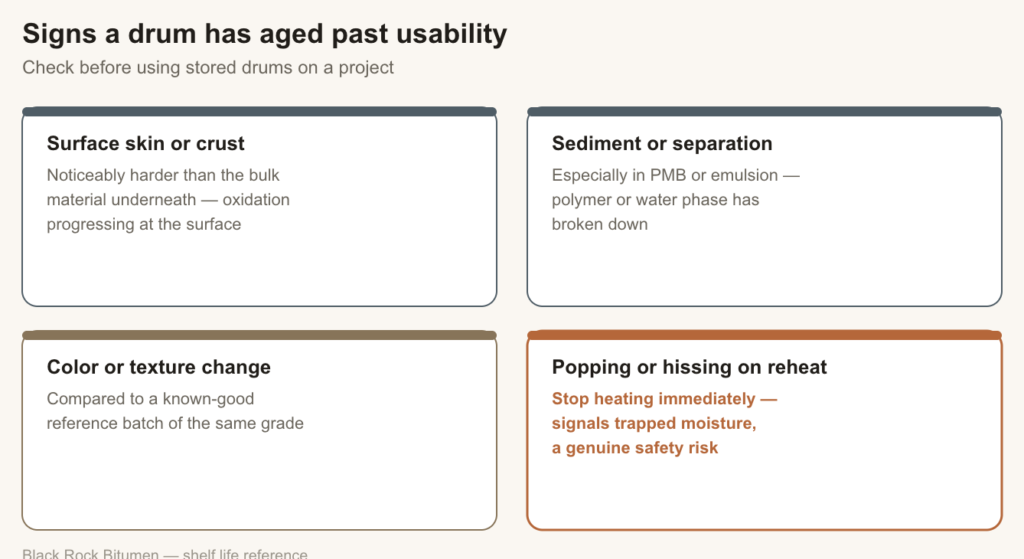
Before using bitumen from a drum that’s been in storage for an extended period, a few checks are worth doing beyond just opening the lid and looking:
Surface skin or crust noticeably harder than the bulk of the material underneath, suggesting greater oxidation at the exposed surface.
Visible sediment or settlement. In PMB, persistent evidence of separation after appropriate reheating and mixing is a concern; in emulsion, settlement may be reversible, whereas irreversible breaking is a different condition.
Unusual colour or texture changes compared with a known-good reference batch of the same grade.
Popping, hissing, or foaming when reheated, which signals possible trapped moisture and should be treated as a genuine safety concern — stop heating immediately.
For any high-value or safety-critical project, retesting penetration and softening point on drums that have been stored for an extended period is a small cost against the risk of using material that has changed during storage. Compare the results with both the original Certificate of Analysis (COA) for that batch and the applicable grade specification. A batch can remain technically inside the specification band while still having drifted materially from the values reported when it shipped.
How to Reheat Bitumen Drums Safely
Heat gradually and follow the product Safety Data Sheet (SDS) and supplier instructions. For general safety, Eurobitume recommends maximum safe handling temperatures of 200°C for bitumen and air-rectified bitumen and 230°C for severely oxidised bitumen; the lower product-specific limit applies where an SDS specifies one. PMB and other specialty products should be reheated according to their supplier’s instructions rather than a generic temperature.
Never reheat a drum if water ingress is suspected. If popping, hissing, or foaming occurs, stop heating immediately. Where a PMB product requires homogeneity after reheating, use the supplier’s specified circulation or agitation procedure rather than prolonged hot holding.
Use purpose-designed indirect heating equipment such as a drum decanter, hot box, or other controlled heating system that warms the material evenly. Do not apply a direct flame to the drum wall: localised overheating can damage the drum, accelerate bitumen degradation, and increase fire and exposure risks.
Shelf Life Summary
* Commercial planning ranges only. Actual storage life depends on formulation, packaging, storage conditions, and supplier guidance; no universal ASTM/EN shelf-life limit applies.
| Product type | Typical shelf life in sealed drums | Primary degradation mechanism |
| Standard penetration grade | 12–24 months* | Slow oxidative ageing through the seal |
| Oxidized bitumen | 12–24 months, often stable* | Oxidative ageing |
| Polymer Modified Bitumen | 3–6 months* | Oxidative ageing and polymer degradation; separation can occur during hot holding/reheating if homogeneity is not maintained |
| Cutback bitumen | Shorter, climate-dependent* | Solvent loss, accelerated by repeated opening, partial use, poor seals, and sustained heat |
| Bitumen emulsion | Weeks to a few months* | Settlement may be reversible; breaking/coalescence is irreversible |
What This Means for Buyers Sourcing Across Long Supply Chains
If you’re importing bitumen into Africa, South America, or Southeast Asia, transit time and warehousing can quietly consume a meaningful share of a drum’s usable storage window before it reaches the job site. For example, eight weeks in transit followed by four months in a distribution warehouse means roughly six months have already elapsed. That matters far more for a PMB with a practical planning window of around 3 to 6 months than for a standard penetration-grade drum with a 12-to-24-month commercial planning window.
bitumen storage, handling, and transport standardsThe practical takeaways: order PMB and other shorter-shelf-life products closer to when they will actually be used rather than stockpiling them like standard penetration grade. Rotate stock on a first-in-first-out basis, keep drums shaded and dry, inspect seals before use, and build retesting into the plan for older stock. For storage, handling, and transport practices, see Black Rock Bitumen’s storage, handling and transport guide
Frequently Asked Questions
Does bitumen expire like food or paint? No, not in the sense of a fixed expiration date. It does age chemically through oxidation, solvent loss, or polymer degradation depending on the product, and material stored too long can drift in its properties even without visible damage. There is no universal ASTM or EN shelf-life limit for drummed bitumen.
How long can I store a sealed drum of standard bitumen? For planning purposes, Black Rock Bitumen uses 12 to 24 months as commercial guidance for properly sealed, shaded, dry storage. That range is supplier guidance, not an ASTM or EN specification limit. Retesting is appropriate when stock approaches or exceeds the expected storage window.
Why does PMB have a shorter shelf life than standard bitumen? The main concerns are oxidative ageing and polymer degradation. A cooled, solid PMB drum does not allow polymer migration as a hot liquid tank does. Phase separation becomes relevant during hot holding or reheating if the material is not kept homogeneous according to the supplier’s instructions.
Can I still use a drum of bitumen that’s been stored for longer than the typical shelf life? Possibly, but it should not be assumed to be unchanged. Check the drum condition and material, and for significant projects retest penetration and softening point against the original batch COA as well as the applicable specification. Never reheat a drum where water ingress is suspected; popping or hissing is a stop-heating safety signal.
The Bottom Line
Drums offer much better shelf stability than continuously hot tank storage, but ‘more stable’ is not the same as ‘indefinite.’ For planning, Black Rock Bitumen uses 12 to 24 months as commercial guidance for properly stored standard penetration-grade drums, while PMB, cutback, and emulsion products require shorter, formulation-specific windows. Store drums shaded and dry, rotate stock FIFO, reheat only with controlled indirect equipment, and retest older stock against its original COA and the applicable specification before significant use.
Drums Polymer Modified Bitumen Bitutainers Jumbo BagsBlack Rock Bitumen supplies these product types in drum and bulk packaging, with product-specific guidance for storage and order timing. See our Drums packaging option for medium-volume shipments, our Polymer Modified Bitumen range for projects requiring PMB, or our Bitutainers and Jumbo Bags options for bulk shipments where different storage considerations apply.