Buying bitumen for an infrastructure project is not just a matter of asking for “60/70” or “VG30” and waiting for a shipment to arrive.
Behind every legitimate bitumen specification is a testing system. The standard tells buyers what properties need to be measured, how those properties are tested, and what limits the material must meet.
Three names appear repeatedly in international procurement: ASTM, BIS and EN. They are not interchangeable labels. They represent different standards frameworks, and the same-looking bitumen designation can mean something different depending on the grading system being used.
For buyers in Africa, South America and Southeast Asia, this becomes particularly important when suppliers, refineries, consultants and contractors are working across borders. A tender may require one standard while a supplier’s technical data sheet uses another. If those requirements are not reconciled before purchase, a shipment can technically be “good bitumen” and still fail the project’s specification.
Here is what ASTM, BIS and EN standards actually do, what their major bitumen specifications cover, and what procurement teams should check before accepting a batch.
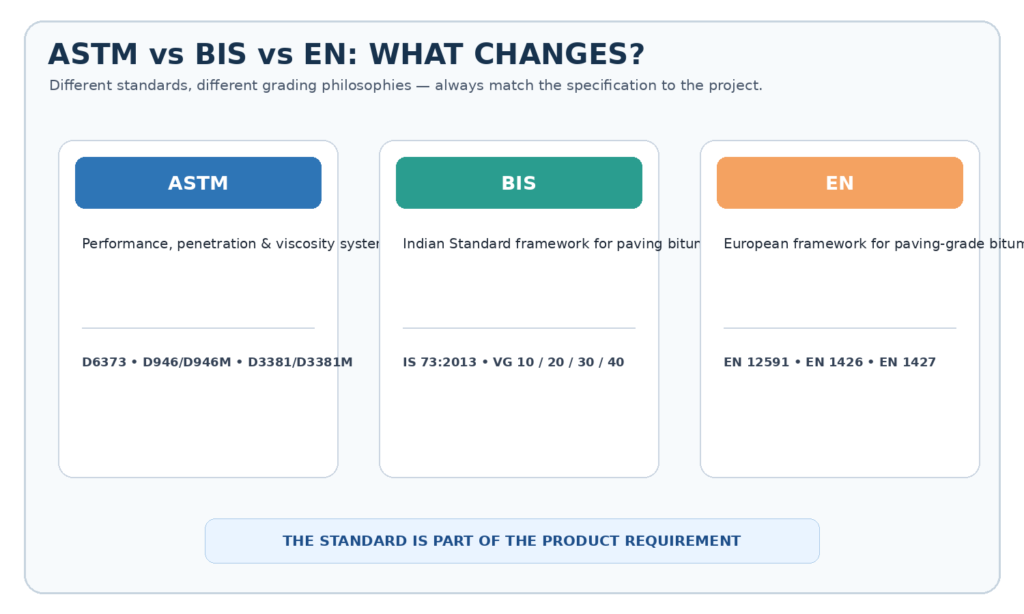
Alt text: Colour infographic comparing ASTM, BIS and EN bitumen standards, showing their grading approaches and examples of major paving-bitumen specifications.
Why Bitumen Standards Matter
Bitumen is a temperature-sensitive, viscoelastic material. Its consistency, viscosity and performance change as temperature changes. That means a product cannot be judged reliably just by appearance or by a generic description such as “paving bitumen.”
A standard creates a common technical language between the buyer, supplier, laboratory, engineer and contractor.
For example, ASTM D6373-23 covers performance-graded asphalt binders, with grade designations linked to pavement design temperatures. ASTM also separately lists penetration-graded and viscosity-graded specifications such as D946/D946M and D3381/D3381M. citeturn0search2turn0search5
BIS IS 73:2013, meanwhile, specifies paving bitumen and grades it by viscosity at 60°C. BIS documentation identifies VG10, VG20, VG30 and VG40 under this framework. citeturn0search36turn0search9
EN 12591 provides a European framework for paving-grade bitumens, including properties and associated test methods. Grades can be designated by penetration or viscosity ranges, depending on the applicable part of the specification. citeturn1search7turn1search0
ASTM Standards for Bitumen
ASTM International publishes a large family of standards covering asphalt binders, paving materials and test methods. The important point is that ASTM does not have one single “ASTM bitumen grade.” Different ASTM specifications use different grading approaches.
ASTM D6373: Performance-Graded Asphalt Binder
ASTM D6373-23 is the current active specification identified by ASTM for performance-graded asphalt binder. Its grades are tied to the average seven-day maximum pavement design temperature and minimum pavement design temperature. citeturn0search2
That makes PG grading fundamentally different from simply asking for a penetration number. The focus is on how the binder is expected to perform across the temperature range relevant to the pavement.
ASTM D6373 also allows modifiers to be used where they enhance asphalt binder performance, which is important for modified binders and higher-performance applications. citeturn0search10
ASTM D946/D946M: Penetration-Graded Asphalt Binder
ASTM D946/D946M is the ASTM specification for penetration-graded asphalt binder for pavement construction. ASTM’s standards catalogue lists the active D946/D946M-25a edition. citeturn0search5
Penetration grading classifies asphalt binder using penetration measured at 25°C. This approach is familiar in many international markets and is still used where the project specification calls for it.
ASTM D3381/D3381M: Viscosity-Graded Asphalt Binder
ASTM D3381/D3381M covers viscosity-graded asphalt binder for pavement construction. ASTM identifies this specification alongside D946 and D6373 as a distinct grading route. citeturn0search2turn0search5
The practical lesson is simple: if a tender says “ASTM,” you still need the exact ASTM specification and edition. ASTM D6373 is not interchangeable with D946 or D3381.
BIS Standards for Bitumen
BIS stands for the Bureau of Indian Standards. Its paving-bitumen framework is important to understand when a tender, supplier document or laboratory report specifically calls for an Indian Standard.
BIS IS 73:2013 is titled “Paving Bitumen — Specification.” The standard states that it prescribes requirements for various grades of paving-grade bitumen used as binders in pavement construction and grades the material by viscosity at 60°C. citeturn0search36
BIS records also show testing against IS 73 for VG10, VG20, VG30 and VG40 grades, with properties including penetration at 25°C, viscosity at 60°C or 135°C, softening point and solubility. citeturn0search1turn0search4
This is important for international buyers because “VG30” by itself is not enough information. The buyer should state the governing standard, edition and required test methods in the purchase specification.
Other BIS Road-Bitumen Standards
BIS publishes standards beyond conventional paving bitumen. Its road-construction standards list includes IS 217 for cutback bitumen, IS 3117 and IS 8887 for bitumen emulsions, IS 15462 for polymer-modified bitumen, and other specifications for modified and recycled-road materials. citeturn0search37
That means the standard should always match the product type. A conventional paving binder, PMB, cutback or emulsion should not be treated as though it belongs to one universal specification.
EN Standards for Bitumen
EN standards are European Standards. For paving-grade bitumen, EN 12591 is the key reference for conventional paving-grade bitumens.
BS EN 12591:2009 provides a framework for specifying properties and relevant test methods for bitumens suitable for construction and maintenance of roads, airfields and other paved areas, and includes requirements for evaluation of conformity. citeturn1search7
The EN framework includes penetration-graded ranges such as 20/30, 30/45, 40/60, 50/70, 70/100 and 100/150. The standard links these grades to tests such as EN 1426 for penetration and EN 1427 for softening point. citeturn1search0turn1search3
EN specifications also address durability and resistance to hardening, with EN 12607-1 used for the Rolling Thin Film Oven Test for relevant paving-grade binders. Other properties include flash point and solubility, depending on the grade and applicable table. citeturn1search2
ASTM vs BIS vs EN: What Is the Difference?
| Framework | Common paving-binder approach | Example specification | Typical grading language |
| ASTM | Performance, penetration or viscosity depending on specification | D6373 / D946 / D3381 | PG grades / penetration / viscosity |
| BIS | Viscosity grading for conventional paving bitumen | IS 73:2013 | VG10 / VG20 / VG30 / VG40 |
| EN | Penetration or viscosity ranges under EN 12591 | EN 12591 | 50/70 / 70/100 / 100/150 etc. |
The key point is that these systems measure related binder characteristics but organise them differently. A procurement document should therefore identify the exact standard rather than relying on a grade name alone.
What Tests Do These Standards Typically Look At?
Although the exact requirements depend on the standard and product type, several familiar properties appear repeatedly in bitumen specifications.
| Property | What it tells you | Why it matters |
| Penetration | Consistency of the binder at a specified temperature | Helps classify conventional penetration grades |
| Softening point | Temperature at which the binder reaches a defined softening condition | Useful for assessing elevated-temperature behaviour |
| Viscosity | Resistance to flow at a specified temperature | Important for handling, mixing and performance |
| Aging / hardening | How properties change after specified heat or aging treatment | Provides an indication of durability |
| Solubility | Fraction soluble in the specified solvent | Used as a quality / composition check |
| Flash point | Temperature associated with specified ignition behaviour | Important for handling and safety |
| Rheological properties | How the binder responds to temperature and loading | Central to performance-based specifications such as PG grading |
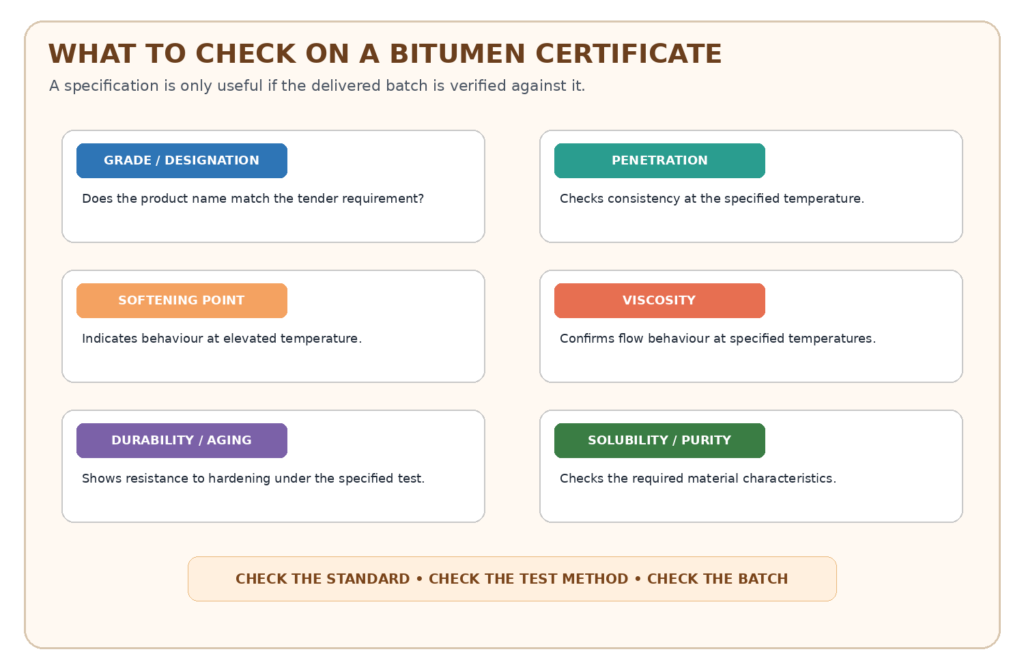
Alt text: Colour infographic listing key items to verify on a bitumen certificate of analysis, including grade, penetration, softening point, viscosity, durability, solubility and batch documentation.
Penetration Grade vs Viscosity Grade vs Performance Grade
Penetration Grade
Penetration grading uses the depth a standard needle penetrates the binder under specified conditions, commonly at 25°C. It is simple and widely recognised, but it does not by itself describe every aspect of pavement performance.
Viscosity Grade
Viscosity grading focuses on the binder’s resistance to flow at a specified temperature. BIS IS 73:2013, for example, grades paving bitumen by viscosity at 60°C. citeturn0search36
Performance Grade
Performance grading goes further by relating the binder designation to pavement temperature conditions. ASTM D6373-23 uses high and low pavement design temperatures as part of the grading framework. citeturn0search2
For modern high-traffic infrastructure, that performance-based approach can be useful because the binder is selected around the conditions it is expected to experience rather than around one laboratory consistency number.
Why You Should Not Convert Grades by Name Alone
This is one of the most important points for international procurement.
A buyer may see 60/70, VG30 and PG 64-22 and assume they are simply three ways of naming the same material. They are not.
They come from different grading systems and use different test philosophies. There may be practical correlations between certain grades for a particular application, but equivalence should be demonstrated against the actual project requirements and test data.
A tender should therefore say exactly what it requires — for example, a named ASTM, BIS or EN specification, edition, grade, test methods and acceptance limits.
How to Read a Bitumen Certificate of Analysis
A Certificate of Analysis, or COA, is one of the most useful documents a buyer receives with a shipment. It should allow the buyer to compare the delivered batch with the agreed specification.
1. Check the product name and grade. The designation should exactly match the purchase order.
2. Check the governing standard. Confirm the named ASTM, BIS or EN specification and edition where relevant.
3. Check test methods. The laboratory method should correspond to the required standard.
4. Compare actual results with limits. Do not look only at the grade name; check the reported values.
5. Check batch identification. The COA should be traceable to the supplied material.
6. Check laboratory and certification details. Confirm the testing source and documentation required by the contract.
What Should Be Written Into an International Bitumen Tender?
For projects sourcing bitumen internationally, a strong specification should remove ambiguity before the supplier quotes.
| Tender item | What to specify |
| Product | Exact binder type and intended application |
| Standard | ASTM / BIS / EN standard number and edition |
| Grade | Exact grade designation |
| Test methods | Required laboratory methods where not fully defined by the standard |
| Acceptance limits | Minimum / maximum values for required properties |
| Documentation | COA, batch traceability and any required conformity documentation |
| Sampling | Who samples, when, and according to which procedure |
| Inspection | Independent inspection or laboratory requirements if applicable |
| Packaging / bulk delivery | Tank, drum or other delivery requirements |
| Heating / handling | Required storage and delivery conditions |
Why the Latest Edition Matters
Standards change. Test methods are revised, specifications are updated, and older editions may be withdrawn or superseded.
ASTM’s current catalogue, for example, identifies D6373-23 as the active performance-graded binder specification and D946/D946M-25a as an active penetration-grade specification. citeturn0search2turn0search5
For BIS, the currently accessible IS 73 material is IS 73:2013, and BIS’s laboratory systems continue to reference it for VG grades. citeturn0search1
For EN, buyers should confirm the applicable national adoption and current status of the relevant European Standard before writing the tender. Do not copy an old technical specification into a new contract without checking its status.
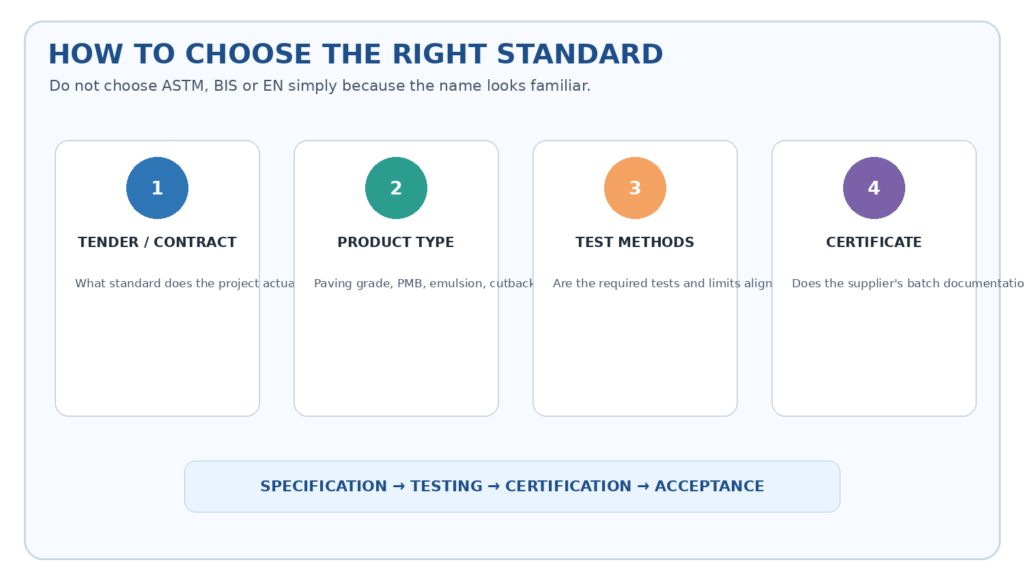
Alt text: Colour infographic showing a four-step process for choosing the correct bitumen standard: identify the tender requirement, product type, test methods and certificate of conformity.
ASTM, BIS or EN: Which One Should You Use?
The answer is usually straightforward: use the standard named by the project’s governing specification.
If the project is designed and tendered around ASTM requirements, the supplier should demonstrate ASTM conformity. If the contract requires an EN grade, the material should be documented and tested against the relevant EN requirements. If a project specifically requires BIS IS 73, that should be stated explicitly.
For international projects, engineers may also specify one system while accepting an alternative standard if equivalence is demonstrated. That should be a formal engineering and procurement decision, not an assumption made from a product name.
The safest approach is to agree the standard before the purchase order is issued and make the supplier’s COA part of the acceptance process.
Common Bitumen Standards Buyers Should Know
| Standard | What it covers | Useful when |
| ASTM D6373-23 | Performance-Graded Asphalt Binder | Performance-based binder selection |
| ASTM D946/D946M-25a | Penetration-Graded Asphalt Binder | Projects specifying penetration grades |
| ASTM D3381/D3381M | Viscosity-Graded Asphalt Binder | Projects using viscosity grading |
| BIS IS 73:2013 | Paving Bitumen — Specification | Projects explicitly requiring BIS paving bitumen |
| EN 12591 | Paving-grade bitumen specifications | European / EN-based paving specifications |
| EN 1426 | Penetration test method | Testing penetration under EN framework |
| EN 1427 | Softening point test method | Testing softening point under EN framework |
| EN 12607-1 | Resistance to hardening / RTFOT method | Durability / aging evaluation |
Frequently Asked Questions
Is ASTM the same as EN for bitumen? No. ASTM and EN are different standards systems. They can address similar binder properties but use different specifications, grades and test-method frameworks.
Is VG30 an ASTM grade? VG30 is associated with viscosity grading and is used under BIS IS 73:2013. It should not be treated as an ASTM grade simply because it describes a bitumen viscosity class.
What does 60/70 mean in bitumen? It is commonly a penetration-grade designation indicating a specified penetration range at 25°C. The exact governing standard must still be identified.
What does PG 64-22 mean? Under ASTM performance grading, the numbers relate to the high and low pavement design temperature framework. ASTM D6373-23 defines PG grading around these pavement temperatures.
Can EN 70/100 be treated as identical to ASTM 70/100? Do not assume that. Similar-looking designations can belong to different specifications. Check the exact standard, test methods and acceptance limits.
What should a bitumen COA include? At minimum, it should identify the product and grade, governing specification, batch and relevant test results required by the contract.
Does a supplier need to provide the standard itself? The supplier should provide evidence of conformity and test results required by the purchase specification. Buyers should obtain or reference the official standard when drafting contractual requirements.
The Bottom Line
ASTM, BIS and EN standards all exist to solve the same basic procurement problem: turning a complex material into a measurable, testable and repeatable specification. But they do it in different ways.
ASTM provides several routes, including penetration, viscosity and performance grading. BIS IS 73:2013 uses viscosity grading for conventional paving bitumen, with VG grades such as VG30 and VG40. EN 12591 provides a European framework for paving-grade bitumens using defined properties and test methods.
For an international infrastructure buyer, the most important rule is simple: never specify only a product name or grade. Specify the standard, edition, grade, test methods, acceptance limits and required documentation.
For procurement teams preparing a bitumen specification, Black Rock Bitumen’s Bitumen Grades & Standards for Infrastructure Tenders is a useful starting point. You can also compare Penetration Grade Bitumen, Performance Grade Bitumen, Polymer Modified Bitumen and Bitumen Emulsion based on the actual application. Once the grade is selected, review Bitumen Storage, Handling & Transport Standards and make sure the supplier’s COA, batch traceability and test results are aligned with the standard written into the contract.