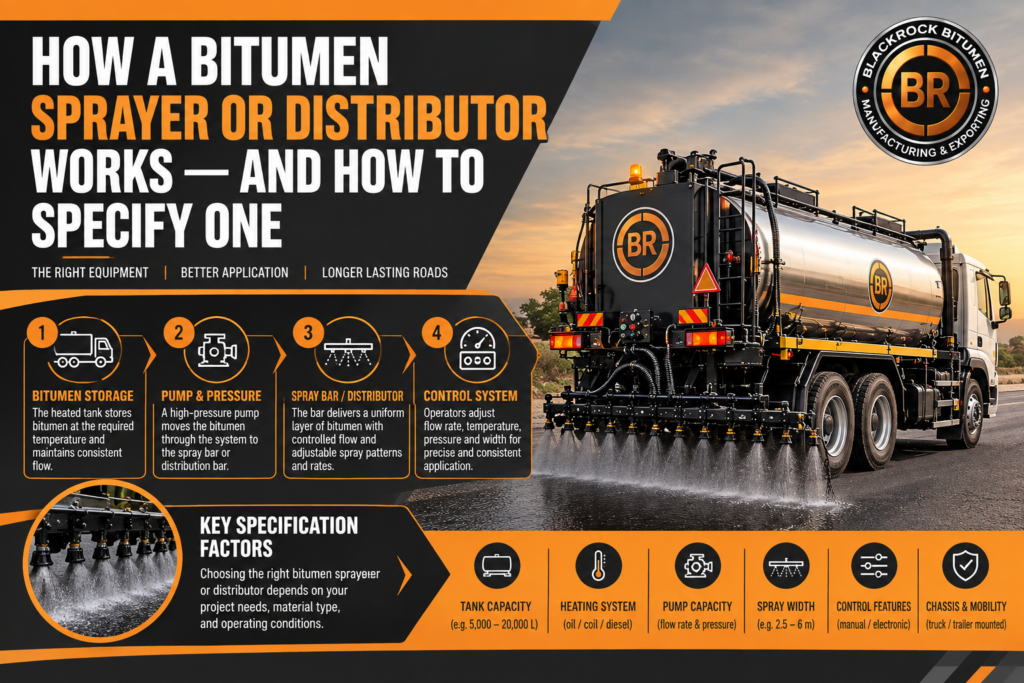
Black Rock Bitumen supplies the binders that go into sprayers and distributors across Africa, Asia and the Middle East, so we field a lot of questions from buyers weighing up a machine. A bitumen distributor works by holding binder in an insulated, heated tank, circulating it continuously with a pump, and metering it onto the road through a bar of fan-spray nozzles at a controlled rate. Everything else on the machine exists to keep that binder at the right temperature and to make sure the same amount lands on every square metre.
That sounds simple, and a distributor is conceptually simple. It is also, as the Texas Department of Transportation puts it in its seal coat manual, the most complex piece of equipment on a surface treatment job — because every one of its systems has to work at once for the shot to be right.
This guide is written for buyers and fleet owners: what each part does, what actually controls the application rate, and which specification lines decide whether a machine will suit your work. If you are comparing quotations for a distributor, the sections on spray bars, rate control and calibration are the ones that separate two machines that look identical on a brochure.
Key takeaway: a bitumen distributor is a heated tank, a pump, a filter and a spray bar working as one circulating loop. The application rate is set by pump output, forward speed and spray width — not by the tank. When buying, the spray bar, the rate controller and the calibration certificate matter more than tank size.
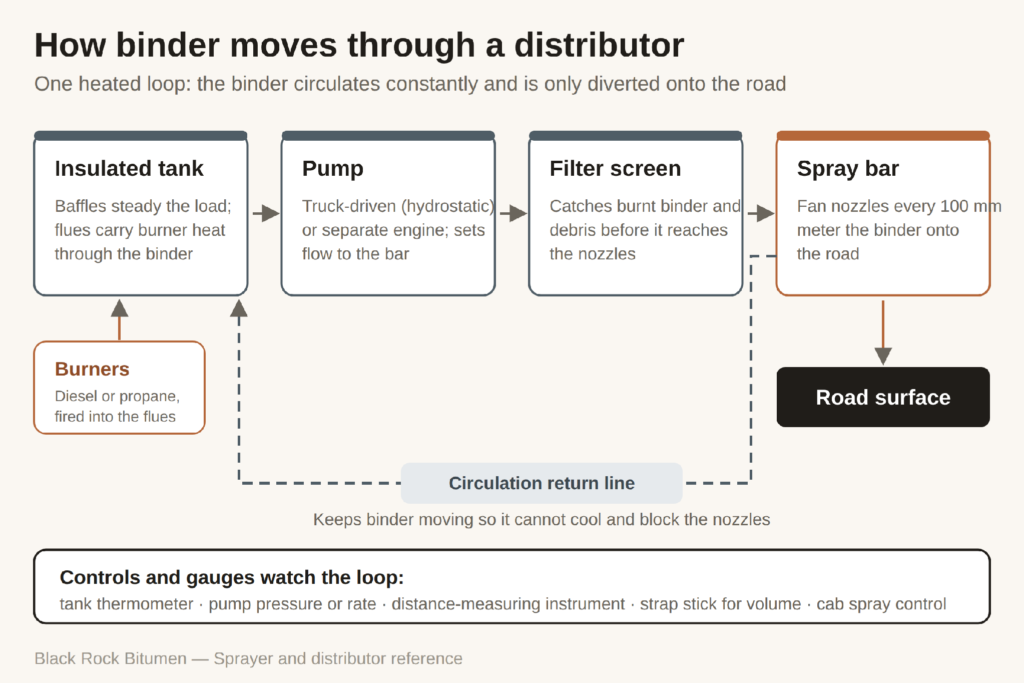
Alt text: Diagram of the binder path through a bitumen distributor. Binder is held in an insulated tank with baffles and flues heated by burners, drawn by a pump, passed through a filter screen, fed to the spray bar and sprayed onto the road through fan nozzles. Unused binder returns from the spray bar to the tank through a circulation line, and controls in the cab monitor temperature, pump rate, distance and volume.
Bitumen Sprayer or Bitumen Distributor: Is There a Difference?
In practice the two words describe the same machine, and suppliers use them interchangeably. “Bitumen distributor” is the common term in North America and in most AASHTO- and ASTM-based specifications. “Bitumen sprayer” is more common in Europe, the Gulf, South Asia and Africa. Note that the European standards for surface dressing work refer to “binder sprayers” rather than bitumen sprayers, so search EN 12272-1 on that term.
Where a distinction does exist, it is one of scale and mounting rather than principle:
| Term you may see | What it usually means |
|---|---|
| Bitumen distributor | A full-size truck- or trailer-mounted unit with a heated tank, pump and spray bar, typically 4,000–12,000 litres |
| Bitumen sprayer | The same machine, or a smaller self-propelled or towed unit used for patching and small areas |
| Hand lance or hand sprayer | A hose and wand fed from the same tank, for edges, kerbs and irregular shapes the bar cannot reach |
| Chip sealer or combination unit | A machine that sprays binder and spreads chippings in one pass |
The Six Systems Inside a Bitumen Distributor
1. The Insulated Tank
The tank holds the binder and keeps it workable. It is insulated, because binder cooling against the tank skin will stiffen to the point where it cannot be sprayed. Inside are two or three baffle plates, which stop the load surging when the truck moves — important when a constant spray pressure is needed — and one or two flues running the length of the tank, which carry burner heat into the middle of the load rather than only at the surface.
Tank sizes vary widely. TxDOT notes that distributors used for most seal coat work hold roughly 1,000 to 2,000 US gallons (about 3,800 to 7,600 litres), which is adequate for most jobs. Bigger is not automatically better: a tank you cannot empty in a working day leaves binder circulating and re-heating overnight.
2. The Heating System
One or two diesel- or propane-fired burners sit at the rear of the tank, firing into the flues. They must be able to run independently or together, and the flame must be adjustable. Heating is not about reaching one fixed temperature; it is about holding the binder within the spraying window for whatever material is in the tank.
Temperature is also a safety boundary. Cutbacks contain solvent and should be sprayed below their flash point — TxDOT puts the margin at 25–50 °F (about 14–28 °C) below the flash point of the grade in the tank. And if water has been left in the tank — after a water calibration run, for example — adding hot binder will flash it to steam. TxDOT warns that this can cause an explosion or send binder out through the manhole.
3. The Pump and Circulation System
The pump is what makes the machine work. It is driven either by a separate engine at the rear or by the truck engine through a hydrostatic drive. Besides pushing binder to the spray bar, it circulates binder within the tank so it neither burns against the flues nor cools against the skin, circulates binder through the spray bar and back so the nozzles cannot block, and pumps binder in and out of the unit when loading or returning material.
That constant circulation is the single idea that explains most of the machine’s plumbing. Binder is always moving in a loop; spraying simply diverts part of that loop onto the road.
4. Filter Screens
Most distributors carry wire-mesh filters in the line between tank and spray bar, catching burnt binder and debris before they reach the nozzles — worth confirming as a specification line rather than assuming. They need cleaning periodically on a long job, because a partly blocked filter starves the bar of pressure and shows up as an uneven shot.
5. The Spray Bar and Nozzles
The spray bar is where the application rate is actually delivered. Nozzles are spaced every 100 mm (4 in) along the bar, each producing a fan-shaped rather than circular spray, and the bar carries a return line so binder keeps circulating through it. Bars are hinged so the ends fold for travel, and are commonly 3.7 m (12 ft) wide — one traffic lane — with 3.0 to 4.3 m (10 to 14 ft) the usual recommended range. Nozzles are usually brass and are easily damaged, which is why spares matter.
6. Controls and Gauges
A distributor has to prove what it sprayed, so it carries a thermometer (reading from below about 38 °C / 100 °F to at least 204 °C / 400 °F), a volume gauge, a calibrated dipstick known as a strap stick, a pump pressure or rate gauge, a distance-measuring instrument — TxDOT’s term is digital-measuring instrument, or DMI — and a spray on/off control the operator can hit instantly. TxDOT specifies a DMI calibrated to within ±6 feet per mile, about ±1.1 m per kilometre, and treats the strap stick, not the volume gauge, as the basis for measurement and payment.
Whether the machine is computerised matters commercially, not just technically. A computerised distributor can be run by one person, while a manually operated one needs two: a driver holding line and speed, and a spray operator working the valve and pump.
How the Spray Bar Controls Uniformity
Two settings decide whether the binder lands evenly: the angle of the nozzles and the height of the bar.
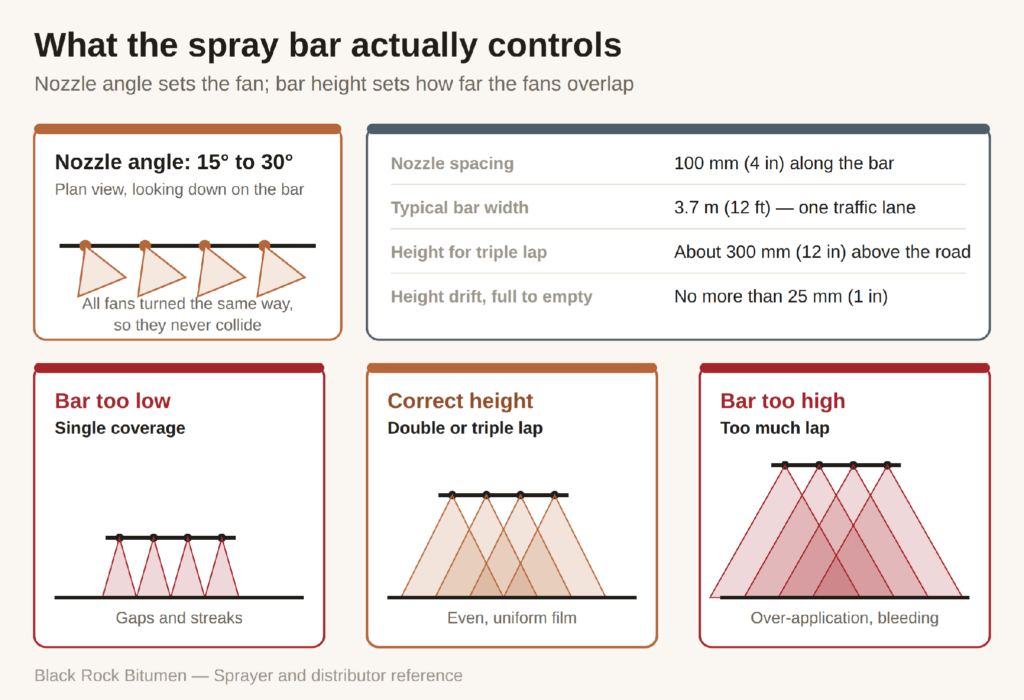
Alt text: Diagram of spray bar geometry. Nozzles sit every 100 mm along the bar and are set at the same 15 to 30 degree angle to the bar axis. Bar height sets fan overlap: too low gives single coverage and streaking, the correct height gives double or triple coverage where every point of road receives spray from two or three nozzles, and too high over-applies binder at the laps.
Nozzle Angle
Each nozzle is turned slightly relative to the bar so that its fan does not collide with the fan beside it. Industry guidance and TxDOT both put this angle at 15° to 30° from the axis of the spray bar, depending on the manufacturer, and every nozzle must be set to the same angle. Distributors should come with a setting tool for exactly this. Get it wrong and the fans interfere, distorting the pattern.
Bar Height and Overlap
Bar height sets how wide each fan has spread by the time it reaches the road, and therefore how many fans overlap at any given point. The target is “double lap” or “triple lap”: every point of the surface receives spray from exactly two or three nozzles. TxDOT gives about 300 mm (12 in) as the height for triple lap coverage. Double lap is acceptable on some applications, but triple lap is the TxDOT target.
| Bar height | Coverage | What you see on the road |
|---|---|---|
| Too low | Single lap or gaps | Streaking — visible longitudinal stripes of heavier and lighter binder |
| Correct | Double or triple lap | An even, uniform film across the full width |
| Too high | Excessive lap | Over-application, which can bleed or flush under traffic |
There is a mechanical consequence here that buyers should ask about directly. As the tank empties, the truck gets lighter and standard springs push the bar upwards, so the shot that started at triple lap ends at something wider. Good distributors prevent this, often with compressed-air stabilisation. TxDOT’s check is simple: measure bar height with the tank empty, then measure it again when the tank is full, and if the difference is more than about 25 mm (1 in), something needs fixing.
What Actually Sets the Application Rate?
Three variables, and only three: how much binder the pump delivers, how fast the truck is travelling, and how wide a strip is being sprayed.
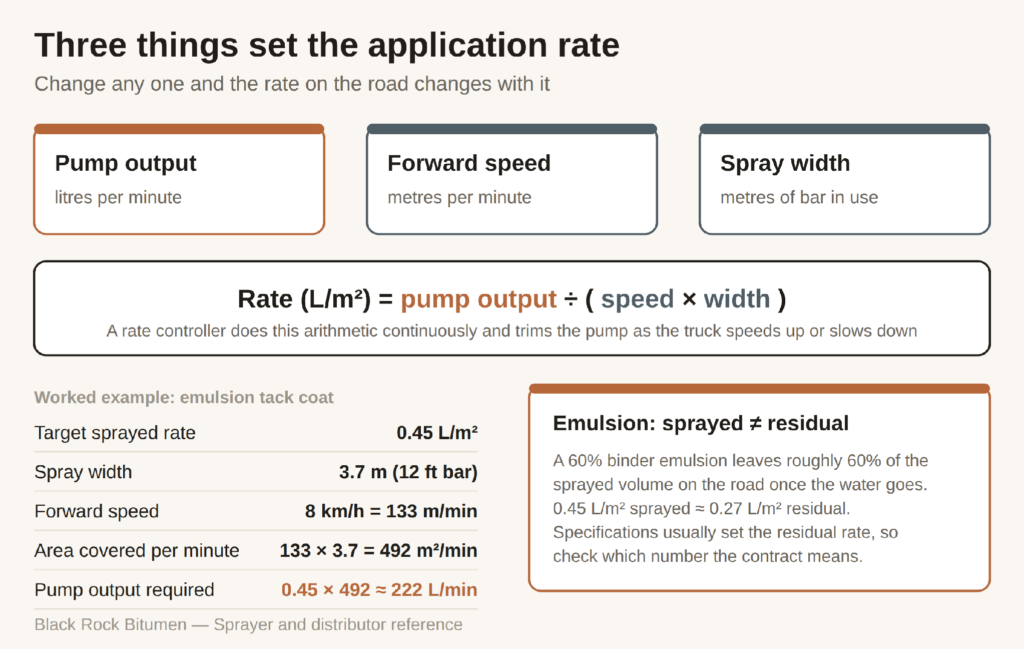
Alt text: The spray rate equation: application rate in litres per square metre equals pump output in litres per minute divided by forward speed in metres per minute multiplied by spray width in metres. A worked example applies a 0.45 litre per square metre tack coat over a 3.7 metre bar at 8 kilometres per hour, which needs a pump output of about 222 litres per minute. For emulsions, an undiluted emulsion is sprayed at roughly 1.5 to 1.8 times the required residual rate, and an emulsion diluted 1:1 with water at roughly three times.
On a computerised machine, the operator sets the target rate and the controller manages the pump against measured speed and the number of nozzles open. On a manual machine, the operator works from a manufacturer’s chart that converts pump pressure or speed into litres per minute, and the driver holds a fixed engine speed. Either way, the arithmetic is the same.
Pump pressure has its own window. Too low and the binder streaks; too high and it atomises, distorting the pattern — a problem that gets worse in wind. The practical rule from TxDOT is to run at the highest pressure that does not atomise the binder, determined by field test.
Sprayed Rate vs Residual Rate
For emulsions, this distinction causes more disputes than anything else on site. An emulsion is binder dispersed in water, so only part of what you spray stays on the road. Residue by distillation for common tack grades runs about 55 to 65 per cent, so an undiluted emulsion has to be sprayed at roughly 1.5 to 1.8 times the required residual rate, and an emulsion diluted 1:1 with water at roughly three times. Confirm the residue figure for the grade you are actually buying from the supplier’s data sheet. This is the basis on which the Asphalt Institute sets its tack coat guidance. Caltrans works the same way: it calculates minimum tack coat spray rates by dividing the required residual rate by the residue by distillation for the specific grade — 55 per cent for RS-1, 57 per cent for SS-1h, higher for other grades — which is exactly the arithmetic a contractor has to be able to reproduce.
Before quoting a rate to a client or accepting one from a specification, confirm which number is meant. A tack coat specified at 0.20 L/m² residual is not the same instruction as 0.20 L/m² sprayed.
Typical Application Rates
Rates always come from the project specification, but these ranges give a sense of the work a distributor has to cover:
| Application | Typical rate | Source |
|---|---|---|
| Tack coat, residual | 0.14–0.23 L/m² (0.03–0.05 gal/yd²) | Asphalt Institute tack coat guidance; NAPA QIP-128 |
| Tack coat, sprayed (emulsion diluted 1:1) | 0.45–0.68 L/m² (0.10–0.15 gal/yd²) — about 3× the residual rate | Asphalt Institute tack coat guidance; NAPA QIP-128 |
| Tack coat, rate of spray (cationic emulsion) | 0.20–0.35 kg/m², depending on the surface | IRC:16-2008 (Second Revision), Table 2; MORTH Table 500-5 |
| Tack coat, rate of spray (VG-10 bitumen) | 0.30–0.50 kg/m², depending on the surface | IRC:16-2008 (Second Revision), Table 2; MORTH Table 500-5 |
| Prime coat, rate of spray | 0.6–1.0 kg/m², higher on more porous bases | IRC:16-2008 (Second Revision); MORTH Table 500-3 |
Rates by mass and by volume are not interchangeable; convert using the binder’s density at the measurement temperature. Indian practice is summarised in IRC 16:2008 (Second Revision), which remains the current edition in the IRC publications catalogue, with the corresponding contract rates in MORTH Tables 500-3 and 500-5. The code permits both cationic emulsion and medium-curing cutback as a primer, and RC-70 for tack coat in cold conditions, though emulsion is now the default in most state practice.
What Goes in the Tank Changes How the Machine Must Be Set Up
A distributor is not material-agnostic. The binder decides the temperature the heating system has to hold, how hard the pump has to work, and in some cases whether the tank can be used at all without cleaning first.
| Material | Typical spray temperature | What it means for the machine |
|---|---|---|
| Bitumen emulsion | 50–70 °C (120–160 °F) | Little or no heating; never overheat, or the emulsion breaks in the tank |
| Hot penetration-grade or PG binder | 135–190 °C (275–375 °F) | Full burner capacity, insulation and hot-handling procedures |
| Cutback bitumen | 50–135 °C (125–275 °F) | Spray 14–28 °C (25–50 °F) below flash point; solvent vapour is a fire risk |
| Polymer-modified bitumen | Per supplier’s data sheet | Higher viscosity; check pump capacity and circulation at temperature |
Those temperature bands come from TxDOT’s seal coat manual; always use the binder supplier’s own figures for the grade in the tank. Emulsions are the most common material in spray applications because they need the least heat: Black Rock Bitumen supplies cationic rapid-setting grades — designated CRS-1 and CRS-2 in ASTM D2397, and supplied in this region as CRS-60 and CRS-70 (nominal 60 and 70 per cent residue) — for surface dressing and tack coats, and slow-setting grades such as CSS-1H for prime coats and slurry work. The full bitumen emulsion range sets out which grade suits which application.
For hot-sprayed work, the binder grade is a separate decision from the equipment: see our penetration grade and performance grade ranges, our guide to choosing a grade for your climate, and, if the tender specifies a PG binder, our Superpave PG grading guide.
One operational warning worth writing into your procedures: never mix binder types in a tank without cleaning it. Loading a fresh material on top of a residue of a different type can cause a physical or chemical reaction, and at minimum it contaminates the load.
How to Specify a Bitumen Distributor
Most buyers compare tank capacity and price, because those are the two numbers on the front of every brochure. The specification lines that actually determine whether the machine does good work sit further down.
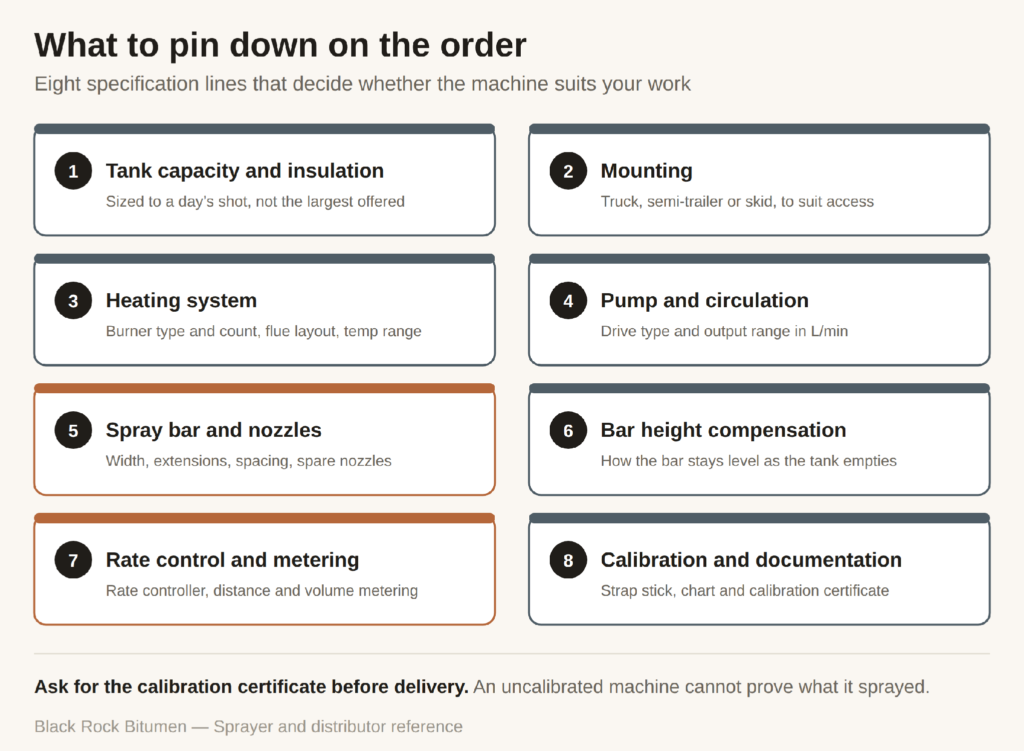
Alt text: Buyer’s specification checklist for a bitumen distributor, covering tank capacity and insulation, mounting, heating system, pump and circulation, spray bar width and nozzles, bar height compensation, rate control and metering, and calibration certification.
| Specification line | What to ask the supplier | Why it matters |
|---|---|---|
| Tank capacity | Working capacity in litres, and insulation type and thickness | Size it to a day’s shot; oversized tanks mean binder held hot too long |
| Mounting | Truck, semi-trailer or skid-mounted | Decides manoeuvrability, road-legal weight and how it is refilled |
| Heating | Burner fuel, number of burners, flue arrangement, controls | Sets whether you can hold hot binder as well as emulsion |
| Pump | Drive type and output range in L/min at working viscosity | A pump rated on water may not deliver on a viscous modified binder |
| Spray bar | Width, extension options, nozzle spacing, spare nozzle sizes | Determines the widths you can shoot and the rates you can hit |
| Bar height control | How bar height is held constant as the tank empties | The most common cause of streaking in service |
| Rate control | Computerised rate controller, distance measurement, metering | Decides whether one operator or two are needed, and how repeatable the rate is |
| Hand lance | Included, with hose length and circulation | Needed for edges, kerbs and irregular areas |
| Documentation | Strap stick and chart, calibration certificate, manuals | Without these you cannot prove or defend an application rate |
Two questions are worth asking every supplier, because the answers tend to be revealing. First, what pump output does the machine deliver at the viscosity of the binder I will actually spray, not at water viscosity? Second, what is the procedure and interval for re-calibrating the bar, and who does it?
Calibration: What Makes a Distributor’s Rate Defensible
A distributor that has not been calibrated cannot prove what it put on the road, which matters as much for payment as for quality.
| Check | Method | Typical frequency |
|---|---|---|
| Tank capacity and strap stick | Verified measurement of the tank and its measuring stick (TxDOT Tex-922-K Part I) | On purchase, and after any tank modification |
| Individual nozzle output | Bucket test: a container under every nozzle, sprayed simultaneously, contents weighed (TxDOT Tex-922-K Part III) | Before a major job, and when a pattern problem appears |
| Transverse and longitudinal rate | Absorbent mats or trays weighed before and after a pass — the same method as the bucket test, TxDOT Tex-922-K Part III | Annually at minimum; TxDOT Item 316 requires a test report under one year old |
| Spray pattern check | Short test strip, or paper laid under the bar for a brief shot | At the start of a job and after any nozzle change |
Two published methods cover the rate check. In ASTM-based practice, ASTM D2995-23 (the active edition, approved in 2023, superseding D2995-14) sets out how to estimate the transverse and longitudinal application rate — and, for emulsions, the residual application rate — of bituminous distributors. In European practice, EN 12272-1 specifies test methods for the rate and accuracy of spread of binder and chippings in surface dressing, and its 2025 edition extends explicitly to sprayed emulsions used as bond coats.
TxDOT Item 316 requires a distributor test report less than one year old, and owner agencies increasingly require a valid certificate of calibration with each project. On the nozzle bucket test, TxDOT’s surface treatment specification allows no more than 10 percent variation in the contents collected between nozzles.
What Goes Wrong, and What It Usually Means
| Symptom | Likely cause | First checks |
|---|---|---|
| Longitudinal streaks | Bar too low, worn or blocked nozzles, or pump pressure too low | Nozzle condition and angle, bar height, filter screens |
| Heavier binder at the laps | Bar too high, or bar risen as the tank emptied | Bar height full versus empty; height compensation system |
| Distorted or misted pattern | Nozzles at different angles, or pump pressure high enough to atomise | Reset all nozzles with the angle tool; re-test pump pressure |
| Rate drifts during a shot | Speed not held, or rate controller not compensating | Distance-measuring instrument calibration; engine speed discipline |
| Heavy binder line at the edge | End nozzle turned perpendicular to sharpen the edge | Fit a proper deflector nozzle instead |
| Blocked nozzles mid-job | Binder cooling in the bar, or dirty filter screens | Circulation through the bar; clean the screens |
| Binder sprayed but rate reads low | Reading the volume gauge instead of the strap stick | Measure with the strap stick; treat the gauge as indicative only |
Buyer Checklist Before Ordering a Distributor
- Define the work first: which binders, which applications, and what shot length in a typical day.
- Size the tank to that day’s work, not to the largest option offered.
- Confirm the spray bar width and extension options match the lane widths you shoot.
- Ask for pump output in L/min at the viscosity of your actual binder.
- Confirm how bar height stays constant between a full and an empty tank.
- Specify the rate controller, distance-measuring instrument and metering, and confirm one-person operation if that is the plan.
- Ask which nozzle sizes are supplied and which spares are stocked locally.
- Require the strap stick, conversion chart, calibration certificate and operating manuals as part of the delivery.
- Agree the calibration interval and who performs it before the machine arrives.
- Check that heating capacity covers the hottest binder you intend to spray, not just emulsion.
Frequently Asked Questions
How does a bitumen distributor work? It holds binder in an insulated, heated tank, circulates it continuously with a pump, filters it, and meters it onto the road through a bar of fan-spray nozzles. The application rate is controlled by pump output, forward speed and spray width.
What is the difference between a bitumen sprayer and a bitumen distributor? In most cases, none — they are two names for the same machine, with “distributor” more common in North American specifications and “sprayer” more common in Europe, the Gulf and South Asia. Some suppliers reserve “sprayer” for smaller towed or self-propelled units.
What controls the spray rate on a bitumen distributor? Pump output, forward speed and the width of bar in use. The rate in litres per square metre equals pump output in litres per minute divided by speed in metres per minute times spray width in metres.
What height should the spray bar be set at? At the height the manufacturer specifies for the required overlap. TxDOT gives about 300 mm (12 in) for triple lap coverage, and the height should not change by more than about 25 mm (1 in) between a full and an empty tank.
Why is my distributor leaving streaks? Streaking usually means the fans are not overlapping properly: a bar set too low, nozzles at inconsistent angles, worn or blocked nozzles, or pump pressure too low to form a proper fan.
What angle should the spray nozzles be set at? Between 15° and 30° to the axis of the spray bar, depending on the manufacturer, with every nozzle set identically so the fans do not interfere with each other.
How often should a bitumen distributor be calibrated? At least annually — TxDOT Item 316, for example, requires a distributor test report less than one year old, and many owner agencies now require a valid calibration certificate for each project. ASTM D2995-23 and EN 12272-1 set out the methods for checking application rate; in TxDOT practice the procedures are Tex-922-K Part I (tank and strap stick) and Part III (nozzle output and transverse distribution).
At what temperature is bitumen sprayed? It depends on the binder. Emulsions are typically sprayed at around 50–70 °C, hot penetration or PG binders at roughly 135–190 °C, and cutbacks between about 50 °C and 135 °C, always 14–28 °C (25–50 °F) below the flash point of the grade. Follow the supplier’s data sheet for the grade in the tank.
What size tank do I need? Enough to cover a typical day’s shot without a mid-day refill you cannot service, and no more. Binder held hot in an oversized tank ages unnecessarily, and a bigger tank raises axle loads and reduces manoeuvrability.
Can the same distributor spray emulsion and hot bitumen? Many can, provided the heating system and pump suit both and the tank is cleaned between material types. Never load one binder type onto the residue of another without cleaning.
The Bottom Line
A bitumen distributor is a circulating loop with a tank at one end and a spray bar at the other. Understanding it that way makes the buying decision clearer: the tank stores and heats, but the spray bar, the pump and the rate controller decide whether the binder lands where and at the rate the specification requires.
When you compare machines, compare those three, plus the documentation that lets you prove the rate afterwards. And remember that the best distributor on the market cannot fix the wrong binder in the tank — the grade, the standard it is tested against and the batch certificate still have to be right.
To discuss emulsion or hot binder supply for sprayed work, contact Black Rock Bitumen.