Two suppliers quote a polymer-modified bitumen with the same polymer content, at prices that differ by a wide margin. What is the difference?
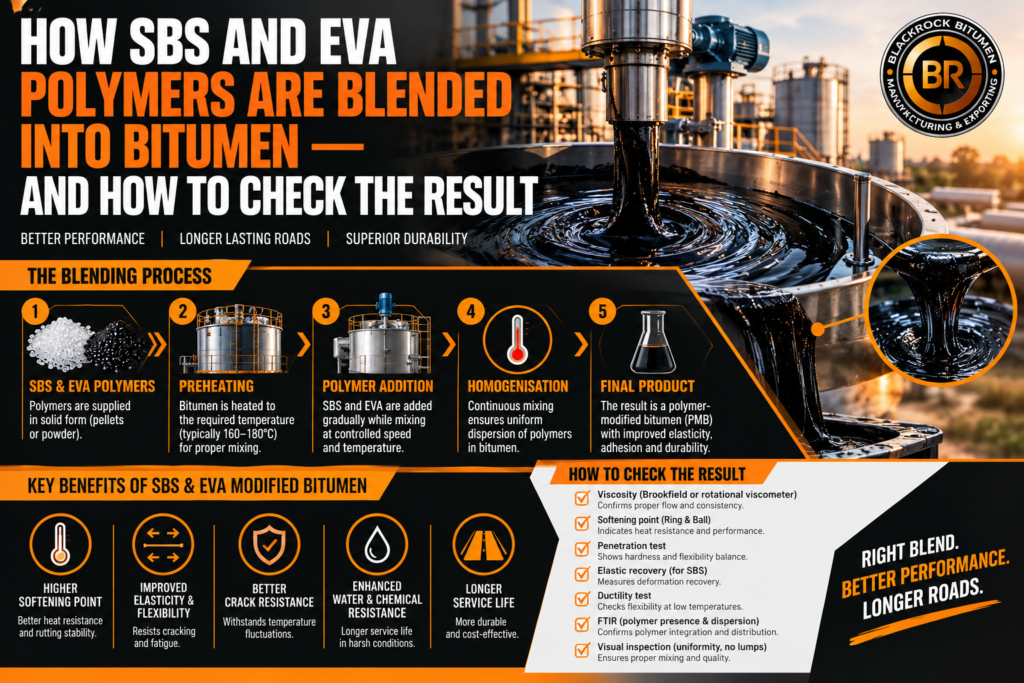
Usually it is the blending. PMB is not made by stirring polymer into a tank of bitumen. SBS and EVA are dispersed under high shear at around 170 to 190 °C, then held in an agitated tank for hours while the polymer swells and develops its structure. Skip or shorten either step and you get a product that can still pass a penetration test and still separate in your storage tank two days later.
Black Rock Bitumen supplies polymer-modified bitumen alongside conventional grades, and this is the question buyers ask us most often when comparing offers. This guide explains how the blending is done, what SBS and EVA each contribute, and — the part that matters commercially — which results on a certificate of analysis actually show whether the blending was done properly.
Key takeaway: polymer content is an input, not a result. What you are buying is the morphology the blending produced: a polymer network dispersed through the binder. The two certificate results that reveal it are storage stability by the tube test (EN 13399 or ASTM D7173) and elastic recovery (EN 13398). Under EN 14023 the storage stability limit is declared as a class rather than fixed by the standard, and 5 °C is the figure most often specified.
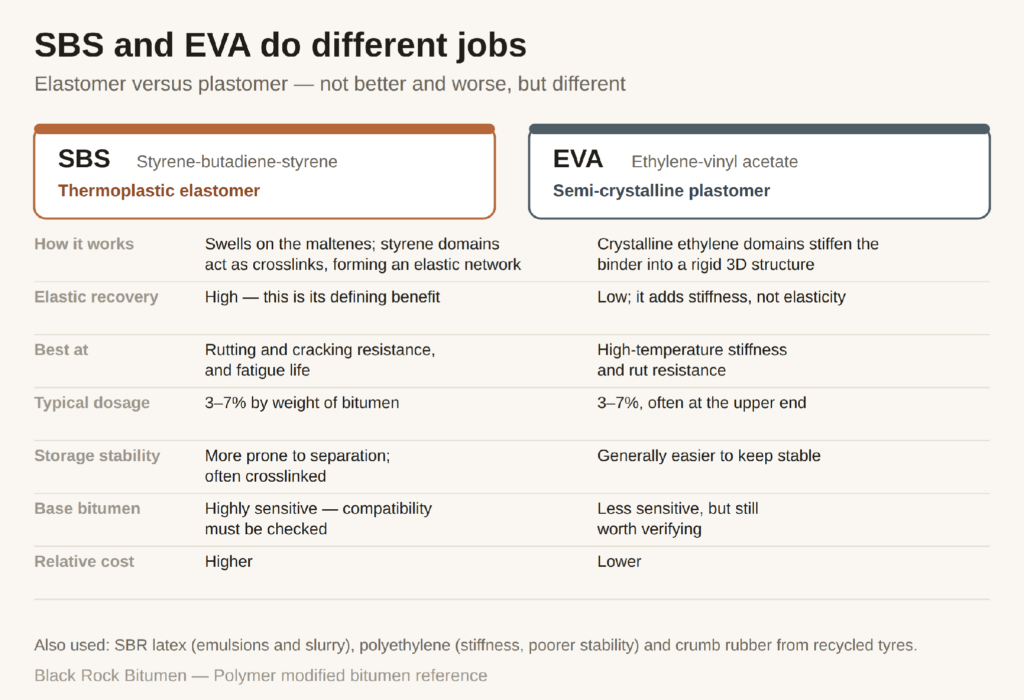
Figure 1. What the blending has to achieve, seen as producers see it under a fluorescence microscope. Research using this technique has shown that low polymer contents give dispersed particles, while higher contents in a compatible base bitumen produce a continuous polymer phase (Lu and Isacsson, Materials and Structures, 1997).
Alt text: Three polymer dispersion states in modified bitumen: poor, fine and a continuous network.
Why Bitumen Needs a Polymer at All
Unmodified bitumen has one temperature range in which it performs well, and the range is narrower than many projects need. Make it hard enough to resist rutting in a Gulf summer and it becomes brittle on a cold night. Make it soft enough to stay flexible and it deforms under slow, heavy traffic.
A polymer widens that window. Adding 3 to 7 per cent of the right polymer, properly dispersed, gives a binder that is stiffer at high service temperatures and more flexible at low ones than the base bitumen it was made from. That is the whole commercial case for PMB, and it is why the material is specified for freight corridors, intersections, airfields and hot-climate highways.
Modifiers fall into two families. Elastomers such as SBS and SBR add elasticity and strain recovery, improving fatigue and cracking resistance. Plastomers such as EVA and polyethylene increase stiffness through semi-crystalline structures, improving rutting resistance but contributing little elasticity. Which family you need depends on the failure mode the project is trying to avoid.
How SBS Works Inside Bitumen
SBS stands for styrene-butadiene-styrene, a triblock copolymer with hard polystyrene end blocks and a soft, rubbery polybutadiene middle block. It is supplied as pellets or crumb in linear or radial (branched) forms.
Two things happen when it meets hot bitumen. First, the polybutadiene absorbs the lighter oily fractions of the bitumen — the maltenes — and the polymer swells, often to several times its original volume. Second, the polystyrene end blocks cluster together into rigid domains that act as physical crosslinks, tying the swollen rubber into a continuous three-dimensional network through the binder.
That network is the product. It is what gives a PMB its elastic recovery: the ability to deform under a wheel and spring back rather than staying deformed. Fluorescence microscopy shows the difference directly. In a classic study of compatibility and storage stability, Lu and Isacsson found that a small polymer addition left dispersed polymer particles, while at higher contents — depending on the base bitumen — a continuous SBS phase formed (Materials and Structures, 1997).
The practical consequence for a buyer is this: the same 5 per cent SBS can produce a network or fail to, depending on the base bitumen, the shear applied and the curing time. Polymer content is not the specification. The network is.
Why the Base Bitumen Matters as Much as the Polymer
SBS does not blend equally well with every bitumen. The same 1997 work found that binders made from bitumens with a higher aromatic content showed better compatibility and higher storage stability, while an increase in asphaltenes worked against stability. More recent research reached the same conclusion from the other direction: a correlation study across six different bitumens found that the amount of polymer swelling was governed by the saturate content of the base bitumen, and that polymer distribution and storage stability both tracked the SARA fractions (Wieser, Schaur and Unterberger, Materials, 2021).
This is why a competent PMB producer does not simply buy the cheapest base bitumen available. It is also why a PMB that performed well from one supplier may behave differently from another, even at the same nominal grade. If you are specifying a PMB for an unfamiliar climate or application, our guides to bitumen grade selection and performance grading cover how the target properties are defined before the polymer question arises.
How EVA Works, and How It Differs
EVA is ethylene-vinyl acetate, a semi-crystalline copolymer. The vinyl acetate content — typically somewhere between about 10 and 30 per cent for paving applications — controls how crystalline the polymer is, and therefore how it behaves in bitumen.
EVA does not form an elastic network the way SBS does. Instead, its crystalline ethylene domains create a rigid three-dimensional structure through physical crosslinking as the blend cools, stiffening the binder. The result is strong high-temperature performance with much less elastic recovery.
Laboratory ranking of the two bears this out. Comparing SBS- and EVA-modified binders using the MSCR and linear amplitude sweep tests, Saboo and colleagues found that the EVA-modified binder performed well at high temperatures, with the lowest non-recoverable creep compliance, but was highly strain-susceptible at intermediate temperatures, while the SBS-modified binder performed well in both rutting and fatigue (Journal of Materials in Civil Engineering, 2018).
That trade-off is the whole story. EVA is generally more compatible with bitumen than polyethylene, easier to keep stable in storage, and cheaper than SBS. What it does not give you is the elastic response that matters for fatigue and cracking resistance.
Figure 2. Elastomer against plastomer. Laboratory ranking of the two supports the split: EVA performed well at high temperature but was strain-susceptible at intermediate temperatures, while SBS performed well for both rutting and fatigue (Saboo and others, Journal of Materials in Civil Engineering, 2018).
Alt text: Comparison of SBS and EVA as bitumen modifiers across seven properties.
Some producers blend both, aiming for the elasticity of the elastomer and the high-temperature stiffness of the plastomer at a lower total cost. If you are offered a hybrid PMB, the certificate checks later in this article apply in exactly the same way.
| Property | SBS | EVA |
|---|---|---|
| Family | Thermoplastic elastomer | Semi-crystalline plastomer |
| Mechanism in bitumen | Swells on maltenes; styrene domains form physical crosslinks into an elastic network | Crystalline ethylene domains form a rigid structure on cooling |
| Main benefit | Elastic recovery, fatigue and cracking resistance, rutting resistance | High-temperature stiffness and rutting resistance |
| Elastic recovery | High | Low |
| Storage stability | More prone to separation; often crosslinked to stabilise | Generally easier to keep stable |
| Sensitivity to base bitumen | High — compatibility must be verified | Lower, but still worth verifying |
| Relative cost | Higher | Lower |
How the Blending Is Actually Done
A PMB plant is, in essence, a heated tank, a high-shear mill and a circulation loop. The sequence below is the one most producers follow, whether at refinery scale or in a dedicated blending unit.
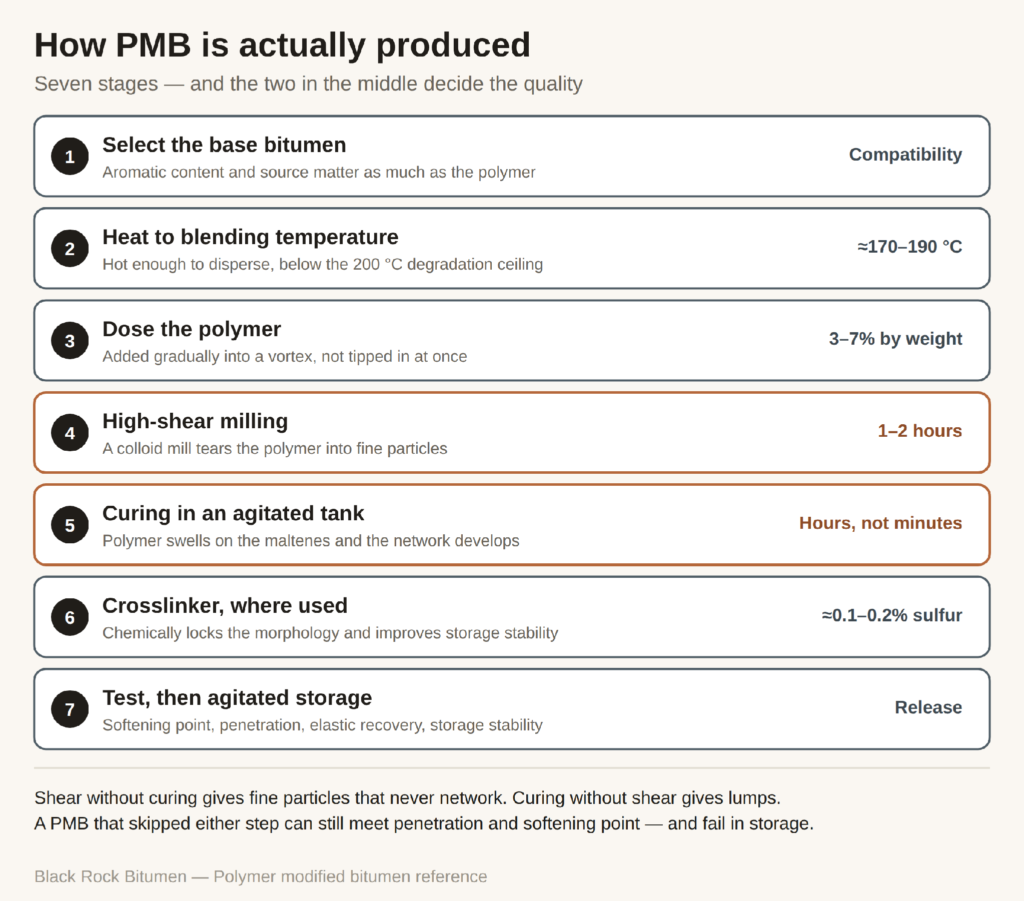
Figure 3. The production sequence. Stages four and five — shearing and curing — are the ones that decide whether the polymer forms a network. Times and temperatures shown are indicative; each plant sets its own from its mill and recirculation rate.
Alt text: The seven stages of polymer-modified bitumen production, from base bitumen to agitated storage.
1. Select a Compatible Base Bitumen
The producer starts from a base grade — often a softer penetration grade, because the polymer will stiffen it — chosen for compatibility with the polymer as well as for its own properties. This decision is made before any polymer is bought.
2. Heat to Blending Temperature
Typical blending temperatures sit around 170 to 190 °C. The blend must be fluid enough to shear but stay below the point where the bitumen oxidises or the polymer itself degrades; bitumen should not be taken above 200 °C during preparation, and excessive shear temperature or duration can degrade the very network the process is trying to build.
3. Dose the Polymer
Polymer is added gradually into a vortex rather than tipped in, typically at 3 to 7 per cent by weight of bitumen. Dosing too fast produces agglomerates that the mill then has to break up, which costs time and shear energy.
4. High-Shear Milling
A colloid mill or high-shear mixer tears the polymer into fine particles and disperses them through the binder. Laboratory procedures commonly run high-shear mixing for one to two hours at several thousand rpm at 180 to 185 °C, and studies of dispersion and swelling use exactly this kind of set-up (Polymers, 2019). Production is different in form but not in principle: the blend recirculates through the mill rather than passing once, and the timings are set by the plant’s own mill and recirculation rate. Laboratory mixing times are not a contractual benchmark — asking a producer to guarantee “two hours of shear” tells you nothing useful about the result.
5. Curing, or Digestion
This is the step buyers rarely hear about and the one that most affects quality. After milling, the blend is held in an agitated tank — commonly for several hours — while the polymer continues to absorb maltenes and swell, and the network develops. Shear disperses; curing builds structure. A blend that was milled but not cured contains fine polymer particles that never joined up.
6. Crosslinking, Where Used
Many producers add a small quantity of sulfur or a sulfur donor at a lower temperature after milling, forming chemical crosslinks between polymer chains and reactive species in the bitumen and locking the morphology in place. Typical doses are in the region of 0.1 to 0.2 per cent, but this varies by system — proprietary crosslinkers and reactive additive packages work at their own dose rates. Over-crosslinking can make the binder brittle, so it is a controlled addition rather than an insurance policy.
7. Test and Release
The blend is sampled and tested before it goes to agitated storage. What gets tested — and what appears on your certificate — is the subject of the next section.
What Blending Quality Means on Your Certificate
Here is the buyer’s problem in one sentence: a poorly blended PMB and a well blended one can report similar penetration and softening point values. Those two tests do not distinguish between polymer that is dispersed and polymer that is merely present.
Figure 4. The four results worth asking for. Storage stability and elastic recovery are the two that distinguish a properly blended PMB from one that merely contains polymer.
Alt text: Four certificate checks for polymer-modified bitumen: storage stability, elastic recovery, MSCR and grade.
Storage Stability: The Tube Test
This is the single most revealing test on a PMB certificate, and it is worth understanding what it is and is not. EN 13399 — and its American counterpart ASTM D7173 — is a conditioning practice rather than a test that produces a number on its own. A sample is sealed in an aluminium tube, stood vertically in an oven at 180 °C for three days, then cooled, frozen and cut into sections. The softening point of the top and bottom sections is then measured by a separate method — EN 1427 or ASTM D36 — and the two results compared.
If the polymer separated during storage, the top and bottom will differ. What the difference is allowed to be is a specification decision rather than a fixed rule: EN 14023 is a framework standard that declares storage stability as one of a set of numbered classes, and the national annex or the project specification chooses which class applies. In practice a softening point difference of 5 °C is the figure most commonly specified. EN 14023 also requires that where a product does not meet those classes, the supplier states the storage conditions needed to keep it homogeneous — which is itself useful information for a buyer with a tank.
The practical question to ask is therefore not “does it pass?” but “which class or limit is declared, and what was the measured difference for this batch?” A supplier who cannot produce that result for the material you are buying cannot demonstrate that their blend will survive your storage tank.
Elastic Recovery
Elastic recovery to EN 13398 measures how much of an imposed stretch the binder recovers in a ductilometer, typically at 25 °C. It is direct evidence that an elastomer network formed, which is why it appears in EN 14023 and in most PMB specifications. A high elastic recovery is difficult to achieve without proper dispersion and curing, regardless of how much polymer went into the tank.
MSCR Percent Recovery
Where the project uses performance grading, ASTM D7405 and AASHTO T 350 give percent recovery alongside the non-recoverable creep compliance. Its advantage over elastic recovery is that it measures elastic response at the project’s high pavement design temperature rather than in a water bath at 25 °C. For how MSCR fits into a PG specification and the S, H, V and E traffic letters, see our Superpave PG grading guide.
The Designation Itself
Under EN 14023, PMBs are named by penetration range and minimum softening point: PMB 45/80-65 means a penetration of 45 to 80 dmm and a softening point of at least 65 °C. That tells you the target properties but nothing about how they were reached, which is why the stability and recovery results still matter.
| Certificate line | What it proves | Reference |
|---|---|---|
| Storage stability, softening point difference | The polymer is dispersed well enough not to separate | Conditioning to EN 13399 or ASTM D7173; softening point by EN 1427 or ASTM D36; limit declared as an EN 14023 class |
| Elastic recovery | An elastomer network formed | EN 13398 |
| MSCR percent recovery and Jnr | Elastic response and rut resistance at service temperature | ASTM D7405 or AASHTO T 350 |
| Softening point and penetration | The declared grade was hit | EN 1427 and EN 1426, or ASTM D36 and ASTM D5 |
| Force ductility or cohesion | Toughness of the modified binder | EN 13589, EN 13703 or EN 13588 |
| Flash point | Safe handling classification | EN ISO 2592 or ASTM D92 |
For the wider set of checks that apply to any binder purchase, see our guide to testing bitumen quality before purchase. If you already have a PMB certificate in front of you and are unsure how to read the stability result against the declared class, send it to us and we will go through it with you.
Questions Worth Asking a PMB Supplier
- Which polymer is used, at what dosage, and is it SBS, EVA or a blend?
- Is the PMB crosslinked, and if so with what?
- What is the storage stability result for this batch, by which method, and against which declared class or limit?
- What is the elastic recovery result, and at what temperature was it measured?
- Which base bitumen grade and source is the blend made from?
- What are the recommended storage temperature and agitation requirements?
- Which specification does the product claim to meet — EN 14023, a PG grade, or a national standard?
- Is the certificate batch-specific, or a typical-values data sheet?
That last question catches more problems than the rest combined. A technical data sheet shows what the product is designed to be. Only a batch certificate of analysis shows what was actually produced and loaded.
Why PMB Behaves Differently in Your Tank
Blending quality determines how a PMB behaves after it leaves the plant, which is why storage is part of this story rather than a separate topic.
| Issue | What is happening | What to do |
|---|---|---|
| Polymer separation | The polymer phase rises or settles because the blend was not stable enough for static storage | Agitate or circulate on a schedule; check the batch storage stability result |
| Inconsistent product top to bottom | Separation that has already occurred, or heavier fractions settling | Circulate before drawing off; retest if the material has stood for a long period |
| Loss of elasticity over time | Prolonged hot storage ages the binder and can degrade the polymer network | Store at the lowest workable temperature and do not hold PMB hot longer than necessary |
| Stiffer than expected at the plant | PMB is more viscous than unmodified bitumen at the same temperature | Use the supplier’s recommended handling temperatures, typically higher than for paving grades |
PMB is normally stored at around 160 to 185 °C with continuous or scheduled agitation. Our guide to storage and handling mistakes covers the agitation schedule and the cost of skipping it.
Specifying PMB for Your Project
Black Rock Bitumen supplies polymer-modified bitumen from Dubai alongside penetration grade, viscosity grade and performance grade binders and bitumen emulsions, each supplied with a batch certificate of analysis and a safety data sheet.
If a tender calls for both a PG grade and polymer modification, both requirements have to be met — a point covered in our bitumen grade selection guide.
Frequently Asked Questions
How are polymers blended into bitumen? The base bitumen is heated to roughly 170–190 °C, the polymer is dosed in gradually at 3–7 per cent by weight, and the blend is sheared in a high-shear or colloid mill. It is then cured in an agitated tank for several hours so the polymer swells and develops its network, sometimes with a small crosslinker addition, before testing and storage.
What is the difference between SBS and EVA modified bitumen? SBS is a thermoplastic elastomer that swells on the maltenes and forms an elastic network, giving high elastic recovery and improving both rutting and cracking resistance. EVA is a semi-crystalline plastomer that stiffens the binder through crystalline domains, giving good high-temperature performance but little elasticity. SBS costs more and is more sensitive to the base bitumen.
How much polymer is added to make PMB? Typically 3 to 7 per cent by weight of bitumen for both SBS and EVA. Waste-derived modifiers such as ground tyre rubber are used at higher contents.
Why does PMB separate in storage? Because the polymer and the bitumen are not fully compatible and the blend is not stabilised. Poor dispersion, an unsuitable base bitumen, insufficient curing or the absence of a crosslinker all make separation more likely. The tube test to EN 13399 or ASTM D7173 is designed to detect it.
What is the tube test for polymer-modified bitumen? A storage stability conditioning procedure. The sample is held in a sealed vertical aluminium tube at 180 °C for three days, then the softening point of the top and bottom sections is measured separately and compared. EN 14023 declares the allowable difference as a class, and a 5 °C limit is the one most commonly specified.
Does a higher polymer content mean a better PMB? No. Polymer content is an input. What matters is whether the polymer is dispersed into a continuous network, which depends on the base bitumen, the shear applied and the curing time. A well blended 4 per cent PMB can outperform a poorly blended 6 per cent one.
Does the base bitumen affect the result? Considerably. SBS swells by absorbing the maltene fractions, so bitumens from different crude sources give different results from identical polymer dosing. Research has linked both swelling and storage stability directly to the base bitumen’s SARA composition.
How can I tell if a PMB was blended properly? Ask for the batch storage stability result and the elastic recovery result. Penetration and softening point alone do not distinguish a dispersed polymer from one that is merely present.
The Bottom Line
Polymer modification is a manufacturing process, not an ingredient list. SBS builds an elastic network by swelling on the maltenes and crosslinking through its styrene domains; EVA stiffens the binder through crystalline structure. Both need high shear to disperse and time in an agitated tank to develop.
When you compare two PMB offers, the polymer type and dosage tell you what was intended. The storage stability and elastic recovery results tell you what was achieved — and those are the numbers to ask for before comparing prices.
Send us the grade, the intended application and the storage arrangements at your plant, and we will tell you which PMB specification fits and what the certificate should show — get in touch here.